Based on a mixture of primary historical research and secondary sources, this book explores the reasons for the failure of the state in England during the twentieth century to regulate, tax, and control the market in land for the common or public good. It is maintained that this created the circumstances in which private property relationships had triumphed by the end of the century. Explaining a complex field of legislation and policy in accessible terms, the book concludes by asking what type of land reform might be relevant in the twenty-first century to address the current housing crisis, which seen in its widest context, has become the new land question of the modern era.
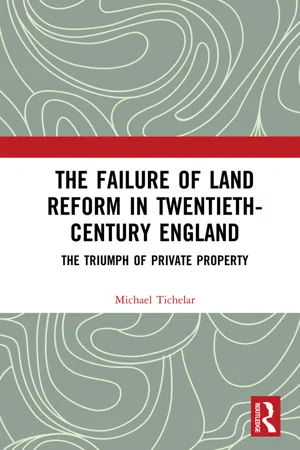
eBook - ePub
The Failure of Land Reform in Twentieth-Century England
The Triumph of Private Property
- 230 pages
- English
- ePUB (mobile friendly)
- Available on iOS & Android
eBook - ePub
The Failure of Land Reform in Twentieth-Century England
The Triumph of Private Property
About this book
Information
Part I
The historical setting
1The English land question in historical perspective
This chapter discusses the way in which the ‘land question’ in England has been interpreted by historians and other academics up to the present day. In doing so it seeks to restore a general discussion of land reform to a more central place in English history and contemporary political debate. The chapter will start by reviewing how the meaning of landed property has changed during the course of the twentieth century and how it has become an important aspect of the ideology supporting a property-owning democracy with important implications for land reform. This will be followed by a discussion of how historians have understood the development of land reform in England during the twentieth century, noting how they have tended to neglect the broader question of the role of land in society in the light of the remarkable spread of owner-occupation and the relative decline of the political influence of the landed aristocracy. The chapter will conclude by identifying a number of new approaches being undertaken by historians, economists and town planners, who have started to widen our understanding of land reform in the context of the current housing crisis and the financial crash of 2008.
Changing meanings of landed property during the twentieth century
The meaning of property ownership underwent important changes during the twentieth century. Such changes played a crucial part in the fortunes of different land reform movements. They have also influenced the way historians and others have interpreted developments after 1900. Landed wealth as a source of economic and political power was by far the most important aspect of property ownership before 1914. Rent income from agricultural land guaranteed significant political power for the landed aristocracy. Although large-scale landownership is still a significant part of overall wealth at the end of the twentieth century, (especially rural estates), and a surprisingly large number of aristocratic landowners have survived during the course of the century, other forms of landed property have assumed greater economic importance, especially owner-occupation and ownership of land by financial institutions investing in land as a commodity. The role of land in the economy has changed dramatically, as Thomas Piketty has demonstrated in his book Capital in the Twenty-First Century.1 From being a site for agricultural production before 1900, the value of residential property has now replaced agricultural land as a result of the spread of owner-occupation. A recent economic analysis has concluded that ‘the proportion of the total stock of wealth represented by housing has risen rapidly since the mid-twentieth century, while the value of agricultural land has dwindled to almost nothing as a share of GDP’, and the family home has become the site of a near-universally entitled consumption good and increasingly the source of speculative investment.2 Furthermore, the economic power of landed property has been displaced by other more intangible types of ownership such as equity, shares and bank accounts, and intellectual property in the form of patents and ownership of the airways controlling the World Wide Web.
It is no longer possible for radical reformers to identify the landed aristocrat as the sole enemy of democracy and progress, as it was before 1914. Opposition to the concentrated wealth of the aristocracy has been to a large extent dissipated by the spread of owner-occupation and the growth of the ideology of home ownership. Radical support for land reform now tends to focus on the property speculator (or finance capitalism more generally) rather than the landed aristocrat. For historians, the major difference over the course of the twentieth century has been the way other forms of rent extraction has replaced the rent income from land. By the end of the century a wider range of other owners of property extract rent from any commodity, including land that can be tradeable in local, national or global markets. Ownership of residential property is no longer confined to a small group of powerful landlords but spread throughout the population reaching a high point of 71% of total households by the beginning of the twenty-first century. While the ‘bundle of rights’ that make up a legal claim to ownership of non-residential land has been constrained by the state over time, especially during the first half of the twentieth century, the rights of residential owner-occupiers have been to a large extent protected in the name of a property-owning democracy and its accompanying ideology of home ownership during the second half of the century.
Since 1945, the state has intervened in a number of different ways to reduce the rights of private property owners to use or transfer land by such measures as confiscation, compulsory purchase for town and country planning purposes, taxation of land as a capital asset including its inheritance, attempts to recover the ‘unearned increment’ from development land, and the strengthening of the rights of leaseholders and sitting tenants over the rights of freeholders. Governments have also, for example, nationalised different types of natural resources above and below the land surface, such as coal and oil or gas, sometimes with compensation to the owners, for example underground coal deposits in the 1930s, and sometimes without compensation, for example open-cast mining and on-shore deposits of oil and gas after the Second World War. But in other respects, the rights of property owners have been strengthened, especially during the last quarter of the twentieth century as owner-occupation and the ideology of home ownership has spread.3 These rights have been reinforced and financial investment in owner-occupied housing now underpins the performance of the economy as a whole through the integration of property and financial markets in a global economy. Such investment guarantees the financial security of a very large proportion of the population through equities and pension funds, a process which accelerated after 1980, described by economists as the financialisation of housing and land.4
As a result, the interventionist powers of the state with regard to landownership have been progressively reduced. Town and Country planning has been diluted in favour of landowners, the rights of agricultural tenant farmers have been taken away, inheritance tax and other taxes on capital and land have been relaxed, and a strong property-owning ideology ‘supported by the practice of deregulation’, has developed.5 Right of centre think tanks in favour of the free market now argue that compulsory acquisition of private land by the state is a threat to individual liberties, a strand of thinking now strongly represented in the United States and the United Kingdom, where neoliberalism as a system of economic thought has been most dominant.6 By the end of the twentieth century the right to private property has been reinforced by neoliberal ideology. In the powerful tradition of laissez-faire economics, land is now commonly regarded as no different to capital or labour and can be traded in a free market like any other commodity. According to this perspective, land should not be treated as a special case in the way advocated before 1914, when many reformers from across the political spectrum saw land as belonging to all members of society in common, which differentiated it from capital or labour.7
The situation at the beginning of the twenty-first century is very different. Land reformers who seek to challenge the primacy of private property are very much in the minority. In America there is a body of academic literature, which sees the protection of private property as a constitutional right, arguing that private ownership of land is a guarantor of liberty and the rule of law.8In terms of legal protection, the Universal Declaration of Human Rights, adopted by the United Nations in 1948, states that everyone has the right to own property alone as well as in association with others, and that individuals should not be arbitrarily deprived of it. Such rights are more understated in an English context given the absence of a written constitution. The European Convention on Human Rights defines the protection of property rights as ‘the right to peaceful enjoyment of possessions’, but places greater emphasis on ‘the right of the state to enforce such laws … to control the use of property in accordance with the general interest or to secure the payment of taxes or other contributions or penalties’.
In historical terms, therefore, property is a changing and dynamic concept subject to shifts in political power and changes in technology and the economy.9 To take one crucial example, the abolition of slavery in the nineteenth century saw the almost total elimination of the concept of private property in human beings, although such practices continue to survive on a wide scale but without the ideological or political justification they once enjoyed. The ‘bundle of rights’ and legal obligations of owners, whether they be an aristocratic landlord, an owner-occupier or a property developer, have been subject to different levels of government intervention during the twentieth century. This book will explore such trends in relation to the ownership and control of land, with particular reference to the controversial question of compensation and betterment.
Historical interpretations of land reform in twentieth-century England
There is a considerable body of historical studies on the land question in Britain before 1914 covering England and taking into account the different nationalist experiences of Scotland, Ireland and Wales.10 Radical opposition to the concentration of aristocratic landownership was a major feature of Victorian politics as can be seen in the campaigns to abolish the Corn Laws in the 1840s; or to achieve free trade in land and the end of primogeniture in the 1860s; or to introduce the taxation of land values and to create smallholdings and allotments in the period after 1870. Land reform reached a climax at the beginning of the twentieth century, especially in Ireland where the issue was closely associated with the demand for home rule. This controversy was serious enough in the 1880s to split the Liberal Party of its unionist supporters who joined the Conservative Party over the issue of Irish home rule. By the Edwardian period, the parameters of the land question had also expanded to include not only traditional agrarian demands, such as the creation of smallholdings and the taxation of land values, but new reforms designed to appeal to newly enfranchised voters in urban as well as rural areas. Keeping rural labour on the land was seen as a solution to urban unemployment and housing shortages in overcrowded cities as well as a means of encouraging agricultural self-sufficiency in an era of increasing international tension and anxieties. Early advocacy of garden cities on publicly owned land was also a feature of the Edwardian urban land question and helped give birth to the modern town and country planning movement.
Much attention has been given by historians to the confrontational and rhetorical manner in which Lloyd George sought to revitalise his political appeal by attacking the entrenched power and privilege of the ennobled aristocracy, most notably in his 1909 budget, which sought to introduce new types of land taxation, and in his ambitious rural land campaign launched in 1912. Such a radical programme posed a real political threat to the power of landed wealth at the time and created a constitutional crisis leading to the Parliament Act of 1911, which reduced the powers of the House of Lords to block financial legislation. At the same time, Lloyd George sought to lay the foundations for a potential progressive alliance built on a strong case for radical land reform in both rural and urban areas for the forthcoming general election scheduled for 1915.11 The outbreak of war destroyed such plans, and severely weakened the Liberal Party which had championed land reform up to that time. It never recovered thereafter to ena...
Table of contents
- Cover
- Half Title
- Title Page
- Copyright Page
- Contents
- Preface
- Acknowledgements
- Introduction
- Part I The historical setting
- Part II The land question and taxation of land values, 1914 to 1939
- Part III The political conflict over landed property rights, 1942 to 1979
- Part IV The land question and the housing crisis, 1979 to 2017
- Bibliography
- Index
Trusted by 375,005 students
Access to over 1.5 million titles for a fair monthly price.
Study more efficiently using our study tools.
Frequently asked questions
Yes, you can cancel anytime from the Subscription tab in your account settings on the Perlego website. Your subscription will stay active until the end of your current billing period. Learn how to cancel your subscription
No, books cannot be downloaded as external files, such as PDFs, for use outside of Perlego. However, you can download books within the Perlego app for offline reading on mobile or tablet. Learn how to download books offline
Perlego offers two plans: Essential and Complete
- Essential is ideal for learners and professionals who enjoy exploring a wide range of subjects. Access the Essential Library with 800,000+ trusted titles and best-sellers across business, personal growth, and the humanities. Includes unlimited reading time and Standard Read Aloud voice.
- Complete: Perfect for advanced learners and researchers needing full, unrestricted access. Unlock 1.5M+ books across hundreds of subjects, including academic and specialized titles. The Complete Plan also includes advanced features like Premium Read Aloud and Research Assistant.
We are an online textbook subscription service, where you can get access to an entire online library for less than the price of a single book per month. With over 1.5 million books across 990+ topics, we’ve got you covered! Learn about our mission
Look out for the read-aloud symbol on your next book to see if you can listen to it. The read-aloud tool reads text aloud for you, highlighting the text as it is being read. You can pause it, speed it up and slow it down. Learn more about Read Aloud
Yes! You can use the Perlego app on both iOS and Android devices to read anytime, anywhere — even offline. Perfect for commutes or when you’re on the go.
Please note we cannot support devices running on iOS 13 and Android 7 or earlier. Learn more about using the app
Please note we cannot support devices running on iOS 13 and Android 7 or earlier. Learn more about using the app
Yes, you can access The Failure of Land Reform in Twentieth-Century England by Michael Tichelar in PDF and/or ePUB format, as well as other popular books in Social Sciences & Sociology. We have over 1.5 million books available in our catalogue for you to explore.