![]()
1
From Nosokomeion to Hygeia
Foundations of an architecture for health
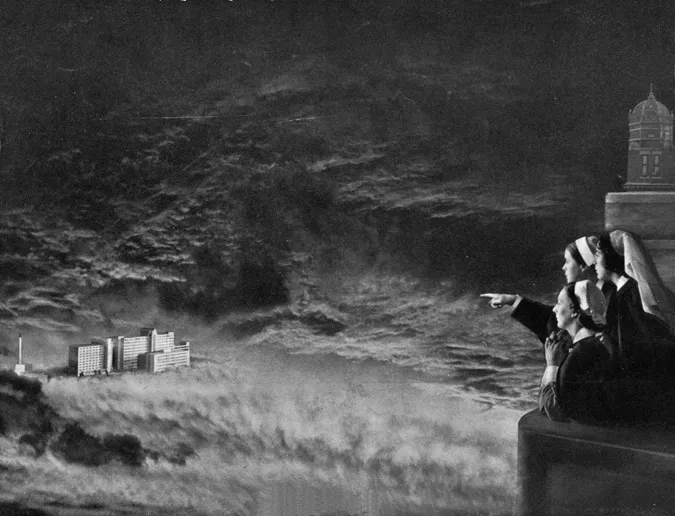
Hospitals of the recent past can be miserable places. And when they are not miserable, they can often be dreary looking and stale smelling. So it will no doubt strike some readers as counter-intuitive that this book is based around the contention that the modern hospital was a beacon of hope. The modern hospital, defined here as the distinctive product of international hospital discourse between 1918 and 1960, emerged as a bulwark against the hopelessness of disease and persistent ill-health that, in spite of the great advances in medical science, beset industrialised countries through the first half of the twentieth century. One Australian hospital’s annual report in the late 1930s linked new hospitals with hope in an illustration captioned “The Vision Splendid” (Figure 1.1). Nurses standing on the balcony of an old hospital, with its traditional stylistic trappings, point towards a new hospital building, an unadorned modern edifice that emerges clear and bright from the storm clouds. The caption for the image begins, “Dawn – and the night nurses relieved from duty conjure up visions of another dawning. From the mists of hope long deferred will soon rise their ‘sunshine’ hospital” (Royal Melbourne Hospital 1939: 36). The image conjured the hope that hospital staff – proxies for the wider community – had invested in the idea of the modern hospital. The change was depicted in very clear terms: as one from darkness to light and from tradition to modernity.
The “Vision Splendid” image framed a transition in institutional identity, a move from charitable care to rationally organised health and welfare. This idea resonated with hospital experts in the period. As Yale Professor of Public Health Charles-Edward Winslow noted in 1932, the hospital of the past “was in its essence a work of mercy, an expression of pity rather than organized knowledge” (Winslow 1932: 222). Winslow’s career, like that of other hospital experts of the time, was dedicated to furthering the process by which hospitals became institutions of knowledge where research, treatment and education would all be conducted on a single campus.
The hope invested in the modern hospital rested, therefore, on more than just architectural expression and dreamlike images of the new. The great height and expressive modernism of new hospital buildings were also powerful markers of a whole apparatus of healthcare and medical knowledge that would enable major transformations in the health of populations and increased expectations of lifespan in the period. The international network of hospital experts that coalesced in the 1920s and 1930s – a group that included architects, doctors and economists, as well as management and organisational specialists – shared a belief that the properly planned modern hospital could treat the individual with unprecedented scientific rigour. As medical specialist and historian Joel D. Howell has argued:
By around 1925 the people who ran and financially supported the general hospital in the United States, as well as those who delivered health care within it, had come to see science as the essential tool for making the institution a central part of twentieth century medicine.
(Howell 1995: 4–5)
Figure 1.1 “Dawn – and the night nurses relieved from duty conjure up visions of another dawning. From the mists of hope long deferred will soon rise their ‘sunshine’ hospital”.
This was a wide view of science that incorporated everything from Taylorist organisational principles to advanced uses of pathology laboratories in everyday diagnosis. The collective implication of this wide embrace of science, experts believed, would be the improved health and wellbeing of whole societies. Though in reality, of course, different populations within each society experienced that promise differently and access to the benefits of new hospitals was uneven.
The conscious project to modernise the hospital through a rationalisation of its architectural plan and its procedures was in part a response to the depredations of World War I. Medical and political leaders in Europe, in particular, in the 1920s and 1930s believed that future economic expansion and military strength demanded fitter, healthier populations. The modern hospital was a key piece of infrastructure that would help realise that ambition. Consequently, the hospital, more than any other building type, was integral to the biopolitical social policy of the interwar decades.
The economic and political upheavals of the interwar period ensured that social policy was far from consistent. Yet there was an increasingly explicit ambition across Europe, North America and in other industrialised societies to govern using techniques that took the body and the health of populations as their explicit object. The hospital was a key instrument in this process. Writing in the Stuttgart-based quarterly hospital review Nosokomeion in 1936, the American economist and healthcare specialist C. Rufus Rorem argued that the hospital “is not merely a hotel, nor is it merely a place from which to dispense medical care at a reasonable price. It is a focal point for the concentration and dissemination of knowledge concerning life itself” (Rorem 1936: 245).
Medical historians have acknowledged that in this period, hospitals became vital educational institutions, forging themselves decisively as the profession’s training ground. But for Rorem and other hospital specialists, the implications of the modern hospital were more far reaching. Dr Wilhelm C.F. Alter (1875–1943), editor of Nosokomeion, the official journal of the International Hospital Association, from its founding in 1929 for almost a decade, highlighted the great scope and ambition of hospitals. In his editorials and at conferences throughout the 1930s, Alter asserted that hospitals must be redesigned and rebuilt to reflect the era of health. A doctor, administrator and researcher into hospital practices and nursing, Alter regularly articulated his view that the hospital must no longer be a home of illness, but must become a “Maison de Sainte”, a centre of the activities of health. In a 1933 editorial he wrote:
health training of the people is the fundamental task of a hospital … Materially, [the hospital] must be the efficient central institution for the organization of all preventative and curative work of the district. Spiritually it must be the centre from which new ideas emanate, and which provides the fertile soil of their growth.
(Alter 1933: 2)
Writing in the same venue in 1937, architect Vladimir Uklein (1898–1986) underlined Alter’s great theme, arguing that hospitals must be developed according to the principle of health (Hygeia1) and that this should replace the older idea of the hospital as a place to care for the sick (Nosokomeion2) (Uklein 1937). The idea and ambition of the modern hospital, therefore, was not simply to assist the professionalisation process for nursing and for medicine generally, though hospitals in the first half of the twentieth century unquestionably did this. They were also centrally implicated in what political theorists, following Michel Foucault, have described as “the modern conception of power as a way to enhance, render productive, compose, maximise, and administer life” (Wallenstein 2008: 9).
As has been widely noted, this account of power is productive rather than repressive and depends upon the consent of political subjects rather than a coercive state. Individuals under such a regime accept responsibility for their own biological enhancement and productive powers, and are provided with incentives and infrastructure to do so. The normalisation of hospital birthing across this period is an excellent case in point. As hospital administrator and leader of the American Hospital Association, Malcolm T. MacEachern (1881–1956), noted in 1935, “the hospital is quickly becoming the birthplace of mankind” (MacEachern 1935: 97). This happened not because women were coerced into attending hospital to give birth. Rather doctors and hospital managers, people such as MacEachern, with the strong support of governments in almost all industrialised societies, persuaded their citizens that the birthing process would be administered more safely, efficiently and, at least from a certain viewpoint, more humanely in hospitals than was typical in the home.
The various national hospital networks and associations and the International Hospital Association (IHA), formed in 1929, were almost unanimous in this period in their support for a liberal model of health promotion and service delivery, even though governments, both regional and national, supported very different economic models for funding the provision of healthcare. Indeed, the IHA was explicitly liberal and internationalist, despite maturing as an organisation just as aggressive nationalisms and totalitarianism were on the rise in the 1930s. Sigismund Schultz Goldwater (1873–1942), a leading figure in the field of public health in New York and an expert on hospital planning and administration, articulated the internationalist aspirations of the hospital movement in a 1929 article for the American journal Modern Hospital. He noted: “In a humanitarian field as important and significant as that of hospitals, geographical barriers and linguistic obstacles must be swept away and the totality of human experience made universally available” (Goldwater 1929: 50).
After a string of successful international biannual conferences held in Atlantic City, New Jersey, USA (1929); Vienna, Austria (1931); the coastal town of Knokke in Flanders (1933); Rome, Italy (1935) and Paris, France (1937), the IHA was split by war and by the hardening eugenic outlook of German public health under Nazism in the late 1930s. In 1935, Swiss-born German psychiatrist and geneticist, Professor Ernst Rüdin (1874–1952), a key proponent of racially based eugenic theories in Germany, gave a paper to the IHA’s World Congress in Rome, discussing the uses of sterilisation. The condemnation of Rüdin’s views was swift and clear. The Dutch delegation protested that his paper propagandised for the “active application of eugenic methods in hospitals” without regard for the ethical and religious convictions of delegates (“Declaration” 1935: 314). Pope Pius XI addressed the conference and underlined the Catholic Church’s opposition to eugenic methods, arguing that hospital specialists and others in the health field should protest their application. The French delegation, who had agreed to host the next conference in Paris, made it clear that they would not allow the discussion of eugenics or sterilisation to be part of their official programme in 1937 (Leon 2013).
The presence of Rüdin and his advocacy of ethically unsound and morally repugnant eugenic practices did not destroy the spirit of international cooperation in the hospital movement at that time, nor disrupt its liberal foundations. But it did point to a fault line within the hospital movement and international public health in the period. Eugenics was an unstable discourse embraced to some degree by public health advocates across the political spectrum as histories of eugenics have shown (Nye 1993; Turda 2010). Eugenic policies were a logical extension of the conviction that the individual political subject and populations as a whole should be governed at the level of biological life and physical health. Nevertheless, the sovereign, state-centred biopolitics of Nazi eugenics served to highlight the limits and character of the liberal international ideals of the hospital movement. Once the enhancement of life was no longer based around the active consent and participation of citizens and patients, then the very effective operations of liberal governmentality were clearly undone.
The eugenics controversy in 1935 highlighted an important shared assumption for the hospital movement. But the line between the broad social consent of patients and the morally charged mission of health promotion was difficult to discern. Wilhelm Alter, for example, adopted a bellicose tone in some of his editorialising for Nosokomeion. In a 1933 editorial he wrote:
Civilised humanity demands a science of health. The immense intensification of our social, political, and economic life forces the individual and society as a whole to become disciples of the creed of health, and to support a movement for the combating of disease through prevention. This journal has from its very beginning called attention to the fact that the hospital occupies the deciding strategic position in this movement. The hospital is holding this key position not only in the defensive war against disease, but also in the great offensive war of our time, in the war for health. No other institution or organisation is better adapted and has a more legitimate calling to be the pioneer in safeguarding human life for health.
(Alter 1933: 2)
While most active participants in the hospital movement shared Alter’s zeal for their work, they framed their mission in more moderate terms, more as a form of progressive humanity and care than a war for health. Nevertheless, evocations of fortification and war were common in the discussion of hospitals. New York’s Columbia-Presbyterian Medical Center, New York, USA (Architect: James Gamble Rogers, 1928), for example, was repeatedly described as a great fortress raised against disease (Betsky 1994). But the question of how the architect should treat the problem of the hospital was not circumscribed by martial images and ideas. It was in fact a surprisingly complex arena for thinking through and expressing modern aspirations for health and architecture.
Architecture as medical equipment
Referring to architectural discourse during the 1920s and early 1930s, architectural historian Beatriz Colomina has remarked that modern architecture was “understood as a kind of medical equipment, a mechanism for protecting and enhancing the body” (Colomina 1997: 61). Margaret Campbell has highlighted the centrality of the tuberculosis sanatorium to this discourse, but importantly, she qualifies its earnest enthusiasm where, “[s]uperstition, myth and subjectivity partnered modernist functional lifestyles that emphasized purity, hygiene, fresh air and sunlight” (Campbell 2005). One might assume then that the hospital would be at the centre of the modernist architectural project. Wallenstein has suggested, moreover, that architectural modernity is “intertwined with the ordering and administering of life” and that within this regime the hospital becomes “a kind of laboratory for the testing of new ideas, which are then extended to the whole of urban space” (Wallens...