In a context of growing social and environmental concerns, the role of large enterprises and corporations in encouraging sustainability has drawn increasing attention in recent years. Both academic debates and public-opinion research have called into question the extended responsibilities of firms in our increasingly inter-connected world. By studying issues associated with the greatest challenges mankind is currently facing — from climate change to social exclusion — the scientific community is aware of the need to account for the actions and agendas of companies, especially large ones. They are becoming important global political actors with great power, but also unprecedented responsibilities. With this in mind, the authors believe that it is more important than ever that large enterprises, on the one hand, take into account the opinion of their stakeholder while defining their strategies and, on the other hand, disclose material and relevant information on their ability to contribute to sustainability while delivering value for all of their stakeholders. A consensus is being reached on the responsibility of large enterprises to report in a triple bottom perspective — not only on their financial performances, but also on their social and environmental outcomes. Consequently, it is important to understand what elements organizations need to report on in order to provide stakeholders with relevant and comprehensive sustainability reports. Against this background, this book presents a significant and original contribution, both empirically and theoretically, to the social and environmental accounting literature by studying the various features of stakeholder engagement in sustainability reporting.
- 214 pages
- English
- ePUB (mobile friendly)
- Available on iOS & Android
eBook - ePub
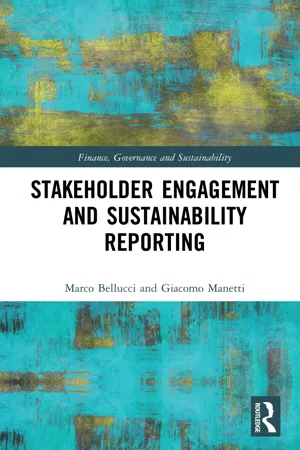
Stakeholder Engagement and Sustainability Reporting
1 Introduction
Currently, many of the largest economies in the world are corporations, not nations. Many multinationals’ revenues surpass the budgets of entire countries. For example, Apple’s turnover exceeds Austria’s revenues by a few billion dollars, while the revenues of British Petroleum easily compete with the federal budget of Mexico1 (CIA, 2016; Fortune, 2016). Although we acknowledge that dollar-value company revenues are not equivalent to governments’ dollar-value budgets, this illustrative comparison nevertheless reveals the vast power held by corporations and raises important questions regarding large firms’ accountability and responsibility to civil society.
Particularly in the context of growing environmental concerns, the role of large enterprises in promoting sustainability is increasingly highlighted. Both academic conversations and public opinion debates increasingly question firms’ extended responsibilities in the frame of contemporary and inter-connected societies. In studying issues associated with the greatest challenges mankind currently faces – from climate change to social exclusion – the current scientific community is fully aware of the need to account for companies’ actions and agendas, especially those of large companies (Aras & Crowther, 2008; Crane & Matten, 2016). Large firms are becoming global political actors – but with great power comes greater responsibility.
As shown later in this volume, many authors agree that the historically prevailing thesis that a firm’s first and only responsibility is to maximize value for shareholders (cf. Friedman, 1970) is becoming progressively untenable (cf. Freeman, 1984). Enterprises themselves are increasingly willing – for different reasons – to show their commitment to the needs and expectations of their stakeholders (not just those of their shareholders), their aspiration to create shared value (not only value for shareholders) and to make every element of their business sustainable. Although they vary case by case from genuine to be completely rhetoric, statements on this commitment are commonly found in the sustainability reports and integrated annual reports of companies operating in various sectors, even and especially in the most impactful ones, such mining and oil and gas (Bini, Bellucci, & Giunta, 2018).
Given consumers’ and investors’ evolving expectations, corporations currently face the need to communicate to internal and external stakeholders how their business model is integrated with aspects of sustainability. In the last 40 years, companies have exhibited increasing interest in environmental and social issues (Aras & Crowther, 2016; Bagnoli, 2004); at the same time, the research attention devoted to social and environmental accounting topics has grown substantially (Bini et al., 2018; Deegan, 2002). This growing interest has raised new questions on the real objectives of large corporations and the best ways to account for and report on the degree to which these objectives have been achieved. The development of social and environmental accounting and reporting in recent decades has resulted in a wide range of actual and potential accounts of extended organizational interactions with society and with the natural environment: such accounts can be understood as narratives of events that articulate, with varying degrees of thoroughness and misdirection, the relationships between the organization and its stakeholders and the environment (Gray, 2010).
With that in mind, we believe it is now more important than ever that large enterprises take into account their stakeholders’ opinions when defining their strategies on the one hand and, on the other, disclose material and relevant information regarding their ability to contribute to sustainability while delivering value to all their stakeholders. An increasing consensus is being reached on large enterprises’ responsibility to report not only on their financial performance but also on their social and environmental outcomes. Consequently, in practical terms, it is important to understand the elements on which organizations need to report to provide stakeholders with relevant and comprehensive sustainability reports.
In the past two decades, stakeholder dialogue and engagement have played an increasingly important role in defining the contents of integrated and sustainability reporting (Fasan & Mio, 2017; Manetti, 2011) in accordance with the principle of materiality and relevance of information disclosed (Global Reporting Initiative, 2013; Unerman & Bennett, 2004). According to the materiality principle, material aspects are those that reflect the organization’s significant economic, environmental and social impacts or that substantively influence stakeholders’ assessments and decisions (Global Reporting Initiative, 2013). Stakeholder engagement can represent a powerful tool for dialogic communication and accounting (Bebbington, Brown, Frame, & Thomson, 2007; Brown & Dillard, 2014) and a channel for interactive mutual learning that is capable of promoting transformative action and social change (Bebbington et al., 2007; Bellucci & Manetti, 2017; Passetti, Bianchi, Battaglia, & Frey, 2017). Moreover, stakeholder engagement is a milestone policy in social and environmental accounting because it allows an organization to interact with its stakeholders in a two-way dialogue in which the engager and the engaged mutually learn from this cooperation and potentially revise their expectations, strategies and behaviors (Manetti & Bellucci, 2016; Manetti, Bellucci, & Bagnoli, 2016; Owen, Swift, & Hunt, 2001).
Against this background, this volume aims to contribute to the social and environmental accounting literature by studying the role and features of stakeholder engagement in sustainability reporting.
This contribution is structured as follows. The next chapter introduces and discusses corporations’ extended responsibilities in contemporary societies and considers the opposition between shareholder and stakeholder theories. Alongside the evolution of enterprises’ objectives lies the evolution of reporting and the need to account for an integrated and broader set of information. Consequently, the concept of sustainability and the role of enterprises and accounting in sustainability are framed in light of social and environmental accounting.
The third chapter provides a literature review on sustainability reporting, materiality assessment and stakeholder engagement. Many local and global factors currently advocate for social and environmental reporting: the increasing relevance of beneficial relations with stakeholders, the growing concern about business ethics and CSR and the mounting importance of ethical investment have all increased the need for new accounting methods that organizations and their stakeholders can use to mutually address these issues. After analyzing the main motivations underlying sustainability reporting, we discuss the topic of materiality and the salience of information in social and environmental reports through the lens of the materiality principle and the main sustainability reporting guidelines. We then discuss how the involvement of every relevant group of stakeholders can represent the most straightforward way to produce comprehensive, relevant and material sustainability reports.
The fourth chapter provides a theoretical framework based on stakeholder theory and the involvement of stakeholders in decision making and sustainability reporting. We introduce a review of the different definitions of stakeholders and the diverse approaches to stakeholder theory. Consequently, the process of stakeholder engagement is theoretically divided into three phases: 1) stakeholder identification and analysis; 2) interaction with stakeholders; and 3) evaluation and reporting. Each phase is analyzed by considering the contributions of the most relevant authors and our own elaboration. Then, we discuss the theory underlying the possible achievement of materiality among the information in sustainability reports through stakeholder engagement. The last section of the fourth chapter is dedicated to a review of stakeholder engagement tools in practice and to a focus on social media as a tool that supports dialogic accounting.
Many theoretical tools introduced in the fourth chapter are then used to support our empirical analysis. The fifth chapter adopts a deep empirical focus on how sustainability reports address the topic of stakeholder engagement, the distinctive features of this involvement process and the role of stakeholder engagement in assessing materiality and defining the contents of such a disclosure. To pursue this objective, we opted for a mixed methodology built on content analysis – a research technique based on the objective, systematic and quantitative description of the manifest content of communications (Berelson, 1952). We analyze 211 sustainability reports that were published in 2016 in compliance with the Global Reporting Initiative (GRI) G4 guidelines from organizations operating in eight sectors with high social and environmental impact (Chemicals, Energy, Food and Beverage Products, Forest and Paper Products, Mining, Textiles and Apparel, Tobacco and Waste Management). We focus on these sectors because of the legitimate concerns they raise: organizations operating in these sectors must wrestle various societal, organizational and environmental issues linked to sustainability and legitimacy and are very sensitive to the interests of several stakeholder groups. The results of this content analysis are discussed in detail in the last section of the fifth chapter. Through this empirical analysis, we aim to contribute to the stakeholder theory literature and sustainability reporting literature original insights on the properties of information regarding stakeholder engagement policies and practices stated in sustainability reports.
Finally, we draw conclusions that summarize our contribution, offer supplementary comments on our main results and practical implications, and provide several ideas for further research on stakeholder engagement in social and environmental accounting.
Note
1 Considering the 2010 spillage of the BP-operated Deepwater Horizon oil platform in the Gulf of Mexico, this association is not completely casual.
References
Aras, G., & Crowther, D. (2008). The social obligation of corporations. Journal of Knowledge Globalization, 1(1). www.journal.kglobal.org/index.php/jkg/article/view/22
Aras, G., & Crowther, D. (2016). The durable corporation: Strategies for sustainable development. London: Taylor & Francis.
Bagnoli, L. (2004). Quale responsabilità sociale per l’impresa? (Vol. 21). Milano: Franco Angeli.
Bebbington, J., Brown, J., Frame, B., & Thomson, I. (2007). Theorizing engagement: The potential of a critical dialogic approach. Accounting, Auditing & Accountability Journal, 20(3), 356–381.
Bellucci, M., & Manetti, G. (2017). Facebook as a tool for supporting dialogic accounting? Evidence from large philanthropic foundations in the United States. Accounting, Auditing & Accountability Journal, 30(4), 874–905. doi:10.1108/AAAJ-07-2015-2122
Berelson, B. (1952). Content analysis in communication research. New York: Free Press.
Bini, L., Bellucci, M., & Giunta, F. (2018). Integrating sustainability in business model disclosure: Evidence from the UK mining industry. Journal of Cleaner Production, 171(Supplement C), 1161–1170. doi:https://doi.org/10.1016/j.jclepro.2017.09.282
Brown, J., & Dillard, J. (2014). Integrated reporting: On the need for broadening out and opening up. Accounting, Auditing & Accountability Journal, 27(7), 1120–1156. doi:doi:10.1108/AAAJ-04-2013-1313
CIA. (2016). The World Factbook. Retrieved September 2016, www.cia.gov/library/publications/the-world-factbook/fields/2056.html
Crane, A., & Matten, D. (2016). Engagement required: The changing role of the corporation in society. In D. Barton, D. Horvath, & M. Kipping (Eds), Re-imagining capitalism: Building a responsible, long-term model. Oxford: Oxford University Press.
Deegan, C. (2002). Introduction: The legitimising effect of social and environmental disclosures-a theoretical foundation. Accounting, Auditing & Accountability Journal, 15(3), 282–311.
Fasan, M., & Mio, C. (2017). Fostering stakeholder engagement: The role of materiality disclosure in Integrated Reporting. Business Strategy and the Environment, 26(3), 288–305.
Fortune. (2016). Global 500. Retrieved September 2016, http://beta.fortune.com/global500
Freeman, R. E. (1984). Strategic management: A stakeholder approach. Boston: Pitman.
Friedman, M. (1970). The social responsibility of business is to increase its profits. New York Times Magazine, September 13, 1970, 122–126.
Global Reporting Initiative. (2013). Reporting principles and standard disclosure. Amsterdam: Global Reporting Initiative.
Gray, R. (2010). Is accounting for sustainability actually accounting for sustainability . . . and how would we know? An exploration of narratives of organisations and the planet. Accounting Organizations and Society, 35(1), 47–62. doi:10.1016/j.aos.2009.04.006
Manetti, G. (2011). The quality of stakeholder engagement in sustainability reporting: Empirical evidence and critical points. Corporate Social Responsibility and Environmental Management, 18(2), 110–122.
Manetti, G., & Bellucci, M. (2016). The use of social media for engaging stakeholders in sustainability reporting. Accounting, Auditing & Accountability Journal, 29(6), 985–1011. doi:10.1108/AAAJ-08-2014-1797
Manetti, G., Bellucci, M., & Bagnoli, L. (2016). Stakeholder engagement and public information through social media: A study of Canadian and American public transportation agencies. The American Review of Public Administ...
Table of contents
- Cover Page
- Stakeholder Engagement and Sustainability Reporting
- Finance, Governance and Sustainability: Challenges to Theory and Practice Series
- Title
- Copyright
- Dedication
- List of Figures
- List of Tables
- Foreword by Linda Thorne
- Acknowledgements
- 1 Introduction
- 2 Business and Sustainability
- 3 Materiality in Sustainability Reporting
- 4 A Theory of Stakeholder Engagement
- 5 An Empirical Overview of Stakeholder Engagement in Sustainability Reports
- 6 Conclusions
- Index
Trusted by 375,005 students
Access to over 1.5 million titles for a fair monthly price.
Study more efficiently using our study tools.
Frequently asked questions
Yes, you can cancel anytime from the Subscription tab in your account settings on the Perlego website. Your subscription will stay active until the end of your current billing period. Learn how to cancel your subscription
No, books cannot be downloaded as external files, such as PDFs, for use outside of Perlego. However, you can download books within the Perlego app for offline reading on mobile or tablet. Learn how to download books offline
Perlego offers two plans: Essential and Complete
- Essential is ideal for learners and professionals who enjoy exploring a wide range of subjects. Access the Essential Library with 800,000+ trusted titles and best-sellers across business, personal growth, and the humanities. Includes unlimited reading time and Standard Read Aloud voice.
- Complete: Perfect for advanced learners and researchers needing full, unrestricted access. Unlock 1.5M+ books across hundreds of subjects, including academic and specialized titles. The Complete Plan also includes advanced features like Premium Read Aloud and Research Assistant.
We are an online textbook subscription service, where you can get access to an entire online library for less than the price of a single book per month. With over 1.5 million books across 990+ topics, we’ve got you covered! Learn about our mission
Look out for the read-aloud symbol on your next book to see if you can listen to it. The read-aloud tool reads text aloud for you, highlighting the text as it is being read. You can pause it, speed it up and slow it down. Learn more about Read Aloud
Yes! You can use the Perlego app on both iOS and Android devices to read anytime, anywhere — even offline. Perfect for commutes or when you’re on the go.
Please note we cannot support devices running on iOS 13 and Android 7 or earlier. Learn more about using the app
Please note we cannot support devices running on iOS 13 and Android 7 or earlier. Learn more about using the app
Yes, you can access Stakeholder Engagement and Sustainability Reporting by Marco Bellucci,Giacomo Manetti in PDF and/or ePUB format, as well as other popular books in Business & Business General. We have over 1.5 million books available in our catalogue for you to explore.