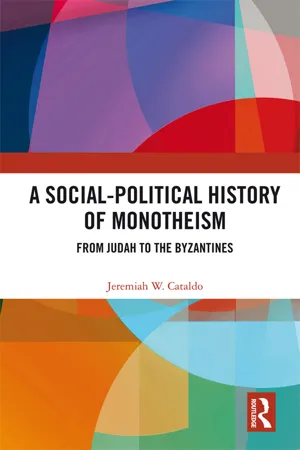
In A Social-Political History of Monotheism, Cataldo shows how political concerns were fundamental to the development of Judeo-Christian monotheism. Beginning with the disruptive and devastating historical events that shook early Israelite culture and ending with the seemingly victorious emergence of Christianity under the Byzantine Empire, this work highlights critical junctures marking the path from political frustration to imperial ideology. Monotheism, Cataldo argues, was not an enlightened form of religion; rather, it was a cultic response to effluent anxieties pouring out from under the crushing weight of successive empires. This provocative work is a valuable tool for anyone with an interest in the development of early Christianity alongside empires and cultures.
eBook - ePub
A Social-Political History of Monotheism
From Judah to the Byzantines
- 242 pages
- English
- ePUB (mobile friendly)
- Available on iOS & Android
eBook - ePub
1 Understanding monotheism as a cultural institution
Any study that realistically and effectively shows the history of the social and political forces that shaped monotheism must not be theological or theologically motivated; were either true, it would be ideologically bound by apologetic defense. To avoid that, it must treat monotheism no differently than any other historical, social, or political subject. It must cast aside notions of divine inspiration and intent. It must be social-scientific in nature. It must view divine law as a culturally produced set of ideals and regulations, in the same way that one would view political laws. And it must view monotheistic ideas of restoration (Heaven, Paradise, Israel, etc.) as the projected desires of their respective communities.
It must view monotheism, and religion generally, as entirely a human activity. Should it not do so, it sins egregiously by brushing all the “dirt” of monotheism under the rug of “divine mystery.” No other type of religion has consistently been more obstinate, more prone to exclusion, more prejudiced, and more apt to justify those feelings within communities, than has monotheism. Why? Because the foundation upon which monotheism rests is fear.
What is monotheism?
This study presupposes a couple things generally accepted by scholars of the area: (1) that there was no such thing as Judean monotheism before the 6th century BCE; and (2) that monotheism emerged out of sociopolitical conflicts between different sociopolitical groups in Judah (or, the Persian province of Yehud), as well as between the people in the land and the imperial authorities that ruled over the province throughout its history. It will help the reader to keep these things in mind as I move thematically over different fundamental ideas and stages important to the history of Judeo-Christian monotheism.
It is a fairly common practice among modern academic authors to begin a written project with a statement of aims and difficulties. In some ways, the practice is an exercise in humility, a humble admission to the challenges of speaking about history, society, politics, and culture. It also serves as a caveat meant to relinquish the author from the impossible task of covering every event and every opinion. With those, the reader is encouraged to look for meaning and understanding beyond any particular text, idea, or claim. She is encouraged not to blindly accept what is written, by historical texts or modern studies, and to be open to the complexity of meaning and the diverse forces that shape it. The practice and reminder are good. But why are sacred texts not held to the same standard?
Is it because claims of objective truth have been imposed upon the Bible, imposed by communities giving greater voice to their own values? Does the Bible become a potent symbol of revealed truth not on its own but at the hands of communities seeking to elevate themselves in hierarchies of sociopolitical power? Put more bluntly, is religious objectivity a political strategy for gaining power? In more recent times, claims to that have encouraged intergroup contests over the privatization of God, divine revelation, and divine restoration – those things upon which arguments for objectivity are based. It has also, in some cases, resulted in emphases upon biblical literalism – which at its core is a strategy for protecting a community’s claims about the world and the community’s place in it. And it does that by refusing to acknowledge any changeability in concepts of God, revelation (and the divine word), and divine intent behind or in creation. Biblical literalism maintains that the meaning of the Bible is not susceptible to change regardless of reader, historical context, or cultural need. It encourages readers not to keep their eyes and ears open, but to uncritically accept what the Bible (and sometimes a specific translation) says without the need for something more. But literalism is defensive strategy, it resists with all possible strength the threat and chaos of change, relying instead on the past as the basis for an idealized and stable society.
However, because monotheism is not only about literalism, though literalism emerges in every monotheistic tradition, one must seek out its cause, which is shared by any number of other strategies, ideologies, or responses. That cause, which produced a range of diverse response, of which literalism is only one, can be traced back to the original communities’ marginal statuses. Moreover, the range of responses will tell us something about monotheism’s development.
To fully understand on a sociopolitical level how a (polytheistic) community became monotheistic requires us to better understand what monotheism is, as a cultural practice or ideology, and how the surrounding sociopolitical world affected its development. Toward that end, definitions of monotheism as “the doctrine or belief that there is only one God (as opposed to many, as in polytheism)” (OED) are inadequate. They explain nothing about monotheism apart from the quantity of its gods. Moreover, adherents to such problematic definitions tend to assume that monotheism was a logical progression from polytheism. Such definitions also do not explain the sociopolitical anxieties that shaped monotheism at its origin and which continue to do so. Perhaps most importantly, such definitions offer nothing in the way of understanding monotheism as a product of unique historical, political forces. What is needed is an analysis of the development of monotheism outside religious agenda and with a focus on those social and political forces that shaped it. Such a study must also avoid tendencies to project modern forms of monotheism upon the past, a practice that unfairly restricts any historical monotheistic tradition to modern theological aims and sentiments.
Toward that end, this history breaks with traditional tendencies by historians and theologians of monotheism by analyzing dominant political forces that shaped religious belief. And it presents a history in which monotheism is not defined as the belief in a single God but maintains that belief in a single God is a monotheistic belief.
As far as can be determined, Henry More (1614–1687 CE), a member of the Cambridge Platonists,1 first coined the term “monotheism,” which he took from a combination of Greek words monos and theos. In his usage, the combined term emphasized the singularity of the Divine during a time in which it was politically and intellectually important to do so. In the shadow of the imperialism of the 17th century CE, and before increasing accusations of religion as something irrational and anti-modern, More defended monotheism as not being subject to the historical and material changes of human civilizations and powers. Instead, he maintained, monotheism was the climax of intellectual and religious development. More importantly, it was the exercise of civilized cultures – especially so in contrast to the cultures of the “oriental,” the “savage,” etc., who were typically dismissed as polytheists.
The emergence of this term occurred in response to cultural and philosophical changes during the so-called “Age of Reason,” or the Enlightenment (generally accepted as 1685–1815 CE). During this time, “old hierarchies” were replaced by a political and social order that emphasized ideals of freedom and equality founded on principles of human reason. Explanations of the world stemming from the natural sciences were favored over those of theological and mythical natures. Human reason was no longer subject to Divine will and, as Frederick Nietzsche put so colorfully when he boisterously proclaimed “God is dead,” became self-sufficient. What this means for More’s definition is that “monotheism” as an English category of religion emerged during a time in which an emphasis upon reason resulted in a deemphasis upon the central importance of religion. Religion was increasingly categorized as a type of extracurricular activity that no longer had any productive role in the advancement of human knowledge. In its defense, More gave religion a new sense of (restricted) purpose by coining a term that served a political aim by categorically distinguishing political agents on the basis of a common religious faith. In addition, the boundaries of functional knowledge were redefined, drawing boundaries between irrational belief and rational truth. The so-called Age of Reason was an age of epistemological colonialism. And the term “monotheism” was a defensive response, even a sociopolitical one, to the unfettered encroachment of reason upon religion.
More’s coining of the term doesn’t mean that what could be identified as “monotheistic” practices or expressions didn’t exist beforehand. They did, which is one reason why scholars such as William Schmidt (1868–1954 CE) argued for the existence of an “Ur-monotheism,” which Rudolph Otto (1869–1937 CE) echoed in his arguments for the existence of a mysterium tremendum existing in all rational beings. Even for those scholars, despite their best attempts, such expressions of monotheism could not be clearly distinguishable from cultural practices and beliefs. Isolating monotheism from political and cultural meanings and behaviors was itself a political act on the part of the person or institution making the distinction.
In modern parlance, “monotheism” typically denotes distinction. Societies in which monotheism is found are typically viewed as civilized, rational, intelligent societies that have achieved an advanced state of thinking. Tribal societies, by contrast, are rarely described as monotheistic, even if they might have strong monotheistic tendencies. Instead, modern scholars have often presupposed the above “pre-monotheistic” categories, as though the people and their religion have not yet self-actualized. More than that, monotheism is used to describe a religious attitude within a relatively politically advanced sociopolitical context – its community stands apart from other societies. Consequently, it is a religious category that celebrates political achievement but does admit to being tied to the political composition of the society. And in most cases, modern usages of the term do not restrict themselves to any particular political or cultural context, but assume monotheism to be something that can move easily and fluidly from one cultural context to another. That explains in part the modern dependence upon a simplified definition as the belief in one God. That explains also the ease of external evaluation, with the expectation that the qualities of monotheism are objective. And that explains, in part, historical (and still used by some denominations) justification of colonialist strategies by mission agencies in the Christian tradition, or even physical takeover by some within the Islamic tradition.
Yet that fluidity should not be surprising. Religions are cultural products. Cultures are diverse. God remains an attractive ideal in academic as well as popular culture. Or as Mark Smith put it, “In the face of contemporary attitudes toward God and biblical monotheism, interest in these topics clearly shows no signs of abating… . ‘God-talk’ retains an interest for people, whether for their faith, their quest for spirituality (whether traditional or nontraditional), or their desire to understand Western culture.”2 Cultures and their peoples invest in the idea of God, but they do so guided by their own traditions and systems of value and meaning.
But that said, is it, for the sake of argument, possible to speak of a religion without speaking of culture? Can one speak of monotheism as though it were an empowering cloak, from an external maker, laid upon culture’s feeble shoulders? And once there it would provide protection against the threatening forces of chaos and change? Sociologist of religion Peter Berger said no. He maintained, rather, that religion was the skeleton and shoulders upon which any external projection of identity was lain. Or, in loftier theoretical terms, “[R]eligion has played a strategic part in the human enterprise of world-building. Religion implies the farthest reach of man’s self-externalization, of his infusion of reality with his own meanings. Religion implies that human order is projected into the totality of being. Put differently, religion is the audacious attempt to conceive of the entire universe as being humanly significant.”3 And even his resistant peer, Robert Bellah, who wanted to save religion from social constructionism, could not in the end avoid acknowledging that religious reality was restricted by the realm of experience.4 He could not avoid it. Religion is a cultural, or human, institution. With it we create systems of meaning, morality, values, hierarchies, and more. It began with a basic purpose: to preserve social stability. And according to Robert Harrison, the basis of that stability reaches backward and forward through time, connecting the sociopolitical world of the ancestors to our own and to the world of our children:
Our basic human institutions – religion, matrimony, and burial … but also law, language, literature, and whatever else relies on the transmission of legacy – are authored, always and from the very start, by those who came before. The awareness of death that defines human nature is inseparable from – indeed, it arises from – our awareness that we are not self-authored, that we follow in the footsteps of the dead. Everywhere one looks across the spectrum of human cultures one finds the foundational authority of the predecessor.5
Maybe Harrison is too sensational; the subject of his book is about death. But he emphasizes something central about all human cultures and their religions: all are motivated by a fear of death, disorder, and lawlessness. To guard against it, cultures may glorify aspects of the past (conservatism) and resist change in the order of the social world as it is already known and experienced. They will carve out and ritualize ideological and physical boundaries for protection. They will ritualize the past and the need to return to a time less threatened by forces that excite anxieties. They will prohibit or restrict interactions with foreigners to avoid assimilation of external, inferior, and disruptive elements. They will reify as an objective and authoritative “Other” the most cherished of their desires, principles, and expectations for the world. And they will memorialize the ancestors and heroes that helped fashion their cultural world as authoritative models to follow. Of this, monotheism is a most excellent example.
The realm of experience versus the realm of representation
If, as Peter Berger maintains, religion is a response to and a qualification of experience, study of it should not be restricted to the realm of what can be experienced. It...
Table of contents
- Cover
- Title
- Copyright
- Contents
- Preface
- Abbreviations
- 1 Understanding monotheism as a cultural institution
- 2 The prophetic paradigm
- 3 Yahweh, the god of monarchy
- 4 The emergence of monotheism
- 5 The Maccabean Revolt
- 6 Sectarianism and political strife in response to imperial rule
- 7 The punishment of Palestine
- 8 Heresy, Trinity, and political strife in three parts
- 9 Persecution or the end of it?
- 10 Chalcedon and orthodoxy
- Bibliography
- Index
Trusted by 375,005 students
Access to over 1.5 million titles for a fair monthly price.
Study more efficiently using our study tools.
Frequently asked questions
Yes, you can cancel anytime from the Subscription tab in your account settings on the Perlego website. Your subscription will stay active until the end of your current billing period. Learn how to cancel your subscription
No, books cannot be downloaded as external files, such as PDFs, for use outside of Perlego. However, you can download books within the Perlego app for offline reading on mobile or tablet. Learn how to download books offline
Perlego offers two plans: Essential and Complete
- Essential is ideal for learners and professionals who enjoy exploring a wide range of subjects. Access the Essential Library with 800,000+ trusted titles and best-sellers across business, personal growth, and the humanities. Includes unlimited reading time and Standard Read Aloud voice.
- Complete: Perfect for advanced learners and researchers needing full, unrestricted access. Unlock 1.5M+ books across hundreds of subjects, including academic and specialized titles. The Complete Plan also includes advanced features like Premium Read Aloud and Research Assistant.
We are an online textbook subscription service, where you can get access to an entire online library for less than the price of a single book per month. With over 1.5 million books across 990+ topics, we’ve got you covered! Learn about our mission
Look out for the read-aloud symbol on your next book to see if you can listen to it. The read-aloud tool reads text aloud for you, highlighting the text as it is being read. You can pause it, speed it up and slow it down. Learn more about Read Aloud
Yes! You can use the Perlego app on both iOS and Android devices to read anytime, anywhere — even offline. Perfect for commutes or when you’re on the go.
Please note we cannot support devices running on iOS 13 and Android 7 or earlier. Learn more about using the app
Please note we cannot support devices running on iOS 13 and Android 7 or earlier. Learn more about using the app
Yes, you can access A Social-Political History of Monotheism by Jeremiah W. Cataldo in PDF and/or ePUB format, as well as other popular books in History & Ancient History. We have over 1.5 million books available in our catalogue for you to explore.