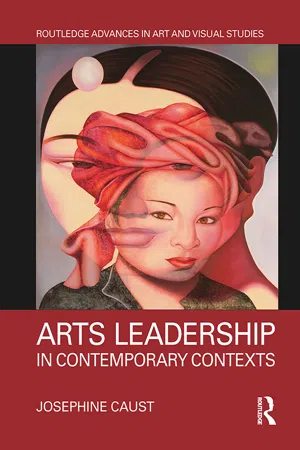
This book explores and critiques different aspects of arts leadership within contemporary contexts. While this is an exploration of ways arts leadership is understood, interpreted and practiced, it is also an acknowledgement of a changing cultural and economic paradigm. Understanding the broader environment for the arts is therefore part of the leadership imperative. This book examines aspects such as individual versus collective leadership, gender, creativity and the influences of stakeholders and culture. While the book provides a theoretical and critical understanding of arts leadership, it also gives examples of arts leadership in practice.
- 178 pages
- English
- ePUB (mobile friendly)
- Available on iOS & Android
eBook - ePub
Arts Leadership in Contemporary Contexts
About this book
Information
Part 1
Overview
1 Arts and Leadership: An Overview
The practice of art can be revelatory and inspiring as well as powerful and threatening, especially in a modern environment where culture and ethnicity, gender and technology have more impact than ever before. There are many forms of art and there are many forms of leadership, and both are changing to suit a diverse and dynamic environment. That is why a discussion about the leadership of the arts is so important.
From recognizing the role that arts practice has had in the development of humankind to how we frame contemporary arts practice, this first chapter considers the role of art and artists and the way that the arts have been framed over the last century. It takes into consideration the latest critical perspectives, drawing into the conversation how the arts are framed and viewed into the 21st century.
Historical approaches to the study of leadership set the scene for understanding a specific context for leadership – that is, the arts. This chapter addresses the way leadership is seen and understood, and includes different models and approaches to leadership such as heroic, transactional, transformational, charismatic, participative, collaborative and shared. Examples of how these models are manifested in the arts sector are considered. There are also new directions and contributions from the critical leadership literature about leadership and space, aesthetic and embodied leadership and entrepreneurial leadership.
What Do We Understand by the Arts and Its Place/Role?
Arts practice has been recorded as being part of the human condition for thousands of years since the revelation of cave paintings. The earliest examples of cave art are traced back over 35,000 years and are believed to be located in Indonesia (Marchant 2016). Over centuries, people have recorded their existence, described their practices, honored their gods and heroes, and developed ways of celebrating their lives through arts and cultural practices in their many different forms. Arts and cultural practices were seen in older societies as the way they honored their forefathers or as a means of teaching the young about the nature of life. French prehistorian Jean Clottes observes that “the sparks of artistic creativity can be traced back to our earliest ancestors … Wherever you find modern humans … you’ll find art” (Clottes quoted by Marchant 2016).
The Australian Aborigines, for example, use dance, story-telling, music, artefacts and pictures to pass on their heritage from one generation to another, explaining the meaning of life along the way (Horne 1986). Similarly, in many Asian societies arts and cultural practices are still part of everyday life and there is no disconnect between the practice of art and the lived experience. In relation to different societies in Asia, de Leon notes:
From ritual vessels to hunting tools, textiles to masks, and epic poetry to rhythmic dances we witness a plethora of patterns and designs, an endless variety of expressive forms … the infusion of everyday life, phenomena and activities with sacred values, the integration of use and function in everyday objects and activities, the oral transmission of knowledge, or non-linear – particularly polychromic – concepts of time.(de Leon 2016: 37)
Art and cultural practices are integrated with the survival and development of humanity and have enormous significance for the participants and the observers. They present a rich picture of how a society is integrated with its culture and art-making. In Western culture, though, the commodification and separation of art from mainstream society over the past hundred years has produced a gap between the production of art and many people’s experience of it.
The making of art and its place in Western society has attracted theorists from many different disciplines across both the social sciences and the humanities. An interdisciplinary approach can present quite different perspectives on what art is, who makes it and how it is valued in society. Linking concepts around art and leadership is also doing this, as it is an exercise in connecting different disciplines of thought and practice which at times may conflict with each other. There are views here about art that come from economic, political, psychological, sociological and historical perspectives.
The art historian John Berger, referencing the work of philosopher Walter Benjamin, notes how ‘art’ in Western society is the preserve of those in power, whether it be the Church, the ruling classes or, in contemporary society, the corporation and the state (Berger 1972: 32). In the Western model, there may be a tendency to frame arts practice into an elevated position and make it special and superior. Thus, arts practice is seen in an elitist context and the organizations that are involved with it then reflect this notion (e.g. opera houses, art museums). Arts infrastructure is expensive to build and often expensive to visit. The political theorist Karl Marx notes:
Production therefore creates the consumer… . An object d’art creates a public that has artistic taste and is able to enjoy beauty – and the same can be said of any other product. Production accordingly produces not only an object for the subject, but also a subject for the object.(Marx 1857 translated by Ryazanskaya 1971)
This locating of art-making with the buyer of that art, seeing it as interconnected, frames arts practice into an economic transaction and sees it both as a commodity and as an object of beauty. Janet Woolf, working from a sociological model, sees art practice as a ‘social construct’ reflecting the values of the world and society it exists in, rather than being the production of a one-off genius (Woolf 1993). She argues that all art has to be interpreted in terms of the world it came from, rather than separate or apart from it. Pierre Bourdieu, a sociologist and philosopher, argues that an understanding and appreciation of art relates to an individual’s class, values and education (Bourdieu 1993: 217–27). He notes that educated people have been given the equipment to decode particular works of art, whereas those who have not been educated in a similar manner experience the challenges of dealing with a different culture when approaching the same work of art (Bourdieu 1993: 217). In addition, differences in gender, race, ethnicity, age and culture could be added to this list of challenges for the appreciation and understanding of a work of art. In this understanding, the nature of ‘art’ is not value-free but is associated with what the observer brings to the transaction, and with the values (beliefs, education, class, etc.) of the artist who is presenting it. If both ‘art’ and the ‘artist’ are products of society, the making of art itself becomes an activity that is neither objective nor value-free.
A separation from cultural participation and art-making may explain why a society primarily focused on economic outcomes may not access deeper meanings and understandings of life. This can then mean that members of that society do not connect with deeper social and cultural issues, given their preoccupation with money-making as the prime social driver. The role of art and of artists is an ongoing discussion, and the value and meaning placed on it is influenced by one’s own understandings and philosophical position. Edgar Schein, a management theorist, talking about the relationship between artists and society, notes that
art and artists stimulate us to see more, hear more and experience more of what is going on within us and around as … Art does and should disturb, provoke, shock, and inspire … the role of the arts and artists is to stimulate and legitimize our own aesthetic sense …(Schein 2001: 81–2)
Schein sees the role of art, and that of artists, as something that essentially has the power to educate us as well as being an agent for change. In this context, ‘art’ is seen as transformational, thereby taking the audience/consumer to somewhere new and different. Thus, art, like leadership, is something that invokes many different views and responses. Nancy Adler, an artist and leadership scholar, observes:
Art offers a unique perspective with which to confront the chaos and unpredictability that surround us.(Adler 2015: 481)
In this reading, the practice of art provides meaning when there is confusion and chaos.
The Arts and the Environment
There is, however, a major disparity between what arts practice may be trying to achieve and how the arts are located within the broader environment. In terms of the performing arts, many of the structures that house performances have been expensive to build and represent another form of value to the city in which they are located, in addition to their actual cultural role (Caust 2015). For example, having its own opera house/performing arts center gives a city status and signifies both wealth and sophistication. Opera houses began to be built in Europe from the 17th century and proliferated into the 19th century. Although opera was a popular artform in Italy, particularly in the 18th and 19th centuries, in modern times it represents in many cases the most expensive of the so-called ‘high’ arts. Opera is seen as the highest of the artforms because it combines music with theater and design and melds them into one distinct form. Both the theater building that opera is presented in and the needs for its production are generally very expensive. This in turn makes the ticket prices high and means that usually only the wealthiest in any society can attend. Yet throughout the world much of a state’s cultural resources is spent on the producing of opera (Bereson 2002).
In a way, opera presents the conundrum that the arts find themselves in at the beginning of the 21st century. From the 15th century, various European nations colonized much of the rest of the world. In that process, they took their preferred arts and cultural practices with them on their journey and then replicated them in their colonies. This meant that as countries threw off their colonial shackles and became new nations, they frequently inherited a preference for the European models of art practice. Hence opera houses and theaters were built throughout South America and North America, and in many parts of Asia, Oceania and Africa, first by the colonial masters and then later to indicate the coming of age of that nation. Ironically, this pattern of edifice building has also now taken place in China as it asserts its power and independence internationally. There has been a huge building program of large performing arts centers at great cost over the past few years throughout China (Qiao 2015). Wherever they are located globally, these centers are very expensive to maintain and demand a distinct kind of arts practice to occur in them. This arts practice may not be relevant to the local people where the arts center is built, but nevertheless precious arts dollars continue to be spent on these edifices.
In the visual arts world in the 20th century, art galleries and museums have become the new churches and are seen as places to visit throughout the world. Galleries such as the Tate, the Louvre and the Guggenheim have become little empires that have many branches – in the Guggenheim’s case, it is a brand that can be seen as a way to market a city (e.g. Bilbao) guaranteeing visitors who would not otherwise have it on their itinerary. While galleries and museums have a role in preserving and presenting art, they are also now seen as tourism destinations that generate enormous economic benefits for themselves and their location. They are seen as part of the ‘creative’ city framing where artists, and creative practitioners more generally, have a direct impact on the image and attraction of a city to visit or live in (Florida 2005; Landry & Hyams 2012).
The funding of arts practice has been framed in different ways over the past 50 years. It is noted that state policies towards the arts reflect the ideologies and values of the government in power (Ridley 1987). If you take the example of the United Kingdom for instance, when John Maynard Keynes and his colleagues founded the Arts Council of Great Britain in 1946, the principles for its creation were located around the need to encourage arts activity that was not dependent on the marketplace to survive, to keep arts funding at a distance from the politics of government and to provide access to arts activity for a broader mix of the population (Upchurch 2004). As the ideologies driving governments changed, their relationship with arts funding also changed. From the 1970s to late 1990s, the rationale for arts funding became more located around the ‘instrumental’ benefits that the arts could provide for society (Belfiore 2004; Gray 2007). For example, the arts were seen as contributing to positive social outcomes (Matarasso 1997). The arts were also associated with educational outcomes and seen as a method for increasing a student’s aptitude, in maths, say, through learning music, or providing a pathway to academic achievement through engagement with the arts (Catterall 2009; Cornett 1999; Robinson 1999).
From the late 1990s, the arts were framed more as an ‘industry’ and were seen as contributing to national economic success. ‘Creative Britain’ is an example of this thinking (Hesmondhalgh & Pratt 2005; Myerscough 1998). The arts were also conflated with culture or creativity, making them part of the cultural or creative industries, instead of just the arts industry or sector (Galloway & Dunlop 2007; Gray 2007). Various ways of recording the economic impact of arts events, such as festivals, were introduced (Brown et al. 2015; Williams & Bowdin 2007). This means that arts practice on its own is not seen as necessarily achieving anything if it cannot be reflected in a series of numbers (Meyrick 2015). In the context of an economic framing of society, the support by government of any activity must be justified by evidence that there is some measurable return on the money invested (Caust 2003; Klamer 2002). Thus, an argument of funding of ‘arts for art’s sake’ has not been popular politically because there are no obvious outcomes generated that can be measured quantitatively (...
Table of contents
- Cover
- Half Title
- Title Page
- Copyright Page
- Dedication
- Table of Contents
- List of illustrations
- Acknowledgments
- Introduction
- PART 1: Overview
- PART 2: The Application of Arts Leadership
- PART 3: Other Influencers and Changes
- Index
Trusted by 375,005 students
Access to over 1.5 million titles for a fair monthly price.
Study more efficiently using our study tools.
Frequently asked questions
Yes, you can cancel anytime from the Subscription tab in your account settings on the Perlego website. Your subscription will stay active until the end of your current billing period. Learn how to cancel your subscription
No, books cannot be downloaded as external files, such as PDFs, for use outside of Perlego. However, you can download books within the Perlego app for offline reading on mobile or tablet. Learn how to download books offline
Perlego offers two plans: Essential and Complete
- Essential is ideal for learners and professionals who enjoy exploring a wide range of subjects. Access the Essential Library with 800,000+ trusted titles and best-sellers across business, personal growth, and the humanities. Includes unlimited reading time and Standard Read Aloud voice.
- Complete: Perfect for advanced learners and researchers needing full, unrestricted access. Unlock 1.5M+ books across hundreds of subjects, including academic and specialized titles. The Complete Plan also includes advanced features like Premium Read Aloud and Research Assistant.
We are an online textbook subscription service, where you can get access to an entire online library for less than the price of a single book per month. With over 1.5 million books across 990+ topics, we’ve got you covered! Learn about our mission
Look out for the read-aloud symbol on your next book to see if you can listen to it. The read-aloud tool reads text aloud for you, highlighting the text as it is being read. You can pause it, speed it up and slow it down. Learn more about Read Aloud
Yes! You can use the Perlego app on both iOS and Android devices to read anytime, anywhere — even offline. Perfect for commutes or when you’re on the go.
Please note we cannot support devices running on iOS 13 and Android 7 or earlier. Learn more about using the app
Please note we cannot support devices running on iOS 13 and Android 7 or earlier. Learn more about using the app
Yes, you can access Arts Leadership in Contemporary Contexts by Josephine Caust in PDF and/or ePUB format, as well as other popular books in Art & Art General. We have over 1.5 million books available in our catalogue for you to explore.