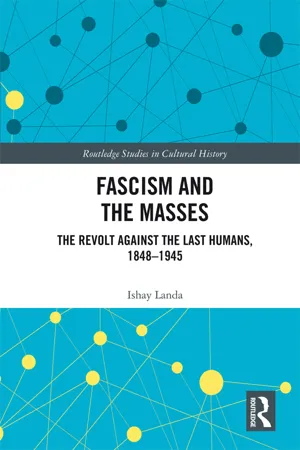
Highlighting the "mass" nature of interwar European fascism has long become commonplace. Throughout the years, numerous critics have construed fascism as a phenomenon of mass society, perhaps the ultimate expression of mass politics. This study deconstructs this long-standing perception. It argues that the entwining of fascism with the masses is a remarkable transubstantiation of a movement which understood and presented itself as a militant rejection of the ideal of mass politics, and indeed of mass society and mass culture more broadly conceived. Thus, rather than "massifying" society, fascism was the culmination of a long effort on the part of the élites and the middle-classes to de-massify it. The perennially menacing mass – seen as plebeian and insubordinate – was to be drilled into submission, replaced by supposedly superior collective entities, such as the nation, the race, or the people. Focusing on Italian fascism and German National Socialism, but consulting fascist movements and individuals elsewhere in interwar Europe, the book incisively shows how fascism is best understood as ferociously resisting what Elias referred to as "the civilizing process" and what Marx termed "the social individual." Fascism, notably, was a revolt against what Nietzsche described as the peaceful, middling and egalitarian "Last Humans."
- 432 pages
- English
- ePUB (mobile friendly)
- Available on iOS & Android
eBook - ePub
Table of contents
- Cover
- Title
- Copyright
- Dedication
- Contents
- List of Figures
- List of Tables
- Acknowledgments
- Introduction: The Masses and the Fascist Political Unconscious
- 1 The Rise of the Last Human I: The Formation of Mass Society
- 2 The Rise of the Last Human II: The Opposition to Mass Society
- 3 Fascism and Mass Politics
- 4 Fascism and Mass Society I: Cultural Questions
- 5 Fascism and Mass Society II: Consumption, Leisure, Americanism
- 6 The Wandering Womb: Fascism and Gender
- 7 The Wandering Jew: National Socialism and Antisemitism
- 8 Epilogue: Nietzsche, the Left and the Last Humans
- Index
Trusted by 375,005 students
Access to over 1.5 million titles for a fair monthly price.
Study more efficiently using our study tools.
Frequently asked questions
Yes, you can cancel anytime from the Subscription tab in your account settings on the Perlego website. Your subscription will stay active until the end of your current billing period. Learn how to cancel your subscription
No, books cannot be downloaded as external files, such as PDFs, for use outside of Perlego. However, you can download books within the Perlego app for offline reading on mobile or tablet. Learn how to download books offline
Perlego offers two plans: Essential and Complete
- Essential is ideal for learners and professionals who enjoy exploring a wide range of subjects. Access the Essential Library with 800,000+ trusted titles and best-sellers across business, personal growth, and the humanities. Includes unlimited reading time and Standard Read Aloud voice.
- Complete: Perfect for advanced learners and researchers needing full, unrestricted access. Unlock 1.5M+ books across hundreds of subjects, including academic and specialized titles. The Complete Plan also includes advanced features like Premium Read Aloud and Research Assistant.
We are an online textbook subscription service, where you can get access to an entire online library for less than the price of a single book per month. With over 1.5 million books across 990+ topics, we’ve got you covered! Learn about our mission
Look out for the read-aloud symbol on your next book to see if you can listen to it. The read-aloud tool reads text aloud for you, highlighting the text as it is being read. You can pause it, speed it up and slow it down. Learn more about Read Aloud
Yes! You can use the Perlego app on both iOS and Android devices to read anytime, anywhere — even offline. Perfect for commutes or when you’re on the go.
Please note we cannot support devices running on iOS 13 and Android 7 or earlier. Learn more about using the app
Please note we cannot support devices running on iOS 13 and Android 7 or earlier. Learn more about using the app
Yes, you can access Fascism and the Masses by Ishay Landa in PDF and/or ePUB format, as well as other popular books in History & 19th Century History. We have over 1.5 million books available in our catalogue for you to explore.