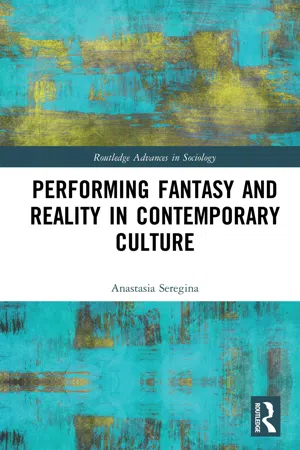
We frequently engage with that which we consciously perceive not to be real, yet fantasy, despite its pervasive presence and strong role in everyday life through its connection to identities, communities, desires, and meanings, has yet to be properly defined and researched. This book examines fantasy from a performance theory perspective. Drawing on multidisciplinary literature, it presents ethnographic and art-based research on live action role-playing games to explore fantasy as a bodily and negotiated phenomenon that involves various kinds of engagement with one's surroundings. Overall, this book is a study of various forms and roles that fantasy can take on as part of contemporary Western culture. The study suggests that fantasy emerges as a different type of interpretation of normalised performance and reality, and can thus provide individuals with the tools to wield agency in everyday life. The book will appeal to scholars of sociology, cultural and media studies, literature and performance studies.
- 206 pages
- English
- ePUB (mobile friendly)
- Available on iOS & Android
eBook - ePub
Performing Fantasy and Reality in Contemporary Culture
About this book
Information
1 Introduction
What is it like to experience something that you describe and define as being not real? How is this different from experiencing something real? Why do we engage in such behaviour? And what do we get out of it? Such questions were the basis of and the driving force for this book.
Fantasy, simply described as experiencing something that is consciously perceived and subjectively defined as not real, is a natural and essential part of human life. Saler (2012) suggests that fantasy has always been a part of the human world, and Schechner (1993) proposes that it is perhaps what makes us human. Schechner further explains that fantasy is a unique human quality that allows us to dream and imagine, and also reflect and elaborate on these processes by placing our wants, goals, and desires into their realms. Fantasy is thus an important part of social processes, with people devoting a lot of time and energy to it, as Goffman (1974) and Cohen and Taylor (1976) note. In other words, as Saler (2012) explains, fantasy has become an important tangible, communally shared presence in contemporary life; an inherent element of today’s consumption-driven culture that connects to meaning-making and desires (Peñaloza 2001; Kozinets et al. 2004; Martin 2004).
Fantasy has been explored as part of different phenomena in various research fields, such as psychology, aesthetics, as well as literature, media, and gaming studies. While building our understanding of human life and culture, these studies have mainly explored fantasy theoretically and/or as a cognitive and individual behaviour, often associating it with entertainment, leisure, and even Utopia. Chronis, Arnould, and Hampton (2012) write that research has focused too much on fantasy as pleasurable mental imagery, and suggest that we need to move beyond this limited understanding. Similarly, Hoogland (2002) stresses that we can no longer “disregard the flesh” (p. 214) of fantasy, elaborating that, while the inner world of individuals is an important part of fantasy, the bodily experience of fantasy, which has received little attention, is just as significant. Fine (1983) and Borer (2010) explain that empirical exploration of fantasy is still largely missing, because such an approach is challenging due to fantasy’s ephemeral and subjective nature. Yet Fine stresses that a better understanding of fantasy could provide us with deeper comprehension of both fantasy and reality. Overall, as fantasy appeals not just to our mind and emotions, but to all of our senses, we need to look at how the phenomenon takes place interactively and materially.
Following these ideas, the aim of this book is to explore how fantasy is subjectively experienced by individuals as it is lived. More specifically, the research focuses on bodily, intersubjective, and spatial aspects of fantasy, as well as the connection of these to individuals’ perceived real (everyday) lives. Fantasy takes up an important place in contemporary culture, as I will show in more detail below. Hence, its in-depth understanding can aid us in comprehending human life and culture, as well as various aspects of these that are influenced by fantasy experiences.
To approach fantasy as lived, acknowledged experience of something not real, I ethnographically explored live action role-playing games (LARP), a form of face-to-face role-playing games, in which individuals take on fantasy characters and interact with one another in fantasy spaces. Irwin (1976), Schechner (1993), and Mackay (2001), among others, have noted that fantasy is a central part of the activity of play. Focusing on a form of play that is bodily and face-to-face, as well as involves acknowledged interaction with fantasy allowed access to an almost tangible experience of fantasy. To explore LARP, I took on a performance theory approach, which is a methodology that focuses on experience, participation, and interaction, thus allowing access to behaviour as it is lived and co-created among people.
Through the study, I provide a description of fantasy as a multisensory and changing experience of acknowledged parallel performances that heavily tie into and reflect individuals’ understanding of reality. I propose how fantasy works structurally as a bodily and spatial performance; how it emerges subjectively and intersubjectively through ties into its surrounding culture; and how it is linked to experiences of agency and investment into one’s reality. Moreover, I map out a typology of fantasy performances: other-worldly fantasy performance focuses on momentary realisation of desires, and othering fantasy performance provides a more long-term agency through reflexive understanding of performance structures. Overall, fantasy transpires to be a complex performance that is intrinsically tied into our everyday lives.
Next, I provide a background to the research, starting with the context and literature it stems from, and followed by an overview of the research context, methods, and methodology.
Fantasy in contemporary consumer culture
Fantasy has become a central aspect of contemporary Western culture. Saler (2012) explains that fantasy contributes “to human cognition and everyday life in a capitalist market economy,” (p. 30) in that it helps produce communities, structures, and futures. Through this, fantasy has become combined with the logic of contemporary culture, artifices of mass culture, and the capitalist economic order. Zukin (1991) adds that, specifically, fantasy’s link to consumption connects it to structures of economic power and cultural value, thus reinforcing fantasy as an important underlying process of contemporary life.
Contemporary Western culture can be described as a culture of consumption; a development described as the result of various cultural, economic, and technological advancements, which have allowed wider production and distribution of, as well as access to consumption goods (see e.g., Slater 1997; Bauman 2007).1 Bauman (2007) explains that consumption has come to provide the ‘raw material’ for social life and its patterning, widely influencing our lives and becoming the underlying logic of “politics and democracy, social divisions and stratification, communities and partnerships, identity building, the production and use of knowledge, or value preferences” (p. 24). The logic of interhuman relations now mimics that of a consumer and the object of consumption, yet these two notions become indistinguishable, with consumers also becoming something to be consumed. Moreover, as Firat and Venkatesh (1995) suggest, practices of production and consumption become increasingly blurred. Hence, it becomes unclear who or what is the producer, the consumer, and the consumed. Nevertheless, their consumption-oriented relationships come to underpin social relations at large.
Consumption becomes a “dominant human practice,” say Arnould and Thompson (2005, p. 873), forming blueprints for culture, action, and interaction, as well as becoming an intrinsic part of ideology. In a similar vein, Firat and Venkatesh (1995) explain that contemporary socialising institutions have become saturated with the logic of markets. Going into more detail, Muniz and O’Guinn (2001) as well as Schouten and McAlexander (1995) describe how communities emerge around consumption activities and consumption objects. Belk (1988), Schouten (1991), Holt (2002), and Ahuvia (2005) provide insight into how consumption and brands become central to identity-building, as well as to understanding one’s self and one’s agency as an individual. All in all, consumption has come to permeate various levels of contemporary life.
Bauman (2007) notes that the overall driving force of consumption-oriented culture is desire. Individuals’ aim is to fulfil their desires, yet, to keep the momentum of consumer culture going, these desires cannot be fully fulfilled. Campbell (1987) similarly suggests that the ability to ‘want,’ ‘desire,’ and ‘long for’ form the basis of contemporary culture. Campbell suggests that fantasy plays a central part in this. He proposes that fantasy involves the creation of convincing daydreams, into which consumers place their desires and to which they react as though they were real. In this way, desire is strengthened and made more pleasurable, but its consummation becomes disillusioning, as the fantasy is perfect, but the reality never lives up to it. Therefore, the longing created through fantasy is never extinguished, but constantly regenerated, leaving the consumer in a permanent state of dissatisfaction and yearning for something better (see also Slater 1997).
While Campbell did not perhaps refer to an acknowledged performance of fantasy, the processes he described have come to form a basis for individuals to engage more directly with what they perceive as not real. Sherry (1990), Schechner (1993), and Martin (2004) show that individuals have learned to place their wants, goals, and desires into fantasy in an acknowledged manner, thus tying other important aspects of contemporary life and culture to the non-real realm. In parallel, Firat and Ulusoy (2007) as well as Borghini et al. (2009) note that companies increasingly drive the use of fantasy to attract individuals, as well as engage their imagination and desires. Fantasy thus emerges as a central process within contemporary consumer culture, pushed forward both by consumption and production.
In consumer culture research, the concept of fantasy has received some attention in recent years, with studies noting its importance as part of consumption and culture. Research has linked fantasy to the creation and attainment of desires and the evoking of meaning, which are central underpinning elements of consumer culture (McCracken 1988; Peñaloza 2001; Martin 2004). Following these ideas, research has shown fantasy to enable the emergence of long- and short-term communities (Kozinets 2002) through creating collective meanings (Goulding, Shankar, and Canniford 2011) and communal experiences (Fernandez and Lastovicka 2011). Moreover, research has noted that individuals develop their identities through creating and investing in ‘fantasy selves’ (Rook and Levy 1983; Schouten 1991) as well as experimenting with characteristics in ‘fantasy settings’ (Belk and Costa 1998). As becomes apparent, fantasy manifests itself in connection to various consumption practices and as part of investment in material and immaterial objects of consumption (Rook and Levy 1983; Schouten 1991; St. James, Handelman, and Taylor 2011).
Fantasy is especially visible as part of the increased thematisation of contemporary culture (Zukin 1991, 1995). Zukin explains that thematisation is largely used to distinguish a place, such as a city, within fragmented contemporary culture. On a smaller scale, various consumption environments, such as theme parks or thematised restaurants aim to distinguish themselves in a sea of consumption choice, thus building fantasy worlds that endorse fantasy experiences (Firat 1991; Kozinets et al. 2004). Thematisation and creation of fantasy worlds can be very direct and clear, as in the case of Disneyland or a Viking restaurant. However, it can also take place in a subtler manner in city or public space planning. Materiality and space are thus important aspects of fantasy experiences (Rook and Levy 1983; Belk and Costa 1998; Martin 2004; Fernandez and Lastovicka 2011; St. James, Handelman, and Taylor 2011), yet their role has remained unclear and underexplored.
While linked to many cultural phenomena, fantasy has rarely been the focus of consumer culture research in itself, as Stevens and Maclaran (2005) note. When given attention, fantasy has often been approached as fancy-free, entertaining, and pleasurable temporary emancipation (Kozinets 2001; Martin 2004). Moreover, research has mainly focused on fantasy as an individual and v...
Table of contents
- Cover Page
- Performing Fantasy and Reality in Contemporary Culture
- Routledge Advances in Sociology
- Title
- Copyright
- Contents
- List of Illustrations
- Acknowledgements
- 1 Introduction
- 2 Perspectives on Fantasy
- 3 Performance
- 4 The LARP Performance
- 5 Fantasy Performance
- 6 Types of Fantasy Performances
- 7 Conclusions
- Index
Trusted by 375,005 students
Access to over 1.5 million titles for a fair monthly price.
Study more efficiently using our study tools.
Frequently asked questions
Yes, you can cancel anytime from the Subscription tab in your account settings on the Perlego website. Your subscription will stay active until the end of your current billing period. Learn how to cancel your subscription
No, books cannot be downloaded as external files, such as PDFs, for use outside of Perlego. However, you can download books within the Perlego app for offline reading on mobile or tablet. Learn how to download books offline
Perlego offers two plans: Essential and Complete
- Essential is ideal for learners and professionals who enjoy exploring a wide range of subjects. Access the Essential Library with 800,000+ trusted titles and best-sellers across business, personal growth, and the humanities. Includes unlimited reading time and Standard Read Aloud voice.
- Complete: Perfect for advanced learners and researchers needing full, unrestricted access. Unlock 1.5M+ books across hundreds of subjects, including academic and specialized titles. The Complete Plan also includes advanced features like Premium Read Aloud and Research Assistant.
We are an online textbook subscription service, where you can get access to an entire online library for less than the price of a single book per month. With over 1.5 million books across 990+ topics, we’ve got you covered! Learn about our mission
Look out for the read-aloud symbol on your next book to see if you can listen to it. The read-aloud tool reads text aloud for you, highlighting the text as it is being read. You can pause it, speed it up and slow it down. Learn more about Read Aloud
Yes! You can use the Perlego app on both iOS and Android devices to read anytime, anywhere — even offline. Perfect for commutes or when you’re on the go.
Please note we cannot support devices running on iOS 13 and Android 7 or earlier. Learn more about using the app
Please note we cannot support devices running on iOS 13 and Android 7 or earlier. Learn more about using the app
Yes, you can access Performing Fantasy and Reality in Contemporary Culture by Anastasia Seregina in PDF and/or ePUB format, as well as other popular books in Social Sciences & Sociology. We have over 1.5 million books available in our catalogue for you to explore.