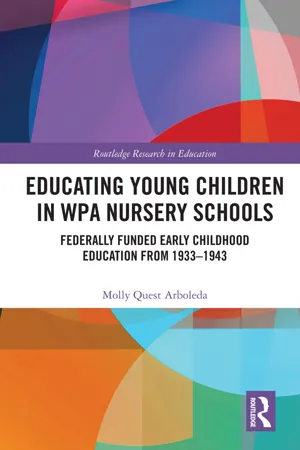
Educating Young Children in WPA Nursery Schools, the first full-length national study of the WPA nursery school program, helps to explain why universal preschool remains an elusive goal. This book argues that program success in operating nursery schools throughout the United States during the Great Depression was an important New Deal achievement. By highlighting the program's strengths—its ideals, its curriculum, and its community outreach—the author offers a blueprint for creating a universal preschool program that benefits both children and their families. This volume uncovers the forgotten perspective of WPA nursery school leaders and highlights the program's innovative curriculum for young children by incorporating both extensive archival research and neglected sources.
eBook - ePub
Educating Young Children in WPA Nursery Schools
Federally-Funded Early Childhood Education from 1933-1943
- 164 pages
- English
- ePUB (mobile friendly)
- Available on iOS & Android
eBook - ePub
Educating Young Children in WPA Nursery Schools
Federally-Funded Early Childhood Education from 1933-1943
About this book
Information
1 WPA Nursery Schools as Educational Reform
In the 1930s, WPA nursery school leaders positioned themselves as cutting-edge educational reformers who could change the lives of small children and even the course of society as a whole.1 Minnie Bean, a Washington state elementary supervisor, told one group:
You really are pioneering in every sense of the word. You are going to be very, very, proud twenty or thirty years from now when you read that every school has a nursery school. You can say: “I was one of the first teachers in that movement.”2
Willard Givens, Secretary of the National Educational Association (NEA), saw a stark choice before the nation:
A new age has come. Its trend no man can forecast, but the spirit of America, our love for our children and our faith in the validity of education and the equality of education opportunity lies at the center. Any people losing hold of its traditions and its ideals cannot long survive. We are at the parting of the ways—one path leads to national decay—the other to renewed life and strength for our county. Let us accept the challenge of the day by protecting and developing our children.3
Givens made nursery schools for all a key issue for the NEA. British nursery school pioneer Grace Owen framed the program’s social significance in an international context. Voicing optimism that all countries would eventually have government-funded preschool programs, she placed great faith in the transformative power of the nursery school:
The nursery school … may serve as a bond of true sympathy and understanding between citizens of all classes and conditions. Still happier is the thought of the nursery school movement as one which has its place in all nations amongst all races, and which must therefore become a bond between all… . As each nation comes, as it must come, to exalt the significance of a perfect childhood for its own people, so each must come to respect the childhood of other nations, and the world movement towards the deeper study of care of the pre-school years will play no mean part in bringing about between all nations the sympathy that comes from realizing together a great common purpose: full development for all, of the promise of childhood.4
Believing early childhood education strengthened democracy, WPA nursery school leaders wanted to transform society through nursery schools. Developing their ideas in the context of the interwar progressive education movement, they hoped to bring universal preschool to American public schools. Creating a group care model that encouraged young children to cooperate with one another, WPA nursery school leaders hoped to build a new social order.5
Nursery School Pioneers
WPA nursery school leaders were important progressive educators. They promoted both a classroom curriculum devoted to the “whole child” and the scientific study of young children. They argued that nursery schools should act as agents for social reform in the belief that educating young children into new ways of thinking and behaving would ultimately transform society.6 With John Dewey as their intellectual godfather, they advocated the growth of nursery schools, and the WPA provided their most important opportunity:
The Emergency Nursery Schools were a powerful statement to the country—a very dramatic statement—that the early years in a child’s life are important educationally. Their very existence made it clear that it matters, in the ultimate development of the human, what children learn in their earliest years, and how they learn it.7
As nursery school pioneers, WPA nursery school leaders epitomized the progressive “who was dissatisfied with things as they are, who had a philosophy of what should be, and who was doing something about it.”8 Some, like Lois Meek Stolz, maintained close ties to John Dewey and William Heard Kilpatrick, the founders of progressive education.9 Others drew upon their experiences in the pre–World War I kindergarten reform movement, which had encouraged home visits as one way to help children and their families.10 The Great Depression led many of those involved with early childhood education to reflect on its implications for society at large:
This enhanced interest in early childhood has resulted in part from the discovery that many of the adults who are involved today in serious social difficulties were the neglected, dependent, poorly nurtured, or otherwise maladjusted children of yesterday.11
The WPA nursery school program took off as quickly as it did “only because there already existed a well-established and functioning program of nursery school education.”12 Yet few schools for very young children predated World War I. The handful that existed were so experimental they either faded away or did not encourage emulation. “Infant schools” developed in Boston in the late 1820s and early 1830s and in Robert Owen’s antebellum utopian community of New Harmony, Indiana, did not take root.13 From the 1870s on, kindergartens sometimes included preschool-age children in addition to those on the verge of entering first grade.14
Sidonie Gruenberg, Maria Montessori, and Harriet Johnson helped renew interest in preschool education in the years immediately preceding American involvement in World War I. In 1912, the same year that Montessori published The Montessori Method, Gruenberg published Your Child Today and Tomorrow.15 Accessible to a lay audience, it emphasizes parent participation in young children’s education. Soon after, University of Chicago faculty mothers banded together to form a play school for their young children, as did faculty mothers at the California Institute of Technology.16 Montessori, the first female doctor in Italy, drew mixed reactions from American educators when she toured the United States in 1913, but schools inspired by her model sprung up, especially in the Northeast and California.17 Harriet Johnson’s interest in preschool education began after meeting progressive educators Caroline Pratt and Lucy Sprague Mitchell in New York City.18 In 1917, Johnson opened a school near Pratt’s City and Country School in Greenwich Village that catered to the needs of children from fifteen months to three years old.19 It became the first “genuine nursery school in America.”20 In 1919, Johnson and Mitchell organized the Bureau of Educational Experiments, which eventually developed into the Bank Street College of Education. They continued to collaborate with Pratt and created learning environments focused on children’s development.21 In the process, these three women provided researchers with rich opportunities to analyze young children’s physical, social, and emotional growth, a distinguishing feature of Bank Street to this day.22
Bank Street leaders like Harriet Johnson, parent educators like Sidonie Gruenberg, and, to a lesser extent, leaders of parent cooperatives and Montessori schools continued to influence early childhood education in the two decades following World War I.23 From 1919 to 1923, others created additional “pioneer nursery schools.”24 Harriet Johnson herself played a formative role in helping organize the WPA program during its first school year, 1933–1934, and was especially admired for her teaching, as “perhaps the most sensitive and creative of all of the workers with young children that this country has ever known.”25
Patty Smith Hill, a Columbia University professor of education with an activist past, initiated the American nursery school movement.26 An influential leader in the push for kindergartens before World War I, Hill earned the title “young radical from the South” because her kindergartens did not rigidly adhere to the curriculum of German kindergarten founder Friedrich Froebel. Whereas traditional kindergartens used only play materials he advocated, Hill rebelled to create toys, books, and music based on children’s actual interests. She designed, for example, large floor blocks and wrote the popular tune “Happy Birthday to You.”27 Refusing to think in terms of a single perfect curriculum, she criticized Maria Montessori, whom she believed a genius, for underestimating children’s desire to work in groups.28 Others admired this experimentation with new ideas and practices.29 John Dewey thought Hill was an outstanding educator.30
Hill capitalized on her reputation among educators to fashion the American nursery school into a quintessentially progressive institution.31 Hill had worked with children as young as a year in the 1890s, and the dismal test results of World War I military recruits prompted her to begin working again with children who were too young for kindergarten. Accounts by British pioneers Margaret McMillan and Grace Owen led Hill to invite Owen (a former student) to New York in the spring of 1921 to train Hill’s staff and students.32 A year later, Owen’s protégé, Kathleen Edwards, arrived from England to establish a nursery school for Hill, the Manhattanville Day Nursery School.33 Writing in 1921, Patty Smith Hill asked:
When will America awaken to the fact that … if we wait until the child is three years old, it may be too late to form those habits of physical, mental and moral health, which are the foundation of character and citizenship?34
Other nursery school pioneers soon mirrored Hill’s efforts, including home economist Edna Noble White, social worker Abigail Eliot, kindergarten reformers Barbara Greenwood and Amy Hostler, doctor (MD/PhD) Arnold Gesell, and psychologists Helen T. Woolley, George Stoddard, and Lois Meek Stolz.35
Unlike Britain, where the focus was on saving children living in slums, the first American nursery schools before the WPA program generally catered to the wealthy. They also differed from the American day nursery, a charity institution that began around 1900 to provide custodial care for young children of working-class mothers.36 About three-quarters of the nursery schools established after 1925 were in thirty-five states, the District of Columbia, and Hawaii and were largely an urban phenomenon. Located i...
Table of contents
- Cover
- Title
- Copyright
- Dedication
- Contents
- List of Figures and Tables
- Acknowledgments
- Introduction
- 1 WPA Nursery Schools as Educational Reform
- 2 American Modernism and the WPA Nursery School Curriculum
- 3 The WPA Nursery School and the Community
- 4 In Time of War
- 5 Buried Treasure
- Index
Trusted by 375,005 students
Access to over 1.5 million titles for a fair monthly price.
Study more efficiently using our study tools.
Frequently asked questions
Yes, you can cancel anytime from the Subscription tab in your account settings on the Perlego website. Your subscription will stay active until the end of your current billing period. Learn how to cancel your subscription
No, books cannot be downloaded as external files, such as PDFs, for use outside of Perlego. However, you can download books within the Perlego app for offline reading on mobile or tablet. Learn how to download books offline
Perlego offers two plans: Essential and Complete
- Essential is ideal for learners and professionals who enjoy exploring a wide range of subjects. Access the Essential Library with 800,000+ trusted titles and best-sellers across business, personal growth, and the humanities. Includes unlimited reading time and Standard Read Aloud voice.
- Complete: Perfect for advanced learners and researchers needing full, unrestricted access. Unlock 1.5M+ books across hundreds of subjects, including academic and specialized titles. The Complete Plan also includes advanced features like Premium Read Aloud and Research Assistant.
We are an online textbook subscription service, where you can get access to an entire online library for less than the price of a single book per month. With over 1.5 million books across 990+ topics, we’ve got you covered! Learn about our mission
Look out for the read-aloud symbol on your next book to see if you can listen to it. The read-aloud tool reads text aloud for you, highlighting the text as it is being read. You can pause it, speed it up and slow it down. Learn more about Read Aloud
Yes! You can use the Perlego app on both iOS and Android devices to read anytime, anywhere — even offline. Perfect for commutes or when you’re on the go.
Please note we cannot support devices running on iOS 13 and Android 7 or earlier. Learn more about using the app
Please note we cannot support devices running on iOS 13 and Android 7 or earlier. Learn more about using the app
Yes, you can access Educating Young Children in WPA Nursery Schools by Molly Quest Arboleda,Molly Arboleda in PDF and/or ePUB format, as well as other popular books in Education & Early Childhood Education. We have over 1.5 million books available in our catalogue for you to explore.