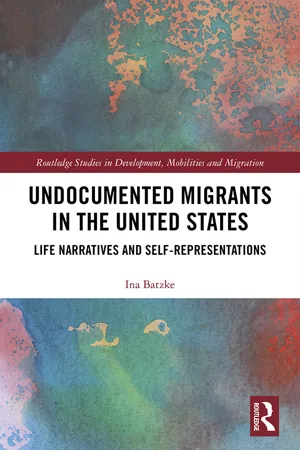
Whilst many undocumented migrants in the United States continue to exist in the shadows, since the turn of the millennium an increasing number have emerged within public debate, casting themselves against the dominant discursive trope of the "illegal alien," and entering the struggle over political self-representation. Drawing on a range of life narratives published from 2001 to 2016, this book explores how undocumented migrants have represented themselves in various narrative forms in the context of the DREAM Act and the Deferred Action for Childhood Arrivals (DACA) movement.
By reading these self-representations as both a product of America's changing views on citizenship and membership, and an arena where such views can potentially be challenged, the book interrogates the role such self-representations have played not only in constructing undocumented migrant identities, but also in shaping social borders. At a time when the inclusion and exclusion of (potential) citizens is once again highly debated in the United States, the book concludes by giving a potential indication of where views on undocumented migration might be headed. This interdisciplinary exploration of migrant narratives will be of interest to scholars and researchers across American Literary and Cultural Studies, Citizenship Studies, and Ethnic and Migration Studies.
eBook - ePub
Undocumented Migrants in the United States
Life Narratives and Self-representations
- 212 pages
- English
- ePUB (mobile friendly)
- Available on iOS & Android
eBook - ePub
About this book
Part I
From aliens to DREAMers
1The making of the “illegal alien”
As much as life narratives by undocumented migrants might be understood as moments of rupture with the potential to break with pre-existing frameworks, they are also always closely connected to and influenced by existing representational histories and, of particular importance for this project, established narratives about migration and migrants in the United States. Not only do “mediated narratives of immigrants and their place in the nation have a long and storied history” (Flores 363), they are also closely related to the nation’s current cultural, demographic, social, and economic changes (see 366f.; also Ono and Sloop 53). Life narratives by undocumented migrants are no exception to this undeniable connection. As this chapter hopes to outline, whether invoked directly or indirectly, particularly in the decade after 9/11—when the first undocumented activists started to tell their stories—a discourse surrounding illegality and the thereto related trope of the “illegal alien” had been “hauntingly consistent” (Bluff 14) in public and political immigration discourse in the United States, and hence was also taken up, recycled, and challenged in these first self-representations by undocumented individuals.
To understand the prominence of this trope, this chapter charts the historical and discursive origins of the “illegal alien” in US law and society and the simultaneous “emergence of illegal immigration as the central problem in US immigration policy” (Ngai 3). To understand the notions of inclusion and exclusion lying at the heart of this debate, one must have knowledge of the makings of the United States nation and its legal upholding, as both are two major constituents in creating and understanding America and the discourses that maintain it. By exploring the process of writing American national identity, which hinges on the exclusion of non-citizens from becoming members of the citizenry, this chapter shall demonstrate the long-term impact of these negotiations on contemporary narrative strategies of displacement. It will be argued that the succeeding strategy of writing undocumented migrants as “illegal aliens”—and therefore as legal exceptions to the rule of the law, written to be inside US jurisdiction, but outside the regular regime of law (see Johnson, Huddled Masses)—ultimately recycles notions of spatial and legal marginality traditionally associated with non-citizens, or foreigners, and tries to deny these outsiders the possibility to pose a challenge to the US national narrative.
In other words, in its attempt to construct a homogenous US national identity, creating and recycling the trope of the “illegal alien” are induced by the self-sustaining need of US nationhood to legally draw borders of exclusion, thereby barring non-citizens from its citizenry.
The first aliens
As theorists such as Bonnie Honig and Engin Fahri Isin have shown, since the ancient Greeks and Romans the foreigner, as an analytical category of alienness, has played a founding role in the exclusionary politics of migration. Through exclusion a broader imaginary of citizenship can be constructed, and in this respect citizenship qua belonging is defined in relation to foreign figures such as the “alien.”1 Almost all historical ages offer comparable accounts of the virtues of citizenship and draw discursive and legal boundaries between insiders and outsiders.
Numerous critics have established theories that explore this binary opposition in the creation and maintenance of US nationhood, as it has indisputably also haunted the United States since its founding. To Benedict Anderson, whose work is among the most prominent and influential of these theories, the American nation is first and foremost an “imagined community” (24), which does not only depend on geographic or physical proximity, but instead exists in the imagination of people who consider themselves part of the nation. At first sight, for Anderson, belonging is a rather open concept, as anyone who is willing to join in the “unisonance” of the “common language” choir (145) can become part of the nation. At the same time, Anderson highlights that
nation-ness is assimilated to skin-color, gender, parentage, and birth-era—all those things one cannot help. And in these “natural ties” lies the “beauty of gemeinschaft.”
(143)
Although Anderson’s definition implies that anyone who was willing to learn the language could join the “gemeinschaft,” there are other clear limitations. Since the nation-state sovereignty operates “fully, flatly, and evenly … over each square centimeter of a legally demarcated territory” (19), those not willing or not welcome (based on, for example, skin-color, gender, parentage, and birth-era) to join in the unisonance of the nation, are strictly written out of it/its space. Marginality, difference, in-betweenness, and porous borders, which to Anderson are typical for the archaic medieval dynastic states (see 19), cannot be accommodated within the legally sanctified, sovereign terrain of the modern nation. The spatial borders of the nation-state are ultimately created to distinguish it from the bordering nation, “beyond which lie other nations” (7).
In Anderson’s analysis of the United States’ transition from colony to nation, or imagined community, parallel to Honig’s and Isin’s argument,2 he finds that the imagining of the nation automatically includes an excluding, an Othering. Indeed, already during the inscription of US nationhood into territory, which is described by Anderson “as relying on the movement of creole functionaries” (116), a reference to the outsider, the foreigner, can be found: cartographers reported that the American border was a “messy space” (Hunt 141); they found that “[m]apping and marking the boundary will not … make the Southwest a safely American space.” It is concluded that the newfound nation-state could only succeed if the threat of “banditti,” “horse thieves,” and “wild Indians” was ended (Emory 70). In other words, the foreigners’ presence in the borderland is already described as a major endangerment to US nationhood at the time of inscription. In bringing up the threatening resistance of the nation’s foreigners (wild Indians and banditti), the report admits a non-national population and presence that is uncontrollable and can thus escape not only the cartographers’ “power to exert his will over the country” (Hunt 142), but also American sovereignty. The fear of a “racial mixing” or “hybridity” (143) inside the borders, which could threaten the purity of the American nation and its citizens, indicates moreover a possibility of resistance within the space outside of the nation-state.
The border itself becomes a symbolic and figurative “space of encounter” (see Schoonderbeek) between an imagined US nation-state/identity and the spaces/identities that are excluded from it. In so doing, an issue is commenced that has dominated political theory for centuries: In classical political thought, “foreignness is generally taken to signify a threat of corruption that must be kept out or contained for the sake of the stability and identity of the regime” (Honig 1). This “xenophobic way of thinking about foreignness” (2) thus must be understood as the origin for a naturalized exclusion process, which has transcended into the contemporary world, particularly through legal, but also discursive, expressions.3
The making of the legal alien
This “natural” process of exclusion essential to the national imaginary in the United States is also evident in the United States’ legal inception and upholding, as it is the law that “helps define the boundaries of an American national identity” (Dudziak 4). In the specific self-perception of the US nation-state, the law is, however, not only an instrument for setting legal limitations between the inside and the outside. Quite to the contrary,
American ideology incorporates a particular vision of law, which is law as the rule of law, and law as a guarantor of democracy, equality, and freedom. Americans believe that their law is the rule of law.
(4)
This self-perception, in theory, does not allow for contradictions, not for a “single square centimeter of legally demarcated territory” that is not “fully, flatly, and evenly” (19) operated by the sovereign nation-state, and not for a single human being who is neither fully inside, nor fully outside US territory.
Nevertheless, these spaces and human beings exist, and the undocumented migrants, who are at the heart of this discussion, are a prime example. They constitute a frontier case that seems to defy existing categories: even if undocumented individuals have lived in the United States for many years, have children with citizenship status, and have deep community ties, by definition and status they are considered “outsiders to the national community” (Johnson, Huddled Masses 153). Yet, notably, as soon as they have entered American territory, they are covered by US law, as rights inhere in persons, not just citizens,4 as Section One of the Fourteenth Amendment to the Constitution, enforced by the US Supreme Court in 1886, 1896, and 1903 exemplifies: no state shall “deny to any person within its jurisdiction the equal protection of the laws” (U.S. Constitution, amendment XIV, sec. 1).
But to clearly distinguish outsiders from insiders, regardless of their actual location within or outside US territory, US law has over time developed a comprehensive vocabulary to deal with non-citizens, one which revolves around the term “alien.” In general, anyone “born out of the jurisdiction of the United States, who has not since been naturalized under their constitution and laws” (Bouvier 91) is considered an “alien.”5 The US government’s use of “alien” dates back to 1790, when it was first used in the Naturalization Act of 1790, in which the US Constitution gave Congress the power “[t]o establish a uniform Rule of Naturalization” (sec. 1, 1790 Naturalization Act). As the first law touching at all on the issue of immigration, it allowed Congress to naturalize “any Alien being a free white person” (sec. 1, 1790 Naturalization Act) so long as such outsiders met certain requirements: they had to possess good moral character and take an oath to endorse the US Constitution. Later, in the Alien and Sedition Acts of 1798, the term was fully adopted and at that time also acquired a negative overtone: the president was henceforth authorized to imprison or deport aliens considered “dangerous to the peace and safety of the United States” (Alien and Sedition Act of 1798) at any time, and to do the same to any male citizen of a hostile nation during times of war.
It thus seems that from the very beginning the legal term “alien” developed a meaning that is far beyond the quite neutral denotation “one who is not a naturalized citizen of the country where they are living” (OED). While it could be argued, and sometimes is, that the fact that the term “alien” is embedded in the very law of the United States “would seem to belie any suggestion of stigma associated with the word” (Shannon), the connotation of “alien” in discourse nowadays cannot be separated from its alternative meaning, as “a hypothetical or fictional being from another world,” who is often considered an enemy. Moreover, a significant body of scholarship exists on the exclusionary and racist roots of US immigration laws and how the term “alien” has been used not only to demarcate foreign nationals but to make them feel unwelcome, may that be because of race, religion, language, culture, poverty, or some combination of the above. Hiroshi Motomura, for example, noted in 1990 that while the term is standard usage in legal discourse, it “has a distancing effect and somewhat pejorative connotation” (547). Gerald L. Neuman likewise stated that “it is no coincidence that we still refer to non-citizens as ‘aliens’, a term that calls attention to their ‘otherness’, and certainly associates them with nonhuman invaders from outer space” (1428). And Kevin R. Johnson concluded that historically “[t]he concept of the alien … help[ed] to reinforce and strengthen nativist sentiment toward members of new immigrant groups, which in turn influenc[ed] U.S. responses to immigration and human rights issues” (“Legal Construction” 265). Particularly the following prominent examples underline these observations: In the 1882 Chinese Exclusion Act, migrants of Chinese descent were excluded from US citizenship and made into permanent aliens; in the Immigration Act of 1924, aliens, particularly Japanese, were excluded from admission to the United States if they were ineligible to become citizens;6 and by means of the Immigration and Nationality Act of 1952 and 1965, a preference system was established to specify which ethnic groups were desirable aliens, in 1965 particularly with regard to labor qualifications, skills and family relationships.
What such legislation exemplifies is how the term “alien” ensures, most importantly, that non-citizens are only limited or conditional members of the community. At the same time, in principle, aliens could become citizens, however, only if they were ...
Table of contents
- Cover
- Half Title
- Seriestitle
- Title Page
- Copyright
- Contents
- List of figures
- List of abbreviations and acronyms
- A note on language
- Introduction: documenting the undocumented
- PART I: From aliens to DREAMers
- PART II: Life narratives by undocumented migrants
- PART III: Life writing by undocumented migrants
- Concluding remarks: undocumented in Trump’s America
- Index
- Back Cover
Trusted by 375,005 students
Access to over 1.5 million titles for a fair monthly price.
Study more efficiently using our study tools.
Frequently asked questions
Yes, you can cancel anytime from the Subscription tab in your account settings on the Perlego website. Your subscription will stay active until the end of your current billing period. Learn how to cancel your subscription
No, books cannot be downloaded as external files, such as PDFs, for use outside of Perlego. However, you can download books within the Perlego app for offline reading on mobile or tablet. Learn how to download books offline
Perlego offers two plans: Essential and Complete
- Essential is ideal for learners and professionals who enjoy exploring a wide range of subjects. Access the Essential Library with 800,000+ trusted titles and best-sellers across business, personal growth, and the humanities. Includes unlimited reading time and Standard Read Aloud voice.
- Complete: Perfect for advanced learners and researchers needing full, unrestricted access. Unlock 1.5M+ books across hundreds of subjects, including academic and specialized titles. The Complete Plan also includes advanced features like Premium Read Aloud and Research Assistant.
We are an online textbook subscription service, where you can get access to an entire online library for less than the price of a single book per month. With over 1.5 million books across 990+ topics, we’ve got you covered! Learn about our mission
Look out for the read-aloud symbol on your next book to see if you can listen to it. The read-aloud tool reads text aloud for you, highlighting the text as it is being read. You can pause it, speed it up and slow it down. Learn more about Read Aloud
Yes! You can use the Perlego app on both iOS and Android devices to read anytime, anywhere — even offline. Perfect for commutes or when you’re on the go.
Please note we cannot support devices running on iOS 13 and Android 7 or earlier. Learn more about using the app
Please note we cannot support devices running on iOS 13 and Android 7 or earlier. Learn more about using the app
Yes, you can access Undocumented Migrants in the United States by Ina Batzke in PDF and/or ePUB format, as well as other popular books in History & North American History. We have over 1.5 million books available in our catalogue for you to explore.