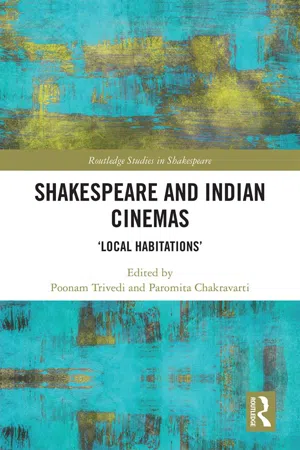
This book is the first to explore the rich archive of Shakespeare in Indian cinemas, including less familiar, Indian language cinemas to contribute to the assessment of the expanding repertoire of Shakespeare films worldwide. Essays cover mainstream and regional Indian cinemas such as the better known Tamil and Kannada, as well as the less familiar regions of the North Eastern states. The volume visits diverse filmic genres, starting from the earliest silent cinema, to diasporic films made for global audiences, television films, independent films, and documentaries, thus expanding the very notion of 'Indian cinema' while also looking at the different modalities of deploying Shakespeare specific to these genres. Shakespeareans and film scholars provide an alternative history of the development of Indian cinemas through its negotiations with Shakespeare focusing on the inter-textualities between Shakespearean theatre, regional cinema, performative traditions, and literary histories in India. The purpose is not to catalog examples of Shakespearean influence but to analyze the interplay of the aesthetic, historical, socio-political, and theoretical contexts in which Indian language films have turned to Shakespeare and to what purpose. The discussion extends from the content of the plays to the modes of their cinematic and intermedial translations. It thus tracks the intra–Indian flows and cross-currents between the various film industries, and intervenes in the politics of multiculturalism and inter/intraculturalism built up around Shakespearean appropriations. Contributing to current studies in global Shakespeare, this book marks a discursive shift in the way Shakespeare on screen is predominantly theorized, as well as how Indian cinema, particularly 'Shakespeare in Indian cinema' is understood.
- 344 pages
- English
- ePUB (mobile friendly)
- Available on iOS & Android
eBook - ePub
About this book
Information
Part I
Indigenising the Tragic
1
Woman as Avenger
‘Indianising’ the Shakespearean Tragic in the Films of Vishal Bhardwaj
Poonam Trivedi
Vishal Bhardwaj has been called Hindi cinema’s ‘Renaissance man,’1 a tribute based not only on his three Shakespeare films, more than any other Indian film-maker, but also on the critical attention they have garnered, cross-culturally and internationally. These films have instigated a new approbation, a shift of attitudes akin to a rebirthing of the Indian film industry in a new, crossover light. Until the past few decades, Indian cinema spoke mainly to the local, though millions, of the subcontinent. The growing diaspora created a space for it in many other parts of the world. But Vishal Bhardwaj’s Shakespeare films have in no small measure changed this; they have become the ‘global’ face of Indian/Hindi cinema. Since renowned Shakespeare thespian Sir Ian McKellen offered to start learning Hindi in a conversation with Bhardwaj during the festival of his Shakespeare films at the British Film Institute in April 2016, we can be confident that Indian cinema has crossed into another threshold.2
Bhardwaj’s reputation is also based on the fact that he has started his reckoning with the core of the Shakespearean canon, the major tragedies. While there has been considerable comment on his films, what has been little noticed is how he has modified the configuration of the genre, mainly through changes in the endings and the role of women, in the process putting an unmistakable Indian stamp on it. If there is a common thread running through Vishal Bhardwaj’s film versions of Shakespeare’s tragedies, Macbeth, Othello and Hamlet, that is, Maqbool (2004), Omkara (2006) and Haider (2014), it is that all three foreground their relocation in specific cultures of violence: urban, rural and of the state. Violence and the tragic have a symbiotic relationship in Shakespeare; the background of war and power struggles infects the heroes, who embark on a fatal course of action from which there is no return. Macbeth is introduced as ‘Bellona’s bridegroom’ (1.3.54), identified with a sword ‘smoking with bloody execution’ (1.3.18); Othello is called a ‘savage’ (4.1.52) whose attraction is ‘the dangers I had passed’ (1.3.166); and Hamlet debates whether to take up arms in a state which is ‘rotten’ (1.4.67).3 Entire societies seem to reel under the onslaught of violence, both physical and emotional. Women are not spared either, but their roles in Shakespeare tragedies, apart from Juliet and Cleopatra, are limited to being either instigators or victims, or both, but not protagonists of the violence. Contemporising of Shakespearean drama often challenges these given positions, creating new localisations of the narrative which shift the dynamics of character and action. Vishal Bhardwaj’s relocations of the tragedies in contemporary India enhance their equation with violence to make pointed political statements. His retellings critique ‘systemic violence,’4 i.e. spheres of organised violence – the criminal underworld of Mumbai in Maqbool, rural gangsterism in Omkara and the army excesses versus insurgency in Kashmir in Haider – all critical flash points of independent India. They show characters, male and female, trapped within the excesses of violence that they themselves generate. His other films too, like Kaminey (2009), an underworld thriller, and Matru Ki Bijili Ka Mandola, a satiric dig at land scams, scour the economic violence of corruption. Bhardwaj seems committed to exposing the cancer of violence in modern Indian society. While Haider is obviously the most political of the three films, the other two, contrary to what some critics believe, are equally concerned with contentious issues, asking serious questions of the state.
This exposé is mainly effected through the changes he makes in the role of the women, unpicking the accepted equation between women and violence in the tragedies and shifting the onus of establishing the final justice and executing vengeance upon the females in the play, almost akin to the manner in which women playfully sort out the situation in Shakespearean comedies. Bhardwaj’s films, while remaining true to an essence of the plays, interpolate, extend and excise to subtly ‘fill out’ suggestions and echoes, re-textualising submerged meanings and re-placing events in their contemporisation of the plays. Anthony Howard, in his review of Haider, put his thumb squarely on it: ‘One of Bhardwaj’s greatest strengths is his readiness to rebalance Shakespeare, giving new speeches to the silent and bolstering relationships.’5 A salient feature of this mode of adaptation, which has not been picked up in critical discourse, is the change Bhardwaj effects in the agency of the female figures. His versions of the tragic women, though infected by the violence around them, are more proactive, more instrumental in the expanded roles they are given. Individuals in their own right, they are not simply the ‘other’ of the masculine self. They intervene, interrogate and instigate resolutions that mere men cannot. In addition to their original role and function in Shakespeare, they promote and deflect the challenges faced by the male protagonists, courting violence and helping resolve it. Nimmi (Lady Macbeth) in Maqbool, who is Duncan’s mistress in the film, forces Maqbool (Macbeth) at the point of a gun to accept her love for him, a relationship which proves to be both his undoing and his redemption. Dolly (Desdemona) in Omkara pursues Omi far more aggressively than the ‘fair’ Desdemona would ever dream of doing, and Emilia, not content in a supportive role, morphs into a slasher for justice. Gertrude, Shakespeare’s most misunderstood woman, in Haider as Ghazala, takes over the role of the bloody avenger from Hamlet, blowing herself up in the process. Innocent Arshia (Ophelia), too, handles not flowers but a pistol.
Clearly, Vishal Bhardwaj’s reconfiguration of Shakespeare’s tragedies hinges upon the transgressive dimensions of the women’s extended roles. In fact, it is possible to read his tragic trilogy as ‘women’s films’; Bhardwaj has said over the course of his interviews that he believes women to be stronger than men and that he finds it much easier to work with female actors – they ‘leave it to you and are not a problem’ – and wished that he could make female-oriented films (The Times of India 12 December 2012). This essay will investigate these dynamic changes of a re-gendering of the course of justice and their implications in the reading of not just the women but also the dimensions of Shakespearean tragedy on film. It will contextualise these changes by looking at the place, influence and assimilation of Shakespearean tragedy in Indian literary and performative cultures; the filming of Shakespeare tragedies in Hindi cinema; and the genres and conventions the particular films intersect with. It will argue that Bhardwaj’s particular slant in his adaptations, not just in the mise en scène but also in the cultural and philosophic dimensions, is determined by his deep roots in Indian society and culture. It will demonstrate how his versions of the women emerge out of many complex symbolisms and tropes concerning women in Indian culture, which form the breeding ground for his imaginative recreations.
Shakespearean Tragedy in Indian Cinema
Indians have not been entirely comfortable with the tragic genre. Though it has been commonly accepted, it is observed more often in violation. Tragedy as a genre was introduced to Indian literary culture through Greek and Shakespearean drama in colonial times. Sanskrit poetics did not conceive of tragedy – depiction of death on stage was proscribed in the Natya Shastra. Hindu philosophy, positing rebirth, did not hold death as a finality but as a stepping stone into a future existence. Hence the aim of creative expression was to show the ultimate harmonisation of the earthly and metaphysical realms. Even though tragedy was opposed to traditional beliefs, it intrigued Indian intellectuals, stimulated debate, wielded influence and was accepted and assimilated in various ways.6 And as with all Western genres, it was often modified to suit popular taste. For instance, a very popular early stage version of Romeo and Juliet, in Kannada, had the god Vishnu descend from the heavens at the end, to revive, bless and marry the lovers. Indian film genres too have adapted and remoulded their borrowings comprehensively. Popular Indian cinema, as we know, has charted an altogether different track to the accepted modes of film-making, creating what has been termed a ‘different universe.’7 Shakespeare’s tragedies were prominent in Indian cinema right from the beginning. Hamlet, Khoon-e-Nahak (Unjust Assassination, 1928) and Macbeth, Khooni Taj (Bloody Crown, 1930) are to be found among the early silent films. One of the earliest talkies, Sohrab Modi’s Khoon Ka Khoon (Filial Murder, 1935), has the distinction of being the first full-length Indian Shakespeare film as well as, according to Kenneth S. Rothwell’s filmography, the very first known talkie of the play globally!8 The pioneering Indian film-makers, busy with mythologicals and historicals, did not shy away from Shakespeare or tragedy. Almost all the Indian-language cinemas continued to experiment with Shakespeare’s plays, taking up the challenge to embed them in their own cultural milieus, Tamil and Hindi producing the most versions. And by the time we come up to the twenty-first century, it is Vishal Bhardwaj’s acclaimed Shakespeare tragic trilogy which has in no small way contributed to the internationalisation of Indian cinema. Interest in Bollywood had been burgeoning, but the trilogy has added a crucial critical esteem.
Vishal Bhardwaj’s Shakespeare films achieve their impact through opposites: simultaneously global yet very local, they are reasonably close to the original texts but introduce critical changes. They are produced as full-scale commercial films but are characterised by an auteuristic vision. In their intensive engagement with the central icon of English literature they seem to be addressing the growing anglophone younger generation; yet the story, sounds and mise en scène of the films remain authentically indigenous and regional. And though there is the tragic, inevitable but unmerited death of the protagonists at the end, the films are all topical, with decided political overtones. In all the three films, the heroes are underplayed in favour of the women who rise up to become the avenging protagonists. What is most striking is that while the women are given a transgressive individuality, it is the changed gendered equation with violence which instruments the resolution of redemptive justice. Bhardwaj himself does not belong to the anglophone generation: he says that he had no schooling in Shakespeare but came to him as an adult. He has also repeatedly said that it is the stories that interest him most in Shakespeare. Hence, he has no hesitation in acculturating the stories into Indian situations, and he is not hampered by the residual colonial awe which still afflicts many Indians. It therefore becomes imperative to unpack his versioning of the Shakespearean tragic in which women are more deeply implicated in the violence when they finally turn towards a resolution, sacrificing their lives nevertheless. What is the gain of this gendering of justice? How and what do the women reframe and affirm through violence? Are these changes of characterisation to be considered monstrous or heroic? What social, psychic or ethical compulsions do they satisfy? And do they achieve a curative or regenerative impact? These are some of the questions that Bhardwaj’s films provoke.
The Avenging Woman in Film and Culture
The figure of the violent avenging woman in Indian films is not exceptional. She has appeared in different forms from the early decades of Indian cinema. As a matter of fact, the considerable presence of this figure has created a subgenre in Indian cinema: the ‘avenging woman’ film, which intersects with other subgenres, like the ‘vigilante woman’ film, the ‘rape and revenge’ film and the early ‘female action’ film. These films have provoked considerable discussion, especially among feminist critics, who confront the contradictory readings which surround such ‘women’s’ films. They were dismissed earlier as ‘hackneyed’ responses to the wave of violence and breakdown of the state (especially during the Emergency), seen as a ‘welcome break’ from the dominant stereotypes of the submissive women or seen as male fantasies recycling the old victimisation and masquerading as the female power trope. The proliferation of the genre, especially since the 1980s, has led to competing analyses testifying to the complexities and contradictions inherent in it. Issues of ‘scopophilia and spectatorship’, ‘censorship and state’ also form, as Lalitha Gopalan, in one of the earliest essays on the topic, put it, ‘intertextual relays between them.’9 This critical trajectory, incidentally, resembles the turns and counter-turns familiar from the feminist estimation of Shakespeare’s tragic women, who were earlier undermined in binary readings of victim versus monsters, seen only as the ‘Other’ of the masculine Self or as fictions covering up oppressive reality.10 Just as later, third-wave, feminism has attempted to recoup an agonistic reading of Shakespeare’s women, so have Indian film critics had to rethink their positions on Indian women’s film (Bandit Queen, dir. Shekhar Kapoor, 1994, sparked a huge debate). If Shakespeare’s avenging women have yet to receive full critical estimation, the Indian counterpart too needs a consensus of views.
Further, Indian cinematic representation is fed, one needs to remember, by multiple streams of signification, not the least from the evergreen Indian epics, folklore and history. The figure of the avenging virangana or the warrior woman in different forms is to be found everywhere. Draupadi, the common wife of the five Pandava brothers in the Mahabharata, is usually seen as the vengeful one...
Table of contents
- Cover
- Half Title
- Title Page
- Copyright Page
- Table of Contents
- List of Figures
- List of Contributors
- Introduction: Shakespeare and Indian Cinemas: ‘local habitations’
- Part I Indigenising the Tragic
- Part II Critical Innovations
- Part III Between the Global and the Local
- Part IV Reimagining Gender, Region and Nation
- Part V Interviews
- Part VI
- Index
Trusted by 375,005 students
Access to over 1.5 million titles for a fair monthly price.
Study more efficiently using our study tools.
Frequently asked questions
Yes, you can cancel anytime from the Subscription tab in your account settings on the Perlego website. Your subscription will stay active until the end of your current billing period. Learn how to cancel your subscription
No, books cannot be downloaded as external files, such as PDFs, for use outside of Perlego. However, you can download books within the Perlego app for offline reading on mobile or tablet. Learn how to download books offline
Perlego offers two plans: Essential and Complete
- Essential is ideal for learners and professionals who enjoy exploring a wide range of subjects. Access the Essential Library with 800,000+ trusted titles and best-sellers across business, personal growth, and the humanities. Includes unlimited reading time and Standard Read Aloud voice.
- Complete: Perfect for advanced learners and researchers needing full, unrestricted access. Unlock 1.5M+ books across hundreds of subjects, including academic and specialized titles. The Complete Plan also includes advanced features like Premium Read Aloud and Research Assistant.
We are an online textbook subscription service, where you can get access to an entire online library for less than the price of a single book per month. With over 1.5 million books across 990+ topics, we’ve got you covered! Learn about our mission
Look out for the read-aloud symbol on your next book to see if you can listen to it. The read-aloud tool reads text aloud for you, highlighting the text as it is being read. You can pause it, speed it up and slow it down. Learn more about Read Aloud
Yes! You can use the Perlego app on both iOS and Android devices to read anytime, anywhere — even offline. Perfect for commutes or when you’re on the go.
Please note we cannot support devices running on iOS 13 and Android 7 or earlier. Learn more about using the app
Please note we cannot support devices running on iOS 13 and Android 7 or earlier. Learn more about using the app
Yes, you can access Shakespeare and Indian Cinemas by Poonam Trivedi,Paromita Chakravarti in PDF and/or ePUB format, as well as other popular books in Literature & Film & Video. We have over 1.5 million books available in our catalogue for you to explore.