Digitalization is changing the world of work. Technology is shifting the relationship between workers and machines and how work is organized; new skills are becoming increasingly relevant in the workplace where workers no longer work for a single company, in 9-to-5 jobs, five days a week.
Industry 4.0, also known as the Fourth Industrial Revolution, is revolutionizing the way managers can design, control and improve their activities. While the nature of the tasks and the interdependences between individuals are changing, the impact of intelligent technologies is severely questioning the span of control of leaders and the effectiveness of their leadership styles.
The authors sketch out the main changes occurring in the business landscape and identify the new expectations that organizations are formulating for leaders across several industries. In an age in which new leadership models are about to emerge, they describe how the relevant changes impact and shape the managerial arena.
This book sets the stage for a new way of thinking on the nature of the relationship between HR and technology. It examines the influence of Industry 4.0 and Innovation 4.0, (i.e. the connection between physical and digital processes in industrial production, where human competencies and machine potential are strictly interconnected throughout the entire value chain), from a myriad of viewpoints: namely in terms of structures, practices, influences (learning, training and communication), competencies and roles. A chapter is also dedicated to the understanding of the impact of Innovation 4.0, in the context of European Universities through E-learning Experiences where a multiple-case study analysis is provided.
UNLOCKING THE IOT POTENTIAL IN MANUFACTURING: AN ORGANIZATIONAL ANALYSIS AND RESEARCH AGENDA1
Cristiano Ghiringhelli-Francesco Virili
SUMMARY: 1.1. Introduction. – 1.2. Background. – 1.3. Exploring the potential of IoT: from data to action, via decisions. – 1.4. Unlocking the potential of IoT: the organizational perspective. – 1.5. A suggested research agenda. – References.
1.1.Introduction
The basic concept underpinning the Internet of Things (IoT) is the possibility of connecting objects to the Internet, typically by means of a small and inexpensive “smart label”. The transition from a world of objects to a world of smart objects connected, identified, and monitored in real time paves the way for radical innovations in the field of manufacturing: a development known as Smart Manufacturing (also referred to as Industry 4.0, Factory 4.0, Smart Enterprise, Industrial IoT). Over the past five years, Smart Manufacturing has gained significant momentum in terms of market diffusion, levels of investment, and productivity gains, as reported by a body of analytical studies (McKinsey & Co, 2015; GE & Accenture, 2014; DHL & Cisco, 2015; PWC, 2014).
Market diffusion. For example, one study indicates that the deployment of IoT by businesses has grown by 333% since 2012, reporting that 65% of companies sampled deployed IoT technologies in 2014 (compared to 15% in 2012) (Forrester Research, 2014). A survey of 235 German industrial companies conducted by the market research institution TNS Emnid found that “while today only one fifth of the industrial companies have digitized their key processes along the value chain, in five years’ time, 85% of companies will have implemented Industry 4.0 solutions in all important business divisions” (PWC, 2014:7)
Investment levels. Furthermore, investments in Industry 4.0 solutions are forecast to account for over 50% of planned capital investment over the next five years (PWC, 2014). German industry will thus invest a total of €40 billion in Industry 4.0 every year by 2020. Applying the same investment level to the European industrial sector, the annual investments will be as high as €140 billion per annum” (PWC, 2014:7). In Italy, “Industria 4.0 National Plan 2017-2020” – recently promoted by the Italian Government – provides for a wide array of initiatives aimed at promoting investment in innovation and competitiveness according to the Industry 4.0 approach.
Productivity gains. Again, IoT is predicted to generate productivity gains of over 18% over the next five years, with estimated additional revenues averaging between 2% and 3% per annum (PWC, 2014). However, it should be frankly acknowledged that the long-term impact of IoT is currently difficult to estimate. Early ongoing projects show that the potential of IoT for manufacturing may only be unlocked by adopting new, and still largely unexplored, organizational solutions at a range of levels, including new organizational structures, systems, processes, and relationships. Innovative people management and HR development approaches are likely to be key success factors in Smart Manufacturing initiatives, and this generates novel research requirements in the field of organizational studies.
The aim of this chapter is to examine these requirements, contributing to the development of an organizational research agenda. More specifically, we first provide a brief macro overview of IoT innovations, emphasizing the factors underpinning their development as well as currently unresolved problem areas. Second, we outline the potential of IoT to enhance manufacturing via new business models and production paradigms. Third, we discuss the critical challenges associated with implementing IoT models, in terms of the organizational traits, work organization, workforce characteristics, change management, and organizational relationships required for their potential to be fully realised. Finally, we describe promising lines of enquiry and theoretical frameworks for future research programmes, with a view to defining an organizational research agenda with the power to assess emerging opportunities for smart manufacturing and analyse the related organizational issues.
1.2.Background
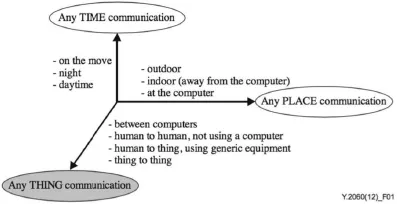
IoT definition. The IoT has been defined as “a global infrastructure for the information society, enabling advanced services by interconnecting (physical and virtual) things based on existing and evolving interoperable informationand communication technologies (ICT)” (Recommendation ITU-T Y.2060, 2012:2). A key aspect of IoT is that it adds an “Any THING” dimension of communication to ICT. This expands opportunities for things and systems to be controlled remotely, but more importantly enables direct – thingthing, human-thing, human-human (non-computer-mediated), thing-computer and computer-computer – interaction while continuing to exploit the existing network infrastructure (fig. 1).
Figure 1.The new dimension introduced in the IoT (Recommendation ITU-T Y.2060, 2012).
All these forms of interactions are driven by data and, at the same time, also produce data that may be processed by advanced systems (using, for example, algorithms) designed to support (or substitute – (Rifkin, 2014)) sophisticated human decision-making processes. Such “cyber-physical systems” – i.e., engineered systems that are built from, and depend on, the seamless integration of computational algorithms and physical components (National Science Foundation, 2016) – include smart firms, smart homes, and even smart cities, and offer enhanced efficiency, efficacy, accuracy, flexibility and economic benefits.
A macro-economic overview of IoT. It has been observed that the IoT reconfigures the communication-energy-logistics circle in such a way that productivity is dramatically increased and marginal costs reduced. Consequently, IoT has the potential to boost a hybrid economy based on both the capitalistic and “Global Collaborative Commons” paradigms (Rifkin, 2014). In particular, Rifkin states that IoT could reconfigure the Communication-Energy-Logistic circle in such a way that the productivity dramatically grows and, at the same time, marginal costs fall down to near zero, in perspective making goods and services priceless, nearly free, and abundant. Shortly, no longer subject to market forces. The new hybrid economy boosted by IoT is seen by Rifkin as based partially on the rules of the capitalistic paradigm (exchange value, financial capital, ownership, consumerist approach, competition), and partially on the new rules of the Global Collaborative Commons (sharing value, social capital, access, sustainability, cooperation) (Rifkin, 2014).
The recent growth in the IoT, privacy issues and further barriers. Even if the term “IoT” has been introduced in the 1995 by Kevin Ashton, a co-founder of the Massachusetts Institute of Technology Auto-ID Center (that created a global standard system for RFID), the IoT has only expanded significantly in the past five years (Rifkin, 2014; Lee & Lee, 2015). Up to 2010, many barriers hindered the growth of IoT, including the cost of sensors (such as tags and chips), gyroscopes and accelerometers, and the limited address space allowed by the IPv4 Internet protocol. However, as the cost of these components has decreased and the IPv4 Internet protocol has been substituted by IPv6, the IoT has seen major expansion. However, a highly critical aspect of the spread of IoT is privacy (Weber, 2010; Sicari et al., 2015).
Research has examined the complex challenges posed by personal security, technical security, and data protection issues, as well as by the current legal and standardization guidelines, all of which continue to slow down the broader diffusion of IoT (Rifkin, 2014; Lee & Lee, 2015; Weber, 2010; Sicari et al., 2015). Policy makers are now developing a common security framework (see AIOTI, launched by the European Commission in 2015).
Finally, two further aspects are currently working against IoT in manufacturing: first, a growing but still limited awareness, both in Italy and elsewhere (Staufen, 2015); second, a limited understanding of the organizational issues raised by IoT.
With regard the first issue, the awareness and/or knowledge of the IoT approach differs among countries. In a general view, it is higher in the German area (where the Industry 4.0 label has been introduced and developed), high in USA (where the same approach is known as Smart Manufacturing) and very low in Italy, as confirmed by a recent research which found that almost 70% of the Italian companies surveyed haven’t started yet initiatives in the Industry 4.0. Only 20% have experienced Industry 4.0 (Staufen, 2015). Not surprisingly, in Italy the departments perceived as most involved are operations and logistics but – more than in Germany – sales are seen as a key application field. Moreover, very high organizational impacts are expected by Italian companies from Industry 4.0: approximately the 70% of companies surveyed expect benefits in areas such as business model, R&D, human resources qualities, improving overall organizational performance (above all quality of service).
In general, these data confirm that, at the moment, in Italy the Industry 4.0 approach is still a relatively new phenomenon, and this may still represent a serious barrier to its diffusion and experimentation. The Italian “Industria 4.0 National Plan” paves the way towards a wider adoption of the Industry 4.0 model by the Italian companies supporting the digitalization of industrial processes, the improvement in workers’ productivity, as well as the development of new skills, new products and new processes (Minister of Economic Development, 2007).
1.3.Exploring the potential of IoT: from data to action, via decisions
IoT technologies help to develop “agile decision-making processes” for descriptive, diagnostic, prescriptive and predictive purposes at three different levels: 1) at the operational level, with a view to running and managing formal procedures; 2) at the continuous improvement level, in terms of designing formal procedures to enhance efficiency, productivity, flexibility, and adaptation; 3) at the organizational development level, with the aim of fostering organizational learning and the development of new business models and markets. The case of DHL provides one of the clearest available examples of these diverse functions of IoT.
An illustrative case study. In Europe as well as in the United States, logistics has been one of the first industries to start experiments on IoT for operations. In this field, the experience of DHL represents a very well-defined case study showing how the organizational structure, systems and processes have to be redesigned in order to unlock the potential embedded in the IoT technologies. DHL has conducted wide-scale experimentation in applying the IoT to its logistics operations. As result, DHL’s most sophisticated operating sites currently apply IoT systems in all three main areas of the logistics value chain: Warehousing, Freight Transportation, and Last-Mile Delivery Operations (DHL & Cisco, 2015). This allows to appreciate, in particular, the cycle descriptive-diagnostic-prescriptive-predictive organizational decision-making process above introduced.
DHL Warehousing Operations and IoT: operation automation and optimization. With regard to Warehousing Operations, DHL has developed an IoT-enabled smart-inventory management system based on pallet or item-level tagging. This involves the use of devices such as RFID, wireless readers that receive, aggregate and send data (gathered from each pallet as it arrives through inbound gateways) to the WMS for processing, as well as cameras attached to warehouse gateways that can also be used for damage detection (by scanning pallets for imperfections). Each movement of a pallet generates a tag transmission report that is sent to the WMS and, in the case of misplacement or compromised temperature / humidity conditions, an automatic alert enables the warehous...
Table of contents
Cover
Half Title
Title Page
Copyright Page
Table of Contents
List of Illustrations
Foreword
Part I OVERVIEW
Part II PRACTICES
Part III LEVERAGES
Part IV COMPETENCIES AND ROLES
Part V INSTITUTIONS
Authors
Trusted by 375,005 students
Access to over 1.5 million titles for a fair monthly price.
Study more efficiently using our study tools.
Frequently asked questions
Yes, you can cancel anytime from the Subscription tab in your account settings on the Perlego website. Your subscription will stay active until the end of your current billing period. Learn how to cancel your subscription
No, books cannot be downloaded as external files, such as PDFs, for use outside of Perlego. However, you can download books within the Perlego app for offline reading on mobile or tablet. Learn how to download books offline
Perlego offers two plans: Essential and Complete
Essential is ideal for learners and professionals who enjoy exploring a wide range of subjects. Access the Essential Library with 800,000+ trusted titles and best-sellers across business, personal growth, and the humanities. Includes unlimited reading time and Standard Read Aloud voice.
Complete: Perfect for advanced learners and researchers needing full, unrestricted access. Unlock 1.5M+ books across hundreds of subjects, including academic and specialized titles. The Complete Plan also includes advanced features like Premium Read Aloud and Research Assistant.
Both plans are available with monthly, semester, or annual billing cycles.
We are an online textbook subscription service, where you can get access to an entire online library for less than the price of a single book per month. With over 1.5 million books across 990+ topics, we’ve got you covered! Learn about our mission
Look out for the read-aloud symbol on your next book to see if you can listen to it. The read-aloud tool reads text aloud for you, highlighting the text as it is being read. You can pause it, speed it up and slow it down. Learn more about Read Aloud
Yes! You can use the Perlego app on both iOS and Android devices to read anytime, anywhere — even offline. Perfect for commutes or when you’re on the go. Please note we cannot support devices running on iOS 13 and Android 7 or earlier. Learn more about using the app
Yes, you can access Human Resource Management and Digitalization by Franca Cantoni, Gianluigi Mangia, Franca Cantoni,Gianluigi Mangia in PDF and/or ePUB format, as well as other popular books in Business & Business generale. We have over 1.5 million books available in our catalogue for you to explore.