This book offers a new account of Freud's work by reading him as the social theorist and philosopher he always aspired to be, and not as the medical scientist he publicly claimed to be. In doing so, the author demonstrates that's Freud's social, moral, and cultural thought constitutes the core of his life's work as a theorist, and is the thread that binds his voluminous writings together: from his earliest essays on the neuroses, to his foundational writings on dreams and sexuality, and to his far-ranging reflections on art, religion, and the dynamics of culture. Returning to the fundamental questions and concerns that animate Freud's work - the nature of evil; the origins of religion, morality, and tradition; and the looming threat of resurgent barbarism - Freud as a Social and Cultural Theorist provides the first systematic re-examination of Freud's social and cultural thought in more than a generation. As such, it will be of interest to social and cultural theorists, social philosophers, intellectual and cultural historians, and those with interests in psychoanalysis and its origins.
eBook - ePub
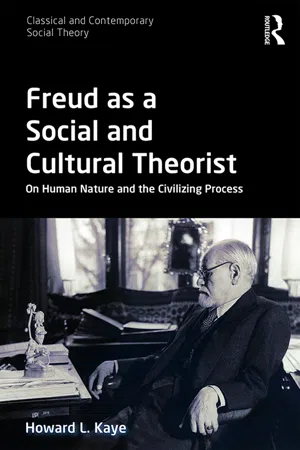
Freud as a Social and Cultural Theorist
On Human Nature and the Civilizing Process
- 238 pages
- English
- ePUB (mobile friendly)
- Available on iOS & Android
eBook - ePub
About this book
Information
1 Was Freud a medical scientist or a social theorist?
… only the idée fixe makes a discoverer of one … Holding fast to the wishes of one’s youth is the only way to lend strength to intention, i.e., as with Schliemann.Freud, undated and unpublished note in Grubrich-Simitis (1996, 126)
The mysterious “Development of the Hero”
Believing himself to be at “the great turning point” of his life, the twenty-nine-year-old Sigmund Freud wrote to his fiancée, Martha Bernays, on April 28, 1885 informing her that he had taken a course of action “which a number of as yet unborn and unfortunate people will one day resent.” The “unborn” to whom this obscure neurologist was referring were, remarkably enough, his future biographers, and the offending action, destined to lead astray all those who would attempt to trace “The Development of the Hero,” was the destruction of “all my notes of the past fourteen years, as well as letters, scientific excerpts, and the manuscripts of my papers.” Suffocating under mounds of scribbling, “like sand drifts round the Sphinx,” he had decided to give the “coup de grâce” to “all my thoughts and feelings about the world in general and about myself in particular” contained in these papers (Letters, 140–141). But why should this simple bit of housekeeping be presented with only the slightest bit of irony as so momentous an event?
Freud’s biographers are fond of quoting from this letter, because it helps to explain the difficulty of their task, while also conveying the remarkable ambition, if not overweening egotism, of their subject. Nevertheless, the question of this letter’s significance for Freud has been largely ignored. What was the nature of this “turning point” in his life? What was the life prior to “our love and my choice of profession” which had “died long ago” and which was now being given “a worthy funeral”? What may have been contained in these lost papers which could account for Freud’s confession that “I couldn’t have matured or died without worrying about who would get hold of these papers” (141)?
Despite Freud’s efforts to bury his past life, sufficient materials from this period have survived to offer some guidance on these matters. At the time of this “funeral,” an aunt of Martha’s had promised money as a wedding present, thereby helping to bring the marriage of the relatively poor, bourgeois couple closer to reality (137). In addition, Freud’s career prospects were improving slowly as he had managed to climb a few more rungs up the Viennese medical hierarchy. Most importantly, his choice of profession had finally been made: the treatment of nervous disorders would provide the income necessary for establishing a family, but “brain anatomy” would win him fame and attract his biographers, because it would enable him, he hoped, to ultimately “solve the riddle of the brain” (137–139, 145).
With so many favorable developments Freud should have been happy, but despite his ardor for Martha and hope for the future there is an unmistakable note of mourning in this letter. His future life is beginning to take shape, yet he complains to his fiancée that he has just endured “a bad, barren month … I do nothing all day; sometimes I browse in Russian history, and now and again I torture the two rabbits …” (140). More than a source of embarrassment, “all my thoughts and feelings about the world in general and about myself in particular,” which had just been laid to rest, were a painful reminder of a cherished life which had to be abandoned in the name of love and necessity, or “Eros and Ananke” as he was later to call them. Yet the mystery remains: what was the substance of this freshly buried life? What would we find if we could sift through its remains, and most importantly, how might it correct our understanding of “The Development of the Hero”? How might it, in fact, modify our understanding of the “Hero’s” work as well?
With this simple act of destruction, Freud managed to obscure the nature of those youthful wishes that were the wellsprings of his work, and the “idée fixe” to which he always held fast. Reducing these earliest products of his deepest intellectual passions to ashes enabled the later Freud to fashion his own mythical “Development of the Hero,” one in which he appeared to be a fearless neurologist and dedicated physician, who simply followed the trail of scientific evidence wherever it led, even into the distant realms of religion, morality, and social psychology. But like all myths, Freud’s gives a distorted and tendentious account of both the origin and the nature of his work, which continues to shape how it is read and misread today. To correct these distortions and to propose a reinterpretation of his vast and sprawling work is the principal aim of this book.
Despite his determination to make the work of his biographers as difficult as possible, Freud permitted himself a few explicitly autobiographical remarks later in life, which point us in the right direction. In his 1927 “Postscript” to The Question of Lay Analysis, Freud confessed:
I have never really been a doctor in the proper sense. I became a doctor through being compelled to deviate from my original purpose; and the triumph of my life lies in my having, after a long and roundabout journey, found my way back to my earliest path … In my youth I felt an overpowering need to understand something of the riddles of the world in which we live and perhaps even to contribute something to their solution.(Freud 1927a, SE20: 253)1
Freud does not elaborate here on the precise nature of these particular riddles which fascinated him as a youth, but in sentences added in 1935 to his Autobiographical Study (1925), he acknowledges that it was the Bible which had first fired his imagination and which, he now realized, had “an enduring effect upon the direction of my interest” in “human concerns” rather than “natural objects” (Freud 1925d, SE20: 8).
Such remarks might strike modern readers, schooled in the “hermeneutics of suspicion,” as retrospective myth-making by a septuagenarian scientist wishing to have his late works on religion and culture, written at a time when he had become scientifically impotent, taken seriously. They are, however, borne out by those letters of his youth and young adulthood which have survived—against his will—particularly those to his school friend Eduard Silberstein, to his friend and colleague, Wilhelm Fliess, and to Martha as well.
Covering the years 1871–1881, Freud’s letters to Silberstein enable us to trace the development of those buried thoughts and feelings which flourished during his late adolescence and early adulthood, as he experienced his first stirrings of love (directed ambiguously towards both the twelve-year-old Gisela Fluss and her mother) and pursued his various intellectual passions with far greater fervor. The letters tantalize us with references to Freud’s youthful poems, diaries, fragments of novels, a cherished “biblical study with modern themes” tragically lost in the mail, an essay on “the teleological argument” for God’s existence for an abortive student journal of philosophy, and a treatise on “the means poets are accustomed to use in matters of love,” as well as commentary and remarks—sometimes jesting, sometimes serious—on a wide range of literary and philosophical figures (FSil, 12, 26, 49–50, 53–54, 89–90, 110–111).2 They also attest to Freud’s surprisingly intense involvement with the Leseverein der deutschen Studenten Wien, a German nationalist organization committed to democratic reform and cultural change, to which Freud belonged throughout his university years, until it was banned in 1878 (FSil, 96–97; Gödde 1991; McGrath 1967, 1986).
In line with his political interests and ambitions, Freud originally planned to study law, like Silberstein and another school friend, the future social scientist and Social Democratic leader Heinrich Braun. With them, and with countless other newly-emancipated Austrian Jews, Freud dreamed of a political career in a liberalizing Austro-Hungarian Empire, but during the spring of 1873, prior to his enrollment at the University of Vienna, he abruptly changed his mind, deciding on biology and medicine instead. In his Autobiographical Study, Freud attributed this sudden shift to the joint action of his exposure to Darwinian ideas, which “strongly attracted me, for they held out hopes of an extraordinary advance in our understanding of the world,” and to his chance attendance at a public reading of “Goethe’s [sic] beautiful essay on Nature read aloud … by Professor Carl Brühl” (Freud 1925d, SE20: 8).
Characteristically, the later Freud avoids clarifying what aspects of the world he hoped to understand through the study of Nature, but his letters to Silberstein, and to his boyhood friend, Emil Fluss, reveal that the shift from the Bible, politics, and law to biology and medicine was not as radical as it may appear to our twenty-first-century eyes. Particularly in the German-speaking world of Freud’s youth, Darwinism, like the mechanistic materialism of Helmholtz, Du Bois-Reymond, and Freud’s revered teacher, Ernst Brücke, was believed to hold the key to understanding human nature and the development of human culture, which were the real foci of Freud’s interests. Not only would materialistic science, and above all biology, provide privileged access to philosophical truth, but it would also serve as the most powerful means both of challenging the philosophical underpinnings of Church and State and, ultimately, of reforming the social and political worlds (Gilman 1993, 225; Gregory 1977; Ritvo 1990, 9–28, 191, 198; Schorske [1973] 1981). What attracted Freud to biology were such topics as “The Sea Squirt and Morality,” the title of another of Brühl’s lectures, and “theism and materialism,” the focus of his studies with the philosopher Franz Brentano, with whom Freud planned to take his Ph.D. in philosophy and zoology (FSil, 46, 95, 101, 104, 109).
In the young Freud’s mind, Brentano, a former Catholic priest who had recently joined the faculty of the University of Vienna, was a “remarkable man … who is, in many respects, an ideal human being” in part because he managed to be both a “believer” and a “Darwinian” (FSil, 95). While Freud’s avowed materialism clashed with, and wavered before his teacher’s theism, he found that they were both adherents “of the empiricist school which applies the method of science to philosophy and psychology in particular” (102). For Freud, only such an approach, which combined “logical and psychological studies,” would make it possible to settle such fundamental philosophical questions as the existence of God, the nature of religion, and the problem of causality (107, 109, 111). Like Feuerbach, the philosopher whose works engrossed Freud at the time and whom he professed to “revere and admire above all other philosophers” (96), Freud became a “Naturforscher,” an “intellectual researcher into nature” and above all, human nature, for essentially philosophical and social ends (Feuerbach, in Gay 1988, 29; Freud, Letter to Emil Fluss, March 17, 1873, in McGrath 1986, 89).
As Freud’s interest in philosophy and psychology grew, his engagement with the political debates of the day appeared to wane. What accounts for this shift is not growing indifference to social problems or an attempt at flight from intolerable political realities, as Carl Schorske ([1973]1981) and William McGrath (1986) have argued, but Freud’s emerging conviction that Social Democratic politics were simply not “revolutionary” enough in “the philosophical and religious spheres,” where he now believed it mattered most (FSil, 96–97, 110). Echoing Brentano’s (1874) recently published Psychology from an Empirical Standpoint, Freud argued that human betterment had to be grounded in truths, philosophically, psychologically, and scientifically established, not in the sort of unthinking dogmatism and popular illusion which dominated the political life of the day (FSil, 96, 109–111; McGrath 1986, 120).
After his third year at the university, Freud abandoned his plan for a double doctorate in philosophy and zoology, as well as his dream of studying for a semester with Helmholtz and Du Bois-Reymond in Berlin. Both now seemed impractical. In addition, his visit to England in the summer of 1875 helped to turn his interests away from German metaphysics and towards English empiricism and to add, at least, temporarily, a practical ideal, “alleviating physical ills”—to his earlier theoretical ones (FSil, 127). Freud’s engagement to Martha Bernays in June 1882 certainly provided an additional incentive to put aside his interest in what Gay (1988, 27) terms “the riddles of mind and culture,”3 but even then, he hesitated to devote himself wholeheartedly to medical practice and research at the expense of his “theoretical” interests. In his letter to Martha on August 16, 1882 he confessed that
Philosophy, which I have always pictured as my goal and refuge in my old age, gains every day in attraction, as do human affairs altogether or any cause to which I could give my devotion at all costs, but the fear of the supreme uncertainty of all political and local matters keeps me from that sphere.(J, III: 41)
After three more years of scientific and personal frustration, Freud finally set about the unpleasant task of preparing himself for medical practice, so that he could afford to marry at last. Thus, the destruction announced on April 28, 1885 may well have marked Freud’s conscious abandonment of his interest in social philosophy and human affairs, sacrificed to love and necessity. Nevertheless, these social theoretical interests reemerged a decade later with the development of psychoanalysis. As Freud’s attempts—with the assistance of his fellow bio-physical reductionist, Wilhelm Fliess—to work out a physiological explanation of the “mental apparatus” in both its normal and pathological functioning repeatedly failed both theoretically and therapeutically, his interest in philosophy and psychology reawakened. Purely psychological explanations, emphasizing mental defenses against emotional conflicts began to compete with, and not simply complement, the desired physiological ones. A final attempt in the Fall of 1895 “to represent psychical processes as quantitatively determined states of specifiable material particles” (Bonaparte et al. 1954, 355), the so called “Project for a Scientific Psychology,” ran aground on what Freud considered “the heart of the riddle,” the problem of “repression” (defense). “What does not yet hang together,” he explained to Fliess, “is not the mechanism—I can be patient about that—but the elucidation of repression, the clinical knowledge of which has in other respects greatly progressed” (FFl, 141).
Finding himself unable to explain physiologically what he was observing clinically, Freud replaced his failed “psychology for neurologists” with a new psychology for clinicians. By doing so, he began to create the psychology for philosophers and social theorists which constitutes the essence of his work. On January 1, 1896, Freud revealed to Fliess that: “I see how, via the detour of medical practice, you are reaching your first ideal of understanding human beings as a physiologist, just as I most secretly nourish the hope of arriving, via the same paths, at my initial goal of philosophy, for that is what I wanted originally when it was not yet at all clear to me to what end I was in the world” (159). With continued progress on his psychology of the neuroses, his “discovery” of the meaning of dreams in 1895, and ultimately, his own self-analysis which followed in the wake of his father’s death in 1896, Freud’s “longing … for philosophical knowledge” was finally being fulfilled (180). His “discovery” of the psychic mechanism of “projection” in the aetiology of paranoia led immediately, in Freud’s mind, to speculations, first about “mass paranoia” and “delusions of betrayal” on the level of nations, and then, as Feuerbach had done, to religion and mythology as well (110, 286). The phenomenon of repression, which initially seemed most plausibly to be derived from morality, now seemed to enable him to “uncover the source of morality” (163–164, 249, 280). Most famously of all, the discovery of hostile wishes against his father and erotic longings for his mother—and the powerful phantasies which they spawned—seemed to open up the whole realm of human culture which he had always longed to conquer (250–252, 272–273). For if such desires and phantasies were not limited to neurotics but constituted a universal experience of human childhood—a plausible assumption given the apparent ubiquity of families—then the structure of works such as Oedipus Rex and Hamlet, their extraordinary emotional power, and their cultural significance became more comprehensible.
The “past life” that Freud attempted to bury a decade earlier was now unearthed with his depth psychological excavations, which ultimately formed the foundation for psychoanalysis. For all of Freud’s later efforts to portray himself publicly as a bio-medical scientist4 and clinician, whose work with individual patients generated a body of ideas and methods which were then “applied” to social phenomena towards the end of his life, the letters of his youth and early adulthood demonstrate otherwise. Secretly holding fast to the wishes of his youth, Freud was, from first to last, a philosopher and social theorist passionately engaged with the great “cultural problems”: the interactions between human nature and culture; the origins and development of religion, morality, and tradition, and the nature of their extraordinary power; the sources of social order and disorder; the direction of ...
Table of contents
- Cover
- Half Title
- Series Page
- Title Page
- Copyright Page
- Table of Contents
- Preface
- Acknowledgements
- Abbreviations
- 1. Was Freud a medical scientist or a social theorist?
- 2. In search of the “royal road”
- 3. The “compelling call” of psychology and the foundational texts of 1899–1905
- 4. Psychoanalysis as cultural critique: From frustrated sexuality to the problem of authority
- 5. Totem and Taboo: The emergence of Freud as a social theorist
- 6. From metapsychology to social psychology
- 7. Death, the uncanny, and the post-war crisis of authority
- 8. The psychology of the ego and the riddles of mind and culture
- 9. The work of culture
- 10. Freud’s testament
- Conclusion: The Freud who endures
- References
- Index
Trusted by 375,005 students
Access to over 1.5 million titles for a fair monthly price.
Study more efficiently using our study tools.
Frequently asked questions
Yes, you can cancel anytime from the Subscription tab in your account settings on the Perlego website. Your subscription will stay active until the end of your current billing period. Learn how to cancel your subscription
No, books cannot be downloaded as external files, such as PDFs, for use outside of Perlego. However, you can download books within the Perlego app for offline reading on mobile or tablet. Learn how to download books offline
Perlego offers two plans: Essential and Complete
- Essential is ideal for learners and professionals who enjoy exploring a wide range of subjects. Access the Essential Library with 800,000+ trusted titles and best-sellers across business, personal growth, and the humanities. Includes unlimited reading time and Standard Read Aloud voice.
- Complete: Perfect for advanced learners and researchers needing full, unrestricted access. Unlock 1.5M+ books across hundreds of subjects, including academic and specialized titles. The Complete Plan also includes advanced features like Premium Read Aloud and Research Assistant.
We are an online textbook subscription service, where you can get access to an entire online library for less than the price of a single book per month. With over 1.5 million books across 990+ topics, we’ve got you covered! Learn about our mission
Look out for the read-aloud symbol on your next book to see if you can listen to it. The read-aloud tool reads text aloud for you, highlighting the text as it is being read. You can pause it, speed it up and slow it down. Learn more about Read Aloud
Yes! You can use the Perlego app on both iOS and Android devices to read anytime, anywhere — even offline. Perfect for commutes or when you’re on the go.
Please note we cannot support devices running on iOS 13 and Android 7 or earlier. Learn more about using the app
Please note we cannot support devices running on iOS 13 and Android 7 or earlier. Learn more about using the app
Yes, you can access Freud as a Social and Cultural Theorist by Howard L. Kaye in PDF and/or ePUB format, as well as other popular books in Social Sciences & Sociology. We have over 1.5 million books available in our catalogue for you to explore.