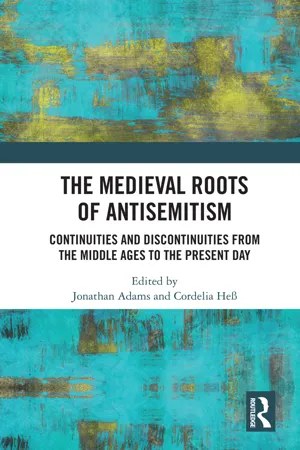
This book presents a fresh approach to the question of the historical continuities and discontinuities of Jew-hatred, juxtaposing chapters dealing with the same phenomenon – one in the pre-modern, one in the modern period. How do the circumstances of interreligious violence differ in pre-Reformation Europe, the modern Muslim world, and the modern Western world? In addition to the diachronic comparison, most chapters deal with the significance of religion for the formation of anti-Jewish stereotypes. The direct dialogue of small-scale studies bridging the chronological gap brings out important nuances: anti-Zionist texts appropriating medieval ritual murder accusations; modern-day pogroms triggered by contemporary events but fuelled by medieval prejudices; and contemporary stickers drawing upon long-inherited knowledge about what a "Jew" looks like. These interconnections, however, differ from the often-assumed straightforward continuities between medieval and modern anti-Jewish hatred. The book brings together many of the most distinguished scholars of this field, creating a unique dialogue between historical periods and academic disciplines.
eBook - ePub
The Medieval Roots of Antisemitism
Continuities and Discontinuities from the Middle Ages to the Present Day
- 474 pages
- English
- ePUB (mobile friendly)
- Available on iOS & Android
eBook - ePub
The Medieval Roots of Antisemitism
Continuities and Discontinuities from the Middle Ages to the Present Day
Part I
Longest Hatred versus Invented Tradition
2 The Medieval (and Ancient) Roots of Antisemitism
Scholars do not hesitate to debate the question of the medieval origins of the modern state or of the nation. Books pour out on these topics, authored by social scientists as well as historians, pressing the reader to keep well in mind the weighty mantle of age worn by nations and states—not least evidenced by the strong and affective, if secular, “religiosity” that nation-states often generate.1 So why do many recent scholars of modern antisemitism dispute the relevance of a “deep” past?
A strictly sociological answer to that question would point to the structure and functioning of the present-day academic profession: getting a job and getting ahead in the contemporary university require constantly renewed specialisation and productivity. They, in their turn, suppose reflexive revisionism of previous viewpoints, regardless of whether said revisions are justified or interesting. Then, too, we need to consider that the human brain does not grow apace with the uncovering of new historical sources and the ongoing production of historiography. We long ago reached a point in antisemitism studies where the amount of material available was overwhelming. The number of books and articles written in this field by intelligent, often brilliant, minds—minds which have come up with complex, original, and controversial thoughts—is disconcerting. It is certainly far greater than in, say, Napoleonic studies where I previously toiled for a decade, or even in nationalism, where I worked for three decades before that. To be obliged to add one’s own mite to Funkenstein, Katz, Yerushalmi, or Nirenberg is intimidating (the more so if one is not Jewish).
But the chief factor at play in the reticence to adduce deep historical causality for modern antisemitism is, I would say, the sticky matter of religion. It is complicated: religion’s multiform afterlife in unbelieving ages; the forms that le religieux may take or that individual religiosity may give rise to; the varieties of so-called secular religions.2 The most summary inquiry quickly shows that what the unsuspecting contemporist might have taken to be a massive block (orthodox defunct religion) is in fact a moving kaleidoscope of shifting forms. No cheerful readiness to concede personal religious tone-deafness gets one off the hook; just because the scholar herself has no background or interest in religion, she cannot with impunity exclude or underplay it in her subject matter.
Nota bene, I do not mean to say that formal topics like “Catholic antisemitism in the Vatican or in the Kaiserreich” is a taboo research topic—far from it. David Kertzer’s and Olaf Blaschke’s works are ready at hand to remind us of the legitimacy of such subjects.3 Rather, I mean that the desirability, still less the necessity, of worrying out the religious inflections and pondering their consequence in hardcore racial-cultural, anticlerical Jew-hatred such as Eugen Dühring’s or Theodor Fritsch’s is not evident, still less congenial, to many scholars. It is easier to take Dühring and Fritsch at their word—i.e., that they are free of any religious motivation and are offering the world an entirely new form of Jew-hatred.
It is easy to do this. All of us, myself included, tend to account for the recent upsurge of antisemitism in Western societies in terms of current geopolitics and immigration trends. It rarely occurs to us that explanations tailored solely in the habiliments of Israeli-Palestinian relations or the problematic presence of numerous Muslim immigrants in modern society pass over in silence the fact that diverse publics intuitively understand the millennial negative meaning attached to the word—the epithet—“Jew” in Christian society. (To the point that “Aryan,” a concept with which we are acquainted, is sufficiently defined as simply the absence of Jewish blood.)
The position that modern antisemitism has no important—indeed, decisive—“back of the store” dimension reminds me of an interview I once conducted, as a young reporter for TIME Magazine, with B.F. Skinner. The task at hand was to elicit from him a clear explication of the new field of psychological behaviourism. “That’s simple,” Dr. Skinner replied (he often found things simple), “it makes no sense—it is quite literally nonsense—to speak of mind and the unconscious when we can neither see nor measure them. Psychology will only be scientific when it concerns itself with the visible, measurable, and duplicable—and that is behavior.”
You see where I am heading: the impulse to reduce modern antisemitism to its racial-economic-socio-political-cultural precipitants and triggers is indisseverable from the impulse to lay out a new academic field for cultivation, different from, and unrelated to, the endless forests of anti-Judaism in theology, literature, philosophy, folklore, and you-name-it. It has the appeal to historians of offering a field permitting archival mastery on a micro-historical basis, studying exempla of anti-Jewish behaviour in given venues and moments—and keeping it there. It frees the practitioner from the need to juggle five or six balls at once—balls from the deep past of the instances at hand, including their social psychology or mentalité, elements of which may be—usually are—unconscious to the actors. And speaking of the actors, this approach permits the contemporary researcher the demarche of collapsing etic and emic points of view (anthropologists call etic the scholar’s view, and emic, the subject’s, or as historians say, “the contemporary’s,” view). For it is well known that the antisemites themselves indignantly rejected any suggestion that they sprang from a Jesse’s stem of eternal hatred of the Christ-killers.4 To take them at their word reassures the scholar he has “something new” at hand, but this does not relieve him of the need for dubiety as to the complexity of his subjects’ political motivations or the frailty and superficiality of their self-understanding.
Let it be said, however: a great deal has been accomplished via the positivist archival approach. Brick upon brick, recent historiography, particularly that coming out of the Centre for the Study of Antisemitism (Zentrum für Antisemitismusforschung) in Berlin, has constructed an impressive wall of scholarship which establishes for the 1870–1914 era the birth of a “new kind of hostility against the Jews,” enfleshed in social-political movements: antisemitism-as-a-counter-culture, located not only (familiarly) in Germany and Austria-Hungary, but nearly simultaneously in related movements in much of the rest of Europe (Bulgaria, Romania, Russia, etc.), including even the French Republic before Drumont. While we may not go so far as to claim that antisemitism is an intellectually worked-out ideology in the same way socialism, anarcho-syndicalism, political Catholicism or the myriad of irredentist-nationality movements in the Danubian monarchy are, thanks to the centre we do now see it as a discrete political movement.5 We may now claim for antisemitism something like the sorts of discrete and complex social embodiments that we have long associated with socialism, anarcho-syndicalism, political Catholicism, or the myriad irredentist-nationality movements in the Danubian monarchy. It is a splendid accomplishment.6
So, what is the problem, you ask. Well, here is an example of one. Three of the most productive of recent scholars write as follows about the specific social contexts that gave rise to “exclusionary violence”—the term now used to refer to violence against Jews. “The analytical problem,” note Messrs Hoffmann, Bergmann, and Walser Smith, in the Introduction to a valuable volume of recent essays, “is to explain why antisemitic violence, and not something else, constituted a popular response to problems extraneous to Christian-Jewish relations.” The answer, they assert, cannot be the pre-existence of a long-term anti-Jewish discourse, for a carte blanche appeal to “the longest hatred” of antisemitism
does not tell us why Christians, now in this context, now in another, appropriated a persecutory discourse directed against a minority rather than, say, a discourse about the abuses of rulers or about the inequalities of class … [A]n explanation that focuses on the “structure of belief” or a “cognitive model” tells us little about the specific uses for which historical agents employed, and thus changed, vocabularies of hatred.7
True, a generalised “social imaginary,” such as that which David Nirenberg has excavated for Western anti-Judaism,8 does not tell us anything about the onset of specific instances of hatred in a given situation—any more than a general theory of class conflict can account for the outbreak of revolution in Mexico in 1910 or in Russia in 1917. This is not because the social imaginary or a general theory are irrelevant, but rather because the preconditions of events are not of the same explanatory order as an event’s precipitants; and they, in turn, are not its triggers. Cause in human history, as befitting human beings, is a complex matter and cannot be reduced to Skinnerian behavioural models, much as it would be simpler to account for if it could be.9 Unhappily for the already overburdened historian, mind—including the unconscious, both individual and collective—often plays as decisive, if subtler, a role in determining events as does immediate behaviour.
Specifically, to return to the case of anti-Jewish riots, the usual concatenation of issues associated with violence—discursive deployments by antisemitic actors in specific movements pushing tailored agendas, provoking riots—does not, for all that, cover the task of explaining what is going on. Richard S. Levy, in the very volume in which the editorial trio’s remarks appear, draws a perturbing conclusion. What emerges from these collected essays, Levy notes, is “that the precise role of antisemitic ideology in the violence becomes problematical. Was it causal or a casual accompaniment?”10 “Casual accompaniment”? If it is merely that, then what is the more dispositive explanatory factor than immediate provocation, conflict, opportunity, etc.? Does “structure of belief” sneak in through the back door, affecting overt behaviour in profounder ways than the precipitants and triggers? No one is maintaining that an ancient social imaginary of anti-Judaism is alone the determinant of, say, the Neustettin riots of 1881, via some kind of longue durée black magic, but the most archival-prone, present-minded scholar cannot fail to be aware of influencing elements that are unbeknownst to the carriers and other actors he is studying.
Scholars of modern antisemitism conclude that anti-Jewish violence is best limed as the expression of resentment and rage on the part of an aggrieved population which feels that its traditional and legitimate “moral economy” (to use E.P. Thompson’s concept)11 has been violated by the arrival or, more likely, by the promotion, of Jews in some evident social, economic, political way. In worst case scenarios, the moral economy is seen to have been violated by the guardians of the State itself, who are accused of being in cahoots with “the Jew,” of having been corrupted by him, of having been “Jewified” or “Judaised.”
We may ask—we indeed must ask: just what is thi...
Table of contents
- Cover
- Title
- Copyright
- Contents
- List of Figures
- Acknowledgments
- Introduction
- Part I Longest Hatred versus Invented Tradition
- Part II Antisemitism without Jews
- Part III Christianity and Antisemitism
- Part IV Islam and Antisemitism
- Part V Bodies, Gender, and Antisemitism
- Part VI Blood Libel and Ritual Murder Allegations
- Part VII Neighbours
- Part VIII Economy and Finance
- Part IX Land and Home
- Part X Medieval Roots and Anti-Judaism
- Contributors
- Index
Trusted by 375,005 students
Access to over 1.5 million titles for a fair monthly price.
Study more efficiently using our study tools.
Frequently asked questions
Yes, you can cancel anytime from the Subscription tab in your account settings on the Perlego website. Your subscription will stay active until the end of your current billing period. Learn how to cancel your subscription
No, books cannot be downloaded as external files, such as PDFs, for use outside of Perlego. However, you can download books within the Perlego app for offline reading on mobile or tablet. Learn how to download books offline
Perlego offers two plans: Essential and Complete
- Essential is ideal for learners and professionals who enjoy exploring a wide range of subjects. Access the Essential Library with 800,000+ trusted titles and best-sellers across business, personal growth, and the humanities. Includes unlimited reading time and Standard Read Aloud voice.
- Complete: Perfect for advanced learners and researchers needing full, unrestricted access. Unlock 1.5M+ books across hundreds of subjects, including academic and specialized titles. The Complete Plan also includes advanced features like Premium Read Aloud and Research Assistant.
We are an online textbook subscription service, where you can get access to an entire online library for less than the price of a single book per month. With over 1.5 million books across 990+ topics, we’ve got you covered! Learn about our mission
Look out for the read-aloud symbol on your next book to see if you can listen to it. The read-aloud tool reads text aloud for you, highlighting the text as it is being read. You can pause it, speed it up and slow it down. Learn more about Read Aloud
Yes! You can use the Perlego app on both iOS and Android devices to read anytime, anywhere — even offline. Perfect for commutes or when you’re on the go.
Please note we cannot support devices running on iOS 13 and Android 7 or earlier. Learn more about using the app
Please note we cannot support devices running on iOS 13 and Android 7 or earlier. Learn more about using the app
Yes, you can access The Medieval Roots of Antisemitism by Jonathan Adams, Cordelia Heß, Jonathan Adams,Cordelia Heß in PDF and/or ePUB format, as well as other popular books in History & World History. We have over 1.5 million books available in our catalogue for you to explore.