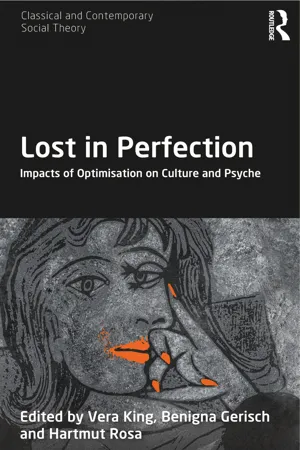
The permanent struggle for optimisation can be seen as one of the most significant cultural principles of contemporary Western societies: the demand for improved performance and efficiency as well as the pursuit of self-improvement are con-sidered necessary in order to keep pace with an accelerated, competitive modern-ity. This affects not only work and education, but also family life, parent–child relationships and intimate relationships in respect to the body and the self, in regard to the public as well as the private realm. Bringing together contributions from renowned scholars from the fields of sociology, psychology and psycho-analysis, this book explores the impacts of optimisation on culture and psyche, examining the contradictions and limitations of optimisation, in conjunction with the effects of social transformations on individuals and shifts in regard to the meaning of 'pathology' and 'normality'.
eBook - ePub
Lost in Perfection
Impacts of Optimisation on Culture and Psyche
- 198 pages
- English
- ePUB (mobile friendly)
- Available on iOS & Android
eBook - ePub
Lost in Perfection
Impacts of Optimisation on Culture and Psyche
About this book
Information
Part I
Optimisation in economy and working life
1 Optimisation in a context of financialisation
Eve Chiapello
Introduction
My reflections on the importance and role of the concept of optimisation in our society will start from a conventionalist viewpoint, taking a particular interest in the calculation operations required for optimisation and the associated conventions used, especially for quantification (Diaz-Bone and Salais 2011; Diaz-Bone and Didier 2016).1 Optimisation is originally a branch of mathematics and computer science that seeks to model, analyse and solve problems analytically or numerically. Its aim is to determine which solution(s) will satisfy a quantified objective under certain constraints. I, therefore, seek to understand and decode the content of optimisation techniques. The concept of the convention draws attention to the many choices made to produce an optimisation technique. These choices consist of setting conventions: conventions for valuation, classification, calculation, for example. Every single operation is marked by the seal of some partly arbitrary choice between several possible options. Other choices could have been made, other conventions selected. Optimisation is indeed a quest that may take various forms. It all depends on what is being optimised and the kind of modelling adopted. I also consider that quantification systems have a history and that it is possible to sketch out that history by identifying some major turning points in our calculation methods. Desrosières (2003), for example, analyses the relationships between conceptualisations of the state’s role in economic affairs and certain statistical tools.2 I consider that forms of optimisation evolve in response to changes in capitalism.
The contemporary stage of capitalism is characterised by financialisation, and this context triggers the rise of a special kind of optimisation, one that uses calculative methods deriving from financial economics. One of the aims of this chapter is to grasp the assumptions that are embedded in these financial calculations, and therefore understand what they are leading us to optimise today. I shall begin by giving a closer definition of the terms of reflection, i.e. an advance identification of what the concept of optimisation carries with it, in any of its variable historic forms. I shall also set out a definition of financialisation. The conclusions that can be drawn from these initial considerations will enable us to understand the specific current forms of optimisation in a context of financialised capitalism and its consequences.
Optimisation
First, optimisation should be considered as a special pattern of rationalisation, in the Weberian sense. We know that in Economy and Society Max Weber differentiates various forms of rationality and rationalisation (Kalberg 1980), and concerning economic action, the main differentiation is between formal and substantive rationality. Optimisation clearly relates to formal rationality, whose specificity is that it can be founded on the implementation of numerical calculations,3 although these calculations can take different forms. As Weber says, ‘[it] is quite independent of the technical form these calculations take, particularly whether estimates are expressed in money or in kind’ (Weber 1978: 85). Weber then devotes several pages to discussing monetary calculation – which itself comprises budgetary and capital accounting – and calculation in kind. He argues that although capitalism means monetary calculation, particularly capital accounting, capitalist firms are still concerned by budgetary accounting and calculation in kind.4
I consider that the concept of optimisation, like the concept of formal rationality does not in principle predetermine the type of calculation we take as our foundation.
The specificity of the calculation of optimisation is that it aims to consider quantified objectives in relation to constraints, for instance concerning resources affecting the achievement of those objectives. Strictly speaking, there is no optimisation if there are no constraints or no contradictions between objectives. The aim of optimisation is to draw the greatest benefit from the constraints that are recognised as relevant to the calculation, whether those constraints concern budget, time, energy or anticipated negative effects. Calculating optimisation requires a convention-based definition of what is to be maximised, and under what type of constraints. If the constraints or objectives are changed, the result of the calculation changes. The purpose is to make the best use of what we have, find the best balance between contradictory aims (e.g. producing the greatest possible output, while remaining below a certain level of pollution).
Optimisation is rooted in the ordinary idea that resources (natural resources, time, space, money, energy, etc.) are limited, or that it is not possible to ‘win’ on every aspect. For example, it is impossible to have a car that is very fast, very safe and very economical in energy use. The faster you drive, the deadlier any accidents, and the higher the petrol consumption. The work of optimisation intervenes in this relationship of conflicting objectives. The aim is to have more of everything while acknowledging the constraints: using a little less petrol, or increasing safety for the same speed of travel.
Adopting the categories defined by Freud (Freud 1920), it could be said that optimising is a way to acknowledge that the pleasure principle must be filtered by the reality principle, with the optimisation calculation proposing a way to maximise pleasure while respecting the constraints of reality. At this point too, Weber’s analyses can be useful. In The Protestant Ethic and the Spirit of Capitalism, Weber (2005) considers that although the desire for money (auri sacra fames, the accursed greed for gold) is arguably functional for capitalism, this desire is not the distinguishing feature of capitalism: that feature lies instead in the rationalisation process that imposes moderation on the modern economic being, rather than allowing him to fully indulge his passion for lucre.5 Optimisation thus covers the various processes that enable rational consideration of conflicts between desires and maximisation of objectives under the constraint of reality.
Optimising is also the chosen way to push the boundaries of an unfortunately finite world, to make the most of a situation. Optimising is following the precepts of a very special ‘reasonableness’, adapted for a world oriented towards growth and accumulation, in which the aim of maximising profit is legitimate. The reasonable response is not to stop seeking the maximum, but to acknowledge the constraints and contradictions and seek a local optimum, making marginal savings. Efficiency is the cardinal value in this process, with effectiveness second.
One last feature of optimisation should be mentioned. Optimisation requires an ability to model the system we want to optimise and present it as a system of mathematical relationships between variables. This modelling work is guided by a mainly mechanical analogy. Taylor’s management method is certainly the most remarkable form of the optimisation project applied to a social system. For Taylor, mechanistic modelling does not only apply to the technical object; it governs the organisation of labour and human relations. The aim is to find the ‘one best way’, i.e. the optimum for the system modelled. Over the past century, criticism of Taylorism has amply demonstrated the prerequisites, limitations and drawbacks of this approach when it is extended to the organisation of people. The mechanistic imagination can lead to a considerable loss of efficiency when it produces formal rules and bureaucracy. Simon (1947) also notes that no perfectly rational decision can be made about the future in an open system, because it is impossible to predict all the scenarios and all the interactions; rationality is necessarily bounded, and only ‘satisficing decisions’ exist.
Understanding the ideas embedded in the concept of optimisation thus enables us to identify some limitations, even at this early stage. First of all, regarding the aim of maximisation, optimisation is not the only way to push the boundaries of what is possible and get more. For material questions, the first alternative is innovation: disruptive inventions, particularly of a technological nature, that bring about change in the coordinates of the problem and push meticulous calculations and the search for marginal savings or gains into second place. Innovation involves trying to eliminate the nuisance of modelling the system framing the possibilities. The second method is violent appropriation: war, theft, primitive appropriation of capital. The reality principle is thus expressed twice in optimisation: a reality of the frame of knowledge, notably technical knowledge, and the reality of the frame of legal relationships, where only methods that are peaceful in form are allowed.
Finally, concerning social organisation, in line with Organisation Theory research on the limitations of rational organisation and mathematical modelling for social systems, it appears that once the bounded nature of rationality and the uncertainty inherent to action and situations are acknowledged, there are many other methods apart from optimisation to balance opposites and seek to get the best out of situations. These alternative methods relate to management, in a sense that goes well beyond a formal-rationality calculation-based search for effectiveness, and encompasses learning processes, progress by trial and error, political compromise-building processes, routinised choices,6 and more.
I now turn to the question of the current phase of capitalism in the West, and the financialisation that characterises it.
Financialisation
The concept of financialisation has been used for slightly over a decade to designate a collection of changes in our economic system that began to emerge in the 1970s and have been accelerating since the late 1990s (Van der Zwan 2014; Boyer 2009; Erturk et al. 2008; Epstein 2005; Krippner 2005). The term has been used to describe changes in the governance of large firms subject to demand for shareholder returns (Aglietta and Rébérioux 2005), the growing capture of resources at macro-economic level by providers of capital, to the detriment of labour (Duménil and Lévy 2001), a growth in financial activities by non-financial firms (Baud and Durand 2012), changes in the forms of government financing with a rise in indebtedness on the financial markets (Streeck 2014; Lemoine 2016), increasing numbers of savings products for households, faster accumulation of wealth for people working directly or indirectly for the financial sector (Godechot 2012; Lin and Tomaskovic-Devey 2013), and so on. All this research emphasises the rising power of actors in finance who manage and handle money professionally and act (mainly, but not exclusively) on the financial markets. They all take an approach to financialisation that I call ‘externalist’, stressing the role and power of financial actors, i.e. mainly the asset management industry and all categories of investment funds. These are the actors that keep the financial markets in operation and organise a financing circuit for the economy in which they play the leading role, collecting savings and investing in the purchase of various types of asset.
Rather than concentrating on the financial actors themselves, according to my conventionalist approach, I propose a slight shift in focus, towards the socio-technical arrangements that enable financial actors to operate, the forms of knowledge and know-how they use in these operations, and the techniques – primarily financial and legal – in which they are experts and on which their legitimacy is founded. This approach focuses on the techniques, management instruments, devices and instruments (Lascoumes and Le Gales 2004; Chiapello and Gilbert 2013, 2016) that equip the action, have a substantial influence on situations, and partly escape the underlying intentions and aims.
Financialisation in the ‘internalist’ sense can be seen as a ‘colonization’ of situations by ‘financialized’ forms of reasoning and calculation (Chiapello 2015). It is reflected in the spread of a financialised technical culture that tends to see everything from the point of view of an investor. I proposed a first description of this financialisation based on three identified conventions of valuation that are specific to financial methods (Chiapello and Walter 2016): (1) the actuarial convention, which uses discounting to present value; (2) the mean-variance convention central to portfolio management techniques which considers that any value can be expressed in terms of expectation (returns) and standard deviation (‘risk’); (3) the market-consistent convention which identifies value with market price.
In this view, money should be invested in order to generate more money, a financial return for the investor, and the activity (the goods produced and sold) that makes financial growth possible is only a means to greater wealth. It is only worth buying a thing, or investing in it, if it produces future revenues that are higher than the amount invested, if it can be considered as ‘capital’. This point of view is capitalist, as described in Marx’s (1990: ch. IV) formula M-C-M. The capitalist (here, the investor) is the person who bears the risk of the circulation of capital (investment) to recover the gain (the return); he analyses any outlay as an investment, associated with an expected return and a risk. This culture carries embedded forms of valuation, calculation methods and decision-making rules, and it is possible to trace the adoption and incorporation of these formats and ways of thinking into new socio-technical arrangements in a very diverse range of sectors (Chiapello 2015).
One important point of this argument is that financial techniques are optimisation techniques in their own right, and financial textbooks are full of the vocabulary of optimisation. For example, calculation of present values using actuarial methods is presented as a way to optimise decisions in time. The portfolio models require fund managers to build up their portfolio using optimisation based on modelling that takes each security’s risk and return into consideration. Also, financial models are founded on very strong assumptions of agent rationality and market efficiency. Even though an emergent stream of finance research is paying required attention to the bounded rationality of actors, most of the financial models used either aim to endow agents with calculation abilities that enable them to strive for perfect rationality, or in order to assert their validity assume that agents have perfect rationality.
The world of financial calculation techniques is thus a world where the aim of calculatory optimisation has continued to spread without really being affected by the criticisms mentioned earlier. And one highly specific form of optimisation is dominant, based on the form of calculation that Weber associated with capital accounting. Not only has the calculation in kind been sidelined but so have other forms of monetary calculation, for example, budgetary accounting.7
The current period, marked by financialisation, is accompanied by a rise in the number and power of actors that handle and reason with these systems. More broadly, these forms of thought and action are being instilled into (social, cultural, educational and other) actors whose forms of thought and action were traditionally very different from the financial framework. It is also possible to show that many public policies concerning all sorts of issues are being rewritten according to financialised modes of reasoning.
Every period of capitalism can arguably be described partly through the forms of optimisation (type of modelling, type of data, etc.) used by the actors, and their extension (to certain types of subject and problem). This financialised period of c...
Table of contents
- Cover
- Title
- Copyright
- Contents
- Notes on contributors
- Introduction: 'lost in perfection' — ideals and performances
- PART I Optimisation in economy and working life
- PART II Changes in intersubjectivity — pathologies of the social
- PART III The optimised self
- PART IV Optimisation of the body
- Conclusions
- Index
Trusted by 375,005 students
Access to over 1.5 million titles for a fair monthly price.
Study more efficiently using our study tools.
Frequently asked questions
Yes, you can cancel anytime from the Subscription tab in your account settings on the Perlego website. Your subscription will stay active until the end of your current billing period. Learn how to cancel your subscription
No, books cannot be downloaded as external files, such as PDFs, for use outside of Perlego. However, you can download books within the Perlego app for offline reading on mobile or tablet. Learn how to download books offline
Perlego offers two plans: Essential and Complete
- Essential is ideal for learners and professionals who enjoy exploring a wide range of subjects. Access the Essential Library with 800,000+ trusted titles and best-sellers across business, personal growth, and the humanities. Includes unlimited reading time and Standard Read Aloud voice.
- Complete: Perfect for advanced learners and researchers needing full, unrestricted access. Unlock 1.5M+ books across hundreds of subjects, including academic and specialized titles. The Complete Plan also includes advanced features like Premium Read Aloud and Research Assistant.
We are an online textbook subscription service, where you can get access to an entire online library for less than the price of a single book per month. With over 1.5 million books across 990+ topics, we’ve got you covered! Learn about our mission
Look out for the read-aloud symbol on your next book to see if you can listen to it. The read-aloud tool reads text aloud for you, highlighting the text as it is being read. You can pause it, speed it up and slow it down. Learn more about Read Aloud
Yes! You can use the Perlego app on both iOS and Android devices to read anytime, anywhere — even offline. Perfect for commutes or when you’re on the go.
Please note we cannot support devices running on iOS 13 and Android 7 or earlier. Learn more about using the app
Please note we cannot support devices running on iOS 13 and Android 7 or earlier. Learn more about using the app
Yes, you can access Lost in Perfection by Vera King, Benigna Gerisch, Hartmut Rosa, Vera King,Benigna Gerisch,Hartmut Rosa in PDF and/or ePUB format, as well as other popular books in Social Sciences & Sociology. We have over 1.5 million books available in our catalogue for you to explore.