Relations between Western nations and their colonial subjects changed dramatically in the second half of the twentieth century. As nearly all of the West's colonies gained their independence by 1975, attitudes toward colonialism in the West also changed, and terms such as empire and colonialism, once used with pride, became strongly negative. While colonialism has become discredited, precisely when or how that happened remains unclear. This book explores changing Western attitudes toward colonialism and decolonization by analyzing American, British, and French popular cinema and its reception from 1960 to 1973.
eBook - ePub
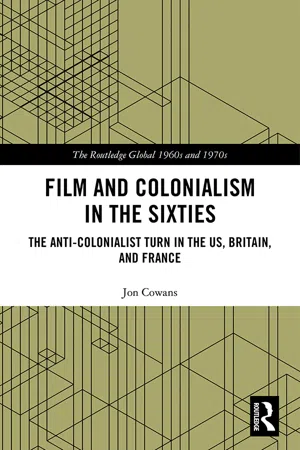
Film and Colonialism in the Sixties
The Anti-Colonialist Turn in the US, Britain, and France
- 292 pages
- English
- ePUB (mobile friendly)
- Available on iOS & Android
eBook - ePub
Film and Colonialism in the Sixties
The Anti-Colonialist Turn in the US, Britain, and France
Part I
Introduction
No decade has attracted more attention or debate than the 1960s. To some it was a period of cultural and political ferment, striking artistic creativity, and lasting achievements in social justice. Skeptics fall into opposing political camps: on the far left, hopes for revolution ended in disappointment, yielding bitter judgments about state repression and missed opportunities; conservatives deride an era of social indiscipline and violence, mindless hedonism, and radicalism. A fourth view questions the decade’s importance, maintaining that few people took part in protest movements and that little real change occurred.1
Periodizing the 1960s has proven difficult.2 Rejecting as artificial the study of the “calendar” 1960s, Arthur Marwick examines the years from 1958 to 1974, while others start in 1963, with the assassination of President John F. Kennedy and the advent of Beatlemania. For the end of the period, some favor 1973, a year that saw America’s exit from Vietnam and the beginning of the oil crisis and economic downturn. What follows is a brief account of some key events and trends in the United States, Britain, and France from 1960 to 1966.
The United States
Among the many aspects of 1950s America that persisted into the 1960s was what historians call a “liberal consensus,” a nearly universal preference for defending capitalism and democracy from Soviet expansion.3 Deep divisions persisted, most notably on race relations, but differences between Democrats and Republicans on many issues were often modest compared to the polarization that would emerge later in the decade. Even the hard-fought Kennedy–Nixon presidential campaign of 1960 did not shatter that fundamental consensus.
The prosperity of the 1950s also continued into the 1960s, fueling Kennedy-era optimism. The young, telegenic president’s inspiring rhetoric about new frontiers made ambitious goals seem reachable, and he oversaw a flurry of new legislation. A policy of maximizing economic growth underlay this pursuit of progress, and Kennedy’s successor, Lyndon Johnson, called for an “all-out war on human poverty” and a “Great Society.”4 Such ambitiousness helped secure a range of achievements, even if it also generated the hubris revealed in Vietnam.
The early 1960s saw a shift from conformism and social conservatism to increasing freedom and rebelliousness, especially among the young. Supreme Court decisions in 1962 and 1963 ending prayer in public schools were part of a trend toward the secularization of the public sphere, while surveys indicated declining religious belief and practice, particularly among young people.5 The popularity of rock music, the advent of new fashions and hairstyles, and increasing recreational and spiritual drug use indicated changes in young people’s outlooks. Bob Dylan famously captured the Zeitgeist in his 1964 record, “The Times They Are A-Changin’.”
Exemplifying a trend toward greater liberty were the Free Speech movement at the University of California at Berkeley in 1964 and legal rulings weakening censorship and obscenity laws. Kennedy’s willingness to cross American Legion picket lines in 1961 to view Spartacus – for which blacklisted screenwriter Dalton Trumbo received a screen credit – helped close the HUAC era in Hollywood. Technology played its part, as cars brought greater freedom and as television, radio, records, magazines, and cinema all spread awareness of change.
The civil rights movement entered a new phase in the early 1960s as protestors adopted increasingly assertive tactics, including sit-ins in Greensboro, North Carolina in 1960, the Freedom Rides in 1961, the March on Washington in 1963, and the 1964 Freedom Summer voter registration campaign. Passage of the Civil Rights Act of 1964 and Voting Rights Act of 1965 did not prevent growing generational and racial tensions, and by 1966, members of the Student Nonviolent Coordinating Committee (SNCC) were growing disillusioned with persistent inequality and strategies of nonviolence.6 A police shooting of a black youth in Harlem in July 1964 touched off riots, which recurred each summer over the next few years. Expressing the new radicalism was Malcolm X’s 1964 call to act “by any means necessary.”
These years were also important for Latinos. In 1962, Cesar Chavez and Dolores Huerta founded the National Farm Workers Association, which organized a series of strikes. Inspired in part by black civil rights campaigns, Mexican Americans, Puerto Ricans, and other Latinos organized and mobilized.7 So did left-wing college students, in groups such as the Students for a Democratic Society, founded in 1960. If activists did not represent the outlooks of most Americans, they voiced the demands of a growing minority.
As Cold War paranoia abated in the early 1960s, American culture produced works unimaginable a decade earlier, including Joseph Heller’s anti-war novel Catch-22 (1961) and satirical films such as The Manchurian Candidate (1962) and Dr. Strangelove (1964).8 Yet anti-communism remained potent, and the 1960 presidential election featured two determined Cold Warriors. Part of Kennedy’s appeal lay in his pleas for activism and commitment, which drew volunteers to groups from the Peace Corps to the Green Berets.9
Complicating American efforts in the Cold War was decolonization in Asia and Africa. Soviet Premier Nikita Khrushchev’s 1961 promise to spread Communism by backing “national liberation wars” in the Third World proved no idle threat.10 Washington, watching frustrated nationalists in the Third World gravitate toward the Soviets and Chinese, considered the European colonies an irritant. Unfortunately, Washington’s attempts to ingratiate itself with Third World leaders in the Suez Crisis of 1956 and in Algeria’s independence struggle angered its Cold War allies in Europe.11 Secretary of State John Foster Dulles had described the dilemma in 1954 as “walking a tightrope” and both Kennedy and Johnson carried on the high-wire act.12 Washington, viewing Communism as the greater evil, backed the invasion of Cuba at the Bay of Pigs in 1961 and invaded the Dominican Republic in 1965 to defeat rebels suspected of ties to Cuba. Polls showing strong support for Johnson’s invasion of the Dominican Republic indicated that the basic Cold War consensus endured as late as 1965.
The crisis in Vietnam, a low priority for Kennedy at first, deepened with a September 1961 offensive by the Communist-backed National Liberation Front (NLF) against the U.S.-backed regime in South Vietnam.13 Most Americans still paid little attention to Vietnam during Kennedy’s presidency, in part because Kennedy concealed the extent of U.S. involvement.14 Such deception continued throughout the war, from false reports about an incident in the Gulf of Tonkin in 1964 that allowed President Johnson to secure Congressional support, to exaggerated enemy body counts and claims of impending victory. These deceptions suggested leaders’ doubts about people’s willingness to “pay any price” to defend liberty, and as reporting from Vietnam gradually revealed a “credibility gap,” Americans’ trust in their leaders eroded.
A common thread running through social and political movements in the 1960s was a belief in equality, so a war waged against a largely peasant society struck some as unjust. Although polls showed majority support for the war in these years, America’s lack of historical ties to Vietnam or urgent interests there combined with American sympathies for national self-determination to limit popular commitment to the war. Because America’s entire strategy depended on a stable, legitimate South Vietnam that could defend itself, that regime’s evident flaws prevented an American departure. Washington’s relationship with Saigon stood somewhere between informal empire and conventional colonialism, and as Americans increasingly ran the war effort, South Vietnam’s independence seemed dubious. Ambassador Maxwell Taylor warned in March 1965 that escalation would “lead more South Vietnamese to accept the Communist line that U.S. colonialism is replacing French,” and some Vietnamese reportedly referred to the U.S. Ambassador in Saigon as the “Governor General.”15 News images such as an August 1965 CBS News program showing GIs burning a Vietnamese village did not yet undermine majority support for the war, but anti-war sentiment was growing.
Britain
Britain also entered the 1960s enjoying basic political consensus as the Conservatives, in power since 1951, largely shared Labour’s commitment to the welfare state.16 Still grappling with a decline from its status as the world’s greatest empire, industrial power, and financial center, Britain endured budget and currency crises and the 1963 rejection of its bid to join the European Economic Community (EEC). Despite general prosperity, Britain seemed to be lagging behind competitors, while crime and other social ills were rising.17 “What Is Wrong with Britain?” asked journalists and scholars, reflecting a national mood of demoralization and self-criticism.18 This mood, combined with scandals involving Conservative Party figures, helped Labour return to power in a close election in 1964. Although Harold Wilson’s plans for a “New Britain” foundered amid economic problems, he was re-elected in 1966 with a larger majority.19 New movements such as the Campaign for Nuclear Disarmament and the Vietnam Solidarity Campaign invigorated the left at a time of growing resentment toward traditional elites.20
Underlying this modest leftward movement were fundamental changes in British society and culture. Even more than in the United States, secularization was advancing.21 Scholars have noted secularization’s effects on attitudes toward imperialism and the values underpinning it, including duty, loyalty, patriotism, and self-sacrifice; 1960 saw the end of the National Service program instituted in 1948.22 Though politically free, Britain remained socially traditional and hierarchical.23 An educational system reformed in 1944 to bring greater equality and fairness in fact perpetuated class hierarchies, as exams channeled students into different kinds of secondary schools.24 Social conservatism appeared in government censorship of books and films, in corporal punishment in the schools, in rules against girls playing football after puberty, and in the denial of birth-control pills to single women.25
Greater permissiveness appeared in the legalization of gambling in 1960, diminishing censorship (following a 1960 obscenity case), and increasing divorce and illegitimacy.26 Despite persistent pockets of poverty, many workers enjoyed rising living standards.27 Wartime austerity was finally over, and with money in their pockets, British youth showed a vitality and rebelliousness captured by The Who’s “My Generation” (1965). Nationalists still decried American cultural imperialism, but international attention to “Swinging London” and its trend-setting fashions and nightlife helped restore national confidence.
One issue gaining attention was immigration by people of color, a by-product of decolonization. Britain had long had a small population of color, and despite perceptions that racism was an American problem, surveys in the 1950s indicated considerable racism, while discrimination was common in employment and housing.28 Hostility toward people of color born in Britain reflected a tendency to equate Britishness with whiteness.29 Immigration from the empire had been growing since the late 1940s, and despite claims of a divide between liberal elites and a racist populace, British leaders quietly promoted fears of colored immigration.30 When a scuffle over an interracial couple in a pub in Nottingham in 1958 escalated into “riots” (actually whites attacking blacks), and when the violence spread to London’s Notting Hill section, it became clear that B...
Table of contents
- Cover
- Half Title
- Series Page
- Title Page
- Copyright Page
- Table of Contents
- Introduction
- Part I
- Part II
- Conclusion
- Works cited
- Index
Trusted by 375,005 students
Access to over 1.5 million titles for a fair monthly price.
Study more efficiently using our study tools.
Frequently asked questions
Yes, you can cancel anytime from the Subscription tab in your account settings on the Perlego website. Your subscription will stay active until the end of your current billing period. Learn how to cancel your subscription
No, books cannot be downloaded as external files, such as PDFs, for use outside of Perlego. However, you can download books within the Perlego app for offline reading on mobile or tablet. Learn how to download books offline
Perlego offers two plans: Essential and Complete
- Essential is ideal for learners and professionals who enjoy exploring a wide range of subjects. Access the Essential Library with 800,000+ trusted titles and best-sellers across business, personal growth, and the humanities. Includes unlimited reading time and Standard Read Aloud voice.
- Complete: Perfect for advanced learners and researchers needing full, unrestricted access. Unlock 1.5M+ books across hundreds of subjects, including academic and specialized titles. The Complete Plan also includes advanced features like Premium Read Aloud and Research Assistant.
We are an online textbook subscription service, where you can get access to an entire online library for less than the price of a single book per month. With over 1.5 million books across 990+ topics, we’ve got you covered! Learn about our mission
Look out for the read-aloud symbol on your next book to see if you can listen to it. The read-aloud tool reads text aloud for you, highlighting the text as it is being read. You can pause it, speed it up and slow it down. Learn more about Read Aloud
Yes! You can use the Perlego app on both iOS and Android devices to read anytime, anywhere — even offline. Perfect for commutes or when you’re on the go.
Please note we cannot support devices running on iOS 13 and Android 7 or earlier. Learn more about using the app
Please note we cannot support devices running on iOS 13 and Android 7 or earlier. Learn more about using the app
Yes, you can access Film and Colonialism in the Sixties by Jon Cowans in PDF and/or ePUB format, as well as other popular books in History & African History. We have over 1.5 million books available in our catalogue for you to explore.