Guided by the Spirits is a case study of youth suicide in the Sault Sainte Marie Tribe of Chippewa Indians. Written by a member of the tribal community, this study focuses on qualitative methods, indigenous experience, and collaborative approaches to explore the social and historical significance of youth suicide in an Ojibwa community. Guided by the Spirits combines traditional methods of analysis, extracts of interviews and field notes, and creative ethnographic writing to present the relationships between culture, history, identity, agency, and youth suicide. This book is a must read for lay readers, policy makers, and researchers who seek a window into contemporary Native American life as well as a critical interpretation of youth suicide in indigenous societies.
eBook - ePub
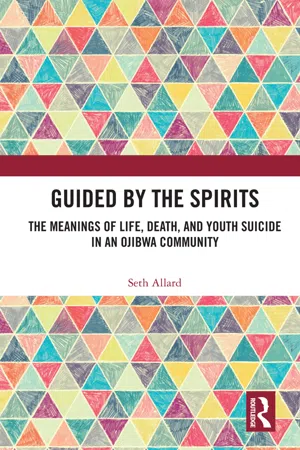
Guided by the Spirits
The Meanings of Life, Death, and Youth Suicide in an Ojibwa Community
- 172 pages
- English
- ePUB (mobile friendly)
- Available on iOS & Android
eBook - ePub
Guided by the Spirits
The Meanings of Life, Death, and Youth Suicide in an Ojibwa Community
About this book
Information
1 Introduction
Author’s Approach
Rates, methods of suicide (e.g., firearm, overdose, strangulation), gender disparities (male-female ratio of completions/attempts), and other patterns of suicide amongst indigenous people of the United States and Canada vary widely according to region and ethnic group (MacNeil, 2008; Strickland, 1996). Generally speaking, however, indigenous peoples residing in both countries display suicide rates significantly higher than the national average—1.5 times higher than the national average in the United States (CDC, 2013), 5 to 7 times the national average in Canada (Health Canada, 2013), and in the case of the Inuit of Canada, 11 times the national average (Health Canada, 2013). As alarming as these statistics are, accurate data on indigenous youth suicide remains clouded by ineffective reporting procedures. While numerous factors, “socioeconomic characteristics, substance abuse, barriers to mental health services and acculturation play a role in the occurrence of” indigenous youth suicide, more effective measurement and reporting procedures are required to accurately gauge indigenous youth suicide at local, regional, and national levels (Olson and Wahab, 2006).
Indigenous youth suicide has been the focus of media attention, public outcry, multidisciplinary research, and to an extent, government attention for nearly half a century—arguably making indigenous youth suicide one of the longest lasting public health issues in the United States and Canada. The immediate reaction to youth suicide, in public and academic circles, often stems from two basic questions: Why did they do it? What could we have done to prevent it? The purpose of answering these questions is to prevent future suicides from taking place. The only component of the story that seems to be missing, then, would be the answer as to why youth suicide occurs in such high numbers within indigenous communities.
I started on my own path toward exploring such questions nearly ten years ago, while visiting friends and family in Sault Sainte Marie, Michigan. Community members voiced great concern over youth suicide and the behavioral and spiritual health of youth. Each discussion exposed the heartbreaking and complex nature of youth suicide, which frustrates the search for answers. Years later, as a graduate student of anthropology at Western Michigan University, I chose to tackle the issue of youth suicide in the Sault Tribe by conducting a case study, with the goal of exploring the history, impact, and cultural complexities surrounding youth suicide in the Sault Tribe, while outlining potential remedies for this destructive issue.
In order to grasp the community’s views on and experiences with suicide and related health topics, I lived in the Sault Sainte Marie area and took part in everyday activities and community events. Research also relied on structured interviews with professionals serving in the areas of education and youth development, medicine, mental health, social work, traditional medicine, government-tribal political policy related to tribal youth, non-tribal youth, and families. This work refers to interviewees as “administrators”—“educational administrators,” “Sault Area Schools administrators,” “mental health administrators,” and similar general titles that help ensure the confidentiality of participants’ involvement. Confidentiality is a key component of ethnographic research, as it allows participants the freedom to discuss views and information that may be sensitive without fear of backlash from the community. Youth under the age of 18 were not included in interviews. However, informal discussions with individuals and groups of Ojibwa youth took place on several occasions, while interactions between youth and community were observed and noted, adding necessary context to this study.
While the inclusion of interview participants was solely based on status as “administrators,” many interviewees are themselves Tribal members, parents of Tribal youth, otherwise related to Tribal members (spouse, in-law), long-term residents of the Eastern Upper Peninsula area, or possess a combination of such backgrounds. As a result, the familial links, local knowledge, and personal-emotional investment in the future of Tribal youth allowed interviewees to speak passionately, and at times emotionally, of their views, observations, and firsthand experiences with Tribal youth and families. The consistency of Tribal backgrounds and Tribally centered backgrounds amongst participants ensured that the views, beliefs, and experiences of the Tribal community, as well as views of the Tribal community, remained central in this work.
Interview participants shared documents and reports (e.g., student surveys, government reports and articles, grant application information), while pointing out various resources that further guided this study. The shared documents and information added to collected government documents, gray literature (e.g., organizational language found on websites or in regulatory guidelines), visual representation of culture, recorded in still photos, video, and field notes describing visual representations of culture and other primary sources that provide a firsthand account of attitudes and contexts surrounding suicide. Throughout my time in ‘the Soo,’ I spoke informally with Tribal and non-Tribal members of various ages and backgrounds about the issue of youth suicide and related topics. The resulting informal conversations and encounters with elders, teenagers, and visitors from outside the community (unstructured interviews) heavily inform this work.
While the larger case study framework relied on interviews, participant observation, and collection and analysis of documents, this study relied greatly on historical and anthropological literature on the Ojibwa and the Anishnaabek (e.g., Cleland, 2001, 1992; Jackson, 2002). The type and combination of methods used in this case study are designed to create the opportunity for information and views, previously unexpressed, to surface in the academic and public arena. In the sense that this work offers previously unexpressed views, information, and forms of evidence; challenges the current views on youth suicide and the cultural and historical realities of mental health in indigenous communities; and combines historical and anthropological methods in order to understand historical developments and cultural interaction (Barber and Berdan, 1998), the work is most accurately presented as an ethnohistorical case study.
Critique of Anthropology
Despite significant participation and community interest in this research, I was ever conscious of the conflicted relationship between anthropology (and the social sciences in general) and indigenous peoples. From the late 1900s to the mid-1900s, early American anthropologists spent a majority of their professional experience in indigenous communities, where they collected artifacts and recorded oral histories, traditions, music, language, and, using video and still photography, the dances of Tribal peoples. Anthropologists hurriedly recorded and collected such aspects of indigenous culture in an effort to preserve the history and memory of what they saw as the ‘dying Indian.’ Speaking on the conflicted relationship between Native America and anthropology, Orin Starn (2011) describes this early period of anthropology:
It can be easy to forget just how central Native Americans once were to U.S. anthropology; Papa Franz [a central figure of early American anthropology] and virtually all his students fanned out into Indian country like a second invading army, this time armed with notebooks and seizing not territory but instead information about myths, rituals, and kinship systems. Even those better known for work in other places like Margaret Mead in Samoa, also did research and published about Native Americans, the Omaha in Mead’s case….
When I worked on the Navajo reservation back in the late 1970s, you still heard a bad joke that indexed the reservation ubiquity of anthropologists; “How many people are there in a Navajo family?” “Five—mother, father, two children … and an anthropologist.”
(180)
The early- to mid-twentieth-century rush to study and preserve tribal ways of life became known as ‘salvage ethnography.’ Written observations, measurements, audio and video recordings, artwork and artifacts were represented in scientific journals and museum exhibits that perpetuated the Western view of Tribal peoples as primitive groups—as lower, less developed forms of human society compared with white, Euro-American society (e.g., Morgan’s Theories on Social Evolution). The status of primitive races as dying and in need of caretaking justified the paternal relationship that Western government and society forced upon indigenous peoples. Anthropologists extremely critical of their own discipline’s complicity in the treatment of indigenous peoples often refer to anthropology at this time as a ‘handmaiden of colonialism’ or a “child of Western imperialism” (Gough, 1968: 12). Responding to such charges and reflecting on the lessons of history, anthropologists hold participant rights and the potential dangers of ethnographic study as an essential component of training, education, and research considerations. Despite the many advances that Tribal communities have made toward self-determination, Tribal communities continue the struggle to achieve an equal role in the writing of ethnic and national histories and regain control and protections of artifacts and historically significant places. To this day, disturbing images of anthropologists digging (sometimes literally, in the case of archaeologists) into the historical, traditional, and physical identity of indigenous peoples obstruct the creation of trusting relationships between Tribal communities and social scientists.
Despite my status as a (budding) anthropologist and the use of Western research methods, nothing could replace the fact that I am a member of the very group experiencing the behavioral phenomena I am attempting to understand. Throughout the research process, I realized that my family shares a similar history with those who faced and continue to face the threat of youth suicide. When setting out to investigate youth suicide, it was with the hope that my connection to the people, places, memories, and history of the Sault Tribe would minimize any sense of distrust arising from my role as an anthropologist, while simultaneously fostering a mutual relationship based on shared connections and experiences. The unique ability of an indigenous anthropologist to gather and ingest information that may otherwise not be available or fully disclosed to an ‘outsider’ is powerfully described by Zora Neale Hurston in Mules and Men (1935), a study of African American folklore in her hometown of Eatonville, Florida. Her experiences collecting stories and folklore shed light on the unique impact that being a daughter of Eatonville had on her assignment and interactions with community members—a situation that Hurston ruminates on throughout her work:
Folklore is not as easy to collect as it sounds. The best source is where there are the least outside influences and these people, being usually underprivileged, are the shyest. They are most reluctant at times to reveal that which the soul lives by. And the Negro, in spite of his open-faced laughter, his seeming acquiescence, is particularly evasive. You see we are a polite people and we do not say to our questioner, “Get out of here!” We smile and tell him or her something that satisfies the white person because, knowing so little about us, he doesn’t know what he is missing. The Indian resists curiosity by a stony silence. The Negro offers a feather-bed resistance. That is, we let the probe enter, but it never comes out. It gets smothered under a lot of laughter and pleasantries.
The theory behind our tactics: “The white man is always trying to know into somebody else’s business. All right, I’ll set something outside the door of my mind for him to play with and handle. He can read my writing but he sho’ can’t read my mind. I’ll put this play toy in his hand, and he will seize it and go away. Then I’ll say my say and sing my song.”
(2, 3)
In much the same vein that the curious “white man who is always trying to know into somebody else’s business” is rebuffed with “stony silence” or a “feather-bed resistance” built around polite half-truths and jest, the non-indigenous anthropologists may find certain thoughts, beliefs, and attitudes of indigenous peoples inaccessible. Participants and community members aware of the study displayed openness through sharing of intimate experiences, personal views, and even unpopular opinions; an openness further underscored by the sensitive nature of the topic of research. Perhaps for the same reason that Zora received such blunt and revealing information in her quest for understanding, my status as an Ojibwa man opened the door to a more nuanced understanding of youth suicide in the Sault Tribe.
Adversely, my identity as an indigenous person may cause Western social scientists to question, openly or introspectively, the accuracy of my representation of research results and the value of this work. A goal of social science—a goal of science in general—is to collect evidence and present interpretations and conclusions based on an analysis of the evidence. The validity and usefulness of conclusions rely on the investigator’s ability to practice objectivity or maintain a sense of detachment from the subject of study. Personal, political, or emotional forms of attachment to the object of study could compromise the collection of information (i.e., frame questions to lead to a presumed conclusion) or influence a biased presentation of research results (favoring specific aspects of the research while sidelining other data).
Regardless of the absence or presence of prevailing bias as a result of my personal attachment to the community, the extended claim that my added status as community member provides further value to the study may be questioned. In essence, if I am using ‘traditional’ social science methods (participant observation, interviews, document analysis), what extra value could be added by me being an indigenous person? However, the place I occupy as a community member and anthropologist favors a vantage point far too absent from research—that of the indigenous person—a sentiment shared by the community. While preparing fish for the feast at the Sugar Island Pow-Wow, I asked Cecil Pavlat, a retired Sault Tribe NAGPRA (Native American Graves Repatriation Act) representative and respected community member, his views on anthropologists, historians, and social scientists. He paused in thought, holding a freshly floured filet of whitefish above the hot oil, and said, “Anthropologists think that they can tell our story, but they can’t. I think it’s about time we had our own anthropologists.” With such words in mind, I join a growing number of indigenous anthropologists like Minnesota Ojibwa Sonya Atalay, who conducts cultural research “for, with and by” the community’ (Atalay, 2012: Preface).
My connection to the Sault Tribe also provides one of the three key components to a story—purpose. The purpose or goal of this work is to enhance the health, happiness, and future of not only the community, but of my own family. I have found, when returning to the question of whether or not I can remain objective in the context of research that includes my community and, in many ways, my family history, that the purpose of this work reinforces urgency for objectivity rather than eroding it. Use of analogy can help explain and elaborate on this point.
A medical doctor, essentially a scientist of the human body, must view the patient objectively in order to interpret symptoms and understand an ailment and its causes. Once the ailment and the causes are recognized, the doctor attempts to heal or ‘fix’ the patient. The doctor’s extensive education in human biology and basic use of the scientific method makes the process of examination and treatment easier. The social relationship that exists between the doctor (scientist, authority figure) and patient (object, subordinate) may help the doctor approach the patient without emotion or distraction. However, what happens when the doctor approaches the operating table, only to find his or her own child?
Initially, the doctor may be overcome with grief and anxiety caused by emotional connection to the person lying before him or her. The doctor is no longer a scientist of the human body, and the patient no longer an object of medical study and treatment—the relationship is now subjective. Can a subjective relationship, in this scenario, help the doctor to focus and increase the likelihood that the child will live? Would a parent, with the ability, knowledge, and opportunity to save the life of a child, operate with as much or more care, concentration, skill, and devotion than a physician not so invested? Add to the investment intimate knowledge of the history of the patient and potential complications—allergies, previous injuries, strengths and weaknesses. The emotional investment of the parent-doctor/child-patient relationship may motivate the most direct, effective treatment, even if painful, ...
Table of contents
- Cover
- Title
- Copyright
- Dedication
- Contents
- List of Figures
- List of Maps
- Preface
- Acknowledgments
- Description of Indigenous Peoples
- Audience
- Government, Demographics, and Economy; Maps, Local and Regional
- 1 Introduction
- 2 Overview of Suicide in the Sault Tribe
- 3 What Is an “Indian”? Conflicted Identity in the Sault Tribe
- 4 Hopelessness Kills: Development of Risk Factors for Youth Suicide and Barriers to Treatment and Relief
- 5 Prevention: An Approach to Mental Health Care and Treatment Models, and Indicator of Social and Cultural Values
- 6 Conclusion: Meanings …
- Epilogue
- Appendix: Interview Questions
- Additional Sources
- Index
Trusted by 375,005 students
Access to over 1.5 million titles for a fair monthly price.
Study more efficiently using our study tools.
Frequently asked questions
Yes, you can cancel anytime from the Subscription tab in your account settings on the Perlego website. Your subscription will stay active until the end of your current billing period. Learn how to cancel your subscription
No, books cannot be downloaded as external files, such as PDFs, for use outside of Perlego. However, you can download books within the Perlego app for offline reading on mobile or tablet. Learn how to download books offline
Perlego offers two plans: Essential and Complete
- Essential is ideal for learners and professionals who enjoy exploring a wide range of subjects. Access the Essential Library with 800,000+ trusted titles and best-sellers across business, personal growth, and the humanities. Includes unlimited reading time and Standard Read Aloud voice.
- Complete: Perfect for advanced learners and researchers needing full, unrestricted access. Unlock 1.5M+ books across hundreds of subjects, including academic and specialized titles. The Complete Plan also includes advanced features like Premium Read Aloud and Research Assistant.
We are an online textbook subscription service, where you can get access to an entire online library for less than the price of a single book per month. With over 1.5 million books across 990+ topics, we’ve got you covered! Learn about our mission
Look out for the read-aloud symbol on your next book to see if you can listen to it. The read-aloud tool reads text aloud for you, highlighting the text as it is being read. You can pause it, speed it up and slow it down. Learn more about Read Aloud
Yes! You can use the Perlego app on both iOS and Android devices to read anytime, anywhere — even offline. Perfect for commutes or when you’re on the go.
Please note we cannot support devices running on iOS 13 and Android 7 or earlier. Learn more about using the app
Please note we cannot support devices running on iOS 13 and Android 7 or earlier. Learn more about using the app
Yes, you can access Guided by the Spirits by Seth Allard in PDF and/or ePUB format, as well as other popular books in Psychology & Abnormal Psychology. We have over 1.5 million books available in our catalogue for you to explore.