eBook - ePub
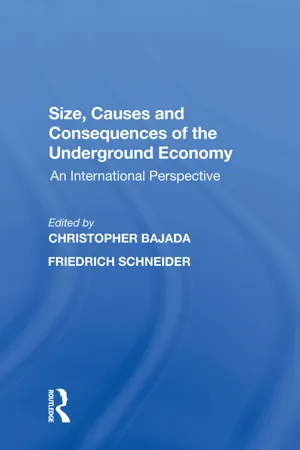
Size, Causes and Consequences of the Underground Economy
An International Perspective
- 308 pages
- English
- ePUB (mobile friendly)
- Available on iOS & Android
eBook - ePub
Size, Causes and Consequences of the Underground Economy
An International Perspective
About this book
Bringing together top international researchers this book provides a worldwide coverage of underground economic activities. It presents estimates of the underground economy for 145 countries - the most comprehensive ever undertaken; an in-depth examination of the underground economy for a select number of these countries; and an analysis of the public policy implications through an assessment of how various governments have attempted to address this issue. The book brings together the latest research on tax evasion, tax morale and other underlying factors that have so significantly influenced participation in the underground economy. It provides a comprehensive overview of the size and development of the underground economy, its major causes and motivations and its effects on the legitimate economy. In addition, it reviews recent public policy concerns by a number of countries and how they have responded with measures to curb these underground economic activities.
Chapter 1
Introduction
Christopher Bajada and Friedrich Schneider
Background and Objectives
As crime and other underground economic activities (including shadow economy ones) are a fact of life around the world, most societies have attempted to control these with measures ranging from education to punishment and prosecution. Gathering statistics about who is engaged in underground activities, the frequencies with which these activities are occurring and the magnitude of the problem is crucial for making effective and efficient policy decisions for the allocation of a country’s resources to tackling this problem. Unfortunately, it is very difficult to get accurate information about these activities in terms of value added or from a labour market perspective because all individuals engaged in these activities do not wish to be identified. Thus the estimation of the size and development of the underground economy can be considered as a scientific passion for knowing the unknown. Public discussions of illicit work, tax evasion and all other activities in the underground economy have grown increasingly overtime. In a number of countries, initiatives to tackle the underground economy have been implemented (to varying degrees), highlighting the fact that in recent years politicians have felt the need to act as well.
However politicians are faced with a dilemma. While wealthy individuals are evading taxes, which has prompted widespread public indignation, the relatively poorer illicit workers are often much less criticized for doing the same thing even though some politicians argue that they are behaving anti-socially and are contributing to unemployment and social injustice in our society. This opinion is broadly shared by the community particularly in relation to social fraud and illegal employment. But what about part-time illicit work in the evenings (moonlighting) which, for example, about half of the population in Germany would tolerate or even take advantage of, if they had the opportunity to make use of it? Can more sanctions and controls, combined with more regulation, be the ultimate solution to combat illicit work and the underground economy? What is the right way to deal with undeclared work?
In the popular scientific media and daily newspapers and magazines, such questions are often given little attention. More often than not the discussions on the underground economy fluctuate between two extremes: either the underground economy is blamed for the many problems related to economic management, such as unemployment or a growing public debt, or it is treated as a consequence of an economic system that is characterized by high taxes and too much regulation.
There are several important reasons why policy makers should be especially concerned about the growth of the underground economy. Among the most important of these are:
- A growing underground economy can be seen as the reaction of individuals who feel overburdened by the state and who choose the ‘exit option’ rather than the ‘voice option’ to express their dissatisfaction. If the growth of underground activities is caused by a rise in the overall tax and social security burden, together with institutional sclerosis, then the consecutive ‘flight’ into the underground economy may erode the tax and social security bases further adversely affecting the future provision of public goods and services. The result can be a vicious circle of further increases in budget deficits or tax rates as a result of continuing growth of the underground economy.
- A growing underground economy may cause severe difficulties for politicians, particularly their use of official indicators – unemployment rates, labour force participation rates, income and consumption figures, just to mention a few – that are unreliable in the presence of a growing underground economy. Policy based on erroneous official indicators is likely to be ineffective or in the worse case, counter-productive.
- The effects of a growing underground economy on legitimate activity is quite important to consider. On the one hand, a prospering underground economy may attract (domestic and foreign) workers away from legitimate employment and create competition for legitimate firms. On the other hand, a significant portion of income (at least 2/3) earned in the underground economy is immediately spent in the legitimate economy, generating a positive impact in the legitimate sector that may otherwise not have come about.
Hence, the major goal of this book is to shed some light on how we might attempt to answer the questions posed earlier. In addition the book provides a comprehensive overview of the size and development of the underground economy, its major causes and motivations and its effects on the legitimate economy. This book brings together the latest research on tax evasion, tax morale and other underlying factors which have so significantly influenced participation in the underground economy. Finally, this book reviews some of the recent strategies a number of countries have undertaken in their attempts to tackle the underground economy problem. In this regard these countries are ‘leaders’ amongst the other nations in their pursuit to limit the growth in their domestic clandestine activities.
In the rest of this chapter we provide a brief overview of the various consequences that come from a large and growing underground economy. We conclude this discussion with a brief summary of the various chapters that make up this collection of works.
Consequences of an Underground Economy
The underground economy serves as the vehicle by which economic agents escape the inspections and regulations of government. It is also the same vehicle that creates economic ‘anarchy’ to the extent that it undermines ‘the stability and responsibility of political, legal and economic institutions that might otherwise serve to facilitate the (economic) development process’ (Priest, 1994). An analysis of the underground economy is incomplete without discussing its consequences on legitimate economic activity. Whichever motive fosters active participation, the consequences of a large underground economy may turn out to be quite significant. For this reason it is important to improve our understanding of these consequences to help identify strategies to discourage clandestine activities. The consequences may be summarized as follows.
Declining Taxation Revenue
The overwhelming interest in the underground economy is with the extent of uncollected tax revenue. Although this is not the only serious consequence of tax evasion, it nevertheless warrants significant attention. Whenever participation in the underground economy expands, tax revenue losses add to the financial pressures of government to satisfy the service needs of the community. Daunted with spending decisions and commitments the government, in response to falls in revenue, may cut its expenditures, raise taxes or finance its expenditures by running larger deficits. Doing so may drive more individuals into the underground economy or encourage existing underground participants to work more extensively (Carter, 1984). The effect may be further compounded as higher taxes reduce investment and savings, inhibiting the growth of the legitimate economy. For example, conservative estimates for Canada have shown that the Canadian government is loosing an average of $6 billion annually in tax revenue from the underground economy (Berger, 1986). Estimates for New Zealand portray a similar scenario. Estimates suggest that the New Zealand government is loosing between 6.4 percent and 10.2 percent of total tax liability from the underground economy (Giles, 1999).
Distortions of Economic and Social Data
Individuals and businesses that participate in the underground economy not only contribute to lowering tax revenue collections, they also bias economic and social information which policymakers use to gauge their economic policies. The fact that the underground economy in many countries has been estimated to be quite large suggests national accounts information is significantly under-estimated. Immediately this distorts measures of economic growth (Houston, 1990), the rate of inflation (Reuter, 1982), the size of the business cycle (Bajada, 2003), the rate of unemployment (McDonald, 1984), productivity (Carson, 1984), the size of the tax base (Hansson, 1982), and the volume of savings (Greenfield, 1993). Incorrect policy prescriptions can only follow from such data distortions. For example, the fact unemployment may be consistently upward biased because of the underground economy may result in policies that are too expansionary and generate inflationary pressures.
Tax Morality
If the community acknowledges that the underground economy is growing and not being detected, there is an incentive to encourage a more active involvement or motivate new participants to join in. Unfortunately the incentives that encourage a participant to join usually have to be followed by strong deterrence policies to have them quit. Generally once a participant crosses over to the underground economy it may be quite difficult to bring them back, particularly since the financial gains to those who participate are immediate.
Unfair Price Competition
By its very nature, the underground economy promotes unfair price competition. If a business sub-contracts labour from the underground economy at significantly lower costs, the firm is in a better position to price compete with its competitors, who may not be participating in the underground economy. Alternatively the firm may engage in selling goods and services in the underground economy while concealing all or part of its income. Unfortunately active participation in the underground economy may force some small legitimate businesses out of the market or force their survival by driving them to participate also.
Welfare Effects
Those who participate in the underground economy may be contributing far less than honest taxpayers for the rights to use government goods and services. The government provides a vast array of goods and services including law enforcement, defence, education, hospitals, roadwork, transport and emergency services. In order that these services may be provided, it is expected that everybody pays their fair share of taxes. If there are a large number of individuals who are participating in the underground economy and not paying their fair share of tax, yet continue to expect the provision of public goods and services, they impose on honest tax payers the burden of raising the finances for their provision. As long as illicit activities are growing, the resource flow from the legitimate to the underground economy implies significant welfare losses.
The competitive advantage that the underground economy offers without doubt contributes considerably to efficiency and productivity losses (see Hansson, 1982). A growth in the underground economy may mean the closure of a large number of small legitimate businesses.
Implications for Efficiency
The underground economy may distort the allocation of economic resources particularly if it channels them into sectors of the economy where tax evasion is more pronounced. The inefficiencies may become larger if the inefficient redistribution of resources impacts on the methods of production, for example, changing to small-scale production techniques, employing fewer workers, fewer tools and equipment and less specialization (see Kesselman, 1997). There may also be further implications for efficiency if decisions to consume or invest are distorted as a consequence. Kesselman (1997) argues that individuals who participate in the underground economy are more likely to increase their consumption rather than their savings or expenditure on consumer durables because doing so would attract the tax administration’s attention. They may even invest very small amounts of human capital in their underground employment in fear that it may only have a short lifespan.
Unregulated Activities
There is also the inevitable consequence of poor work place practices in the underground economy. Goods and services that are provided in the underground economy do not offer the same guarantees of workmanship as one would expect of goods and services provided in the legitimate sector. Unfortunately there are many goods and services that are provided in the legitimate economy under strict health and safety guidelines which ensure adequate consumer protection. However goods and services provided in the underground economy are unlikely to conform in the same way to these guidelines. For example, hairdressers operating legitimately are expected to meet health and safety standards as prescribed in their code of practice. Yet the same hairdresser operating from their backyard after hours may ignore these rules and regulations particularly if it adds to their costs or limits the time the participant has to earn an income in the underground economy. Other examples may include poor plumping and electrical services that may produce significant costs in repairs or pose a fire risk to the occupants.
Income Distribution
Those who are presently on a low income could increase their disposable income by working in the underground economy and claiming to be unemployed in order to receive welfare assistance. The combined income could in most cases exceed the wage received for similar (low paid) work in legitimate economy. The flow of welfare benefits to those who are actively engaged in clandestine activities implies not only an inefficient redistribution of income, but it may also imply that measures of income inequality may be far from what the official statistics suggest (Skolka, 1984).
Are there any Benefits?
Needless to say, there are also some benefits that have been advocated as a consequence of the underground economy. A notable remark by a former Italian Prime Minister highlights the point:
It is a bad thing to say, but these ‘deviations’ are a positive thing, at least as far as employment is concerned. If the taxman was to intervene in the underground economy he would be acting in accordance with the principles of distributive justice but would be ruining not only a host of small businessmen and their workers, but perhaps the country’s economy and social peace as well. (De Grazia, 1982)
With the exception of employment, a number of others have suggested potential benefits that may accrue from an underground economy. These include:
- Portes et al. (1989) suggests that the underground economy may adapt faster to changes in economic conditions thereby helping to accelerate structural changes necessary for economic development;
- Skolka (1984) has suggested that the underground economy may generate positive welfare effects by redistributing income;
- Prager (1983) has credited the underground economy with the provision of goods that may not otherwise be available in the legitimate economy. Such a statement may be true of less developed economies that may have deficient planning for rea...
Table of contents
- Cover
- Half Title
- Title
- Copyright
- Contents
- List of Contributors
- 1 Introduction
- PART 1 TAXPAYER BEHAVIOUR AND MOTIVATIONS
- PART 2 MEASURING THE UNDERGROUND ECONOMY – INTERNATIONAL EVIDENCE
- PART 3 DETECTION, PREVENTION AND PROGRESS
- Index
Trusted by 375,005 students
Access to over 1.5 million titles for a fair monthly price.
Study more efficiently using our study tools.
Frequently asked questions
Yes, you can cancel anytime from the Subscription tab in your account settings on the Perlego website. Your subscription will stay active until the end of your current billing period. Learn how to cancel your subscription
No, books cannot be downloaded as external files, such as PDFs, for use outside of Perlego. However, you can download books within the Perlego app for offline reading on mobile or tablet. Learn how to download books offline
Perlego offers two plans: Essential and Complete
- Essential is ideal for learners and professionals who enjoy exploring a wide range of subjects. Access the Essential Library with 800,000+ trusted titles and best-sellers across business, personal growth, and the humanities. Includes unlimited reading time and Standard Read Aloud voice.
- Complete: Perfect for advanced learners and researchers needing full, unrestricted access. Unlock 1.5M+ books across hundreds of subjects, including academic and specialized titles. The Complete Plan also includes advanced features like Premium Read Aloud and Research Assistant.
We are an online textbook subscription service, where you can get access to an entire online library for less than the price of a single book per month. With over 1.5 million books across 990+ topics, we’ve got you covered! Learn about our mission
Look out for the read-aloud symbol on your next book to see if you can listen to it. The read-aloud tool reads text aloud for you, highlighting the text as it is being read. You can pause it, speed it up and slow it down. Learn more about Read Aloud
Yes! You can use the Perlego app on both iOS and Android devices to read anytime, anywhere — even offline. Perfect for commutes or when you’re on the go.
Please note we cannot support devices running on iOS 13 and Android 7 or earlier. Learn more about using the app
Please note we cannot support devices running on iOS 13 and Android 7 or earlier. Learn more about using the app
Yes, you can access Size, Causes and Consequences of the Underground Economy by Friedrich Schneider in PDF and/or ePUB format, as well as other popular books in Business & Business General. We have over 1.5 million books available in our catalogue for you to explore.