In recent years, an increasing number of separation walls have been built around the world. Walls built in urban areas are particularly striking in that they have exacted a heavy toll in terms of human suffering. As territorialising devices, walls can be protective, but the protection they grant is never straightforward. This collection invites inquiry into the complexities of the social life of walls, observing urban spaces as veritable laboratories of wall-making – places where their consequences become most visible. A study of the relationship between walls and politics, the cultural meaning of walls and their visibility, whether as barriers or as legible – sometimes spectacular – surfaces, and their importance for social processes, Urban Walls shows how walls extend into media spaces, thus drawing a multidimensional geography of separation, connection, control and resistance. As such, the collection will appeal to scholars of sociology, anthropology, geography, architecture and politics with interests in urban studies and social theory.
eBook - ePub
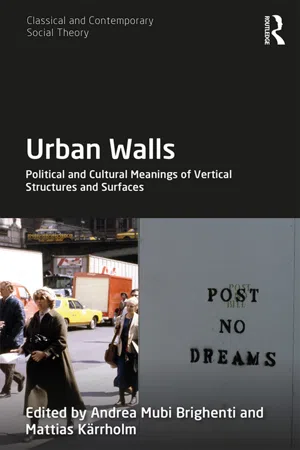
Urban Walls
Political and Cultural Meanings of Vertical Structures and Surfaces
- 258 pages
- English
- ePUB (mobile friendly)
- Available on iOS & Android
eBook - ePub
Urban Walls
Political and Cultural Meanings of Vertical Structures and Surfaces
About this book
Information
1On walls in the open city
Alison Young
What is a wall? There have been famous walls throughout history. A wall was built as a defensive fortification, in what is nowadays called the north of England but what was in AD 122 the northernmost limit of the Roman Empire in the time of Hadrian, with the lands of the Ancient Britons lying beyond it. A wall slashed a brutal divide through Berlin for decades until it was smashed by bulldozers and taken apart by the hands of its citizens in 1989.1 Later the dismantled wall was ground into pieces that were concreted into pavements as a memorial to those who died trying to climb it, and sold to tourists in tiny pieces. Since 1969 there have been walls built in Belfast and elsewhere in Ireland, in response to violence between the Catholic and Protestant populations there.2 Many were intended to be temporary structures, but have been strengthened and extended over the years. Made of iron, brick or steel, they vary from several hundred metres to almost five kilometres in length (Boal 2002; Dawson 2015). They are often called ‘peace lines’ or ‘peace walls’. The Israeli West Bank barrier separates Palestine from Israel along the Green Line.3 Known as a ‘separation barrier’ in Israel and as a form of apartheid wall in Palestine, it runs for 708 kilometres (see Weizman 2012: 161–184).4 And the contested claim that there might be a need for another wall, between the United States and Mexico, figured as a trope in the American election campaign of 2016 (Casey and Watkins 2016) and in American political discourse in 2017. These are walls that have sometimes acquired a capital letter, referred to as the such-and-such Wall, or a euphemism (a ‘line’ or a ‘barrier’), and which symbolise something more than the functions normally performed by walls without euphemism or capitalisation – the ordinary walls of everyday life (Brighenti 2009a).
What functions are served by these ordinary walls? Walls are essential components in the units of architecture that comprise most human habitations and development: it is hard to conceive of a house, office building, parliament or courtroom without walls. Walls provide support for a building’s roof as well as operating as partitions between one room and another, generating spaces of privacy, insulating inhabitants from heat, cold and wind.
From these immensely practical functions, others have also evolved. The privacy offered by a wall can be conceptualised as a legal relationship as well as one of physical architecture: the outer wall of a building has become synonymous with the legal limits of an owner’s proprietary interest in a space. Proprietary rights confer power upon their holder; with power comes the fear of it being challenged or lost, such that the outer wall, in addition to delimiting a boundary between ‘I own this’ and ‘you own that’, is required to act as a barrier to those who might transgress the line demarcating one owned space from another. Cities, being composed of streets whose vertical structures comprise almost exclusively walls (Brighenti 2009a: 64), are a tapestry in which the walls of each individual property function as stitches. Each stitch represents a legal boundary; each boundary generates a desire to defend what lies within it.
Defending with walls
It is not only the properties found within a city that are perceived to require defence with walls. The city itself is conceptualised as a place with boundaries requiring defence – a way of thinking with such a lengthy history there is no doubt it is still hard-wired into contemporary urban architecture. Invasion represents the greatest single threat to any settlement, and protection of a city during wartime poses the most significant test of the capacity of a wall as a mode of defence. Resistance to occupation was assumed to be the necessary approach when invasion was threatened, and for centuries settlements were built in sites that not only were defensible but which offered advantages in repelling attacks by potential invaders: thus, settlements were often built high on hillsides that could offer clear sight lines, or with steep hills at the rear, reducing the number of sides from which an attack could come.
The Second World War’s colonisation of the air as a terrain from which to do battle meant that old strategies of defence were easily overcome. A potential invader could drop bombs on a city from above, wreaking destruction on its residents, food stores, buildings and infrastructure. To avert extensive destruction, city authorities sometimes resorted to declaring a city to be ‘open’: in 1940, during the Second World War, for example, Brussels was declared by the Belgian government to be an open city, and it was later occupied by the Germans. Naming a city as ‘open’ to its attackers indicated that it was undefended, and was open to occupation. Opposing forces were thus expected to simply march into the city, and no resistance would be offered to them. Krakow was declared an open city, as was Paris, Manila, Belgrade, Batavia, Rome, Trieste, Athens, Hamburg and Brussels.5 An open city, then, is one that is open to invasion and occupation.
Once a city has been invaded, whether by its walls being breached or its gates being opened, the members of the opposing forces enter the city and become part of its everyday activities. During wartime, such occupation might have obvious characteristics: the presence of individuals who dress, act and speak differently, for example, and the citizens of an occupied city often developed subtle techniques of everyday resistance or rebellion. While wartime occupation had obvious characteristics – a declaration that the city was open, or a bombing campaign leading to destruction of a city’s defences – in more recent times, it can be argued that a city’s citizens still fear that occupation by others might have taken place.
Able to control entry into the spaces they consider private, such as the home, individuals experience greater uncertainty about the encounters they face within the common spaces of the city. On the streets, on public transport, in shops: encounters in these notionally ‘public’ places are contingent upon the activities and attitudes of the others using and travelling through them. As Iris Marion Young notes,
Because by definition a public space is a place accessible to anyone, … in entering the public one always risks encounter with those who are different, those who identify with different groups and have different forms of life.
(Young 1990: 240)
For Young, the ‘risk’ of that encounter is a social good to be promoted and protected, and I would propose that such an encounter has the capacity to ‘enchant’ by arresting the subject in a moment that can offer outrage, distaste, pleasure, or indifference (see further Young 2014; also Bennett 2001; Watson 2006); however, as if the city is continually in a state of post-invasion, the encounter with the other has become a problem demanding management and control, through urban planning, law and criminal justice. As Brighenti writes
Compared to the medieval walled city, the modern city transforms walls into elements of a spatial political economy of government. The outer boundary and its capacity to protect the city from external invasion is no longer what really matters …. [I]nstead it is the capacity to manage enclaves within the city.
(2009a: 67)
The city exists as much in a network of defensive and protective laws and policies as it does in the mesh of its material architecture. What Philippopoulos-Mihalopoulous has called the ‘lawscape’ (2013, 2015) and I have called the ‘legislated city’ (Young 2014) is a place in which a particular kind of experience is encapsulated and produced through the regulation of space, temporality and behaviour. The legislated city has mappability; it has aspirational qualities expressed through social policies, statutes, local laws and strategic plans. It is characterised by regularity and order (or at least the attempt or desire to create regularity and order).
The efforts of the law to control the city are anchored in time and space. Permitted noise levels vary according to the hours of the day and the location of the sound. Encounters with others might follow a rhythm, which can prompt a concomitant regulatory temporality in the effort to manage the frequency and timing of such encounters, as well as their location.6 Roquet describes the sonic ambience, such as mechanized birdsong, deployed as a calming technology for commuters in the crowded train stations of Tokyo:
Whatever daily and yearly rhythms these birds may have had – dawn choruses and rainy-day retreats – have been eliminated in favour of ensuring the calming affordances of their perpetual chirping presence.
(2013: 78)
According to s 4A(1) of the Summary Offences Act in New South Wales in Australia, ‘a person must not use offensive language in or near, or within hearing from, a public place or a school’, thus criminalising a mode of speech when it occurs in certain designated locations. We might call the result an ‘atmosphere’ (Edensor and Sumartojo 2015; Philippopoulos-Mihalopoulous 2015: 122; Hillary and Sumartojo 2014), where the city becomes a sensorium whose smells, sounds, sights and surfaces are both produced by and productive of juridical regimes. Such strategies create legal territories in time and space: ‘just like any other form of notation and writing, law, too, deals with lines, barring some and allowing others’ (Brighenti 2010a: 225). Such a regulatory apparatus acts as a kind of wall against invasion by others; however, walls themselves need defending.
Defending the wall
Each day when I walk between home and my workplace, I pass by a gallery, located on a street corner formed by one quiet residential street off a larger, busy road. Art is displayed within its interior rooms, as is conventional for such a space, but the building’s exterior walls also feature images referencing artworks that may, the spectator is invited to deduce, have been exhibited within the building or that may be characteristic of the type of image that can be found inside. Several paper posters, showing examples of work by artists who have had exhibitions at the gallery, are pasted to its west- and south-facing walls, with a version of Sidney Nolan’s iconic figure of the bushranger Ned Kelly directly painted on one wall as a black silhouette.

Figure 1.1

Figure 1.2
Pasting paper onto walls and applying paint to them are two of the techniques utilised by street artists and graffiti writers when they add their uncommissioned images to the surfaces found in the urban environment. But it would be difficult to interpret the posters and paint on the gallery’s exterior as the result of the activities of graffiti writers or street artists: the gallery’s name features on one of the posters and the association of the Ned Kelly figure with Nolan, one of Australia’s best-known fine artists, align the images with authorised art rather than with the unauthorised activities of the street artist. Every so often, graffiti writers do add their own work to the gallery’s wall, tagging the posters or the Kelly silhouette. These unlegislated additions are removed or painted over by the gallery owner, who is acting both as curator of the images on this exterior wall and as police officer or cleaning crew in differentiating between the permitted images of self-advertising and the unauthorised images of graffiti, even though they have in common both a range of artistic techniques and an interest in the street as a location for images.
In pasting paper and painting figures directly on to this exterior, street-facing wall, the gallery is taking from the cultures of graffiti, conventionally practised as wall writing, and of street art, whose very name locates its practitioner in public space and its artworks on the surfaces associated with the exteriors of buildings rather than their private interiors.7 On the gallery wall, then, is displayed both a contest over its spaces (between taggers and gallery owner) and a process of judgement that deems some images on the wall to have legitimacy while others do not.
Only one street away from the gallery wall ...
Table of contents
- Cover
- Endorsement
- Half Title
- Series Information
- Title Page
- Copyright Page
- Contents
- List of contributors
- Introduction: the life of walls – in urban, spatial and political theory
- 1 On walls in the open city
- 2 Dismantling Belfast peace walls: New material arrangements for improving community relations
- 3 Walling through seas: The Indian Ocean, Australian border security, and the political present
- 4 Walls, walling and the immunitarian imperative1
- 5 Screening BrazilFootnotes on a wall
- 6 Warsaw afterimages: Of walls and memories
- 7 Wall terrains: Architecture, body culture and parkour
- 8 Gating housing in Sweden: Walling in the privileged, walling out the public from public places
- 9 The right to the city is the right to the surface: A case for a surface commons (in 8 arguments, 34 images and some legal provisions)
- 10 The multiple walls of graffiti removal: Maintenance and urban assemblage in Paris
- 11 Walls as fleeting surfaces: From bricks to pixels, trains to Instagram
- Index
Trusted by 375,005 students
Access to over 1.5 million titles for a fair monthly price.
Study more efficiently using our study tools.
Frequently asked questions
Yes, you can cancel anytime from the Subscription tab in your account settings on the Perlego website. Your subscription will stay active until the end of your current billing period. Learn how to cancel your subscription
No, books cannot be downloaded as external files, such as PDFs, for use outside of Perlego. However, you can download books within the Perlego app for offline reading on mobile or tablet. Learn how to download books offline
Perlego offers two plans: Essential and Complete
- Essential is ideal for learners and professionals who enjoy exploring a wide range of subjects. Access the Essential Library with 800,000+ trusted titles and best-sellers across business, personal growth, and the humanities. Includes unlimited reading time and Standard Read Aloud voice.
- Complete: Perfect for advanced learners and researchers needing full, unrestricted access. Unlock 1.5M+ books across hundreds of subjects, including academic and specialized titles. The Complete Plan also includes advanced features like Premium Read Aloud and Research Assistant.
We are an online textbook subscription service, where you can get access to an entire online library for less than the price of a single book per month. With over 1.5 million books across 990+ topics, we’ve got you covered! Learn about our mission
Look out for the read-aloud symbol on your next book to see if you can listen to it. The read-aloud tool reads text aloud for you, highlighting the text as it is being read. You can pause it, speed it up and slow it down. Learn more about Read Aloud
Yes! You can use the Perlego app on both iOS and Android devices to read anytime, anywhere — even offline. Perfect for commutes or when you’re on the go.
Please note we cannot support devices running on iOS 13 and Android 7 or earlier. Learn more about using the app
Please note we cannot support devices running on iOS 13 and Android 7 or earlier. Learn more about using the app
Yes, you can access Urban Walls by Andrea Mubi Brighenti,Mattias Kärrholm in PDF and/or ePUB format, as well as other popular books in Social Sciences & Sociology. We have over 1.5 million books available in our catalogue for you to explore.