- 292 pages
- English
- ePUB (mobile friendly)
- Available on iOS & Android
eBook - ePub
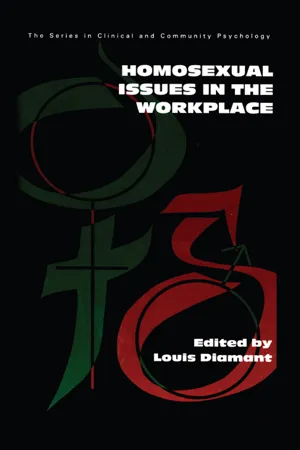
Homosexual Issues In The Workplace
About this book
First published in 1993. This book looks at the stress of gay and lesbian workers within the work world, and for that reason alone deserves its place on a list of recommended mental health, psycho-social health readings. However, more than this major factor merits consideration. Issues that are core to the identity of any person must be examined from the particular position of the homosexual worker and career seeker, and include such fundamental concepts as fairness, self-esteem, economics, survival, the need and right to participate in the work force, and the need and right for a voice and basic identity in vocational systems.
Information
Publisher
Taylor & FrancisYear
2018Print ISBN
9781138011830
9781560320388
Edition
1eBook ISBN
9781317763819
Part One
Introduction
Chapter 1
Some Historical Perspective
Before motion picture actor Brad Davis died, and while he was suffering from the AIDS that brought on his untimely death, he remarked to the news media that the film industry was exceedingly repressive with regard to AIDS and homosexuality (and thus of course repressive to reason in these issues). He also reported that he had been, in his younger years, an aggressive drug abuser. For the purpose of this introduction, sorting out whether gay sex or drug abuse brought about his illness is not the most relevant part of that press interview. It is, rather, the surprise that the motion picture industry would be one that lacked tolerance for gay and lesbian sexual orientation because folklore has it otherwise. Cautious about promulgating conjecture, I brought my notions on Hollywood to some social psychologists who agreed with me and voiced surprise at Davis’ comment. It is no surprise but rather common expectancy that the Church, the military, or even the Boy Scouts (I read somewhere that national Boy Scout leaders have said the ban on homosexual members rests in part on a section of the scout oath that requires members to be morally straight). But if Hollywood, that font of myths could be a myth itself—what then might work environments, not so imbued with a spirit and aura of sexual freedom, be in terms of repressive forces and stressors to gay and lesbian workers?
Today homosexual is a marginal term. Referring to issues it may have acceptability; as an adjective or noun referring to persons it may be considered pejorative. Current designates for those with the same sex orientation are gay and lesbian, while gay and lesbian issues are homosexual issues. History has shown us that there are differences for men and women, which implies also different explanations for sexual orientations and different outcomes for the genders. Lesbianism has been largely unreported by anthropologists as an institutionalized phenomenon when compared to the studies on male homosexuality. Socarides (1965) wrote that he had found no recorded case of lesbian entrapment such as had been common with males, although lesbian behavior has been prosecuted in the United States (State of Louisiana v. Young, 1976). Lesbianism, unlike male homosexuality, has never been a crime in England nor in most European countries. In the United States, most states have had proscriptive laws and many still do. (This includes my current state of residence, North Carolina, which only a decade ago brought a friend and colleague to trial for crimes against nature [homosexuality]). With careful selection of attorneys, the guidance of Julius Chambers, and the progressive attitude of the judge (no humor intended because prison terms for male homosexuality in North Carolina are not meant merely to frighten wayward youths), he pled guilty and received a five-year suspended sentence. He has since moved to California where he has practiced as a licensed clinical psychologist. Certain felonies precluded licensure and practice in the state in which he was convicted.
THE EVOLUTION OF THE PERCEPTION OF HOMOSEXUAL BEHAVIOR IN THE JUDEO-CHRISTIAN EPOCH
Over the centuries, Western societies, in particular, have labored over the question of homosexuality (gay and lesbian sexual behavior). Under various governments, it has gone from criminal to noncriminal behavior and in religious dominated governments, it has been equated to sin and non-sin. In the domains of medicine, psychology, and psychiatry, the homosexual designation has gone from dementia to character disorder to neurotic to nonneurotic to nonmentioned in Diagnostic and Statistical Manuals (DSM) I, II, III, HIR (American Psychiatric Association, 1952, 1968, 1980, 1987). All of this might seem like progress, but it has in essence been a nonliberating journey because it, like slavery, would have been better had it never begun. The residue from all these labels of contamination as we shall see, is a noxious burden. We have created a class of citizens always on trial, always suspect, always beggars for one crumb of equal citizenry. Nothing could more tragically dramatize or illustrate the gay person’s tenuous grip on belonging than the AIDS-related assaults. Even in sports there is an agonizing ignorance and lack of sportsmanship. Following basketball superstar Magic Johnson’s decision to play again, Tom Sorensen (1992) wrote:
Some NBA players will be afraid to share the court with him, but they probably won’t admit it.
There is no disease quite like AIDS. If Magic had cancer, he would be beloved. But there are folks who believe AIDS is a punishment dropped directly from heaven.
Many of them write letters to newspapers. Sometimes, they are illegible, though. Crayon is easily smudged, (p. 1B)
Under continuing player and public pressure, what could Magic do? He resigned, of course.
Each time the notion of social progress appears to signal the end of the sin, crime, and disease, a countermovement may bring out the notion of deja vu again directly related to the issues of this book. Last June, Presbyterian Church (USA) leaders rejected a report recommending that gays and lesbians enjoy full participation nationwide in the church. Reported the Charlotte Observer, “In North Carolina, Pullem Memorial Baptist Church was ousted last week from the Raleigh Baptist Association for allowing the formal union of two homosexual men, considering ‘that no society can exist without a common core of values and acceptable limits’; the Raleigh Baptist Association concluded its statement on human sexuality. Into that atmosphere comes the Charlotte Area Clergy Association, intent on shifting the debate from whether homosexuality is a sin to how clergy can better care for gays and lesbians. ‘Even if you do see it as a sin,’ said Reverend Little, ‘what are you doing to relate to the sinner?’ Reverend Tremann, whose presbytery is not officially involved in the outreach, wanted the focus to be on equal employment (italics added) and pastoral care and not whether to endorse the ordination of gay and lesbian ministers” (Crum, May 12, 1992, p. 4A). And from Today’s Quote (May 14, 1992): “It is an outrageous invasion of privacy. I want to find out what they think they are doing. I want to make clear to them that they need to stop this.” Rep. Barney Frank, D. Mass, an acknowledged homosexual, saying he will ask Federal Emergency Management Agency officials to explain at House Judiciary Subcommittee hearing why they forced an employee to produce a list of homosexual coworkers (p. 7A).
Homosexuality has been reported as being at other times a celebrated event; for example, between males in Ancient Greece (West, 1967). Accordingly, homosexual relationships were encouraged with some restriction of the law in Hellenic society (West, 1967). Regarding lesbianism, the main point of reference for that sexual orientation appears to be the poet Sappho, circa 600 BC. It is from the celebration of female love on the Isle of Lesbos from which the noun lesbian came. For the record, and according to Dover (1978), it was probably a romanticized view of female love rather than overt sexual intimacy, that occurred. Nevertheless, if there was freedom for a homosexual ethic those so oriented were to be highly restricted by the Old Testament and the growing prominence of the Judeo-Christian ethic. The Christian Church, as well as the Jews, developed and promulgated attitudes that cast homosexuality in a despicable light (despite recent attempts to challenge the traditional position, Lovelace, 1978), and voiced the need for punishment for this behavior, i.e., Leviticus 20:13 “If a man is with a man as with a woman, both have committed an abomination, their blood is upon them.” Szasz (1970) commented that only male homosexuality is forbidden and no references to woman lying with woman are made, which reflects the Bible’s treatment of women as less than human. The legal statute of modern Western society, and indifferences to the prosecution of woman for homosexuality support a historical disregard for women (Diamant, 1987).
In more recent times we have seen at least some controversial positions regarding the participation of gays and lesbians in church membership, but ordination of persons with a known gay or lesbian orientation has got to be the rarest of occupational phenomena. Separately, theological Judaism has struggled with the Talmudic homosexual bias and their tendency toward liberalism. According to Matt (1978) this appears to have created a dilemma for the clergy and the homosexual Jew.
In the history of Western civilization, not only homosexuality but all sexual behavior has been restricted within a legal framework. The political control of sexual behavior is in most instances a consequence of the Judeo-Christian ethic. (Currently in the state of North Carolina, for example, not only is homosexual sodomy a crime, but so is heterosexual behavior between unmarried, consenting adults as well as oral sex in the marriage bed.) In Europe, ecclesiastical law incorporated ideas from the Jewish tradition, Christian teaching, and Roman law as a basis for criminalizing and punishing homosexual behavior with the prosecution of homosexuals directed mostiy against males. A rare exception to the tendency to avoid entrapment and prosecution of females is seen in the affirmation of the conviction and sentencing of Mary Young and Dawn LeBlanc for unnatural copulation (State of Louisiana v. Young, 1966).
But entrapment apparentiy continues elsewhere. Recently I sat for jury selection for a case in which the prosecutor alleged that the defendant, who acknowledged his homosexuality, had, at a location frequented by gays, approached an undercover police officer for sex. An interesting number of prospective jurors were disqualified by the defense because of admitted prejudice toward gays as sinful or criminal. Interesting, too, was that the racial makeup of the jury shifted from an original nine whites and three African Americans to an exactiy reversed final panel. (I was not called.) Only months later, in a restaurant I often frequent, a waiter named James told me that he was going to trial in a similar prosecution related to an incident at a city park urinal at which time he asked, “Are you sure you’re not a policeman?” and was told, “Hell, I hate cops.” When I asked if this incident was stressful, he said that he was a nervous wreck and that he had already visited a colleague who specializes in such stressed patients. And at the risk of having this sound invented, he also told me of his horror caused by hearing that a prominent minister had told someone in the restaurant owner’s family that he did not want to be served by a homosexual who could give him AIDS. I asked James how he reacted when he heard this. “I felt rotten, how would you feel? I could have lost my job, I had just moved into a new apartment, how could I pay the rent? I’m just lucky that the people I work for understand.”
In Europe, punitive attitudes toward homosexuality began diminishing under the liberalizing effect of the Napoleonic code. Today, most European countries no longer consider homosexuality in itself a crime if it does not include public indecency, coercion, or minors (West, 1967). Contributing to the change was a modern psychoanalytic theory that until recently said it was a disorder. Krafft-Ebbing (1922) wrote that homosexuality was the result of physical degeneracy and hereditary defects and both constitutional and a disease. Although Freud (1905/1935) did not see homosexuality as a disease or illness, he did think of it as a developmental phenomenon related to infantile sexuality while some disciples pursued it as a mental disorder (Bieber, 1962, 1976; Socarides, 1965; Socarides & Volkan, 1991). Because psychoanalysts and others in the practice of psychiatry were reluctant to give up the notion of homosexuality as a neurotic or personality disorder, its appearance as such may be seen in the first three issues of the Diagnostic and Statistical Manual of Mental Disorders (American Psychiatric Association 1952, 1968, 1980). An influential difference of opinion is not noted until its absence from codification in DSM IIIR (American Psychiatric Association, 1987).
The twentieth century then ushered in the scientific outlook on male and female homosexuality. The illness issue may well have been the scientific issue that brought the application of scientific principles in the fields of neuropsychiatry and clinical personality psychology to test that very concept of illness. The landmark study of Elizabeth Hooker (1956) was followed by scores of researchers using empirical methods that demonstrated, in part, that gay men and lesbians were not any different with regard to personality pathology from heterosexually oriented men and women. For a comprehensive review of the empirical input to the investigation of psychopathology and personality differences between heterosexual and homosexual subjects, I suggest Marvin Siegelman’s (1987) review of the literature.
With all the pluses, where do the minuses show? According to George and Behrent (1988), speaking of gay mental health, “In addition to the normal stress in our society, the homosexual male is subject to other internal and external stresses due to homophobia, the irrational fear of homosexuality” (p. 81). According to the laws of homophobia, regardless of its historical journey into and out of diagnostic labeling, most homosexual males have been exposed to the insults accorded to men of such orientation whether addressed to them, someone else, or just overheard. And according to Gonsoriek (this volume) men themselves often buy into the homophobia with self-negation. In a recent personal ad in a Charlotte paper that carries personal ads for relationships of varying orientation, a female asked for a female companion for living, friendship, and intimacy, and stipulated “No Dykes.” Sophie (1988) defined homophobia in terms of racism or sexism with emphasis on negative attitudes of all sorts. She elaborated that internalized homophobia represents an internalization of negative attitudes and assumptions regarding lesbianism. She compared this to societal homophobia, which encompasses the negative attitudes expressed by others in the individual lesbian environment.
There is then a consistency of opinion that gays and lesbians are under stress. There has also developed a large literature that says gay men and women are no different than other men and women, not so delineated, with regard to personality and emotional problems and illness. Martin and Hetrick (1988) adopt a minority group label for homosexual men and women, and using All-port’s definition declare a minority group as one that suffers from unjustified negative treatment from the dominant group. In other words, the minority group is a victim of prejudice. Now it raises the question, “How can a minority group suffer unjustified negative treatment and remain its equal in mental stability?” For an answer I am reminded of Robert Coles’ (1967) observation in Children of Crisis: A Study of Courage and Fear, in which he tries to sort out this very question involving African American children at the beginning of school desegregation in the South. (His dilemma comes in striking a balance between study of the contemporary as well as antecedents in the past and the treatment of symptoms, some generated by the present and some with a life of their own that largely ignore racial conflict.)
But prior to any postulates that structure the dilemma is an essential statement that clarifies the difference in an illness concept of Bieber and the stress concept of Gonsoriek. To Bieber and others who cling tenaciously to his point of view, homosexuality is a disorder in and of itself. In appraising their belief, it would be well to remember that in those of the old school and in DSM I, II, and III, there was such a diagnostic category and code. It is the diagnostic label applied to a person with the same sex orientation that is forced into an a priori psychiatric condition for the sake of etiology. Others, since Kinsey (Kinsey, Pomeroy, & Martin, 1948), see homosexuality as a condition of expected variation in orientation. In this view the consideration of a priori pathology is as erroneous as it would be in the condition of heterosexuality.
It might be wise to remember that there are many detractors of gays and lesbians who are not much concerned with crime, sin, or illness, at least not cognitively. Difference alone is enough to create antipathy, ridicule, and discrimination that has much in common with many other applications of prejudice and in many other forms of social distancing. Ross Perot, a billionaire, and an unsuccessful candidate for the U.S. presidency in 1992, did not fall on the undisguised formal defamation to justify, in an interview, his rejection of a homosexual person for a cabinet position, but stated simply that he would not want any person in that kind of position who could cause controversy or make others uncomfortable. Thus gays and lesbians were put on the alert that if their sexual orientation were known and if Ross Perot were to become president, and if they had aspirations for a certain kind of White House connection, they were out of this job market. Later he changed his mind, he said. It is ap...
Table of contents
- Cover
- Half Title
- Title Page
- Copyright Page
- Table of Contents
- Contributors
- Foreword
- Preface
- PART 1: INTRODUCTION
- PART 2: CORPORATE OUTLOOK
- PART 3: SPECIAL PLACES, SPECIAL ROLES
- PART 4: AIDS IN THE WORKPLACE
- PART 5: THE INDIVIDUAL AND THE ORGANIZATION: SOCIAL-PSYCHOLOGICAL ISSUES IN THE WORKPLACE
- Index
Trusted by 375,005 students
Access to over 1.5 million titles for a fair monthly price.
Study more efficiently using our study tools.
Frequently asked questions
Yes, you can cancel anytime from the Subscription tab in your account settings on the Perlego website. Your subscription will stay active until the end of your current billing period. Learn how to cancel your subscription
No, books cannot be downloaded as external files, such as PDFs, for use outside of Perlego. However, you can download books within the Perlego app for offline reading on mobile or tablet. Learn how to download books offline
Perlego offers two plans: Essential and Complete
- Essential is ideal for learners and professionals who enjoy exploring a wide range of subjects. Access the Essential Library with 800,000+ trusted titles and best-sellers across business, personal growth, and the humanities. Includes unlimited reading time and Standard Read Aloud voice.
- Complete: Perfect for advanced learners and researchers needing full, unrestricted access. Unlock 1.5M+ books across hundreds of subjects, including academic and specialized titles. The Complete Plan also includes advanced features like Premium Read Aloud and Research Assistant.
We are an online textbook subscription service, where you can get access to an entire online library for less than the price of a single book per month. With over 1.5 million books across 990+ topics, we’ve got you covered! Learn about our mission
Look out for the read-aloud symbol on your next book to see if you can listen to it. The read-aloud tool reads text aloud for you, highlighting the text as it is being read. You can pause it, speed it up and slow it down. Learn more about Read Aloud
Yes! You can use the Perlego app on both iOS and Android devices to read anytime, anywhere — even offline. Perfect for commutes or when you’re on the go.
Please note we cannot support devices running on iOS 13 and Android 7 or earlier. Learn more about using the app
Please note we cannot support devices running on iOS 13 and Android 7 or earlier. Learn more about using the app
Yes, you can access Homosexual Issues In The Workplace by Louis Diamant in PDF and/or ePUB format, as well as other popular books in Social Sciences & Mental Health in Psychology. We have over 1.5 million books available in our catalogue for you to explore.