![]()
1 Contemporary approaches to rock art in South America
Introductory remarks
Andrés Troncoso, Felipe Armstrong and George Nash
David Whitley (2005) has suggested that the archaeology of rock art is living in a Golden Age. Today, and from around the world, there are multiple research projects using a variety of theoretical frameworks that go beyond merely descriptive approaches. A significant role in this regard has been played by the improvement of methods of enquiry, including the role of hard science. In this regard, chronometric methods have been the most significant advances made, along with physical-chemical analysis, including Raman spectrometry and lipid studies. These methods, along with advances in the way researchers think about past societies, have taken rock art studies into new frontiers of research. Within this context, rock art can no longer be addressed as an epiphenomenon of social life or merely an expression of a palaeopsychology (Binford 1965) but rather as forming a fundamental part in human societies. Clearly, both science and various strands of philosophical discourse, as well as anthropological and ethnographical input, have provided significant support in understanding some of the underlying mechanisms that drove prehistoric communities to produce rock art. The interest in rock art has grown dramatically, with a number of seminal works being published in recent years, including several handbooks and edited volumes that take a world view on this phenomenon (e.g. Whitley 2001; Barnett and Sharpe 2010; McDonald 2011; McDonald and Veth 2012; Smith et al. 2012; Gillette et al. 2015; Hampson 2015; Nimura 2015; Bednarik et al. 2016; David and McNiven 2017).
Regardless of the position rock art has in archaeological research today, South American research has had little presence in the global discussion, with only limited scientific publication devoted to the subject. This is evident when reviewing the latest handbooks to be published on rock art in the past two decades. Of a total of 61 papers, only four are concerned with South American rock art. This lack of impact in the global stage is due to multiple factors at different scales, of which we highlight three. Firstly, while there is almost no ethnographic and ethno-historic information on rock art production in South America, the use of this kind of evidence has been central in the global study of rock art, which has positioned Australia and South Africa as referents in the field. This is mainly due to the vast amount of ethnographic information there compared to any other region in the world, including South America. Secondly, rock art research in South America has been developed from a rather local perspective, which has been echoed in local journals where such papers have been published. Many of these papers have focused on addressing local issues rather than global topics. This is of course related to the descriptive nature of most research produced until around the 1970s. Finally, academic geopolitics has prioritised particular centres of research and intellectual development above others, which tend to be located in English-speaking and European countries (Lander 2000).
Nevertheless, South America has a wide and varied history of rock art research and interpretation, which has in the last 30 years gone beyond mere description, exploring different topics and integrating rock art, both as material and as practice, within the interpretive models of pre-Hispanic life in the region (e.g. Aldunate et al. 1985; Podestá and De Hoyos 2000; Fiore and Podestá 2006, Troncoso et al. 2017). In this sense, South American rock art research has been dealing with the challenge of breaking its isolation to become part of the mainstream archaeological discourse. Archaeologist Meg Conkey (2012) has rightly made a call for the archaeology of rock art to abandon its segregation and occupy a place in broader discussions about the past. Also, the increasingly frequent publication of research conducted on South American rock art in international journals has started to integrate these studies into a wider global discussion.
With time, a research tradition has been developed in South America that has offered its own theoretical and methodological contributions that have not always followed the global academic trends. It is in this context that this book emerges, as an effort to bring together the work of different scholars from around the continent who have developed particular approaches to address their different case studies. Several of these researchers have drawn inspiration from theoretical discussions developed in other regions of the world and have adapted these for their own research agendas. In this way, this book offers ten different works with their particular ways of assessing and thinking about rock art as a culturally, socially, and historically significant device. These works tend to lean towards the archaeology of rock art, prioritising formal methods within the rock art record (sensuTaçon and Chippindale 1998), something that has given its identity to the South American rock art research tradition. We believe that these ways of understanding rock art are an important contribution to the global study of rock art, and we hope the reader will agree with us. However, before delving into the different chapters of this book, we will briefly characterise the history of research and the different approaches used in the study of South American rock art.
Studying South American rock art
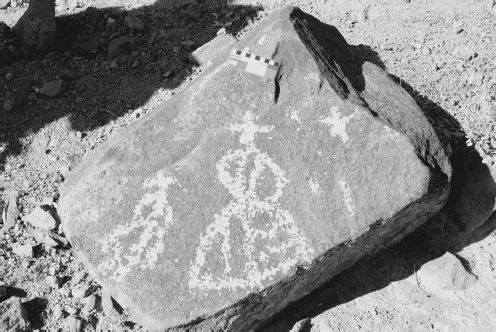
South America is a vast and diverse region with many different landscapes and environments and a huge biodiversity. Many different human groups have lived in these lands for at least 13,000 years, many of which produced rock art. Evidence from northern Brazil and Patagonia suggests that the practice of rock art production goes as far back as to the Pleistocene-Holocene transition (e.g. Neves et al. 2012; Paunero 2012; Podestá and Aschero 2012; Yacobaccio et al. 2012), i.e. around 11,000 BP, if not earlier (Plate 1). Nevertheless, it is only during the Late Holocene (ca. 5,000 BP), that rock art was popularised throughout most of South America, mostly in association with social and cultural change, such as a population increase, more intensive use of the landscape, greater mobility and a growing social complexity (e.g. Guffroy 1999; Aschero 2000; Schobinger and Strecker 2001; Berenguer 2004; Troncoso et al. 2017). In some regions, rock art production survived until even after the conquest of the region by the expansionist European empires, most notably in the Andes (e.g. Querejazu 1992; Martínez 2009; Recalde 2012; Rivet 2013) (Figure 1.1). Even though the “cultural contact” with the European powers brought social disruption, and in some cases the total genocide of indigenous communities, rock art was still being produced until fairly recent times, although on a much smaller scale (Gallardo et al. 1999). Creole communities at the beginning of the twentieth century kept on the tradition, which shows how this practice had a long life in the region (Podestá et al. 2011; Vergara and Troncoso 2016).
Beyond the social and environmental diversity of South America, the production of rock art occurred extensively, in very different spaces as well as at different times. This makes rock art a very pervasive kind of archaeological evidence, being produced and used in different social, economic, and political contexts, which offers a unique opportunity to address rock art as a cross-cultural phenomenon. In South America, rock art was produced by hunter-gatherer groups, agriculture-based communities with low and high social stratification, state formations such as the Inca Empire or Tawantinsuyu (Figure 1.2), peoples under the dominion of different empires (Tawantinsuyu, Spanish, and/or Portuguese), and by Creole communities living in the modern Western republics that originated after the Independence from the colonial powers in the nineteenth century. All this does not mean that rock art was homogenously produced. Regional studies have shown how the rhythms and intensities of this practice can vary greatly, showing how local historical processes are central for the understanding of rock art (e.g. Berenguer and Gallardo 1999; Guffroy 1999; Fiore and Podestá 2006; Strecker 2016).
Figure 1.1 Petroglyph of Colonial times. Limarí River Basin, north-central Chile.
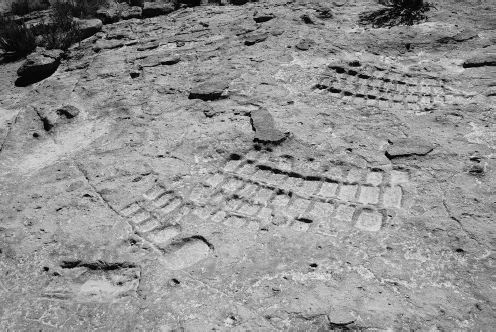
In such an ample region, it is no wonder that the visual and technical repertoires of rock art show great heterogeneity. From a technical point of view, four main types of rock art are found in South America: geoglyphs, rock paintings, petroglyphs, and the combination of the latter two. A fifth and more rare type of rock art corresponds to rocks carved, a particular kind of rock art made by the Inca state and recognised in some provinces of this Andean State (Van de Guchte 1990; Christie 2015; Strecker 2016). These carvings include zoomorphic figures as well as representations of landscapes and agricultural systems (see Figure 1.2). These types require different production processes, and once made, they have very different visibility conditions. These five types of rock art present different challenges, both in the recording methods and in the strategies needed for heritage conservation and management.
Figure 1.2 Inca carved outcrop, depicting crop fields. Cupo Locality, Atacama Desert.
South American rock art presents a set of characteristics that make it interesting not only from a local perspective in order to try to understand the historical development of the different areas, but also for the advance of comparative approaches that aim at a general discussion of rock art as a social and cultural phenomenon from a global point of view.
Rock art research in South America
The first references to rock art in South America within Western literature were given during the early years of European colonialism, when some chroniclers mentioned the existence of markings on rocks, which they associated to pagan rituals that had to be proscribed. For example, sixteenth-century Spanish chroniclers such as Cieza de León and J. de Acosta provided accounts of petroglyphs in Peru (see Guffroy 1999). This led to rock art of some regions to be intentionally destroyed by Catholic priests, in their processes of extirpation of idolatries (Martínez 2009).
After this first acknowledgment of the existence of rock art, and for a few centuries, no study was conducted on this material, and only some occasional references were made about it (Fiore and Hernández Llosas 2007). It was only during the early years of the twentieth century that rock art research became of interest. In South America, studies of rock art have followed four main lines which are not necessarily consecutive but came into being at different times. These lines of study present differences in terms of their use and historical development, based mainly on the internal differences (economic, social, political, etc.) of the subcontinent.
The first line of research can be seen as a descriptive attempt to discover, catalogue, and communicate the visual sets of the different areas of South America. This kind of research has a long history, although it has gone through several changes. The first works were mainly personal endeavours conducted by people interested in the topic but who did not develop a standardised methodology of recording and synthesis (e.g. Ambrosetti 1895; Rengifo 1919; Ryden 1944; Cabrera 1947). Thus, the only aim was to characterise the rock art and organise it chronologically. In most cases, these recording efforts were accompanied by sui generis interpretations that tended to have a strong diffusionist character. These descriptive works are still part of the research traditions of rock art in South America, although they now have systematic methods of recording, as well as having clearer aims, which are mostly related to territorial organisation and the protection and valorisation of the archaeological heritage, thus being closer to applied and public archaeology (e.g. Rolandi et al. 1998; Martínez 2005; Rosete 2015).
The second line of research has focused on style. Here, specialists have attempted to create culture-historical units that allow organising and understanding the underlying norms of rock art production. A central aspect of these approaches has been the development of theoretical, conceptual, and methodological frameworks to assess rock art, discussing the role of style in archaeological research. Thus, style has been addressed from semiotic, iconographic, and technological perspectives (i.e. Llamazares 1986; Troncoso 2005; Valenzuela 2007; Martel and Giraudo 2014; Sepúlveda 2016). This approach contrasts with the research traditions of other regions around the globe, where the concept of style has been criticised or has not been the focus within theoretical discussions to assess its definition, how it expresses materially, or what its different levels are (e.g. Bahn and Lorblanchet 1993). In South America, most efforts have discussed the relationship between different levels of style, together with the relationship between the individual and collective structures that underlie the production of rock art (i.e. Ré and Guichón 2009; Sepúlveda 2011a; Valenzuela et al. 2014).
These discussions have led the definition of styles in many areas to consider the different scales in which style manifests itself, as well as to the configuration of a stylistic set combining visual, technological, and spatial characteristics. A strong group of works in the region has offered technological approaches to rock art, studying and defining the chaînes operatoires involved in its production in order to characterise technological styles, following the proposals of the French school of anthropology of technology (Fiore 1999, 2007; Valenzuela 2007; Méndez 2008; Vergara and Troncoso 2015).
Although the use of style and its theoretical discussion is common in the region, in recent years it has been losing some of its strength, mainly due to the fact that for many scholars identifying rock art style is an initial research tool and forms part of what is a complex set of relationships that extend beyond design and theme. Furthermore, and thanks to the multi-scalar character of styles, the spatial distribution of the different elements that compose a style have been evaluated. This approach has allowed access to topics such as the flow of information between different social units, the creation of social networks, the consolidation of territorialities, and the storage of information (i.e. Ré et al. 2009; Gallardo et al. 2012; Barberena 2013; Troncoso et al. 2016; Barberena et al. 2017).
The third line of investigation can be defined as technological approaches, which have taken technology as the starting-poi...