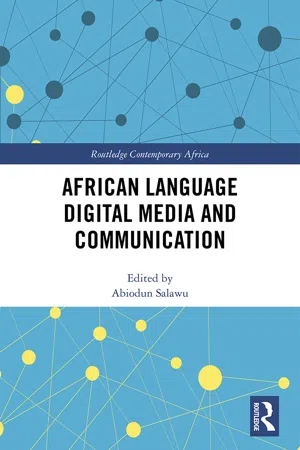
While some academic attention has been paid to the impact of new digital technologies on African media in the colonial languages of English, French and Portuguese, there is a dearth of research into African language digital communication. This book analyses the online presence of African language media. The chapters in the book focus on the speed, structure, content, navigation and interactivity, operations and performance, and audience of the online media. They also pay particular attention to how social media such as Facebook, Twitter and WhatsApp have been appropriated by African language media. Using a wide range of case studies, the contributors assess the challenges of adopting digital technologies by the media, and how the technologies have impacted journalistic practice and media operations.
Examining the ability of the African language press to adopt new technologies, this book will be of interest to scholars of media, journalism, communication, social media and culture in Africa.
- 236 pages
- English
- ePUB (mobile friendly)
- Available on iOS & Android
eBook - ePub
African Language Digital Media and Communication
About this book
Information
Section B
Audience, African language mass media and their adaptation to the digital sphere
2 Alaroye, Isolezwe and the adoption of digital technologies
Introduction
Mabweazara (2014a: 2) remarked that research into the impact of new digital technologies on African journalism is scarce. Here, Mabweazara is referring to the mainstream African journalism in the colonial languages of English, French and Portuguese. While it may be true that research into digital mainstream African journalism is scarce, it is non-existent for the media operating in indigenous African languages. A special issue of Digital Journalism (Volume 2, Number 1 of 2014) was dedicated to African digital journalism. Of the six research articles published in the issue, five of them focused on African journalism in the English language (Akinfemisoye, 2014; Bosch, 2014; El Gody, 2014; Mabweazara, 2014b; Verweij and van Noort, 2014). The remaining article was on journalism in Portuguese in Mozambique (Mare, 2014). Mabweazara et al. (2014) is a 14-chapter book of readings on online journalism in Africa, focusing on journalism in colonial languages of Africa.
Similarly, Sikanku (2011) studied Ghanaian online news sources in the English language, Ezumah (2013) studied online versions of four African newspapers in the English language and Chari (2014) focused on Zimbabwean online newspapers in English.
African journalism, generally, is seen as being “in deficit as regards the emerging global information order” (Berger, 2005: 1). However, Accone (2000:69) cautions that:
African journalists should hardly be viewed as second class Netizens. They have moulded internet tools to suit their specific needs, devised ingenious technical solutions to overcome the idiosyncrasies of their situations, and continue to apply the medium [effectively in various contexts].
Nyamnjoh (2005) agrees with this, contending that African journalists are determined to be part of the technological revolutions of the modern world (cf. Mabweazara, 2014a: 3). Obonyo (2011: 1) notes that what is particularly lacking are detailed qualitative explorations of how newsrooms (and their journalists) are adjusting to the new digital context of practice. This is more so for journalism in African languages.
The African language press remains an endangered species. Publishing newspapers in African languages has largely been a precarious business as many such newspapers disappear no sooner than they appear on the newsstands. A number of factors may be responsible for this short life-span of the newspapers. A possible one is the apathy to indigenous languages in Africa, which results in low patronage in terms of copy sales and advertisement placement. Salawu (2006a) notes that the story of indigenous language newspapers rising and dying is the same across most parts of Africa. In 1930, there were 19 registered African language newspapers in South Africa. They included the isiXhosa Imvo Zabantsundu and Inkundla ya Bantu. Today, most of those newspapers are non-existent. As recently as the 1990s, there were newspapers in 15 Ghanaian languages; today, there are none (Salawu, 2006b). In the colonial Democratic Republic of Congo, there were more than 150 periodicals in indigenous languages. Today, the story is quite different (Vinck, 2006). In Cameroon, there are no notable indigenous language newspapers (Tanjong and Muluh, 2006). Of all the newspapers in the first to the fourth “waves” of indigenous language press in Nigeria (Folarin and Mohammed, 1996), only Gaskiya Tafi Kwabo (established in 1937) still exists today. Iroyin Yoruba, established in 1945, existed till 1996 when it was finally laid to rest. Meanwhile, many other newspapers that came after Gaskiya and Iroyin Yoruba have since ceased to exist. Writing about (scholarly) writing and publishing in Africa, Mulokozi (2007: 105) observes that, besides attitudinal, policy and technical limitations, other constraints include a limited audience for works in some of the languages; shortage of writers well-versed in the languages and willing to write in those languages; lack of academic scholarly tradition; lack of reference resources; lack of specialised terminologies; and hesitancy of publishers to publish works in those languages.
There are, however, some outstanding success stories in African language newspaper publishing. In Yorubaland (Nigeria) today, for instance, there are still some Yoruba newspapers serving the people. Among them, Alaroye, in particular, is a phenomenal success. In South Africa, there is a daily Zulu newspaper, called Isolezwe. The newspaper has become a household name among its readers, while its popularity is attested to by the fact that it sells on average more than 100,000 copies per day (Salawu, 2013). It is reported that the newspaper, launched in 2002, has even lured readers away from established English newspapers (Salawu 2013: 55). Ilanga and UmAfrika, both in KwaZulu-Natal, South Africa, have been in existence since 1903 and 1929, respectively. And, among the 125 newspapers in Ethiopia, 108 are in Amharic, two in Oromo and one in Tigre. Ethiopia is one of three countries in Africa (with Tanzania and Somalia) where a local language is used as a medium of instruction to a high level and for official and administrative purposes.
The model of managing African languages as presented by Salawu (2013, 2015) indicates that, irrespective of the models adopted for the management of African language newspapers (mainstream or subsidiary), there is always the issue of scarce resources, lack of adequate capacity and priority of attention. It is the sorry state of the African language press that triggers the thinking about their ability to adopt digital technologies, and to what extent they are able to do so. While this study is interested in a survey of the existence of websites for African language newspapers in general, the study will essentially focus on two of them: Alaroye (Nigeria, West Africa) and Isolezwe (South Africa, Southern Africa). The study is interested in knowing the extent to which African language newspapers are present online, the features of these selected online African language newspapers in terms of speed, structure, content, navigation and interactivity, the extent to which the selected African language newspapers appropriate social media such as Twitter and Facebook and how the editors/publishers of the newspapers assess the challenges of adopting digital technologies and the impact of the technologies on their journalism practice and operations.
Digital journalism, innovations and adoption
Kreiss and Brennen (2015) identify four broad values that are unique to theorising about digital journalism. They are participation, deinstitutionalisation, innovation and entrepreneurialism. The value of innovation is of special interest to this chapter. Due to “innovation” being undefined in digital journalism literature, there has been a porous use of the term. Kreiss and Brennen (2015: 11) see it as a catch-all term which spans the development of novel business models, collaborations, technologies, practices and content. However, as far as innovation is concerned, Lewis and Usher (2013: 603) argue that the most developed line of work in journalism has been a “technology-focused approach to journalism innovation”. They argue that there is an increasing transfer of the practices, values and tools of technologists, specifically from open source communities, to journalism (cf. Kreiss and Brennen, 2015: 12). Lewis and Usher (2013) further note how the value of open source technical production is being carried into traditional journalism through the hiring of workers from the technology industry, the work of funding agencies, the migration of normative practices from the open source movement to journalism and the broader cultural work of “meta-journalistic” discourse about the profession’s future.
Meanwhile, scholars such as Spyridou et al. (2013: 77) have expressed concern that innovation in journalism is being held back by professional cultures that simply dictate that journalists take up new technologies to do “their (traditional) jobs better instead of moving on to the next stage built around a stronger commitment to capitalize on the growing sociotechnical potential” of digital media (cf. Kreiss and Brennen, 2015: 13).
Notwithstanding, scholars including Pavlik (2013) have asserted that the key to the viability of news media in the digital age is innovation. Pavlik (2013: 183) defines innovation in news media as “the process of taking new approaches to media practices and forms while maintaining a commitment to quality and high ethical standards”. According to Pavlik, innovation in news media, including both the professional journalists and citizen journalists who generate news content, lies along at least four dimensions: (1) creating, delivering and presenting quality news content; (2) engaging the public in an interactive news discourse; (3) employing new methods of reporting optimised for the digital, networked age; and (4) developing new management and organisational strategies for a digital, networked and mobile environment (Pavlik, 2013: 183).
Diakopolous (2012) suggests that innovations in journalism should be based on three considerations: (1) what innovations are needed to solve problems, meet user needs through new experiences or increase efficiencies in processes; (2) whether the innovation is technically feasible and how to make it work; and (3) whether the solution fits the values of the intended users and is likely to be adopted (cf. Pavlik, 2013: 185).
In their study, Ekdale et al. (2015) find that technological change faces the fewest hurdles as journalists are increasingly convinced of the merits – indeed, the necessity – of adapting their practices to newer technological capabilities. According to them, the diffusion of changes related to audience relationships faces greater resistance, while changes related to the professional culture of journalism remain the most challenging (Ekdale et al., 2015: 2). Scholars of digital journalism often posit professional culture, values, practices and nostalgia as a key source of journalism’s economic woes and failure to innovate (Kreiss and Brennen, 2015: 13). Meanwhile, Garrison (2001) found that reporters’ growing internet use was not only redefining newsroom roles but also encountering resistance, with staffers citing inadequate training and time as reasons for lack of adoption (cf. Ekdale et al., 2015: 4; see also Fenton, 2010; Wallace, 2009; Witschge and Nygren, 2009). Hermida (2010) reports that newer social media technologies, notably, Twitter, have diffused rapidly, perhaps because their features are compatible with established breaking news practices.
Digital journalism in Nigeria and South Africa
All the major newspapers, magazines, radio and television in Nigeria are on the internet (Ganiyu and Akinreti, 2011; Kperogi, 2012). Initially, Nigerian media were cautious in embracing the digital technologies owing to challenges of funding, infrastructure and personnel. Ganiyu and Akinreti (2011: 143) observed that some media organisations merely registered their presence on the internet; a few joined the crowd and got lost owing to inadequate planning and personnel, while others fully embraced the multimedia platform.
The defunct Post Express newspaper was the first Nigerian newspaper to register its presence on the web in 1996. Kperogi (2012: 446) observes that, like many newspapers at the time, the Post Express merely recycled its print content to the web. Soon, others followed. The online appearances of the newspapers evolved gradually from being episodic to being constant, live and interactive. They now contain full multimedia content, including text, audio, video, graphics and pictures.
Naturally, the rise of digital journalism in South Africa is tied to global trends to move newspapers online. Bosch (2010: 265) contends that digital journalism, in many ways, is not a new phenomenon and has been practised in South Africa for some time. She argues that journalists have always used digital technologies in the practice of their craft, even though interactivity is a recent phenomenon. Cited in Bosch (2010), Scott (2005) notes that online journalism in South Africa is often a supplement (and not a complement) to print and broadcast media.
In real terms, South African newspapers started going online in the mid-1990s. Mail and Guardian and Financial Mail led the way. At this time, the newspapers were merely transferring content online with text-heavy sites (Berger, 2004). However, South African digital journalism has improved since that time, demonstrating global standards and practices. Daniels (2015) remarks that the transition to digital in South African newsrooms has radically altered life for journalists. According to her, there are now smaller converged newsrooms with fewer journalists, who have to handle the dissemination of news on several platforms. This unfortunately has led to retrenchments, particularly of older journalists who are considered to be less digitally minded than the younger ones.
Meanwhile, a major problem for commercial/mainstream organisations in South Africa has been how to bring in revenue from the digital products. The report on the state of the newsroom in South Africa in 2014 (Daniels, 2015) also observes that the use of social media in the newsroom is increasing in leaps and bounds. In 2013, Twitter was the most used social network in the newsroom, and by 2014, it had accelerated to being regarded as an “indispensable professional tool”.
English is the dominant language f...
Table of contents
- Cover
- Half Title
- Title Page
- Copyright page
- Table of Contents
- Notes on contributors
- Acknowledgements
- Introduction: not to be left behind – African languages, media and the digital sphere
- SECTION A Digital media, revitalisation and sustainability of African languages
- SECTION B Audience, African language mass media and their adaptation to the digital sphere
- SECTION C African languages in social media
- SECTION D Contents, challenges and prospects of online African language media
- Index
Trusted by 375,005 students
Access to over 1.5 million titles for a fair monthly price.
Study more efficiently using our study tools.
Frequently asked questions
Yes, you can cancel anytime from the Subscription tab in your account settings on the Perlego website. Your subscription will stay active until the end of your current billing period. Learn how to cancel your subscription
No, books cannot be downloaded as external files, such as PDFs, for use outside of Perlego. However, you can download books within the Perlego app for offline reading on mobile or tablet. Learn how to download books offline
Perlego offers two plans: Essential and Complete
- Essential is ideal for learners and professionals who enjoy exploring a wide range of subjects. Access the Essential Library with 800,000+ trusted titles and best-sellers across business, personal growth, and the humanities. Includes unlimited reading time and Standard Read Aloud voice.
- Complete: Perfect for advanced learners and researchers needing full, unrestricted access. Unlock 1.5M+ books across hundreds of subjects, including academic and specialized titles. The Complete Plan also includes advanced features like Premium Read Aloud and Research Assistant.
We are an online textbook subscription service, where you can get access to an entire online library for less than the price of a single book per month. With over 1.5 million books across 990+ topics, we’ve got you covered! Learn about our mission
Look out for the read-aloud symbol on your next book to see if you can listen to it. The read-aloud tool reads text aloud for you, highlighting the text as it is being read. You can pause it, speed it up and slow it down. Learn more about Read Aloud
Yes! You can use the Perlego app on both iOS and Android devices to read anytime, anywhere — even offline. Perfect for commutes or when you’re on the go.
Please note we cannot support devices running on iOS 13 and Android 7 or earlier. Learn more about using the app
Please note we cannot support devices running on iOS 13 and Android 7 or earlier. Learn more about using the app
Yes, you can access African Language Digital Media and Communication by Abiodun Salawu in PDF and/or ePUB format, as well as other popular books in Social Sciences & Media Studies. We have over 1.5 million books available in our catalogue for you to explore.