![]()
Part I
Bible Women, deaconesses, and missionaries
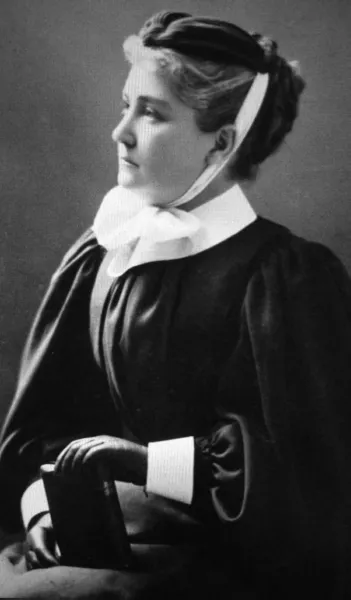
Jean Scott, Superintendent, Methodist National Training School, Toronto
![]()
1 Methodist Bible Women in Bulgaria and Italy
Paul W. Chilcote and Ulrike Schuler
When one thinks of the global character of The United Methodist Church today, the nations of Bulgaria and Italy do not immediately spring to mind as arenas in which this tradition has had a presence. Yet, the Methodist churches in these European countries have a deep and rich history, and much of it may be traced back to the influence of women. Women functioned as pioneers on multiple levels in these two settings, but we must first turn to the indigenous women of Bulgaria and Italy to identify the earliest pioneers of Methodist evangelism and mission.
Pioneering Bible Women
In Bulgaria and Italy the early evangelistic work of the Methodists was closely linked with so-called Bible Women. These women, also known as Bible Readers, were simply indigenous women hired to do evangelistic work, functioning much like the deaconesses of the early church.1 There seems to be little question that the development of this role for women coincided directly with the rise of the various women’s societies since there was no such practice prior to their birth. In Methodism, the earliest “use” of Bible Women as paid employees dates from as early as 1861, perhaps, when Mrs. T. C. Doremus sent money to Annie Gracey “for the employment of some native Christian woman as Bible reader or teacher.”2
According to R. Pierce Beaver, “The Bible woman, catechist or evangelist, was the lowliest employee on the hierarchical ladder of the mission churches.”3 These women seemed to have been trained at first in an ad hoc manner and provided only the most rudimentary skill base for personal evangelism. Actual training schools soon displaced personal tutelage, and schools for girls, in particular, became the primary training ground for these women. The training of girls became all the more significant for the ministry of the mission since boys educated in similar schools often transferred their skills into business, industry, and government rather than finding a place in the service of the church. Used to great effect in Asian contexts, therefore, the office of Bible Woman later spread throughout the various arenas of the Woman’s Foreign Missionary Society (WFMS) activity.4 Beyond this, Dana Robert has noted the predilection of WFMS leaders to use indigenous women in simple evangelistic practices. “Bible women were both cheaper to support and more effective as evangelists than western women,” she observes. “Methodist women were more likely to find themselves training Bible women than serving as evangelists themselves.”5 While they functioned primarily as evangelists, the Bible Women also devoted time and energy to teaching and discipling, distributing Christian literature, and providing health care services to the needy. Unlike other national workers, they were salaried employees of the mission station. While Frances Hiebert correctly notes that they shared in “the evangelism and Bible teaching that brought to birth the churches of the non-Western world,” Methodist Bible Women in Europe also fulfilled this significant role in a Western context.6
It is less known that
in 1845 women missionaries serving with the American Board of Commissioners of Foreign Mission [ABCFM] opened a Female Seminary in Constantinople (the capital of the Ottoman Empire, today Istanbul). It began with eight students, but the number quickly increased. By the 1860s Bible Women were being employed in that city by the American Bible Society.7
Tucker also notes that “there were training programs for Bible women at several mission stations in Turkey, including a Girl’s Seminary at Aintab … still training women five decades later.”8 At the beginning of Methodist work with Bible Women in Bulgaria, it is difficult to distinguish between those who worked for the ABCFM and those who worked for the Methodists; it appears that the greater concern was for a common “Protestant mission.” It is very difficult to document where the first Bible Women in Italy received their education. It seems that Emily Vernon, the wife of the first Methodist Episcopal Church (MEC) missionary to Italy, had her hand in this.9 Barclay confirms that she “had been in charge of women’s work in the mission [and] considered the work of the Bible women as highly important.”10
The MEC mission board and the WFMS simply replicated the non-Western pattern in their European centers, in which the Bible Women became the “backbone of women’s work in missions” through their wide-ranging ministry.11 The evidence drawn from the Methodist work in Bulgaria and Italy confirms Tucker’s settled opinion that “without Bible Women, female missionaries would have been at a loss.”12
Bible Women in Bulgaria
The ABCFM began their work in the Ottoman Empire in 1819, having received calls from Bulgaria for support to renew the Orthodox Church.13 While the Ottoman Empire formally authorized the practice of Islam, Christianity, and Judaism in 1839, in 1850/51 the Turkish Sultan granted a special dispensation to Protestants, permitting them to engage in mission activities in the Ottoman Empire and in the Balkans, in particular.14 Personnel challenges led the ABCFM to request support from MEC, which appointed two missionaries to Constantinople as their base in 1857.15 In Tulča, Frederick William Flocken, later appointed Methodist Superintendent, opened a Sunday school and day school.16 Clara Proca was the first woman employed as a Bible Woman of the WFMS in 1874 when Methodist work began in Bulgaria.17 She was also “one of the first scholars in the mission school in 1860.”18
For details with regard to these developments, we must turn to the Heathen Woman’s Friend.19 Rev. Flocken arrived in Shumen, Bulgaria, in 1859 where he established the first Methodist work in that area.20 As superintendent of the work in the 1870s, he submitted reports of the activities of the Bible Women to the women’s periodical. In 1875, Flocken quoted from Clara Proca’s quarterly report, detailing her encounter with an Armenian widow. She wrote:
I then took out my Russian Testament and read to her of Jesus; how He loved the world, died for sinners, shed His blood for their redemption, and how He invites all sinners to come to Him. I read to her of the prodigal son, and the malefactors on the cross, and begged her to pray to Jesus, to trust in Jesus, and to hope everything from no one else but Jesus. I prayed with her, commended her to Jesus, and left her.21
She later reported the positive effect of her prayers. According to Flocken’s report, during the previous quarter she had visited 65 families and distributed tracts throughout the neighboring areas. Her general pattern was to teach a number of the children part of the day and to visit from house to house during the course of the remaining hours.
The October 1875 issue of the Heathen Woman’s Friend provided a biographical account of Clara and identified some of her accomplishments.22 Born of German parents in Transylvania around 1848, she immigrated with her family to Bulgaria and enrolled in the mission school in Samokov in 1860. Four years later she was appointed assistant teacher at the school and engaged in informal evangelistic work. In 1867 she married, but when her husband’s business failed two years later, he left her for America, leaving behind two children and Clara’s parents under her own care. The WFMS began to fund her work in 1873, thereby providing her with a livelihood – remuneration for the meaningful work she had continued in for some years. Flocken reflected on the range of her accomplishments during the course of her formal appointment as a Bible Woman:
She has now been almost two years in the employ of the mission, and I have many proofs that she has accomplished what no male agent could have done. She has reorganized our former Sabbath School at Tultscha, holds regular prayer-meetings with the women, visits them in their houses, reads, and instructs them in the Bible, and distributes tracts to such as can read. The women attending her meetings are Germans, Russians, Bulgarians, Wallachians, and Jews, with all of whom she can converse in their respective languages.
He also identified Magdalena Elief as a partner in this work with Clara. An excerpt from her quarterly report provides some insight into the nature of her work as well:
In my visits from house to house I find that some of the wom...