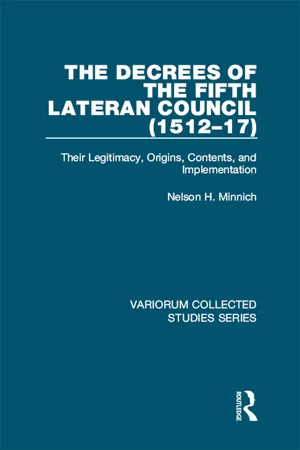
eBook - ePub
The Decrees of the Fifth Lateran Council (1512–17)
Their Legitimacy, Origins, Contents, and Implementation
- 336 pages
- English
- ePUB (mobile friendly)
- Available on iOS & Android
eBook - ePub
The Decrees of the Fifth Lateran Council (1512–17)
Their Legitimacy, Origins, Contents, and Implementation
About this book
The Fifth Lateran Council (1512-17), whose 500th anniversary is being commemorated, has left a legacy little studied by scholars. The council's status as an ecumenical council was questioned by its opponents and its decrees ignored, resisted, or only slowly implemented. This new collection of articles by Nelson H. Minnich examines: what is an ecumenical council, the reasons Lateran V qualifies as such, the roles the popes played in it, the council as a theater for demonstrating papal power, what was proposed as its agenda, what decrees were issued, and to what extent they were implemented. The decrees that receive special attention are those: affirming the legitimacy of the credit organizations known as montes pietatis that charged management fees, imposing prepublication censorship on printed works, abrogating the Pragmatic Sanction of Bourges (1438), reining in the privileges of mendicant friars, and closing the council while imposing a crusade tithe. These decrees were gradually implemented and Carlo Borromeo incorporated some of the Lateran reform decrees into his conciliar legislation that was taken up by other bishops. Lateran V did leave a lasting legacy and Leo X considered the council one of his great achievements. The volume includes four studies not previously published in English. (CS1060).
Information
Table of contents
- Cover
- Half Title
- Title Page
- Copyright Page
- Table of Contents
- Acknowledgements
- Preface
- I What is an ecumenical council? The sixteenth-century teachings of the theologian Roberto Bellarmino and the canonist Domenico Giacobazzi
- II The legitimacy of the fifth Lateran Council (1512–17)
- III Lateran V as a sacred drama demonstrating papal power
- IV Julius II and Leo X as presidents of the fifth Lateran Council (1512–1517)
- V Session IX: Origins of Decree Supernae dispositionis arbitrio (1514) – The reform proposals (1513) of Stefano Taleazzi for the fifth Lateran Council (1512–17)
- VI Session X: Decree Inter multiplices on credit organizations (1515) – The Decree Inter multiplices of Lateran V on Montes pietatis
- VII Session X: Decree Inter sollicitudines on preventive censorship (1515) – The fifth Lateran Council and preventive censorship of printed books
- VIII Session XI: Decree Pastor Aeternus on papal control of councils (1516) – Luther, Cajetan, and Pastor Aeternus (1516) of Lateran V on conciliar authority
- IX Session XI: Decree Dum intra mentis arcana on religious and their privileges – Egidio Antonini da Viterbo, the reform of religious orders, and the fifth Lateran Council (1512–1517)
- X Session XII: Decree Constituti iuxta verbum on closing the Council – The closing of the fifth Lateran Council (1512–17)
- XI The implementation of Lateran V by the Milanese councils of San Carlo Borromeo
- XII Leo X: success or failure?
- Index
Trusted by 375,005 students
Access to over 1.5 million titles for a fair monthly price.
Study more efficiently using our study tools.
Frequently asked questions
Yes, you can cancel anytime from the Subscription tab in your account settings on the Perlego website. Your subscription will stay active until the end of your current billing period. Learn how to cancel your subscription
No, books cannot be downloaded as external files, such as PDFs, for use outside of Perlego. However, you can download books within the Perlego app for offline reading on mobile or tablet. Learn how to download books offline
Perlego offers two plans: Essential and Complete
- Essential is ideal for learners and professionals who enjoy exploring a wide range of subjects. Access the Essential Library with 800,000+ trusted titles and best-sellers across business, personal growth, and the humanities. Includes unlimited reading time and Standard Read Aloud voice.
- Complete: Perfect for advanced learners and researchers needing full, unrestricted access. Unlock 1.5M+ books across hundreds of subjects, including academic and specialized titles. The Complete Plan also includes advanced features like Premium Read Aloud and Research Assistant.
We are an online textbook subscription service, where you can get access to an entire online library for less than the price of a single book per month. With over 1.5 million books across 990+ topics, we’ve got you covered! Learn about our mission
Look out for the read-aloud symbol on your next book to see if you can listen to it. The read-aloud tool reads text aloud for you, highlighting the text as it is being read. You can pause it, speed it up and slow it down. Learn more about Read Aloud
Yes! You can use the Perlego app on both iOS and Android devices to read anytime, anywhere — even offline. Perfect for commutes or when you’re on the go.
Please note we cannot support devices running on iOS 13 and Android 7 or earlier. Learn more about using the app
Please note we cannot support devices running on iOS 13 and Android 7 or earlier. Learn more about using the app
Yes, you can access The Decrees of the Fifth Lateran Council (1512–17) by Nelson H. Minnich in PDF and/or ePUB format, as well as other popular books in Theology & Religion & Architecture General. We have over 1.5 million books available in our catalogue for you to explore.