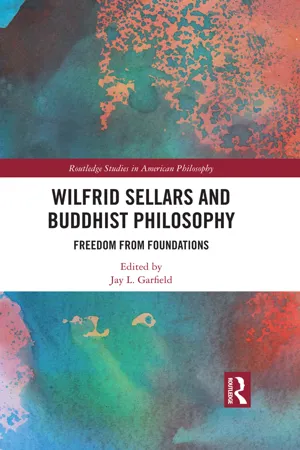
The aim of this book is to address the relevance of Wilfrid Sellars' philosophy to understanding topics in Buddhist philosophy. While contemporary scholars of Buddhism often take Sellars as a touchstone for philosophical analysis, and while many take Sellars' corpus as their entrée into current philosophical discourse, fewer contemporary philosophers have crossed the bridge in the other direction, using Sellarsian ideas as a way of entering into Buddhist philosophy. The essays in this volume, written by both philosophers and Buddhist Studies scholars, are divided into two sections organized around two of Sellars' essays that have been particularly influential in Buddhist Studies: "Philosophy and the Scientific Image of Man" and "Empiricism and the Philosophy of Mind." The chapters in Part I generally address questions concerning the two truths, while those in Part II concern issues in epistemology and philosophy of mind. The volume will be of interest to Sellars scholars, to scholars interested in the contemporary interaction of Buddhist philosophy and Western philosophy and to scholars of Buddhist Studies.
- 254 pages
- English
- ePUB (mobile friendly)
- Available on iOS & Android
eBook - ePub
About this book
Information
Part I
Two Images and Two Truths
1
The World in Which Everything Is the Self
The Philosophy of the Original Image and Pan-Self-Ism
Introduction
The aim of this paper is to explore and try to give an answer to the question: what happens when the philosophy of Wilfrid Sellars meets the tradition of Japanese Buddhist philosophy? That is, what can be gained if we read the text of Sellars vis-à-vis the texts of Japanese Buddhist philosophers, in the style of cross-cultural fusion philosophy?
To be more specific, the philosophies of Dōgen, a 13th-century Japanese Buddhist, and Kitaro Nishida, a 20th-century Japanese philosopher, will be joined to the philosophy of Sellars. The link that connects these historically and geographically disparate figures is the concept of “self.” The confluence of these two distinct currents of philosophy will lead us to the thesis of pan-self-ism: the thesis that everything that is found in the world is an “I” or a “self.” To make clear and specify in which sense the thesis of pan-self-ism is to be understood and make us see the rich philosophical potentiality of it is the final aim of this paper.
With that broad objective in view, let us begin by having a look at Sellars’ take on the images of man-in-the-world and the concept of a person, which is closely connected to his understanding of the concept of an “I” or a “self.”
I. Sellars and the Philosophy of the Original Image
The Importance of the Original Image
1. In “Philosophy and the Scientific Image of Man,” Sellars famously speaks of the “images of man-in-the-world.” To count the number of the images, Sellars is speaking about three, and two are distinct of these; that is, the manifest and the scientific.
2. Of the two images that are said to be distinct, the manifest image, roughly, is the image of the “Lebenswelt” (MEV, I-4) as “the framework of common sense” (SM, I-41), or the image in which we are present as persons and which is full of meaning and normativity.
In contrast, the scientific image is explained as “the world as our best science represents it.” That is, the world of natural phenomena governed by natural law, studied by microphysics, cosmology, chemistry, and biology. This image is devoid of persons, devoid of normativity, and devoid of meaning.1
3. As would be expected (and actually has been pointed out by Garfield [2012]), most scholars have focused solely on these two images, ignoring the third—the original—and not without reasons. In effect, Sellars himself urges the readers to focus on these two images. For example, he says this:
[T]he [contemporary] philosopher is confronted… by two pictures of essentially the same order of complexity, each of which purports to be a complete picture of man-in-the-world, and which, after separate scrutiny, he must fuse into one vision.
(PSIM, 373)
[W]hat I mean by the manifest image is a refinement or sophistication of what might be called the “original” image; a refinement to a degree which makes it relevant to the contemporary intellectual sense.
(PSIM, 375)
It should be reasonable enough if a reader of the first sentence takes it that all that the contemporary philosopher needs to care is the two images of man-in-the-world, and the third, if there exists one, can be relegated to the margin of philosophical inquiry as an outdated worldview. Also, isn’t the second citation telling us that Sellars himself is assuming the original image to be just insufficiently refined, thus cannot be a target of serious consideration in a contemporary intellectual sense?
4. It is not difficult to see why the original image cannot expect much attention from contemporary readers. Only a few citations from Sellars will do.
[In the original image, a] primitive man did not believe that the tree in front of him was a person, in the sense that he thought of it both as a tree and as a person, as I might think that this brick in front of me is a doorstop…. The truth is, rather, that originally to be a tree was a way of being a person, as, to use a close analogy, to be a woman is a way of being a person, or to be a triangle is a way of being a plane figure.
(PSIM, 378)
[I]n the original image to say of the wind that it blew down one’s house would imply that the wind either decided to do so with an end in view, and might, perhaps, have been persuaded not to do it, or that it acted thoughtlessly (either from habit or impulse), or, perhaps, inadvertently.
(PSIM, 380f.)
Evidently, the original image is defined as the framework in which everything is a person. Questions naturally arise: Why bother to fuss about the original image? After all, isn’t it just a worldview of primitive man, who lived in a mythical world devoid of science and rational thought? The world in which the wind blows down a house on its own intention? That’s just a crazy idea.
5. In my opinion, this is a pitiful situation. As Garfield (2012) rightly points out, the original image plays an important role in the philosophical system of Sellars. Thus, argues Garfield: (1) the original image is consistent with the evidence gained from contemporary developmental and cognitive psychology, and (2) the original image, as well as the manifest and the scientific, needs to be in play to fully appreciate the Sellarsian project of naturalizing epistemology and finding a place for normativity in nature. I join Garfield in the project of vindicating the importance of the original image. That is, this paper also aims to argue that the third, “original” image of man-in-the-world, which had been widely and unduly neglected, merits our philosophical attention.
On the other hand, this paper takes a different route from Garfield. Roughly, my argument will proceed in the following order:
- A fair reading of PSIM suggests that there’s a paradox or inconsistency in Sellars’ explanation about the original and the manifest image. Put in advance, it will be argued that Sellars is eventually committed to the idea that “being a person is not equivalent to being a man.” This, at least, is a thesis that needs explaining.
- I will show that Sellars’ original characterization of the original image as “a framework in which everything is a person” can be reformulated as a thesis of pan-self-ism, that is, as the thesis that “everything is an ‘I’ or a ‘self’ in the original image.”
- After discussing Sellars’ original image, I will adopt an approach that might be called a cross-cultural fusion philosophy, with a view to having a deeper understanding of pan-self-ism and making the pan-self-ist reading of Sellars a defensible one. As a first step, I will take up the theory of self advanced by a 13th-century Japanese Buddhist philosopher, Dōgen (1200–1253), who is explicitly committed to the idea of pan-self-ism, and provide a detailed account of what pan-self-ism amounts to.
- Also, I will refer to a 20th-century Japanese philosopher, Kitaro Nishida (1870–1945), who was deeply influenced by Dōgen, and utilize his original conception of “pure experience” and “the logic of the Field (Basho)” to give a further explication of Dōgen’s thought on the self and the pas-self-ist understanding of the world.
- As the final discussion of the paper, I will turn back to the philosophy of Sellars and point out that one vein of his philosophy, which has not been paid much attention so far, will help us to excavate the fine structure embedded in the rich but esoteric ores of Dōgen and Nishida. As will be shown, Sellars’ language of high resolution gives us a very strong aid in understanding and illuminating the bold and eye-opening but sometimes dark and enigmatic texts of Dōgen and Nishida. Thus, my conclusion will be that the Sellars-Dōgen-Nishida triangle affords persuasive evidence for appreciating the rich philosophical potentiality of pan-self-ism.
Persons in the Two Images
6. Let us continue by having a look at the relationship between the manifest and the original image. The key concept that connects these two images is, as is evident from the next citation, that of “persons.”
The first point I wish to make is that there is an important sense in which the primary objects of the manifest image are persons…. Perhaps the best way to make the point is to refer back to the construct which we called the “original” image of man-in-the-world, and characterize it as a framework in which all the “objects” are persons. From this point of view, the refinement of the “original” image into the manifest image, is the gradual “de-personalization” of objects other than persons. That something like this has occurred with the advance of civilization is a familiar fact.
(PSIM, 378)
Sellars seems to be telling us a familiar sort of historical story: there once was a time in which all “objects” were persons (the original image). However, as civilization advanced, this primordial worldview was gradually “depersonalized,” and we came to reside in a more refined framework in which only humans are present as persons.
7. However, at this point, we encounter another, quite puzzling passage. At one point in PSIM, prior to the citation just above, Sellars says this:
[The “manifest” image of man-in-the-world] is, first, the framework in terms of which man came to be aware of himself as man-in-the-world. It is the framework in terms of which, to use an existentialist turn of phrase, man first encountered himself—which is, of course, when he came to be a man.
(PSIM, 374; emphasis mine)
8. Flatly, what Sellars says can be summarized in this way:
- Man couldn’t be man until he encountered himself, and man first came to be a man in the manifest image.
- That is, in the original image, which precedes the manifest image, man was not a man.
- However, as we already saw, Sellars also says that the original image is a framework in which all “objects” are persons.
- In effect, Sellars is saying something like this: “in the original image, man was not a man even though everything was a person.”
- In addition, Sellars says that “man became a man through the process of de-personalization.”
- That is, a person that had not been a man came to be a man through the process of depersonalization.
9. However, the theses specified as (d) and (f) should sound rather perplexing. By these, Sellars is virtually saying “being a person is not equivalent to being a man.” At least, there’s no denying that the thesis that “man was not a man even though everything was a person” contains a tension that needs alleviating.
Sellars on the Concept of a Person
10. Let us proceed by examining what Sellars had in mind when he refers to the key concept of “a person.” As will be shown below, Sellars mentions three conditions that the “objects,” for them to be persons, need to meet. Namely:
- Persons are those who engage in conceptual-cum-normative thinking.
- Persons are those who have membership in a community.
- Persons are those who rehearse the intentions of others.
Our next task is to give a brief review of these conditions and find a clue to solve the problem about being a person specified above.
11. To repeat, the first condition for being a person Sellars puts forward is this: “being a person means being an agent that engages in conceptual thinking” (PSIM, 374). That is, for Sellars, the ability to think (or to use concepts) is “that which distinguishes man from merely material things and from brutes” (SK, I-29).
Sellars says that the gap between that which thinks and that which does not is irreducible, and the core of this irreducibility is found in the normative character of conceptual thinking. In Sellars’ own voice:
To think of a featherless biped as a person is to think of it as a being with which one is bound up in a network of rights and duties. From this point of view, the irreducibility of the personal is the irreducibility of the “ought” to the “is.”
(PSIM, 407)
Being an agent of conceptual thinking is being a resident of the normative space, where one’s thoughts are measured by “standards of correctness, of relevance, of evidence” and are judged to be “correct” or “incorrect,” “right” or “wrong,” “done” or “not done” (PSIM, 408). That is, being a person is equivalent to being an agent that subjects one’s thought or utterance to “a framework […] in terms of which it can be criticized, supported, refuted, in short evaluated” (PSIM, 374).
12. Sellars emphasizes that this irreducible core of personhood can be given a further stipulation, which he says is “even more basic” than the irreducibility of the “ought” to the “is.” As Sellars puts it:
But even more basic than this [irreducibility of the “ought” to the “is”] (though ultimately, as we shall see, the two points coincide), is the fact that to think of a featherless biped as a person is to construe its behavior in terms of actual or potential membership in an embracing group each member of which thinks of itself as a member of the group. Let us call such a group a “community.” […] Thus, to recognize a featherless biped or dolphin or Martian as a person is to think of oneself and it as belonging to a community.
(PSIM, 407f.; [] are my insertion)
Here, Sellars elucidates the irreducible character of normative thinking in terms of “membership” in a community.2 He suggests that this normativity consists of the fact that our linguistic use is evaluated in accordance with rules. To use Sellars’ analogy, the moves of linguistic items are like those of chess pieces. That is, there are correct and incorrect language uses, and the judgments about their correctness or incorrectness are made in accordance with the rules that govern the linguistic practice we are in.
The rules that govern the correct and incorrect uses of language are already and oftentimes implicitly in play in social practice. That is, we don’t choose which rules to follow.
For example, to which further claims your utterance “Xiang Xiang is a panda” entitles you to “Xiang Xiang is a mammal,” but not “Xiang Xiang is a fish,” is determined by the rules that are already and implicitly in play in public practice. In this sense, the evaluation of our linguistic uses is normatively and rationally constrained by social/public practice.
13. Following the soci...
Table of contents
- Cover
- Half Title
- Series Page
- Title
- Copyright
- Dedication
- Contents
- Introduction
- PART I Two Images and Two Truths
- PART II The Myth of the Given and Buddhist Philosophy of Mind
- References
- List of Contributors
- Index
Trusted by 375,005 students
Access to over 1.5 million titles for a fair monthly price.
Study more efficiently using our study tools.
Frequently asked questions
Yes, you can cancel anytime from the Subscription tab in your account settings on the Perlego website. Your subscription will stay active until the end of your current billing period. Learn how to cancel your subscription
No, books cannot be downloaded as external files, such as PDFs, for use outside of Perlego. However, you can download books within the Perlego app for offline reading on mobile or tablet. Learn how to download books offline
Perlego offers two plans: Essential and Complete
- Essential is ideal for learners and professionals who enjoy exploring a wide range of subjects. Access the Essential Library with 800,000+ trusted titles and best-sellers across business, personal growth, and the humanities. Includes unlimited reading time and Standard Read Aloud voice.
- Complete: Perfect for advanced learners and researchers needing full, unrestricted access. Unlock 1.5M+ books across hundreds of subjects, including academic and specialized titles. The Complete Plan also includes advanced features like Premium Read Aloud and Research Assistant.
We are an online textbook subscription service, where you can get access to an entire online library for less than the price of a single book per month. With over 1.5 million books across 990+ topics, we’ve got you covered! Learn about our mission
Look out for the read-aloud symbol on your next book to see if you can listen to it. The read-aloud tool reads text aloud for you, highlighting the text as it is being read. You can pause it, speed it up and slow it down. Learn more about Read Aloud
Yes! You can use the Perlego app on both iOS and Android devices to read anytime, anywhere — even offline. Perfect for commutes or when you’re on the go.
Please note we cannot support devices running on iOS 13 and Android 7 or earlier. Learn more about using the app
Please note we cannot support devices running on iOS 13 and Android 7 or earlier. Learn more about using the app
Yes, you can access Wilfrid Sellars and Buddhist Philosophy by Jay L. Garfield in PDF and/or ePUB format, as well as other popular books in Philosophy & Eastern Philosophy. We have over 1.5 million books available in our catalogue for you to explore.