eBook - ePub
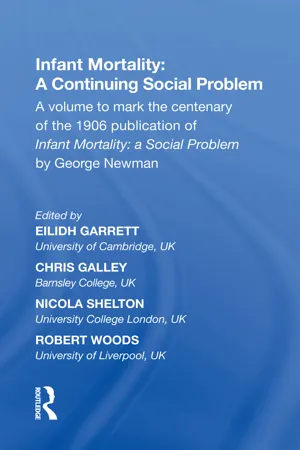
Infant Mortality: A Continuing Social Problem
- 312 pages
- English
- ePUB (mobile friendly)
- Available on iOS & Android
eBook - ePub
Infant Mortality: A Continuing Social Problem
About this book
In 1906, Sir George Newman's 'Infant Mortality: A Social Problem', one of the most important health studies of the twentieth century, was published. To commemorate this anniversary, this volume brings together an interdisciplinary team of leading academics to evaluate Newman's critical contribution, to review current understandings of the history of infant and early childhood mortality, especially in Britain, and to discuss modern approaches to infant health as a continuing social problem. The volume argues that, even after 100 years of health programmes, scientific advances and medical interventions, early childhood mortality is still a significant social problem and it also proposes new ways of defining and tracking the problem of persistent mortality differentials.
Part I
Chapter 2
George Newman — A Life in Public Health
Chris Galley
Introduction — Newman's Career
During the last five years my work in Finsbury has necessitated a careful study of the problem of infant mortality. This book is part of the outcome. It is an attempt to state in a plain way the chief facts concerning a question which is not without national importance.
... It will be understood that the book is of an elementary character only, and it is hoped that it may serve as an introduction to the intricate problem with which it is concerned (Newman, 1906: v-vi).
These modest sentences appear in the preface to Infant Mortality: a Social Question. They summarise Newman's reasons for writing his book and they also give some flavour of his personality, hard work and dedication to improving public health. By surveying a wide range of evidence Newman identified the extent of the problem of high infant mortality and then following careful analysis he concluded that it was essentially 'a social problem' that could be tackled via a hierarchical set of factors relating to the mother, her child and the environment (Newman, 1906: chapters IX-XI). Newman was convinced that public health could best be improved, not via some instant miracle cure, but by the careful and diligent application of the latest scientific principles. He also believed that one of the main roles of the public health official was to disseminate these ideas in a straightforward manner to the widest public possible. Such principles permeate most of Newman's work and by placing Infant Mortality within the wider context of his other publications a proper appreciation of its value, originality and influence can be made. This chapter will therefore examine Newman's distinguished career in public health administration, his working methods and motivation; it will also outline how high infant mortality came to be seen as a problem of national importance, Newman's role within the early child welfare movement and finally both the immediate and longer-term impact of the book's publication.
George Newman (1870-1948) was born in Leominster into a prominent Quaker family.1 He was the fourth child out of three boys and three girls and his parents devoted much of their time and efforts to Quaker matters. Whilst at school, first in Gloucestershire and then in York, he felt neglected by his parents and resented their Quaker work. This emotional void was filled to some extent by his mother's younger sister who, 'nurtured his early Quaker faith and instilled in him an unshakeable belief in the "duty of service"' (Hammer, 1995: 4). Newman's initial ambition had been to do missionary work in India; however, following the death of his closest sister he decided to become a 'medical missionary' instead. He failed his entrance exams to study medicine at Edinburgh University, but after six months of further study he took them again and was accepted. Whilst at Edinburgh, alongside his studies he held religious meetings, did dispensary work in slum areas and led a temperance crusade. During his fourth year he attended a course in public health and, this together with his work in the slums, had a profound influence on his future career. He entered for the Bachelor of Medicine in 1892 and shortly after graduating left for London.
Newman began work as assistant physician at the London Medical Mission, although he resigned after only four months. He then became warden of Chalfont House, a Quaker institution in Bloomsbury and he continued to undertake voluntary work, running the Frideswade Girls Club where he was to meet his future wife. During his first five years in London Newman held a number of posts associated with public health, such as working part-time for the Strand Board on a special enquiry into working class living conditions. He entered for the Cambridge Diploma in Public Health at Kings College and passed the exam in 1895. In the same year he also graduated as Doctor of Medicine with first class honours from Edinburgh University.2 By 1896 Newman had decided where his future lay. In March of that year he applied to become Medical Officer of Health (MOH) for the London Borough of Clerkenwell, finishing fourth on the list of candidates, and in January 1897 he was appointed part-time MOH to the Holborn Board of Guardians. He also continued to pursue his academic interests, becoming lecturer in public health at St Bartholomew's Hospital in 1896 and in 1897 part-time demonstrator of pathology and bacteriology at Kings College. In 1898 Newman found time to marry Adelaide Thorp, an accomplished artist, who was 'renowned to be "the most popular girl in the Society of Friends in London"' (Hammer, 1995: 58). Although it produced no children, his marriage brought Newman happiness, stability and respectability which all proved beneficial to his medical career.3
Until 1900 Newman had undertaken a range of often part-time employment, but from this date his career began to take off. In March he became part-time MOH for Bedfordshire, in April temporary MOH for Clerkenwell and in June MOH for the newly-created London Borough of Finsbury. This last position allowed Newman to relinquish most of his other responsibilities and concentrate on public health. Much later there followed two important public appointments: Chief Medical Officer to the Board of Education (1907) and Chief Medical Officer to the newly created Ministry of Health (1919). These positions, which were held concurrently, were key public appointments that helped him to shape post-war public health policy. Throughout his career Newman was a strong advocate of state medicine. He was responsible for many innovations including the creation of a new medical service, the introduction of medical inspection for school children administered by local education authorities and the establishment of the Medical Research Council. Newman also pursued reforms in medical education which brought about the transfer of clinical training from elite private practitioners to university based academic teachers and he helped secure the creation of the then London School of Tropical Medicine (Newman, 1918, 1923; Bynum, 1995). Whilst working for the Board of Education Newman developed close working relationships with Sir Robert Morant, the permanent secretary to the Board, and Christopher Addison, the Minister for Reconstruction, and it was largely through their influence that he was appointed Chief Medical Officer, alongside both Morant and Addison, when the Ministry of Health was established. However, shortly after taking office, in March 1920 Morant died suddenly and when Addison was forced to resign in the spring of 1921 after he had failed to get a Bill through Parliament, Newman's influence was undermined and subsequently most of his energies were devoted to summarising the state of the nation's health in a series of substantial annual reports for the Ministry of Health and Board of Education. Throughout his long career Newman always sought to promote better public health, largely through social and preventive medicine, and according to Glover (1959: 625), 'no man of his generation did more in this country for public health, medical education and the child'.
Table 2.1 The major publications of George Newman
| (1895) On the History of the Decline and Final Extinction of Leprosy as an Endemic Disease in the British Islands (New Sydenham Society, London) |
| (1899) Bacteria (John Murray, London) |
| (1903) (with Harold Swithinbank) Bacteriology of Milk (John Murray, London) |
| (1905) (with Arthur Whitelegge) Hygiene and Public Health (Cassell and Co., London) |
| (1906) Infant Mortality: a Social Problem (Methuen, London) |
| (1907) The Health of the State (Headley Brothers, London) |
| (1927) Interpreters of Nature (Faber & Gwyer, London) |
| (1928) Citizenship and the Survival of Civilization (Yale University Press, New Haven) |
| (1931) Health and Social Evolution (Allen & unwin, London) |
| (1932) The Rise of Preventive Medicine (Oxford University Press, London) |
| (1939) The Building of a Nation's Health (Macmillan, London) |
| (1941) English Social Services (Collins, London) |
| (1946) Quaker Profiles (Bannisdale Press, London) |
An examination of Newman's major publications, laid out in Table 2.1, reveals his breadth of interests. These may be categorised under four headings: public health, medicine, history of medicine and Quakerism, although elements of all four can usually be found in virtually everything he wrote. His first book, a study in the historical epidemiology of leprosy, was a revised version of his medical degree thesis and gained him a Fellowship of the Royal Historical Society. Little was said about the nature of leprosy itself and Newman concluded that the extinction of this disease was due, 'to a general and extensive social improvement in the life of the people, to a complete change in the poor and insufficient diet ... and to agricultural advancement, improved sanitation, and land drainage'(Newman, 1895: 109). While such conclusions may be challenged today, it is interesting to note that from the beginning of his career Newman was acknowledging the importance of social change in the fight against disease. His next three books, two of which were co-authored, dealt with the latest scientific advances, although they were not just aimed at an academic audience. Bacteria was, 'an attempt ... to set forth a popular scientific statement of our present knowledge of bacteria' (Newman, 1899: vii). As with many of his publications it began by placing the subject within its historical context, in this case starting in the sixteenth century. In Bacteriology of Milk Newman drew on his experiences as MOH and was responsible for the six chapters that dealt with pathogenic organisms in milk and the control of the milk supply (Swithinbank and Newman, 1903: 210-374, 452-543; Newman, 1903). His next book, written with Arthur Whitelegge, Hygiene and Public Health, was a revised manual for students of medicine, in particular MOHs and school medical officers. It dealt with a wide range of issues such as theories of disease transmission, the prevention of epidemic disease, public health legislation and the duties of the MOH.
Newman's belief in the value of education probably found its greatest outlet in The Health of the State (1907b). This was aimed at laymen and was intended to be, 'an elementary handbook dealing in plain language'. It neatly summarized Newman's over-riding philosophy, 'Progress seems, therefore, to depend upon a wide dissemination of some of the more important findings in this department of science (public health)' (Newman, 1907b; v-vi). Newman argued that, 'The people perish for lack of knowledge' (Newman, 1907b: 177) and he went on to outline his idea of 'health conscience',
Fifty years of improvement of environment are now behind us; the future calls for a corresponding reform of personal life ... Much requires to be done in England in the direction of educational life in public health. Especially important is the training of girls in domestic hygiene, food values, and infant management; the personal guidance and teaching by well-qualified health visitors in the homes of the people; the awakening of a well-informed public opinion as to the inestimable value to the State of physical wellbeing; and the creation of a "health conscience" (Newman, 1907b: 194).
Infant Mortality, published in 1906, should therefore be viewed as one of a succession of publications dealing with the promotion of better public health. As with Newman's other work it was written in a plain no nonsense style; the background to the problem was discussed first, the latest scientific understanding was then given and finally a solution was proposed.
Table 2.1 appears to show a hiatus of twenty years between 1907 and 1927 in Newman's publishing activities but, while no books were forthcoming, this was far from the case. During this period Newman continued to give talks and he published both official and unofficial papers. However, his major efforts, from 1907 until his retirement in 1935, were devoted towards the 26 annual reports he produced as Medical Officer to the Board of Education and the 15 he produced for the Ministry of Health. These reports were perhaps Newman's greatest achievements and whilst an analysis of these documents is well beyond the scope of this chapter, cumulatively they provide a unique insight into many aspects of public health in Britain during the first half of the twentieth century. For instance, the 1924 Ministry of Health annual report, entitled 'On the State of the Public Health', begins by providing an overall assessment of the state of public health in England; this is then followed by a large section on infectious disease with individual chapters being devoted to 'Tuberculosis', 'Venereal Disease' and 'those of an exotic origin' (Newman, 1925). Subsequent chapters deal with maternity and child welfare, the insurance and poor law medical services, food hygiene, local sanitation and a summary of important recent research. Newman ends the report with a series of conclusions, although these are little more than his personal recommendations for improving the public's health: 'If it be asked: Where can one find the outline of a national health policy? The answer is not remote. It may be found every year in the contents table of this report' (Newman, 1925).
Newman's later work essentially falls into two categories; edited collections of previously published papers or publications that allowed Newman to expound his medical philosophy that the best way of improving a nation's health was through preventive medicine (Newman, 1928; 1931; 1932; 1941). Interpreters of Nature (1927) brings together a diverse collection of essays on medical history ranging over topics from the Paduan School of Medicine to biographical studies of Thomas Sydenham, Louis Pasteur and John Keats' career as apothecary and poet. Newman was always keen to place contemporary developments firmly within their historical context; 'No medical man can afford to be ignorant of the history of his calling or of his own special branch of medicine' (Newman 1939: 99). His historical writings are however imbued with a Whiggish view of history as the cumulative work of successive generations of doctors is seen to bring disease gradually under control (Newman, 1931; 1932). In some cases, as in the following example about Joseph Lister, there is a tendency towards hagiography:
His diligent persistence and patience, his caution and integrity. his thoroughness and accuracy, his experimental acumen, his faithfulness to truth were his overpowering characteristics. It was like a steady flame of truth burning in the temple of faith. There is no outcrop of unexpected genius as there is the dawn of truth in a prepared mind. In ... Lister there is a steady flow of purposive dedication to the duty to which (he) was called (Newman, 1930: 67-68).
In the same piece Newman argues that Lister's career was a fine example of, 'Quakerism at work' (Newman, 1930: 68). Newman was active in the Quaker movement throughout his life and for forty years he anonymously edited the Friends' Quarterly Examiner. His Quaker beliefs had a profound influence on both his attitude to work and on many of his conclusions concerning how best to improve public health. Writing about the role of Quaker...
Table of contents
- Cover
- Half Title
- Title
- Copyright
- Contents
- List of Figures
- List of Tables
- List of Contributors
- INTRODUCTION
- PART I
- PART II
- PART III
- References
- Index
Trusted by 375,005 students
Access to over 1.5 million titles for a fair monthly price.
Study more efficiently using our study tools.
Frequently asked questions
Yes, you can cancel anytime from the Subscription tab in your account settings on the Perlego website. Your subscription will stay active until the end of your current billing period. Learn how to cancel your subscription
No, books cannot be downloaded as external files, such as PDFs, for use outside of Perlego. However, you can download books within the Perlego app for offline reading on mobile or tablet. Learn how to download books offline
Perlego offers two plans: Essential and Complete
- Essential is ideal for learners and professionals who enjoy exploring a wide range of subjects. Access the Essential Library with 800,000+ trusted titles and best-sellers across business, personal growth, and the humanities. Includes unlimited reading time and Standard Read Aloud voice.
- Complete: Perfect for advanced learners and researchers needing full, unrestricted access. Unlock 1.5M+ books across hundreds of subjects, including academic and specialized titles. The Complete Plan also includes advanced features like Premium Read Aloud and Research Assistant.
We are an online textbook subscription service, where you can get access to an entire online library for less than the price of a single book per month. With over 1.5 million books across 990+ topics, we’ve got you covered! Learn about our mission
Look out for the read-aloud symbol on your next book to see if you can listen to it. The read-aloud tool reads text aloud for you, highlighting the text as it is being read. You can pause it, speed it up and slow it down. Learn more about Read Aloud
Yes! You can use the Perlego app on both iOS and Android devices to read anytime, anywhere — even offline. Perfect for commutes or when you’re on the go.
Please note we cannot support devices running on iOS 13 and Android 7 or earlier. Learn more about using the app
Please note we cannot support devices running on iOS 13 and Android 7 or earlier. Learn more about using the app
Yes, you can access Infant Mortality: A Continuing Social Problem by Eilidh Garrett,Chris Galley,Nicola Shelton,Robert Woods in PDF and/or ePUB format, as well as other popular books in Social Sciences & Geography. We have over 1.5 million books available in our catalogue for you to explore.