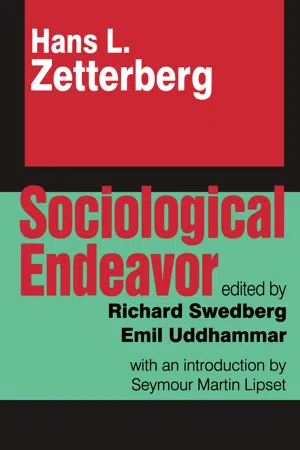
In this, the twentieth volume in the Transaction series honoring distinguished social scientists of the twentieth century, the life and work of the eminent Swedish sociologist, Hans L. Zetterberg is featured. He has had a long and distinguished career in a number of fields including, sociology, publishing, private business and public policy. For many years he was head of the Swedish Institute for Opinion Research, SIFO, and more recently he has been active in the creation of Sweden's only private university, the City University of Stockholm.In this volume the focus is on Zetterberg's activities as a sociologist, and the reader gets an opportunity to become acquainted with the work of one of Sweden's most prominent sociologists. The contributions cover a period of several decades and include several of Zetterberg's classical articles as well as anexcerpt from his most famous book, On Theory and Verification in Sociology. Many recent articles can also be found in the volume, and these well testify to the relevance of Hans Zetterberg's work to contemporary issues.This book is an outstanding sampling of Zetterberg. It is must reading for aspiring sociologists. He provides tools for analyzing distinct national cultures. Zetterberg has shown how one person by combining the roles of scholar, pollster, editor and businessman can integrate insights from each to help us understand modernity.
- 404 pages
- English
- ePUB (mobile friendly)
- Available on iOS & Android
eBook - ePub
Sociological Endeavor
About this book
Information
III. Applications
10. Scientific Acedia*
Definition1
Acedia is an occupational hazard among men of learning that takes the form of a gradual withdrawal of motivation for research and an increasing alienation from science.
History of Knowledge
During the Middle Ages acedia had only a religious meaning. At that time the word stood for sloth, the fourth cardinal sin, the state of not caring about one’s salvation. With the separation in the Renaissance between scholars, clergymen, and artists, it becomes appropriate to speak of secular versions, a scientific acedia, and an artistic acedia.
In most accounts of acedia, the condition is viewed primarily as a psychological or medical problem; individual variations in personality are seen as affecting a person’s endurance in scientific work. However, even students of acedia who by profession are biologists or psychologists concede that some important determinants are of a social nature and, therefore, located not in the scientist, but in the social setting in which he works. The assumption that acedia is primarily a sociological phenomenon has been made by Robert K Merton, who treats it as a case of anomie; it is “retreatism.” The man affected by acedia, in this view, becomes the hobo of science; he rejects both the cultural goals and the socially acceptable means to achieve them.
Creativity is never a regular feature of any scientific career, and, therefore, acedia may often be hidden from the view of colleagues and employers for a long time. Today, when the normal time between the completion of a project and its publication may be as long as an entire year, the affected scientist can keep the image of creativity for an equally long period after the onset of his acedia; the light from the dead star is seen on earth a long time after it has actually faded. If the acedia is cured in the meantime, few people may ever have noticed it.
Perhaps the typical delay in discovery of acedia accounts for the failure of universities, research institutes, and industrial research divisions to deal resolutely with the problem. Heads of departments and laboratories do not have any standard ways of coping with acedia. There are no preventive measures, no treatments, no policy, and hardly any serious discussions of the problem. No one has called a conference on acedia to collate our knowledge and to evaluate the improvisations that are now invoked when a case is discovered. What we can say about acedia, therefore, is largely drawn from cases we have accidentally encountered and from general theory.
Incidence
Everyone knows about some case of acedia among the great ones in his field. The biologists have Darwin’s depression which so delayed the publication of his theories of evolution; the sociologists know about Max Weber’s breakdowns when he was unable to write. Acedia, however, is not confined to the great scientists of the past. Administrators and members of university faculties and research centers know that acedia also affects the scientists of today and is not always limited to the best ones. Every publisher of scientific books or editor of a scientific journal has in his file a letter from a scientist which bespeaks of acedia as the cause for his failure to meet a deadline for the submission of a manuscript. Even young scientists of average ability can testify about periods in which their work fails to engage them and their creativity is nil.
While acedia thus is common, we know very little about the actual distributions of incidents among different categories of scientists. It seems more common among middle-aged scholars than among the young and the old. And it seems more common among those whose specialty is theory than among those whose specialty is research. But no statistics are available to back up such impressions.
Etiology
A beginning understanding of acedia can be obtained from Durkheims notion of anomie. Anomie is what prevails outside the range of the rewards to which we have become accustomed. Thus there is an upper anomic field in which our rewards are so unusually great that we do not know how to judge them (“crisis of riches”) and a lower anomic field in which our rewards are so unusually small that we do not know how to judge them (“crisis of poverty”). Both are dangerous territories; the ordinary girl who after a quick courtship marries a multimillionaire loses her bearings as readily as the ordinary businessman who unexpectedly finds himself bankrupt and stripped of all his assets.
If acedia is a form of anomie we would expect to find it among scientists whose rewards have suddenly become either excessively small or excessively great. It is easy to understand why the scientist whose efforts end in frustration may withdraw from science. Actually, the very structure of science breeds a vague sense of failure in the majority of scientists. The intellectual exchanges around laboratories and research institutes and particularly around university departments in graduate schools are focused on the ideas of a very small number of great men who have made decisive discoveries or who have formulated the current theories. These men are looked upon as models. The adolation of these men generates inspiration and industry among beginners and students. But the same adolation brings a sense of failure among the middle-aged or older scholars, the vast majority of whom realize that they will never receive the recognition given their chosen models. When this realization is sudden, we have the acedia of failure. To have spent years on a research project and find it rejected as a thesis, refused by a publisher, or if published, damned by the reviewers, to have research funds suddenly cut off, to abruptly find that the academic post one has prepared for is given to someone else, to open a journal and find the solution to one’s ongoing project published by someone else—all these events put a scientist in a dangerous zone.
The acedia of success is harder to grasp. A rapid gain in status has one problem in common with a sudden loss in status: The individual is uprooted and transplanted into a strange milieu. Newtons great creativity suddenly faded. Some of his contemporaries thought that he had perhaps acquired the complete knowledge, that there was nothing more in the world to investigate; they treated him like a demi-god. But more intimate documents reveal that he was for awhile unable to do his usual scientific work; he wanted to keep up the pace but he could not. Probably he experienced something like the anomie of wealth. For it is unsettling to make very great discoveries and be suddenly honored way beyond all accustomed expectations. Fame is acquired but all bearings used to orient oneself are lost.
Sudden dramatic fluctuations in the level of rewards for scientific activities are, however, too rare to account for all acedia. To understand the large majority of cases we must focus attention, not on the absolute level of rewards in scientific work, but on the comparison of this level with rewards obtained in non-scientific pursuits, past or present, experienced firsthand or seen among associates. Here we discern two additional types of acedia. One is a result of the concentration of all rewards in the scientific role at the expense of the scientist’s involvement in his family, friends, and community. The scientist in this position has pinned his entire self-evaluation on the solution of some narrow scientific problems. When such solutions are not readily forthcoming, acedia sets in. Let us call this type the acedia of specialization. The other type of acedia is caused by a dispersion of gratifications, so that the scientist feels more rewarded in his non-scientific activities than in his scientific job. His science does not compete well with his family, his business ventures, his political aspirations, and his social life. This type might be called the acedia of differentiation. It is important to keep the two separate because they seem to occur in quite different circumstances.
A good example of acedia of specialization is given by Linnaeus, the father of botany. He speaks about it as his “melancholia,” suggesting that it was caused by his excessive preoccupation with one narrow specialty. “When one scientific specialty tastes better than another,” he says, “one seems to get into company only with men who have the same liking for this specialty and one cannot get one’s thoughts from it.” Birds of one specialty flock together and all they do is talk shop. The one-sided preoccupation with the same set of problems at all hours of the day in all social contacts might be dangerous: if you do not solve the problem, then you are indeed a failure.
This type of acedia seems to affect those who escape from the world into science. Linnaeus was a peasant’s son who had to pass through the assimilation process of the upwardly mobile academician to fit into the university community. While he was accepted as an equal or as a superior in matters concerning his scientific specialty, he had to struggle to be accepted in the social life of the larger academic, political, religious, and economic elite of his time. The scientist arrivé has the same problem as the nouveau riche: he easily becomes subject to social discrimination and, in snobbish settings, embarrassing and clumsy details reveal his humble background. He is tempted, therefore, to withdraw into his science, the realm where he really can compete. But now all eggs are put into one basket. Scientific breakthroughs are not regular like harvests or paychecks. If during long periods no solution appears to the scientist who in this way has placed all his ego involvement in one problem, then acedia is close at hand.
One might surmise that this is often the etiology of acedia in scientists of lowly origin in aristocratic societies, for example, Faraday, son of a blacksmith, and Priestly, son of a weaver, both working in England. In egalitarian societies the scientists of lowly origin do not feel this pressure to the same extent. We sense little acedia in the upwardly mobile Pitirim Sorokin, who rode to scientific fame on a rising proletarian revolution in Russia, the son of a poverty-stricken farmer. In egalitarian societies withdrawal into science and the consequent risks that predispose one to specific acedia seem to have more idiosyncratic causes—unrealistic ambitions, lack of ambience or social skills, failures in love—and social mobility seems to have no significant relation to acedia. However, the pattern of few rewards in non-scientific activities and a dangerous concentration of all rewards to a scientific specialty is here typical of the immigrant or exiled scientist of upper-class background. In his new country he does not normally receive the same honor from and influence with business leaders or politicians as in the old country, and hence may withdraw into his science.
The acedia of differentiation is well illustrated by Lavoisier. He was born of wealthy parents, became a partner in Ferme Generale, the private and profitable company that handled tax collection for the French Crown. He married the daughter of another partner in the Ferme. He had a flying start in science and at the age of twenty-five he was already a member of the Royal Academy of Sciences. However, his background, contacts, and abilities soon were to draw him in other directions. He served as a member of the Provincial Parliament of Orléans, sponsoring a large number of reform bills. From his father he inherited, among other things, a farm to which he added new land, and became so involved in agriculture that he gladly served in the official Administration of Agriculture. He did much consulting for the government on education, taxes, and budgets, and the new republic of 1789 elected him president of the Discount Bank, which eventually became the Bank of France. The preceding royal regime had turned to him for advice about gunpowder production and he had organized and helped administer the state-owned Regie de Poudres. His scientific activity both profited and suffered from his political and financial involvements. He did agricultural experiments on his farm and he ran many experiments in the laboratory attached to his gunpowder arsenal. Often, however, his other commitments took over. His acedia appears rather painless: it just seems that his science was drowned in a shower of other exciting activities. Herbert Tingsten, the outstanding Swedish social scientist, illustrates a similar, painless withdrawal from his academic life to become editor-in-chief of a large newspaper. The casualty in this process was his book on the ideas of liberalism, his most difficult undertaking, which was never completed. Others in a similar situation have suffered more. Max Weber, for instance, under cross-pressure from both academic and political commitments was for long periods unable to pursue either. A near casualty in his case was the ambitious Economy and Society which had to be assembled by others after his death.
We see that acedia of differentiation, in contrast to the acedia of specialization, seems more likely to be a predicament of the scholar born in a well-connected upper-class family whose members are called upon to manage the financial or political affairs of the society. In competition with the rewards from the economic and political sphere, science might lose out.
The above predicaments do not necessarily by themselves produce acedia; they are the predispositions that cock the mechanism. A large number of events, both trivial and serious, may trigger the disease. Among these events we count anything that is physically exhausting: colds, stomach disorders, aches of various kinds, lack of sleep because of overwork or overentertainment. An emotionally exhausting event can also become triggering: death or illness, a financial squeeze, an illicit love affair getting out of hand, jealousy, fights with assoc...
Table of contents
- Cover
- Half Title
- Title Page
- Copyright Page
- Dedication
- Contents
- Introduction by Seymour Martin Lipset
- I. Method
- II. Theory
- III. Applications
- IV. Epilogue and bibliography
- Index
Trusted by 375,005 students
Access to over 1.5 million titles for a fair monthly price.
Study more efficiently using our study tools.
Frequently asked questions
Yes, you can cancel anytime from the Subscription tab in your account settings on the Perlego website. Your subscription will stay active until the end of your current billing period. Learn how to cancel your subscription
No, books cannot be downloaded as external files, such as PDFs, for use outside of Perlego. However, you can download books within the Perlego app for offline reading on mobile or tablet. Learn how to download books offline
Perlego offers two plans: Essential and Complete
- Essential is ideal for learners and professionals who enjoy exploring a wide range of subjects. Access the Essential Library with 800,000+ trusted titles and best-sellers across business, personal growth, and the humanities. Includes unlimited reading time and Standard Read Aloud voice.
- Complete: Perfect for advanced learners and researchers needing full, unrestricted access. Unlock 1.5M+ books across hundreds of subjects, including academic and specialized titles. The Complete Plan also includes advanced features like Premium Read Aloud and Research Assistant.
We are an online textbook subscription service, where you can get access to an entire online library for less than the price of a single book per month. With over 1.5 million books across 990+ topics, we’ve got you covered! Learn about our mission
Look out for the read-aloud symbol on your next book to see if you can listen to it. The read-aloud tool reads text aloud for you, highlighting the text as it is being read. You can pause it, speed it up and slow it down. Learn more about Read Aloud
Yes! You can use the Perlego app on both iOS and Android devices to read anytime, anywhere — even offline. Perfect for commutes or when you’re on the go.
Please note we cannot support devices running on iOS 13 and Android 7 or earlier. Learn more about using the app
Please note we cannot support devices running on iOS 13 and Android 7 or earlier. Learn more about using the app
Yes, you can access Sociological Endeavor by Hans Zetterberg in PDF and/or ePUB format, as well as other popular books in Social Sciences & Sociology. We have over 1.5 million books available in our catalogue for you to explore.