Over recent decades, bicycling has received renewed interest as a means of improving transportation through crowded cities, improving personal health, and reducing environmental impacts associated with travel. Much of the discussion surrounding cycling has focused on bicycle facility design—how to best repurpose road infrastructure to accommodate bicycling. While part of the discussion has touched on culture, such as how to make bicycling a larger part of daily life, city design and planning have been sorely missing from consideration.
Whilst interdisciplinary in its scope, this book takes a primarily planning approach to examining active transportation, and especially bicycling, in urban areas. The volume examines the land use aspects of the city—not just the streetscape. Illustrated using a range of case studies from the USA, Canada, and Australia, the volume provides a comprehensive overview of key topics of concern around cycling in the city including: imagining the future of bicycle-friendly cities; integrating bicycling into urban planning and design; the effects of bike use on health and environment; policies for developing bicycle infrastructure and programs; best practices in bicycle facility design and implementation; advances in technology, and economic contributions.
Bicycle infrastructure that ignores the street network
Steven Fleming
There are rare neighborhoods, streets, and venues, where homosexual couples can walk hand-in-hand and not feel self-conscious. Outside those safe places, it is not so easy to display same-sex affection without feeling threatened, or provocative. From the architectural writer Aaron Betsky, we take the term “queer space” (Betsky 1997) to describe the worlds homo-sexuals physically construct around themselves using clothing, objects, architecture, and urban districts, in order to attain fulfillment and safety.
My book Cycle Space (Fleming 2012) took a loan from Betsky’s idea. In that book the term “cycle space” is used to describe the worlds cyclists build around themselves with clothing, accoutrements, sometimes architecture, and invariably safe routes through cities. Cognitively and actually, we build cycle space to attain our own sense of fulfillment and safety as cyclists. Because there is such a wide range of motivations to cycle—from fitness, to environmental awareness, to plain old frugality—cycle spaces are plural, with their loci in individuals’ minds.
A good example of a kind of cycle space with its locus in riders’ minds is the moving space that follows a critical mass ride. Similarly, lycra wearing members of bunch rides can turn the busiest of roads into places of fulfillment and safety. However, it is the quotidian problem of commuting alone at night in the rain that sees most regular cyclists retreating to non-vehicular routes wherever we can.
There is a danger here that habituation to non-vehicular routes can give us a very different image of our cities to those held in the minds of our neighbors who use the road network. In The Image of the City, Kevin Lynch argued for mental images held in common. Developing an unusual cognitive map by retreating to non-vehicular routes could cause an individual to lose their ability to “operate successfully within his environment and […] cooperate with his fellows,” (Lynch 1960, 46).
Ideally all cities would weld safe and fulfilling bicycling networks to the street network and give cyclists the same image of the city as the one shared by drivers, pedestrians, and frequent bus users. Unfortunately, networks of that sort are mostly only being built in cities so crippled by congestion and shortages of car parking that most voters have abandoned using a car for most trips. These are cities such as New York, Paris, and London. Even here, change is happening slowly. In thousands of other much smaller cities, change is happening at glacial pace. Voters in small cities remain satisfied overall with car dependence, so naturally elect politicians who promise more car lanes, not bike lanes. In small cities, cyclists look doomed to be bullied from streets to the margins, for as long as there are fuel sources.
Working through the five elements that, according to Lynch, define our images of our cities, we can generalize that “paths” in the minds of most cyclists would incorporate a few easements corresponding to former bulk haulage (freight) routes; that “edges” for cyclists are less likely to be shop-lined than lined with blank walls, graffiti, and wire fences; that cyclists’ “districts” could include derelict zones that neither industry nor mainstream car-dependent society are actively contesting; that bike riders’ “nodes” will have no markers put there by governments; and that something like a culvert section under a highway is more likely to be a “landmark” for cyclists than any civic monument or sign of commerce.
Ideologically, we can object to cyclists being banished from the street network. Urban designers from Jane Jacobs to Jan Gehl have campaigned to reclaim the street for vulnerable modes. So magnetic is the street as a topic that even when a research article purports to be about linear parks, it will often swing around to the topic of streets and how they too could be networks of greenways.
That trend begins with Anthony Walmsley’s attack on writers before him, Little 1990 and Lynch 1981, for ignoring the notion of “recovering the most immediate public open space of all—the principal streets of the city—as tree-lined routes” (Walmsley 1995, 82). In like fashion, Karl Kullmann’s 2013 paper about linear voids in post-industrial cities having second lives as circulation systems leads into a lengthy discussion of car-accessible streets in Portland, Oregon that have recently had a change of name from “bike boulevards” to “greenways” (Kullmann 2013), despite them being nothing more than traffic-calmed roads.
Writing from the critical stance of bicycle advocacy, I naturally support the grand project of reclaiming streets from automobiles and recognize the environmental, epidemiological, and economic benefits of non-car-focused streets. At the risk of seeming churlish though, I need to draw attention to one disadvantage. This cause that unites us—reclaiming the street from the automobile—stands in the way of pragmatic discussions about routes through our cities that could be even more helpful to cycling.
Streets provide access to building stock that was not created with bike transport in mind. By contrast, post-industrial voids through our cities could unlock brownfield redevelopment sites for genuinely bike-friendly buildings. In this context, a “bike-friendly building” would be purpose-designed to encourage cycling, the way a garage-fronted house in the suburbs is designed to encourage driving.
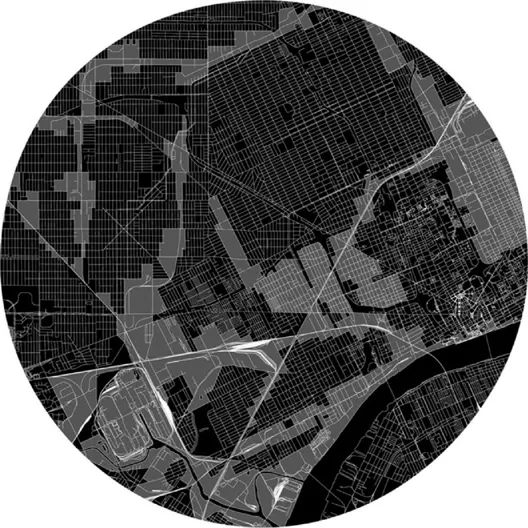
Those in the homosexual community have shown how they can build queer space in places with names such as the Meat Packing District, or lately Hells Kitchen—names that smack of marginalization. If cyclists took inspiration from queers, then those of us living in cities where cycling is marginalized would want to build Cycle Space on land of unique importance to us. Because derelict industrial sites are typically intersected by bulk haulage easements also dating from the industrial era, logic suggests we treat entire networks of vacant brownfields and easements as cycling frontiers (Figure 1.1).
Figure 1.1Detroit figure-ground. The quintessential post-industrial city, Detroit has a vast network of linear voids not being used for motorized transport potentially unlocking brownfields and blighted areas for bicycle-oriented redevelopment.
Source: Steven Fleming and Ben Thorp, cycle-space.com.
It has been shown in past eras that avant-garde architecture can help the public envision the potential of frontier lands they would otherwise never consider as places to live. Construction of Le Corbusier’s Villa Savoye commenced in 1928 in what, at the time, must have seemed an unimaginably remote reach of Paris. Yet the villa’s design helped people imagine a new way of life, when the freeways of the future would direct them straight into their houses. Looking at the Villa Savoye they could have imagined the house of the future incorporating a U-turning bay within its structural volume, especially for cars. Le Corbusier’s vision helped whet peoples’ appetites for the French Autoroute (highway) system.
At the same time in America, Buckminster Fuller was prototyping his Dymaxion House, similarly suited to suburban locations, not in-fill sites in the city. Like the Villa Savoye, the Dymaxion House was raised off the ground for cars to park under. Yet it would be another three decades before America would start in earnest on its national freeway construction and longer still before driving would become mainstream.
Fuller was ahead of his time, so he did not make fortunes selling Dymaxion houses. What he did do was help inspire the influential General Motors-sponsored Futurama Exhibit at the 1939 World’s Fair in New York. Thousands flocked to see what would prove to be a self-fulfilling prophetic vision of the good life to come, when freeways would transport people to futuristic buildings depicted on the peri-urban frontier.
Surely architecture’s persuasive power is as valid today. If we can allow ourselves to take le...
Table of contents
Cover
Half Title
Title Page
Copyright Page
Table of Contents
List of contributors
Preface
Acknowledgments
Advancing Bicycle Urbanism
1. Bike paths to nowhere: Bicycle infrastructure that ignores the street network
2. Traffic signal equity: Crossing the street to active transportation
3. The role of personas in cycling advocacy
4. Instagramming urban design along the Ohlone Greenway
5. A look at bicycle commuting by low-income New Yorkers using the CEO Poverty Measure
6. Middle modalism: The proliferation of e-bikes and implications for planning and urban design
7. Why we should stop talking about speed limits and start talking about speed
8. A framework to analyze the economic feasibility of cycling facilities
9. Secure investment for active transport: Willingness to pay for secured bicycle parking in Montreal, Canada
10. Site suitability and public participation: A study for a bike-sharing program in a college town
11. How GPS route data collected from smartphones can benefit bicycle planning
12. Mapping GPS data and assessing mapping accuracy
Index
Trusted by 375,005 students
Access to over 1.5 million titles for a fair monthly price.
Study more efficiently using our study tools.
Frequently asked questions
Yes, you can cancel anytime from the Subscription tab in your account settings on the Perlego website. Your subscription will stay active until the end of your current billing period. Learn how to cancel your subscription
No, books cannot be downloaded as external files, such as PDFs, for use outside of Perlego. However, you can download books within the Perlego app for offline reading on mobile or tablet. Learn how to download books offline
We are an online textbook subscription service, where you can get access to an entire online library for less than the price of a single book per month. With over 1.5 million books across 990+ topics, we’ve got you covered! Learn about our mission
Look out for the read-aloud symbol on your next book to see if you can listen to it. The read-aloud tool reads text aloud for you, highlighting the text as it is being read. You can pause it, speed it up and slow it down. Learn more about Read Aloud
Yes! You can use the Perlego app on both iOS and Android devices to read anytime, anywhere — even offline. Perfect for commutes or when you’re on the go. Please note we cannot support devices running on iOS 13 and Android 7 or earlier. Learn more about using the app
Yes, you can access Bicycle Urbanism by Rachel Berney in PDF and/or ePUB format, as well as other popular books in Architecture & Urban Planning & Landscaping. We have over 1.5 million books available in our catalogue for you to explore.