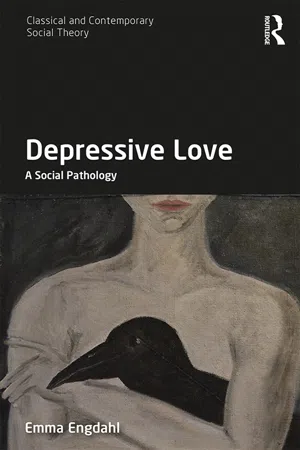
Love and depression are key elements in the cultural script of emotions or affectual life within contemporary Western society, and the two have become intertwined to such an extent that it is informative to talk about depressive love. Indeed, the most common source of depression is intimate relationships, in which one partner is not recognised by the other as being in need or worthy of loving care. This book addresses the question of how it is possible for opposite emotional experiences such as love and depression to appear simultaneously, empirically documenting the phenomenon of depressive love and its implications through studies of art, including music, literature and photography, and the experiences of everyday life, by way of interviews and the analysis of e-mail-, sms-, messenger-correspondence, and other new media spaces. Engaging with a range of sociological, psychoanalytic and philosophical theories of love, depression and emotion, including the work of Simmel, Alberoni, Barthes, Hochschild, Giddens, Luhmann, Beck and Beck-Gernsheim, Illouz, Bauman, Hegel, Honneth, Ehrenberg, Han, Lévinas, Sartre, Freud, Lacan, and Kristeva, to name but a few, the author examines the ways in which depressive love is expressed in modern society, asking whether it is a new phenomenon and confined to the West and if not, what is distinctive about depressive love and its associated (dys)functions in contemporary Western society. An empirically rich and theoretically broad study of depressive love as a sign of our times, this book will appeal to scholars and students of social theory and the sociology and philosophy of emotion and interpersonal relationships.
- 122 pages
- English
- ePUB (mobile friendly)
- Available on iOS & Android
eBook - ePub
About this book
Information
Part 1
Talk of love in the shadowland of despair
1 Talk of love in the shadowland of despair
To develop an understanding of depressive love, we need to first say something about love that is not depressive. How do we talk about love and what do we mean when we say “I love you”? Already the difficulties begin to cumulate. Where does one begin? Where does one end? How many theories, not to mention experiences, of love exist? More than what one single being is able to grasp during a lifetime. That is the only answer I can give you with certainty. Thus, it is not certain that I can provide an accurate description of love. Let me say that it is even unlikely. However, I can ignite your inner, and intuitive, understanding of the phenomena by guiding you through the swarm of voices on love that surround us. Let me start with the legendary words: I love you. From there, we will go further and further until the description of love seem thick enough – thick enough to make it possible for us to witness how love stories slip into the depressive sphere.
Love as affirmation
In Roland Barthes’ book, A Lover’s Discourse: Fragments, we get to meet a blissful blend of characters, all busy with love; alone with their imaginations:
The power of the Image-repertoire is immediate: I do not look for the image, it comes to me all of a sudden. It is afterwards that I return to it and begin making the good signs alternate, interminably, with the bad one: ‘What do these abrupt words mean: you have all my respect? Was anything ever colder?…’(Barthes [1977] 2001, p. 214)
This type of question is asked by the lovers in the absence of the loved ones as actual persons; in the company of the Image. I feel a surprising sense of affinity to the immersive solitude of the characters. Everything that happens around them seems to be redundant in relation to being together with their beloved, whom in many cases is not even there other than in the imaginations of the lovers.
Love is like the sparkle of a tinder stick. It wanders around, it comes and goes, and it takes new shapes and forms. It interacts with itself: a discourse.
Love is a circus force. Isn’t it just flying between the trapezes high up in the sky, crying and laughing in a way reminiscent of that of an evil and obstinate clown? Isn’t it a roaring tiger let loose from its cage, riding on the back of an elephant or forever dancing on a tightrope? Love is life! Everything else is waiting, boredom, or abysmal melancholy.
Barthes ([1977] 2001, p. 44) gives a voice to the lover: a discourse that is utterly alone and drifts out towards the unreal by its own force of nature. It is clear that there are other people than I that talk to the beloved, whose voice is worn-out and weak: who needs to rest.
I am alarmed by everything which appears to alter the Image. I am, therefore, alarmed by the other’s fatigue: it is the cruelest of all rival objects. … I can see that the other, exhausted, tears off a fragment of this fatigue in order to give it to me. … What does this gift mean? … No one answers, for what is given is precisely what does not answer.
The desire of getting a response to speech, reciprocity, a simultaneous I love you, is not the desire of just one person, but of many. A simultaneous I love you is not a real possibility; therefore, we have to settle for: I love you. Me too. The desire takes the shape of a pendulum between the two sentences. It is the end of the road. We no longer have to interpret the beloved one’s gaze, movements, tone of voice and various actions. We accept that I love you means I love you. Love works when it’s taking on the only role that’s left: affirmation. Against all wit and moderation, without any outer support from power or its mechanisms, such as science and art, the lover asserts the significance of her or his love. That claim isn’t completely truthful. We do have marriage, which must be seen as the institution of love: as training wheels to support you in your love endeavors. As is well known, marriage does not indisputably stand as the abode of happiness. The playwright and author August Strindberg compared marriage to a cage, where those who are on the outside wish to enter and those who are inside, or stuck within, wish to exit. In his novel Ett dockhem (A Doll’s House), which is included in the short story collection Giftas (Become Married) and is a response to Henrik Ibsen’s play with the same title, Strindberg ([1884] 1982, p. 153, my transl.) writes:
Oh, how different it was from before! Old Pall looked so old, and he was disappointed too. It was a pure hell, he claimed, to be married but have no wife!
In the shape of assertion, I love you is a counterforce to be reckoned with; an attack against the threat to destroy love – a threat posed by all other acknowledged languages due to the lack of understanding present in their responses to love. Let’s examine the mutual assertion of love as expressed in an SMS correspondence between a Swedish fifty-year-old man and a Swedish thirty-one-year-old woman, who both have a doctoral degree and are working within the university sector:
– Of course we are suffering. But right now in a civilized way. Without acting out. And that’s good. Love you.
– Love you. Don’t suffer. Crave!
– I’m craving!
– You feel far, far from home.
– Thinking of you. Thinking of us.
– Don’t give up!
– The lack of physical reality is sometimes very heavy to bear. But the words exist. Love you.
– Love you. Passed by the old yellow house across the street from X and thought that that’s where we should live and conduct our business. You are someplace else. I notice and it’s reasonable. I know. But, yes… What are you doing?
– I’m writing. And you’re exquisite. If there are no dreams there is no life. And, oh, how much we have been in touch. Love you.
– Hm… And yet you’re not answering when I call…
– The phone has been elsewhere.
– Love you, but sulking a bit.
– So am I.
– Why are you sulking?
– I want to know you more. And it’s mostly your fault I don’t. And you?
– Because I don’t hear from you.
– Yes! When you’re in the house in X you can’t answer the phone sweetie.
– Love you. You are mine.
– I love you with all my heart. Let’s call each other tomorrow. We’ll become each other’s.
– Yes. That’s how it’ll be.
– Love you more than you understand. Love you.
– If that’s the case, that’s good and then it’s mutual. It has to be. It is the only thing that will do.
– Tell me you can see us? Together. I can.
– Yes. Love is for us. We are each other and I love you, love you. Or, what the hell, I love what we are.
I love you is repeated like a mantra by both the man and the woman and all of a sudden it sneaks up on us: the exclusivity. The desire to be the chosen one; to indisputably be the only one, someone’s eternal love. We learn how love contains a will to constantly be in connection with the other, both mentally and physically. For the man and woman corresponding with each other, love is about knowing the other, in the more complex meaning of the word. The physical absence is sometimes agonizingly evident, but the words still exist. Thus, the words are given a prominent place in the act of love and the poet is highlighted as being the best suited to express love’s deepest meaning.
The poet’s sense of love
To highlight the poet as someone with a special sense of the nature of love is not a new idea; it is an idea found in many different contexts. The question of why the poet is perceived as possessing this almost magical power is essential to us. We can find one well-thought-out answer in the tradition of thought that Charles Taylor (1989) calls expressivism – within which the poet is highlighted as being the one possessing the most refined tools, and creative ways, to put words to feelings and subjective experiences. The poet is perceived as having a unique ability to express what has never been put into words before and thereby able to show us something new about what it means to be human – most importantly, what it means to be a loving and suffering being. Aase Berg (2016, my transl.), who is a poet, writes:
… we own the underworld. And then I do not mean crime, I mean the underflows, what I call ‘the unspoken’ in my poems. We master all shades that are not stuck on advertising or porn images, we understand the smallest groan, the smallest breath, the pauses and the comma signs.
Of course, the above-described ability does not belong to the poet alone but to all people, to a greater or lesser extent. It is a crucial ability as a person does not know what her emotional experiences mean but must try them out linguistically in relation to others, which is an insight into the origin and importance of language initially developed by the philosopher Johan Gottfried Herder ([1772] 1982, p. 89 ff.). It has thereafter been developed further by, among others, the philosopher and social psychologist George Herbert Mead, who perceives language as a social construction that makes it possible for us to develop an idea about who we are, or who we want to be. Thus, he takes self-consciousness – the ability to make our own unique ways of being, thinking and feeling into objects to ourselves – to be an advanced form of consciousness, which arises through the process in which we, together with others, develop a common language that helps us communicate with one another in a meaningful way. To learn a language that enables you to understand yourself, others, and society is essentially the same as being together with others in a specific culture and a specific society. In his book on mind, self and society, Mead ([1934] 1967, p. 283) writes:
A person learns a new language and, as we say, gets a new soul. He puts himself into the attitude of those that make use of that language. He cannot read its literature, cannot converse with those that belong to that community, without taking on its peculiar attitudes. He becomes in that sense a different individual.
In other words, we partly become who we are through language, which is one of the most important tools we use to reach out and seek help from others in order to find ourselves. If you, as I do, read poems written by poets like Stig Dagerman you might understand that this idea is not totally preposterous. Who does not get blown away by the following lines from his poem Birgitta Svit (Birgitta Suite); and get a sudden insight into the nature of love and suffering, and ultimately about oneself?
All wish to be loved for what they don’t own.The grass for its stature, for its softness the stone.[…]Why I want to be loved I don’t want to know.But trembling we pull each other out of our quiver.(Dagerman [1950] 1964, p. 5).
In Birgitta Suite, which came to be one of the last poems Dagerman wrote before he took his own life, the effects of love are revealed despite, or maybe precisely because of, his own experiences of lack of it. When we are in despair, we wish that some person could see, within us, those character traits that are yet to be recognized; a wish that can only be realized by the other. In that case, we can reappear in another, and better, place – more ideal for what we wish to accomplish with our lives.1
If we read yet another text by Dagerman, Vårt omättliga behov av tröst (Our Need for Consolation is Insatiable), an even deeper understanding about love and suffering, or, simply about the depressive sphere, can be reached. It appears as if Dagerman himself was a man who suffered from depressive love, and was tormented by his infinite desire for consolation; a kind of desire that towards the end of his life he regarded as something that could only be ended through death.
(O)ther consolations … come to me like uninvited guests and fill my room with their vulgar whispers: I am your desire – lust after one and all!; I am your talent – abuse me as you do yourself!; … I am your solitude – spurn the company of others!(Dagerman [1952] 2013, p. 301 f.)
Further into the text, depression is mentioned by name:
And when depression finally sets in I become a slave to that as well … I become incapable of recognizing anything of worth in myself, except the one thing I dread has already been lost: the ability to squeeze beauty out of my despair, my anxieties, my weaknesses.My depression is a chamber with seven views, and from the last of these I can make out a knife, a razor, a vial of poison … In the end I become a slave of all these instruments of death. They hound me like a pack of dogs. Or am I the dog stalking them? And I begin to sense that suicide may be the only real proof of human freedom.(Dagerman [1952] 2013, p. 304 f.)
Dagerman argues that man’s freedom appears in the shadow of death. However, in another passage, he claims that love, which transcends both life and death as it is unfolding beyond the bound of time, is the most essential thing:
Everything significant that I experience, all the wonderful things that happen in my life – meeting a lover, a caress on my skin, help in distress, eyes reflecting moonlight, sailing on the open sea… – all of it occurs beyond the bound of time. … it actually nullifies life’s attachment to time.(Dagerman [1952] 2013, p. 305 f.)
Dagerman’s poetry, and in many ways also his own short, intense and eventful life, seems to have been a continuous balancing between Eros and Thanatos: between the strong desire to meet the other – or nature – and the death wish, which in the end (and for each and every one of us, sooner or later) conquers. Nevertheless, the meaning of life is not revealed in the inevitable and irrevocable. It possibly presents itself in the life that is led in the shadow of death, but never in the actual moment of death.
I see another, and in its own way more relevant, lead in the quoted passages: the lived loneliness, which is cured only in the confrontation with what, or whom, is other than oneself. The confrontation between two operating forces – a result of what is called intersubjectivity within sociology and philosophy – reveals itself as the source of meaning. There is something destructive in loneliness that ruins the human nature, which is constantly seeking the other in order to find meaning and a sense of community, or comfort, as a cure to the tangibility in being existentially identical with yourself only – that is, you cannot interchange your body and sensuous experiences with others.
The existential loneliness
The existential identity can be understood as being born and dying alone, which is not to be confused with whether other people are, or can be, present when we are born and die. Rather, it is related to the fact that when we are born it is our body that is being thrown into the world. Ours alone. And when we die it is our body, or maybe we should say our spirit, that leaves the world. Not anybody else’s. In experiencing physical pain we become aware of that fact. It certainly hurts in others to see us fall and scratch our knees bloody against the gravelly asphalt. Yet, it is our knees that are aching and bolting, not theirs. Other people’s compassion surely helps to alleviate the fall, but it does not stop our knees from bleeding. No matter how much we want, or wish, to be able to transfer somebody else’s pain to ourselves in order to ease their pain, it is impossible. In physical pain, as in regard to us being purely bodily and sensuous creatures, we are alone. Of course, there are other experiences that remind us that we are existentially identical with ourselves only. For example, when we feel misunderstood; when the world outside is not able to seep into us, or rather, when our way of being, feeling, or thinking cannot get through (Engdahl 2009).
Because our body and senses anchor us in the world and provide the perspective we originally experience reality through, it is not only our body and senses that are unique. Our world, or perception of reality, are also different from that of others. Hence, we are differentiated from our fellow beings and our surroundings in two ways. However, life is not as dependent on our existential identities as one might think. To a much greater degree, life, and not least love, is about using our body and senses to help overcome the inherent loneliness in our existential identity. Life, as well as love, is a never-ending endeavor to transcend our loneliness, through communication with others, through trying to understand and making sense of each other. This is the only way we can really influence and be influenced by the community we are a part of; that is to say, the only way we can reach self-realization. At best, we exist in the genuine social – where whatever is existing within us meets what is on the outside and a transcending, or a mutual, influence takes place. But, to make such a dynamic process possible we have to acquire mutual experiences of togetherness that make it possible for us to identify with each other. We have to develop a social identity; a way of being in the wo...
Table of contents
- Cover
- Half Title
- Title Page
- Copyright Page
- Table of Contents
- Acknowledgements
- Introduction
- PART 1: Talk of love in the shadowland of despair
- PART 2: The leap of love into the depressive sphere
- PART 3: A distorted love ideal
- References
- Index
Trusted by 375,005 students
Access to over 1.5 million titles for a fair monthly price.
Study more efficiently using our study tools.
Frequently asked questions
Yes, you can cancel anytime from the Subscription tab in your account settings on the Perlego website. Your subscription will stay active until the end of your current billing period. Learn how to cancel your subscription
No, books cannot be downloaded as external files, such as PDFs, for use outside of Perlego. However, you can download books within the Perlego app for offline reading on mobile or tablet. Learn how to download books offline
Perlego offers two plans: Essential and Complete
- Essential is ideal for learners and professionals who enjoy exploring a wide range of subjects. Access the Essential Library with 800,000+ trusted titles and best-sellers across business, personal growth, and the humanities. Includes unlimited reading time and Standard Read Aloud voice.
- Complete: Perfect for advanced learners and researchers needing full, unrestricted access. Unlock 1.5M+ books across hundreds of subjects, including academic and specialized titles. The Complete Plan also includes advanced features like Premium Read Aloud and Research Assistant.
We are an online textbook subscription service, where you can get access to an entire online library for less than the price of a single book per month. With over 1.5 million books across 990+ topics, we’ve got you covered! Learn about our mission
Look out for the read-aloud symbol on your next book to see if you can listen to it. The read-aloud tool reads text aloud for you, highlighting the text as it is being read. You can pause it, speed it up and slow it down. Learn more about Read Aloud
Yes! You can use the Perlego app on both iOS and Android devices to read anytime, anywhere — even offline. Perfect for commutes or when you’re on the go.
Please note we cannot support devices running on iOS 13 and Android 7 or earlier. Learn more about using the app
Please note we cannot support devices running on iOS 13 and Android 7 or earlier. Learn more about using the app
Yes, you can access Depressive Love by Emma Engdahl in PDF and/or ePUB format, as well as other popular books in Social Sciences & Sociology. We have over 1.5 million books available in our catalogue for you to explore.