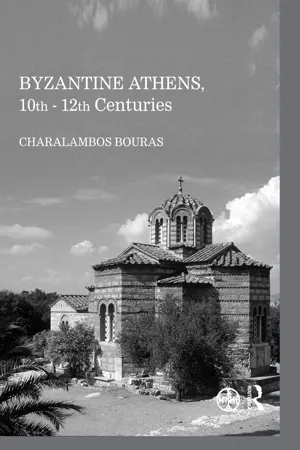
In this masterful synthesis, Charalambos Bouras draws together material and textual evidence for Athens in the Middle Byzantine period, from the mid-tenth century to 1204, when it was conquered by Crusaders. What emerges from his meticulous investigation is an urban fabric surprisingly makeshift in its domestic sector yet exuberantly creative in its ecclesiastical architecture. Rather than viewing the city as a mere shadow of its ancient past, Bouras demonstrates how Athens remained an important city of the Byzantine Empire as the seat of a metropolitan, home to local aristocracy, and pilgrimage destination for those who came to worship at the Christian Parthenon. Byzantine Athens explores the relationship of the Byzantine infrastructure to earlier configurations, shedding light on the water supply, industrial facilities, streets and fortifications of medieval Athens, and exploring the evidence for the form and typology of Byzantine houses. Thanks to Bouras's indefatigable study of all available archaeological reports the first part of the book offers an overall picture of the Middle Byzantine city. The second part presents a fully documented and illustrated catalogue of nearly 40 churches, including synthetic treatments of their typology and morphology set in the wider Byzantine architectural context. Finally, Bouras joins his unrivalled knowledge of the surviving remains and exhaustive scrutiny of the relevant scholarship to offer a historical interpretation of the Athenian monuments. Byzantine Athens is a unique achievement that will remain an invaluable compendium of our knowledge of one of the most complex, yet relatively unknown, Byzantine cities.
- 336 pages
- English
- ePUB (mobile friendly)
- Available on iOS & Android
eBook - ePub
Byzantine Athens, 10th - 12th Centuries
1
Introduction
Previous research and scholarship
Very little remains of Middle Byzantine Athens compared to what has survived from the ancient city. We have, on the one hand, material remains amounting to a modest number of churches as well as the sad relics of buildings brought to light through excavation and, on the other hand, written sources which are unclear, few in number and have to be extracted from a variety of contemporary or later texts. Despite the fact that life continued in Athens over the course of millennia, we are not in a position to recapture an important period in the city’s history as a living organism1 on account of centuries of serious decline or radical changes, but also because we lack archival sources, the result of the political and administrative discontinuity the country has undergone since 1204.
Inevitably, comparison of medieval Athens with the glorious city of antiquity has always been, and continues to be, diminishing to the former. However, comparison with other provincial Middle Byzantine cities in the empire shows Athens to have been an important center with a literally impregnable fortress, relatively large population, metropolitan see, pan-Hellenic pilgrimage site and prestige that did not go unappreciated by educated people of that day. The state of our knowledge and understanding today make it possible for us to appreciate the existence over time of landscapes and ancient monuments, both around and inside the medieval city, that were preserved in a much better condition in the Middle Byzantine period than today. Furthermore, the great transformation and destruction of what Byzantine monuments had survived, as well as the natural environment, took place after the Greek War of Independence and the creation of the new Greek state – in other words, in a recent and quite well-known period.
Studies of Christian Athens, especially those focused on the urban plan and monuments of the tenth, eleventh and twelfth centuries, are numerous. These studies have largely taken the form of articles; they are usually incomplete, some are not up to date, and quite commonly they fail to engage with other studies. Few are synthetic in nature, and those that are concern themselves more with the city’s history and less with its topography and architecture. The information provided by the written sources is either limited or very well known, and has been used in previous studies. By contrast, the archaeological evidence, even though it is constantly growing, has not been adequately exploited by scholars. Moreover, studies using this evidence are primarily descriptive and do not address architectural issues.
The most important synthetic work on the topography and architecture of medieval Athens is still a chapter in a book published by John Travlos in 1960 about the development of the Athenian urban plan.2 While more recent studies3 on the same subject may be well-informed, they tend to be overviews in article form that make minimal and only selective use of newer, more specialized publications. Only a very few Athenian churches have been satisfactorily published. The architecture of most of these has become known through the Index of the Medieval Monuments of Greece (Εὑρετήριον τῶν Μεσαιωνικῶν Μνημείων τῆς Ἑλλάδος)4 (1929, 1933). The significant progress represented by the publications of the American School is focused on Athenian monuments from antiquity and only a few from the medieval period. The same has been true of the hundreds of so-called ‘rescue’ excavations that have been carried out in the city from 1960 onwards and published in the Chronika of the Archaiologikon Deltion. Unfortunately, these publications typically present only general information and do not offer architectural interpretations of the finds.5 Much new information has come to light thanks to the publication of catalogues of permanent museum collections and temporary exhibitions, or albums with photographs from archives found primarily outside Greece.
The state of research and publication led me to conclude that a new study of the medieval city of Athens would be an original and at the same time useful contribution. What is needed is a synthetic work that assembles not only the unexploited primary material, but also older evidence reconsidered and evaluated on the basis of more recent findings with an eye to Byzantine architecture and urban planning. Furthermore, this new study should draw the necessary correlations and attempt a historical interpretation of the monuments using both older and more recent historical studies.
The chronological boundaries of the present study embrace the three centuries of medieval Byzantine prosperity from approximately the mid-tenth century to the Frankish occupation in 1204. In the case of certain monuments, reference will be made to earlier building phases, primarily after iconoclasm. The outermost topographical boundaries have been extended somewhat in order to include comment on three important monasteries, of Kaisariani, Hagios Georgios known as the Omorfi Ekklesia at Galatsi, and the Monastery of Hagios Ioannes Kynegos of the Philosophers on Mt Hymettus.
The written sources
The written sources for medieval Athens, as for other contemporary cities in Greece, are very few. The information they contain regarding the city’s topography and architecture is even more exiguous and, in the main, indirect. Consequently, the written sources contribute more towards our understanding of the city’s ecclesiastical, economic and social history and only indirectly its built environment. Some sources dating from the Frankish period after 1204, and even some from the Ottoman period, are of interest when they refer to past affairs.
Inscriptions and graffiti that have survived to our day contain useful information, mainly about the dating of certain monuments and their founders. They also preserve information about the city’s history that may be of indirect use. Without exception they have all been transcribed and commented upon in earlier publications. Coins and associated portable finds are useful for the dating of buildings discovered through excavation, although investigation of these objects does not fall within the scope of the present study.
Discussion of the above evidence can be found at the relevant places in this study, both in the course of my investigation of particular monuments and in my historical commentary on and interpretation of the built environment of that time. Here, as a start, I present what can be understood as a synthetic catalogue of these monuments and their environs.
The richest source of information for medieval Athens is to be found in the writings of Metropolitan Michael Choniates6 that include orations, letters, treatises, addresses and verse. These have been repeatedly published7 and commented upon and have provided the basic documentation for all modern studies8 of the condition of Athens, as well as southern Greece, at the end of the twelfth century. Choniates’s generalizations, his negative view of provincial life and his endless complaints give a quite different impression from the picture of economic prosperity in Greece9 that can be derived from other sources in the period just before the arrival of the Franks. This situation raises doubts over Choniates’s credibility. The History written by his brother Niketas also provides some information about the city’s fate in the same period.
A fragment of a Praktikon10 recording properties in the Athens area, and preserved by chance, contains very interesting data about the topography of Attica before 1204, including toponyms, physical boundaries, names of residents, economic data and other information indirectly related to the city. Several names of Athenians are attested in another similar document, the Ktematologion (land register) of Thebes.11 Information about monuments still preserved in the Middle Byzantine period can also be discovered in sources from the Late Antiquity.12 For example, a codex from the Monastery of St Catherine on Mount Sinai that was published by Papadopoulos-Kerameus13 contains addresses and letters referring to the known hierarchs in Athens and, indirectly, to the Christian Parthenon. The Life of Hosios Loukas14 also contains indirect information about Athens and mainland Greece more generally in the tenth century. We find scattered information about Athens during the three subsequent centuries in Skylitzes’s Chronicle15 and in the letters of Ioannes Apokaukos.16 Venetian sources,17 as well as an acta of Pope Innocent III,18 preserve occasional information about subjects relating to Athens immediately after 1204. Sources concerned with the metropolis of Athens, its metropolitans and other church officials in the Middle Byzantine period have also been published and commented upon.19 These sources will be discussed below as part of the investigation of the condition of the Church in Athens.
The Middle Byzantine inscriptions preserved in Athens are either incorporated into particular architectural monuments (Hagioi Theodoroi, Hagios Nikolaos Rangavas, Hagia Aikaterine, Hagios Ioannes Mangoutes, the katholikon of the monastery of the Hagios Ioannes Kynegos of the Philosophers), or they are isolated inscriptions derived from monuments that were destroyed (the church of the Hagioi Anargyroi, Sts Kosmas and Damianos) in Halandri and tou Stavrou (of the Cross) at Aigaleo, the tower of Metropolitan Leo, an architrave from the Acropolis, or even funerary monuments that refer to a no...
Table of contents
- Cover
- Title
- Copyright
- CONTENTS
- List of figures
- Foreword
- Acknowledgements
- Abbreviations
- Periodicals and lexica
- 1 Introduction
- 2 The built environment and the monuments
- 3 A historical interpretation of the Athenian monuments
- 4 Epilogue: The Athens of legend during the Middle Ages
- Captions for the map of Byzantine Athens
- Index of personal names
- Index of places and monuments
Trusted by 375,005 students
Access to over 1.5 million titles for a fair monthly price.
Study more efficiently using our study tools.
Frequently asked questions
Yes, you can cancel anytime from the Subscription tab in your account settings on the Perlego website. Your subscription will stay active until the end of your current billing period. Learn how to cancel your subscription
No, books cannot be downloaded as external files, such as PDFs, for use outside of Perlego. However, you can download books within the Perlego app for offline reading on mobile or tablet. Learn how to download books offline
Perlego offers two plans: Essential and Complete
- Essential is ideal for learners and professionals who enjoy exploring a wide range of subjects. Access the Essential Library with 800,000+ trusted titles and best-sellers across business, personal growth, and the humanities. Includes unlimited reading time and Standard Read Aloud voice.
- Complete: Perfect for advanced learners and researchers needing full, unrestricted access. Unlock 1.5M+ books across hundreds of subjects, including academic and specialized titles. The Complete Plan also includes advanced features like Premium Read Aloud and Research Assistant.
We are an online textbook subscription service, where you can get access to an entire online library for less than the price of a single book per month. With over 1.5 million books across 990+ topics, we’ve got you covered! Learn about our mission
Look out for the read-aloud symbol on your next book to see if you can listen to it. The read-aloud tool reads text aloud for you, highlighting the text as it is being read. You can pause it, speed it up and slow it down. Learn more about Read Aloud
Yes! You can use the Perlego app on both iOS and Android devices to read anytime, anywhere — even offline. Perfect for commutes or when you’re on the go.
Please note we cannot support devices running on iOS 13 and Android 7 or earlier. Learn more about using the app
Please note we cannot support devices running on iOS 13 and Android 7 or earlier. Learn more about using the app
Yes, you can access Byzantine Athens, 10th - 12th Centuries by Charalambos Bouras in PDF and/or ePUB format, as well as other popular books in History & World History. We have over 1.5 million books available in our catalogue for you to explore.