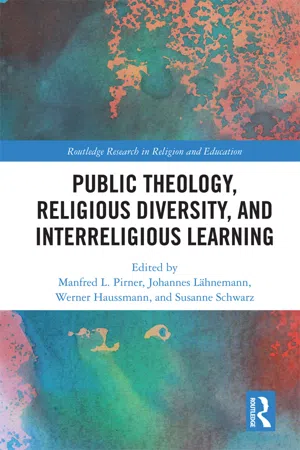
This book describes the relationship of Christian Public Theology to other religions and their ways of contributing to the common good. It also promotes mutual learning processes in public education to strengthen the public role and responsibility of religions in pluralistic societies. This volume brings together not only public education and public theology, but also scholars from a variety of disciplines such as philosophy, cultural studies, and sociology, and from different parts of the world. By doing so, the book intends to widen the horizon and provide fresh impulses for public theology as well as the discourse on public religious education.
eBook - ePub
Public Theology, Religious Diversity, and Interreligious Learning
- 218 pages
- English
- ePUB (mobile friendly)
- Available on iOS & Android
eBook - ePub
Public Theology, Religious Diversity, and Interreligious Learning
About this book
Information
1 Introduction
Since the turn of the millennium, the awareness in liberal democratic societies has grown that religion cannot simply be regarded as a private matter, but that it has an indispensable public dimension. Unfortunately, the religious aspects of terrorism and of violent conflicts have more strongly reinforced this awareness than the many positive, constructive contributions by religions to promoting peace, understanding, societal cohesion, and humanity. There is also an increasing appreciation, however, of how much liberal democratic societies gain from the political and social engagement of NGOs, institutions, groups, and individuals—among which religious groups and religiously inspired people play an important role.
In the Christian context, the calling to contribute to the common good1 has, since the 1980s, come to be prominently discussed under the label of ‘public theology’ and has led to the establishment of the Global Network of Public Theology and the International Journal of Public Theology in 2007. However, in this discourse the relationship of Christian (public) theology with other religions and their engagement for the common good does not seem to have received the amount of attention that it deserves. Also, the obvious links of public theology with educational perspectives and contexts appears to have been widely neglected so far in public theology discourse. It was the objective of an international conference, the 12th Nuremberg Forum that took place in October 2016 in Nuremberg, Germany, to address both of these deficits. This volume documents contributions from the conference which have their main focus on the first aspect, religious diversity and interreligious learning, while a second volume assembles contributions which concentrate on educational and ethical issues (which will be published under the title Public Theology and Education).
In the thematic field of public theology and religious diversity three main aspects or research questions can be distinguished that will be addressed in the present book.
- Are there traditions and concepts in other world religions that have similarities or analogies to the Christian concept of public theology? What can we learn from each other when it comes to religious perspectives of contributing to the common good in a pluralistic world? For instance, the traditional Jewish concept of “Tikkun olam”—which literally means “repairing the world”—is used by current Jewish theologians to motivate and reflect on Jewish contributions to the common good. In this book, Sabrina Worch from the University for Jewish Studies in Heidelberg, Germany, explains this concept and its consequences for Jewish public engagement (chapter 3).
- Is the concept and notion of “public theology” useful as a paradigm for other religions beyond Christianity? In 2013 the International Journal of Public Theology published its volume seven, titled “Jewish Public Theology”. And in a film documentary recorded at the Nuremberg Forum—which can be viewed online (link to the film at www.rupre.uni-erlangen.org)—Rabbi Professor Hanan Alexander from the University of Haifa, Israel, emphasizes that he does not understand the notion of public theology as an exclusively Christian term. He takes it as a concept that most major religions can adopt because it denotes a cause that is vital for all of them: religious engagement is not limited to the in-group but from its very core also aims to serve people from other religions and none.2 In the Islamic context there is at least some literary evidence that the notion of public theology can be constructively related to Islamic thought.
- How can dialogue between diverse religions and worldviews, and mutual interreligious learning from one another, be conceptualized as a subject matter of public theology? The role of religions in and for the public sphere and especially for cohesion in pluralistic societies has always been ambivalent and still is. Many people perceive religions mainly as a source of quarrel, conflict and division. Therefore, promoting interreligious dialogue and understanding can be seen as one major task of public theology. And for this task, (religious) education and interreligious learning seem to be of primary importance.
In this volume the first section addresses the first two research questions, the second section addresses the third question. Consequently, the first section deals with public theology from diverse religious and nonreligious perspectives, while the second section deals with the challenge of interreligious dialogue and learning from a public theology perspective.
The first section is introduced by Dirk J. Smit, Emeritus Professor of (Protestant) Systematic Theology at Stellenbosch University, South Africa, and a long-time representative of public theology discourse. He not only presents a Christian perspective on the contributions of religions to the common good but shows what can be learnt from the Christian public theology discourse so far, namely that religious contributions to society are highly controversial, contested and partly problematic. From his South African context, he argues for a critical and differentiated view of public theology that avoids too harmonistic and complacent idealizations (chapter 2).
As already mentioned above, Sabrina Worch from the University for Jewish Studies in Heidelberg, Germany, in her contribution explicates the historical roots and present meaning of the Jewish term of “Tikkun olam” as one current concept for Jewish engagement for the common good (chapter 3).
From an Islamic perspective, Abdullah Sahin, Reader in Islamic Education at the University of Warwick, England, and Mohammed Nekroumi, Professor of Islamic Religious Studies at the University of Erlangen-Nuremberg, Germany, outline theological foundations of Islamic engagement for the common good (chapters 4 and 5). While Sahin employs a broad range of Islamic traditions which he relates to the present societal context and especially to present discourse on human dignity and human rights, Nekroumi examines primarily the concept of the common good in the writings of aš-Šāṭibī, a scholar from 14th-century al-Andalus. He offers a detailed hermeneutical analysis and discusses the significance of Šāṭibīs concept for today.
A Buddhist perspective is presented by Heesoon Bai, Professor of Philosophy of Education at Simon Fraser University in Burnaby, Canada, and practicing Buddhist (chapter 6). Interestingly, in an interview during the conference—which is part of the above-mentioned film documentary—she contends that even from a Buddhist perspective public theology may be a useful concept as long as it is not narrowed down to a monotheistic understanding of theology. In her contribution she explicates the Buddhist concept of mindfulness that can be seen as a Buddhist contribution to the common good. The concept has been adopted and put into practice by psychology, psychotherapy as well as by other disciplines and institutions, often in secularized form.
A philosophical perspective on the question of how religions can contribute to the common good is offered by Manfred L. Pirner, Professor of Religious Education at the University of Erlangen-Nuremberg, Germany. He draws on two extremely influential political theories, namely those of John Rawls and Jürgen Habermas, and contends that they offer a theoretical framework in which public theology and public religious education can locate themselves. He argues that this framework contains a reflected and plausible concept for meaningful and normatively desirable interrelations between basic political values and diverse religious and worldview-centred values (chapter 7).
Discourse on public theology always needs critical perspectives from outside. Above all, it needs empirical research that checks the facts against theology’s contentions. This fact-checking task is brilliantly performed by two German experts in this field, Gert Pickel and Annette Schnabel, both Professors of Sociology at Leipzig resp. Düsseldorf University. They present the state of research on the question of whether and how religions contribute to the common good in Western societies. For this, they can draw extensively not only on various recent research but also on their own major projects concerning the effects of religious affiliation on people’s attitude toward society and the common good (chapter 8).
Another critical perspective from the outside which yet elaborates on biblical insider perspectives is contained in the essay of the renowned Egyptologist and cultural scientist Jan Assmann, Emeritus Professor at the University of Heidelberg. In a remarkable statement in the above-mentioned film, Assmann, who regards himself as agnostic, expressed his appreciation for the concept of public theology in which he sees a chance for religions to open up to exchange with other religions and worldviews and thereby get a better understanding of themselves. In his contribution he analyzes how curse and blessing are intertwined in the tradition of the Hebrew Bible and what this may mean for judging Abrahamic monotheism as being a curse or a blessing for the world today (chapter 9).
The second section of this book—The Challenge of Interreligious Dialogue and Learning—explores the question of how this challenge can be met by public theology and public religious education. Maybe one of the most crucial contributions to the common good that religions can make is to reduce feelings of hostility and strangeness between religions (and worldviews) and to facilitate a peaceful coexistence and cooperation. It seems to us that this task should be placed more prominently into the focus of public theology.
In his opening lecture to the conference—which is the first contribution of the second section in this volume (chapter 10)—Heinrich Bedford-Strohm, Professor of Systematic Theology and at present Chair of the Council of Protestant Churches in Germany, made it clear that this task requires primarily internal theological perspectives in each religion that promote a constructive attitude towards and fruitful relationship with other religions and with secular contemporaries. He develops such an internal Christian perspective by elaborating on the Trinitarian understanding of God and contends that, although it is precisely this understanding that is met with fiercest opposition from other religions such as Judaism and Islam, it implies the deepest theological way of acknowledging and appreciating other religions.
Clearly, for all major fields of public theology, learning processes play a pivotal role; this also holds true for the field of interreligious dialogue and understanding. It is vital to learn about approaches of promoting the common good in other religions and worldviews, to seek understanding about the concept of “public theology” in mutual learning processes and to learn about the communalities and differences between diverse religions and worldviews in order to enhance dialogue and collaboration. It can also be said that the school subject of Religious Education (RE) at public schools can be a major place for such learning processes and can mirror the responsibility for the common good and especially for interreligious understanding that is so typical of public theologies. Its public relevance is underlined by the fact that RE has been and still is a topic of controversial public debate and political dispute in many countries.
The difference between multifaith approaches that are mainly based on allegedly ‘neutral’ religious studies perspectives and confessional approaches that are mainly based on theological perspectives is explicitly discussed in L. Philip Barnes’ contribution that refers to the British context (chapter 11). Barnes, Emeritus Reader of Religious Education at the King’s College, London, analyzes one major weakness of present multifaith RE in Britain as its detachment from moral issues and from a critical discussion of truth claims. He advocates to reinstate a role for theology in British RE in order to address these deficits. He also draws attention to the insight that both religious studies and theology include normative commitments and normative claims and are not that different from one another as is usually presumed.
Bernd Schröder in his essay places interreligious learning in the framework of Public Religious Pedagogy (Öffentliche Religionspädagogik), a concept which in Germany may have the potential of developing into a new paradigmatic approach to (confessional) religious education with clear parallels and roots in public theology (chapter 12). Schröder, Professor of (Protestant) Practical Theology at Göttingen University, outlines the public dimensions and aspects of religious education and applies them to interreligious learning. He points out the advantages of dealing with interreligious learning in a confessional model of RE that aims at tolerance and interreligious dialogue from a theological basis.
Thomas Schlag is Professor of (Protestant) Practical Theology at the University of Zurich, Switzerland. His background is in the transition from confessional RE to completely state-run multifaith RE in parts of Switzerland, against which he advocates a model of RE that retains space for the public responsibility of the churches and other religious communities (chapter 13). He argues that the Protestant church in the sense of a “public church” plays an important role in society as an “intermediate institution” that brings in a public theology based on the central ideas of the reinvention of the Protestant reformation movement: freedom, responsibility and hope. Confessional RE does not assign a dominant role to the church, but rather opens up perspectives of freedom, responsibility and hope for the pupils on a theological basis.
Jenny Berglund, Associate Professor of Religious Studies at Södertörn University, Sweden, in her contribution focuses on the public role of Islamic education in Europe in the tension between an opportunity for equal rights and a way to control Islam (chapter 14). She draws on her comprehensive research of Islamic RE in several European countries in the context of multifaith as well as confessional models of RE in state schools as well as Islamic education in Muslim schools. One major finding that she presents is that within the same country the basic content, approach, and emphasis of Islamic religious education can vary from school to school based upon the particular theological interpretation of Islam that guides the teaching and governs the school ethos.
Zehavit Gross in her essay explores the contribution of public religious education to promoting peace in the Israeli context (chapter 15). She is Professor and holder of the UNESCO Chair of Peace Education at Bar Ilan University. She explicates the Jewish understanding of peace by presenting three distinctive rabbinic concepts and shows how they are applied in religious education classes at Israeli schools. One interesting finding of her empirical research is that the education towards peace within religious schools seems to create an a priori esteemed educational climate more than in the secular schools where this issue is not part of the official school discourse. In the last section of her contribution she introduces her own innovative concept for peace education for interreligious group encounters.
In his essay on the contribution of interreligious NGOs and interfaith initiatives to public education, Johannes Lähnemann, Professor Emeritus of Religious Education at the University of Erlangen-Nuremberg, Germany, draws on his own vast experience in this field. The long-time Chairman of the Peace Education Standing Committee of the international NGO Religions for Peace (RfP), Lähnemann gives an instructive overview of important statements and activities of interreligious NGOs on international, national and regional levels (chapter 16). They can serve as examples for promoting peace and the common good from faith perspectives.
Last not least, Werner Haussmann, Academic Director at the Chair of Religious Education, University Erlangen-Nuremberg, in his contribution develops concepts for putting mindfulness-based spirituality into practice in public schools for the sake of teachers’ as well as pupils’ well-being (chapter 17). It is his contention that mindfulness-based techniques can promote teachers’ psychic health and their awareness for their pupils’ needs so that this can be an example of religiously rooted practice contributing to the common good of the whole school and thus to society in general.
As should have become plausible from this introductory overview, we as editors believe that this volume offers innovative perspectives that can enrich the discourse of public theology by relating it to the diversity of religions and, in particular, by focusing on interreligi...
Table of contents
- Cover
- Title
- Copyright
- Contents
- Preface
- 1 Introduction
- Part I Public Theology from Diverse Religious and Nonreligious Perspectives
- Part II The Challenge of Interreligious Dialogue and Learning
- List of Editors and Contributors
- Index
Trusted by 375,005 students
Access to over 1.5 million titles for a fair monthly price.
Study more efficiently using our study tools.
Frequently asked questions
Yes, you can cancel anytime from the Subscription tab in your account settings on the Perlego website. Your subscription will stay active until the end of your current billing period. Learn how to cancel your subscription
No, books cannot be downloaded as external files, such as PDFs, for use outside of Perlego. However, you can download books within the Perlego app for offline reading on mobile or tablet. Learn how to download books offline
Perlego offers two plans: Essential and Complete
- Essential is ideal for learners and professionals who enjoy exploring a wide range of subjects. Access the Essential Library with 800,000+ trusted titles and best-sellers across business, personal growth, and the humanities. Includes unlimited reading time and Standard Read Aloud voice.
- Complete: Perfect for advanced learners and researchers needing full, unrestricted access. Unlock 1.5M+ books across hundreds of subjects, including academic and specialized titles. The Complete Plan also includes advanced features like Premium Read Aloud and Research Assistant.
We are an online textbook subscription service, where you can get access to an entire online library for less than the price of a single book per month. With over 1.5 million books across 990+ topics, we’ve got you covered! Learn about our mission
Look out for the read-aloud symbol on your next book to see if you can listen to it. The read-aloud tool reads text aloud for you, highlighting the text as it is being read. You can pause it, speed it up and slow it down. Learn more about Read Aloud
Yes! You can use the Perlego app on both iOS and Android devices to read anytime, anywhere — even offline. Perfect for commutes or when you’re on the go.
Please note we cannot support devices running on iOS 13 and Android 7 or earlier. Learn more about using the app
Please note we cannot support devices running on iOS 13 and Android 7 or earlier. Learn more about using the app
Yes, you can access Public Theology, Religious Diversity, and Interreligious Learning by Manfred L. Pirner, Johannes Lahnemann, Werner Haussmann, Susanne Schwarz, Manfred L. Pirner,Johannes Lahnemann,Werner Haussmann,Susanne Schwarz in PDF and/or ePUB format, as well as other popular books in Education & Education General. We have over 1.5 million books available in our catalogue for you to explore.