- 128 pages
- English
- ePUB (mobile friendly)
- Available on iOS & Android
eBook - ePub
About this book
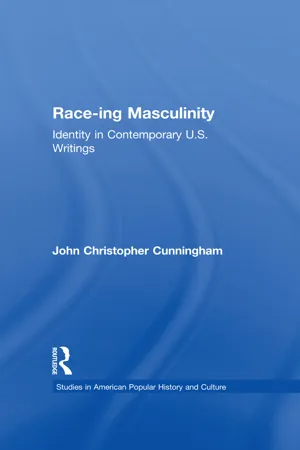
This study explores the intersection of race and gender identity in writings by contemporary American men of color, showing how ostensibly sexist or homophobic texts coexist with or are engendered by articulations of anti-racism. Conversely, certain articulations of gender concerns produce reactionary ideas about race. The author examines Asian American identity in the works of Frank Chin, John Okada, and Shawn Hsu Wong, contending that these writers exhibit a strong masculinist/sexist bias, limiting their value for Asian American women and homosexuals. The author then looks at the work of African American writer Charles Johnson. He examines the conflict between feminism and male supremacy in Johnson's novels, tracing the relationship between this vision of gender and the conservatism of Johnson's approach to race issues. The author also considers the discourse of perverse sexuality with particular attention to the possibility of a countertradition of the joto, or queer in the canon of Chicano novels from Jose Antonio Villareal to Arturo Islas. Through an examination of the readings of Richard Rodriguez and Oscar Zeta Acosta, Cunningham demonstrates the interplay of homosocial sexual politics with Rodriguez and Acosta's respective conservative and revolutionary approaches to race. Finally, the study considers how claims about the universality of postmodern experience implicit in Don DeLillo's novel, White Noise, actually bear the particularizing marks of whiteness and masculinity. Includes index and bibliography
Information
CHAPTER ONE
Introduction:
Literature as a Site for the Constitution and Reconfiguration of Identity
The following book consists of a set of essays on contemporary U.S. male writers. My focus on male writers grew out of the concern, expressed by a number of male writers of color, that their voices were being systematically silenced. Ishmael Reed and Frank Chin, for example, have argued that support for the writing of women of color by academia and the publishing industry constitutes a White supremacist attempt to silence men of color. While I do believe that, in a college literature course, one is more likely to read something by Toni Morrison, Maxine Hong Kingston, Leslie Marmon Silko, or Sandra Cisneros than anything by a contemporary male African American, Asian American, American Indian or Chicano/Latino writer, I don’t believe Reed’s and Chin’s diagnosis is correct. What seems more likely is that the presence in most English Departments of a strong feminist sensibility has raised interest in women-authored texts and has created reservations about arguably sexist texts by writers like Reed and Chin. If, however, it is true that the voices of contemporary men of color are less frequently taught in literature courses, for whatever reason, I believe it is necessary to explore why, committed as I am to a pluralist pedagogy.
I examine work by male writers not to find out what “real” men think and feel, but to see how literature by men represents them. Literature is one mode of writing among many putting forward ideas about what men have been and what they can be. In its highly crafted form, it offers an ideal site for the generation and dissemination of ideas about gender and race. It also offers a particularly clear arena for the kinds of articulations and rearticulations through which identity is produced and changed.
I draw my position on the constitution of identity from the work of selfdefined “post-Marxist” cultural critics, Chantal Mouffe and Ernesto Laclau. In their writings, together and separately, Laclau and Mouffe lay out a theory of “radical democracy” based on the notion that the political world functions through the constant rearticulation of blocs of identity: a process they call “hegemony.” One can trace the genealogical line of their concept of identity to French Marxist Louis Althusser’s work on subjectivity. In his early book, Politics and Ideology in Marxist Theory, Laclau writes that “Althusser’s most important and specific contribution to the study of ideology” is “the conception that the basic function of all ideology is to interpellate/constitute individuals as subjects.”1 It is the process of “interpellation” or “hailing” that will take a central place in all of Laclau’s later work.
Althusser’s well-known early piece, “Ideology and Ideological State Apparatuses,” begins a search for the “ideological” by first distinguishing “between concrete individuals on the one hand and concrete subjects on the other.”2 He explains:
ideology “acts” or “functions” in such a way that it “recruits” subjects among the individuals (it recruits them all), or “transforms” the individuals into subjects (it transforms them all) by that very precise operation which I have called interpellation or hailing. (“I,” 174)
It is in this sense that Althusser claims that the “existence of ideology and the hailing or interpellation of individuals as subjects are one and the same thing” (“I,”175).
The term “individual” here refers not to a position of total undifferentiation, but to that of a person existing within structures of differentiation, but who is, in a sense, unconscious of them, or, unselfconscious. A state of actual undifferentiation is only an abstract, theoretical position, since distinguishing categories pre-exist all persons. What is important and new in Althusser’s argument is his claim that the second position—that of subjectivity—is similarly abstract. Althusser writes:
ideology has always-already interpellated individuals as subjects, which amounts to making it clear that individuals are always—already interpellated by ideology as subjects, which necessarily leads us to one last proposition: individuals are always-already subjects. Hence individuals are “abstract” with respect to the subjects which they always-already are. (“I,”175–6)
Althusser demonstrates by example how this proposition functions:
an individual is always-already a subject, even before he is born…it is certain in advance that it will bear its Father’s Name, and will therefore have an identity and be irreplaceable. Before its birth, the child is therefore always-already a subject, appointed as a subject in and by the specific familial ideological configuration in which it is “expected” once it has been conceived. (“I,”176)
In the end, Althusser offers the binary, individual/subject, only to deconstruct it as a starting point for conceptualizing subjectivity in a way which asserts the ultimate social constructedness of identity: there is no individual or subject “before” socialization.
The strength of Althusser’s formulation does not lie, however, in his “social conditioning” argument (similar arguments are age-old); rather, his innovation rests in the observation that socialization is carried out through a process of interpellation or “hailing” as he calls it, which, even as it creates subjectivity, also creates in the subject a sense that her/his subjectivity preexists this subjectivizing moment. The error comes when one believes that the interpellating or identity-forming call acknowledges an already existing essential identity; that is, when the “recognition” of the hailing acts to validate the feeling that one’s identity is fully-formed and “already there.” The recognition, however, is really a misrecognition of identity as stable and preexistent, since it is exactly such moments, enacted even before one’s birth, that create a differentiated sense of identity. This mis-recognition becomes “ideological” when it acts to “naturalize” one’s identity, and thus one’s beliefs and desires (i.e. one’s ideological orientation). Althusser writes:
those who are in ideology believe themselves by definition outside ideology: one of the effects of ideology is the practical denegation of the ideological character of ideology by ideology. (“I,”175)
To illustrate crudely, in the moment that someone says, “Hey, little girl,” the person so hailed recognizes herself in the call, recognizes that she is a “little girl,” with all that this term entails. This moment is ideological in nature because it feels to her like proof or confirmation that she is, and already was, a “little girl,” whereas, in truth, it is only the infinite similar moments of hailing which make this person imagine herself to really be a “little girl,” with all that this term entails.
Laclau, emphasizing, for his part, the psychological character of interpellation, embraces it as the starting point for his work:
the concept of “interpellation” is the phenomenon of “identification” which Freud described at various points of his work, especially in Group Psychology. In its Lacanian reformulation, it presupposes the centrality of the category of “lack.” In my own analyses, the important issue is also the reconstitution of shattered political identities through new forms of identification.3
Following Althusser, Laclau recognizes the central functioning of mis-recognition in subject formation, writing, “through interpellation individuals live their conditions of existence as if they were the autonomous principle of the latter—as if they, the determinate, constituted the determinant” (PI,101). In other words:
Individuals, who are simple bearers of structures, are transformed by ideology into subjects, that is to say, that they live the relation with their real conditions of existence as if they themselves were the autonomous principle of determination of that relation. The mechanism of this characteristic inversion is interpellation. (PI,100)
Once the ontological status of subjectivity has been problematized by the phenomenon of misrecognition, Laclau insists that the task of analyzing “the ideological level of a determinate social formation” must turn from individuals within a formation to “the interpellative structures which constitute it” (PI,102). This is the point at which Laclau breaks with Althusser.
Because, in “Ideology and Ideological State Apparatuses,” Althusser works from the position that the economic relations of production determine ideology in the last instance, he supports the absolute agency of institutions and the corresponding passivity of individuals interpellated by those institutions. For Laclau, on the other hand, moving away from stable notions of subjective agency does not mean moving toward a stable notion of institutional agency. Laclau refuses to accept the complete determinacy of the economy and its super structural institutions in subject formation, arguing that while it is true that subjects arise only under conditions of interpellation, interpellative structures likewise can only be said to exist when individual subjects collectively constitute them. He writes:
interpellation is the terrain for the production of discourse…in order to “produce” subjects successfully, the latter must identify with it. The Althusserian emphasis on interpellation as a functional mechanism in social reproduction does not leave enough space to study the construction of subjects from the point of view of the individuals receiving those interpellations. (NR,210)
Laclau supplements Althusser’s notion of institutions with an assertion of activity on the part of subjects, again by invoking the psychological character of interpellation. He writes:
the incorporation of the individual into the symbolic order occurs through identifications. The individual is not simply an identity within the structure but is transformed by it into a subject, and this requires acts of identification. (NR,211)
The relation Laclau attempts to establish between subjects and institutions does not, it must be stressed, deny the active role of institutions. Laclau writes:
institutions are fully present in our approach…we have asserted that social agents are partially internal to the institutions, thus forcing both the notion of “agency” and “institution” to be deconstructed…the agents are not just blind instruments or bearers of structures for the simple reason that the latter do not constitute a closed system, but are riven with antagonisms, threatened by a constitutive outside and merely have a weak or relative form of integration…. In opposition to the postulation of two separate metaphysical entities—agents and structures—we suggest the following: (a) that there are merely relative degrees of institutionalization of the social, which penetrate and define the subjectivity of the agents themselves; and (b) that the institutions do not constitute closed structural frameworks, but loosely integrated complexes requiring the constant intervention of articulatory practices. (NR,223–4)
For Laclau, the reconstruction of interpellative structures involves confronting the mutual constitutivity of subjects and interpellators: it involves conceptualizing interpellation as an interchange between subjects and institutions, rather than as a function of either by itself, of the economy, or of other “grounded” forces. Laclau writes:
It’s not a question of “someone” or “something” producing an effect of transformation or articulation, as if its identity was somehow previous to this effect. Rather, the production of the effect is part of the construction of the identity of the agent producing it…one cannot ask who the agent of hegemony is, but how someone becomes the subject through hegemonic articulation instead. (NR,210–1)
Laclau’s work is thus “poststructuralist” in the sense that he accepts that some structuration of social relations is necessary to render them intelligible, but denies any permanence or ultimate “reliability” to any structuration. He writes:
The social is not only the infinite play of differences. It is also the attempt to limit that play, to domesticate infinitude, to embrace it within the finitude of an order. But this order—or structure—no longer takes the form of an underlying essence of the social; rather, it is an attempt—by definition unstable and precarious—to act over that “social,” to hegemonize it. (NR,91)
In another formulation:
the systematic element, its cohesiveness, does not have the status of a ground…insofar as the social “order” does exist, there is a constitutive outside which deforms and threatens the “system” and this very fact means that the latter can only have the status of a hegemonic attempt at articulation, not a ground…while this doesn’t mean depriving social practices of all their coherence, it nevertheless does mean denying that this coherence can have the rationalistic status of a superhard “tran-scendentality.” (NR,214)
Once society is understood to function, like all systems, through partial or “contingent” structurations, the political task thus becomes the formulation of strategies appropriate for decentered subjects and ungrounded interpellative (i.e. social) forces. This task is the goal of Laclau’s collaborative work with Chantal Mouffe.
Acknowledging the ambiguity constitutive of the process of subjectification, Mouffe and Laclau write in Hegemony and Marxist Strategy that subjects cannot “be the origin of social relations…as all ‘experience’ depends on precise discursive conditions of possibility.”4 On the other hand, they recognize that any “precise discursive conditions” cannot be described without reference to the subjects which identify with and give voice to a given discourse. Their work thus seeks to define the conditions under which subjects are created by and reciprocally create interpellati ve structures. Laclau and Mouffe name the mutual constitution of subjects and interpellating discourses as “articulation.” In their schema, Althusser’s “institutions” are recast as “discursive formations,” a term derived from Michel Foucault. In his study, The Archaeology of Knowledge, Foucault conceptualizes socializing forces or institutions as “discourses” in order to demonstrate their ideological character without grounding them in any transcendental force such the economy, Nature or God. Foucault locates these discourses in historical documents—not as discreetly articulated wholes, however, but as signifiers dispersed across a variety of statements. These signifiers may be said to constitute a “discourse” once they have been abstractly reconstructed in a totality defined not by their a priori stylistic or thematic connection, but by their recurrence alone.
Mouffe and Laclau adopt Foucault’s theory of discursive formations, modifying it chiefly by stressing the regularity of the dispersion of signifiers in a discourse and by challenging Foucault’s distinction between discursive and non-discursive objects. They write:
The type of coherence we attribute to a discursive formation is…close to that which characterizes the concept of “discursive formation” formulated by Foucault: regularity in dispersion…Foucault makes dispersion itself the prin...
Table of contents
- Cover
- Title
- Copyright
- Dedication
- CONTENTS
- Acknowledgments
- Chapter One Introduction: Literature as a Site for the Constitution and Reconfiguration of Identity
- Chapter Two “This Thing Going With My Bride to Straighten Out in America”
- Chapter Three Hegemony and the Broad Celebration of Charles Johnson
- Chapter Four “Hey, Mr. Liberace Will You Vote for Zeta?” Looking for the Joto in Chicano Men’s Autobiographical Writing
- Chapter Five “His Complexion was of a Tone I Want to Call Flesh-Colored”
- Bibliography
- Index
Trusted by 375,005 students
Access to over 1.5 million titles for a fair monthly price.
Study more efficiently using our study tools.
Frequently asked questions
Yes, you can cancel anytime from the Subscription tab in your account settings on the Perlego website. Your subscription will stay active until the end of your current billing period. Learn how to cancel your subscription
No, books cannot be downloaded as external files, such as PDFs, for use outside of Perlego. However, you can download books within the Perlego app for offline reading on mobile or tablet. Learn how to download books offline
Perlego offers two plans: Essential and Complete
- Essential is ideal for learners and professionals who enjoy exploring a wide range of subjects. Access the Essential Library with 800,000+ trusted titles and best-sellers across business, personal growth, and the humanities. Includes unlimited reading time and Standard Read Aloud voice.
- Complete: Perfect for advanced learners and researchers needing full, unrestricted access. Unlock 1.5M+ books across hundreds of subjects, including academic and specialized titles. The Complete Plan also includes advanced features like Premium Read Aloud and Research Assistant.
We are an online textbook subscription service, where you can get access to an entire online library for less than the price of a single book per month. With over 1.5 million books across 990+ topics, we’ve got you covered! Learn about our mission
Look out for the read-aloud symbol on your next book to see if you can listen to it. The read-aloud tool reads text aloud for you, highlighting the text as it is being read. You can pause it, speed it up and slow it down. Learn more about Read Aloud
Yes! You can use the Perlego app on both iOS and Android devices to read anytime, anywhere — even offline. Perfect for commutes or when you’re on the go.
Please note we cannot support devices running on iOS 13 and Android 7 or earlier. Learn more about using the app
Please note we cannot support devices running on iOS 13 and Android 7 or earlier. Learn more about using the app
Yes, you can access Race-ing Masculinity by John Christopher Cunningham in PDF and/or ePUB format, as well as other popular books in Social Sciences & Ethnic Studies. We have over 1.5 million books available in our catalogue for you to explore.