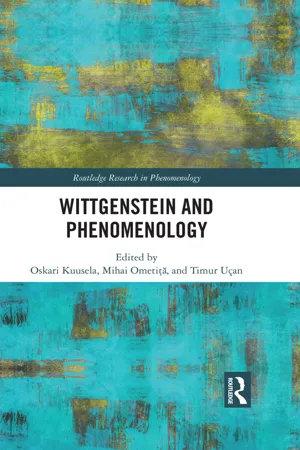
This volume of new essays explores the relationship between the thought of Wittgenstein and the key figures of phenomenology: Husserl, Heidegger, Levinas, Merleau-Ponty and Sartre. It is the first book to provide an overview of how Wittgenstein's philosophy in its different phases, including his own so-called phenomenological phase, relates to the variety of phenomenological approaches developed in continental Europe. In so doing, the volume seeks to throw light on both sides of the comparison, and to clarify more broadly the relations between analytic and phenomenological philosophy. However, rather than treating the interpretation of either phenomenological philosophy or Wittgenstein as an already settled issue, several chapters in the volume examine and question received views regarding them, and develop alternatives to such views. Wittgenstein and Phenomenology will be of interest to scholars working in philosophical methodology and metaphilosophy, the philosophy of mind, philosophy of language and logic, and ethics.
eBook - ePub
Wittgenstein and Phenomenology
- 280 pages
- English
- ePUB (mobile friendly)
- Available on iOS & Android
eBook - ePub
Wittgenstein and Phenomenology
About this book
Information
1
Phenomenology in Grammar
Explicitation-Verificationism, Arbitrariness, and the Vienna Circle
Introduction
Members of the Vienna Circle were quite aware that the Weltanschauung conveyed in the Tractatus and in Wittgenstein’s Middle Period philosophy was not their own. Sometimes the disagreement was put in terms of Wittgenstein’s “mysticism” (Carnap 1963, 27), which is not a particularly illuminating way to express it. Yet, Carnap gets right to the point here: “But Wittgenstein rejected Schlick’s view that religion belonged to the childhood phase of humanity and would slowly disappear in the course of cultural development” (Carnap 1963, 26). Contrary to Schlick, the founder of the Circle, Wittgenstein held religion “in reverence” (WVC, 118). Moreover, he did not share the positivistic faith in the progress of humanity and its scientific outlook. This can be attested already in the Tractatus (TLP 6.371–2), and it is clearly expressed in his unfinished 1930 preface, where he says that his way of thinking was different from the scientist’s way and that he was not in sympathy with “the current European and American civilization” (CV, 6–7; from 1930).1
In spite of different Weltanschauungen, Wittgenstein and the Vienna Circle were in close contact. This can be partly explained by the influential role of the Tractatus. Schlick coordinated a systematic reading of the book from the end of 1925 until the middle of 1926 at least, when Carnap joined the group in Vienna.2 In the second half of 1927 meetings with the author of the Tractatus began. Arguably, the book was especially important for the members of the Circle because it improved their views on the nature of a priori knowledge. Carnap claimed that the idea of ‘tautology’ enabled the Circle to clarify the distinction between analytic and synthetic propositions in an empiricist framework—see Carnap (1930) and (1963, 63–4). Neurath (1931) makes the same claim. Similarly, Schlick (1930b) was convinced that in the Tractatus the notion of ‘form’ was clearly presented for the first time. This, one must suppose, gave a better ground for his structural-formal idea of a priori knowledge in General Theory of Knowledge.
The influential role of the Tractatus might explain why the Circle and Wittgenstein got in touch. However, only deeper ties explain why they kept in touch for approximately nine years (from 1927 until 1936). Already in 1927 Waismann began a treatise about the Tractatus.3 This project was transformed into a presentation of ideas of the Tractatus adapted to Wittgenstein’s phenomenological turn in1929 known as Waismann’s Theses (in WVC, 233–61). Wittgenstein gave up publishing Waismann’s Theses in 1931 (WVC, 183). However, their collaboration continued. Right after, Waismann began a new book with Wittgenstein’s supervision. Roughly, such a book would be a presentation of Wittgenstein’s philosophy at the time of the Big Typescript. In 1932, Wittgenstein went as far as considering the possibility of giving up publishing his own book and publishing only Waismann’s presentation of his ideas (WC, 199). It seems that their common work ended only in 1936, the year of Schlick’s death.4 Given such a long period of collaboration, it would be extraordinary if their exchanges concerning issues beyond the Tractatus were not fruitful.
In this chapter, I explore Wittgenstein’s ties with the Circle in the context of Philosophical Remarks (1930), and indicate some fruitful results of their proximity. In 1929–30, Wittgenstein invented two new views at least partially shared by members of the Circle: verificationism and the thesis (or ‘insight’) of the ‘arbitrariness of grammar’. I intend to explain, first, Wittgenstein’s own understanding of verificationism with the background of his comprehensive ‘grammar’ in Philosophical Remarks and of some views defended in the Circle.5 With this in hand, I aim to explain why the ‘arbitrariness of grammar’ is introduced. Contrary to Hacker (2000), who takes ‘arbitrariness’ as a major break with the Tractatus, I intend to show that it is actually required in order to preserve a fundamental insight of that book, namely, that logic is not justifiable. Wittgenstein’s move towards ‘arbitrariness’ will show Schlick’s important role as critical interlocutor and Wittgenstein’s influence on the Circle after the Tractatus.
The sections of this chapter are organized in the following way. In section 1, I briefly look at some characteristics of ‘verificationism’ in order to point out various aspects of the idea that need to be taken into account if we want to see what Wittgenstein does with it. In section 2, I aim to show why he presupposes a variation of the criterion of verification already in his project of a phenomenological language (1929) and subsequently broadens its use in Philosophical Remarks (1930). This explanation will show that for him verificationism had not merely a ‘negative’ function (the elimination of pseudo-problems) as in Schlick (1930a), Carnap (1929, 1932a), and especially Ayer (1936). Its ‘positive’ function was to organize the adaptation of the pictorial conception of language in Philosophical Remarks grounded in a broader understanding of the context principle. The context of words in sentences includes rules clarified by methods of verification connected with action and the manipulation of physical objects. Moreover, the understanding of methods of verification makes explicit rules of ‘grammar’ related to phenomenological spaces that show what is meant by a sentence and how it is understood. Thus, I call Wittgenstein’s kind of verificationism ‘explicitation-verificationism’.
In sections 3 and 4, I aim to make clear that since rules of specific spaces (color, for instance) restrict the role of Tractarian logic (truth-functional connectives), it was not obvious anymore that logic (or grammar) was completely independent of how the world is (see TLP 5.552). This could lead one to think that logical (grammatical) inferences were, after all, dependent on contingencies, which could jeopardize the hardness of rules of ‘grammar’. Nevertheless, if the rules of ‘grammar’ are in principle unjustifiable, i.e., not derivable from true propositions, it is plausible to think that such a risk is avoided. The role of ‘arbitrariness’ will come to the fore as an answer to Schlick’s worries concerning a priori knowledge.
Sections 5 through 7 conclude this chapter. In section 5, I give some lines of the adaptation of the Tractatus in Philosophical Remarks. In section 6, I briefly point out the fruitfulness of Wittgenstein’s ties with the Circle and the possible roots of misunderstandings concerning physicalism and hypotheses that generated plagiarism accusations. Finally, in section 7, I show why ‘arbitrariness’ is rather trivial if one accepts Wittgenstein’s understanding of ordinary sentences as hypotheses.
1. Verificationism, the Circle, and Wittgenstein
The authorship and the role of the “principle of verification” are controversial. In his ‘Autobiography’ (1963, 45), Carnap talks about “Wittgenstein’s principle of verifiability”, which he characterizes in the following way: “the meaning of a sentence is given by the conditions of its verification and, second, … a sentence is meaningful if and only if it is in principle verifiable” (1963, 45). Carnap had in mind Wittgenstein’s slogan: “The sense of a proposition is the method of its verification” (WVC, 79).6 However, contrary to Carnap’s view, Wittgenstein claimed in 1938 that he did not like to call “a principle” the statement that “the meaning of a statement is the method of its verification” (PPO, 334). The reason for his dislike was that people had turned his “suggestion about asking for the verification into a dogma” (PPO, 334). Since he said those things in 1938, he had probably in mind, for instance, Schlick (1930a), Carnap (1932a), and Ayer (1936), who bear responsibility for the popularization of a “principle of verification”.
As interesting as what Carnap says about “Wittgenstein’s principle” in the passage quoted previously is what he says some pages later in a different context of the same text: that he thought that what led to Wittgenstein’s “principle” was Mach’s idea of sensations, Russell’s atomism, and the idea that propositions are truth-functions of elementary propositions (Carnap 1963, 57). Throughout this chapter we will see that, from Wittgenstein’s point of view, this is a misunderstanding, and, in section 6, we will see that it might be the root of some delicate accusations of plagiarism.
Carnap’s view on what led to the principle shows that the members of the Circle read Wittgenstein’s verificationism through the lens of empiricism. They thought that the “principle” was grounded in an old positivistic idea, namely, that all empirical statements must be interpreted (translated) in terms of immediate data (“experience”). In fact, this is a fundamental aspect of Carnap’s own use of verificationism in his writings—see Carnap (1929, 1930, and 1932). Carnap (1929) refers to Hume and Mach when he presents the “requirement of reducibility”: “each statement must be reduced to sensations, otherwise it is senseless” (1929, 59). Members of the Vienna Circle evidently defended varieties of reductionism before getting in touch with Wittgenstein.7 Philip Frank, for instance, in his homage to Mach, claims that “only those sentences that can in principle be expressed as sentences about the connection of our sensations have a sense” (Frank 1917, 99). So if the “principle” boils down to a variety of reductionism, Wittgenstein cannot be its author. Because of their own philosophical agenda, the members of the Circle were led to their own understanding of the “principle”.8
If ideas concerning reduction and immediate experience (the given) that ground verificationism were certainly not introduced by Wittgenstein, the novelty of his verificationism seems to be the slogan that the sense of a sentence is its method of verification (see PR §166; WVC, 79). However, even this is not completely correct. Wittgenstein suggests that Einstein is the source of the slogan:
The verification is not one token of the truth, it is the sense of the proposition. (Einstein: How a magnitude is measured is what it is.)
(PR §166)
Wittgenstein has in mind time measurement in relativity theory. Einstein claims, for instance, that the statement “these two lightning flashes occurred simultaneously” has sense only if there is a method to verify it:
We thus require a definition of simultaneity such that this definition supplies us with the method by means of which, in the present case, he [a meteorologist] can decide by experiment whether or not both the lightning strokes occurred simultaneously.
(Einstein 1920, 23)
Without a measurement method, one cannot “attach a meaning to the statement of simultaneity” (1920, 24; my emphasis). However, although Einstein’s verificationism arguably inspired Wittgenstein’s, it will not answer for it. So in order to understand what Wittgenstein meant by that slogan we must look at how he used it when he introduced it in his philosophy (the same applies to the ‘arbitrariness of grammar’). We need to pay attention to what led him to explicitation-verificationism and how it works in his comprehensive ‘grammar’, where it indeed plays a relevant and original role.
2. Explicitation-Verificationism: Why a Criterion of Verification and How It Was Used by Wittgenstein
Wittgenstein has a quite general use of the criterion (or method, or way) of verification. Its role is to make explicit some fundamental ‘grammatical’ distinctions in line with his comprehensive ‘grammar’ in Philosophical Remarks. It distinguishes two kinds of sentences: empirical and necessary. On the one hand, the method of proof characterizes the verification of sentences in logic and mathematics. Mathematical sentences (or questions) make sense to the extent that they have a method of solution inside a mathematical system (PR §§149, 152). What essentially distinguishes logic and mathe...
Table of contents
- Cover
- Title
- Copyright
- Contents
- Lists of Abbreviations
- Introduction
- 1 Phenomenology in Grammar: Explicitation-Verificationism, Arbitrariness, and the Vienna Circle
- 2 Phenomenology, Logic, and Liberation From Grammar
- 3 Husserl and Wittgenstein on Description and Normativity
- 4 Heidegger and Wittgenstein: The Notion of a Fundamental Question and the Possibility of a Genuinely Philosophical Logic
- 5 Phenomenology, Language, and the Limitations of the Wittgensteinian Grammatical Investigation
- 6 Pain and Space: The Middle Wittgenstein, the Early Merleau-Ponty
- 7 Internal Relations in Wittgenstein and Merleau-Ponty
- 8 Can There Be a Logic of Grief?: Why Wittgenstein and Merleau-Ponty Say ‘Yes’
- 9 Is Self-Consciousness Consciousness of One’s Self?
- 10 ‘Life and World Are One’. World, Self and Ethics in the Work of Levinas and Wittgenstein
- Lists of Contributors
- Index
Trusted by 375,005 students
Access to over 1.5 million titles for a fair monthly price.
Study more efficiently using our study tools.
Frequently asked questions
Yes, you can cancel anytime from the Subscription tab in your account settings on the Perlego website. Your subscription will stay active until the end of your current billing period. Learn how to cancel your subscription
No, books cannot be downloaded as external files, such as PDFs, for use outside of Perlego. However, you can download books within the Perlego app for offline reading on mobile or tablet. Learn how to download books offline
Perlego offers two plans: Essential and Complete
- Essential is ideal for learners and professionals who enjoy exploring a wide range of subjects. Access the Essential Library with 800,000+ trusted titles and best-sellers across business, personal growth, and the humanities. Includes unlimited reading time and Standard Read Aloud voice.
- Complete: Perfect for advanced learners and researchers needing full, unrestricted access. Unlock 1.5M+ books across hundreds of subjects, including academic and specialized titles. The Complete Plan also includes advanced features like Premium Read Aloud and Research Assistant.
We are an online textbook subscription service, where you can get access to an entire online library for less than the price of a single book per month. With over 1.5 million books across 990+ topics, we’ve got you covered! Learn about our mission
Look out for the read-aloud symbol on your next book to see if you can listen to it. The read-aloud tool reads text aloud for you, highlighting the text as it is being read. You can pause it, speed it up and slow it down. Learn more about Read Aloud
Yes! You can use the Perlego app on both iOS and Android devices to read anytime, anywhere — even offline. Perfect for commutes or when you’re on the go.
Please note we cannot support devices running on iOS 13 and Android 7 or earlier. Learn more about using the app
Please note we cannot support devices running on iOS 13 and Android 7 or earlier. Learn more about using the app
Yes, you can access Wittgenstein and Phenomenology by Oskari Kuusela, Mihai Ometita, Timur Uçan, Oskari Kuusela,Mihai Ometita,Timur Uçan in PDF and/or ePUB format, as well as other popular books in Philosophy & Phenomenology in Philosophy. We have over 1.5 million books available in our catalogue for you to explore.