This book critically evaluates different models of judicial leadership in Indonesia to examine the impact that individual chief justices can have on the development of constitutional courts. It explores the importance of this leadership as a factor explaining the dynamic of judicial power. Drawing on an Aristotelean model of heroism and the established idea of judicial heroes to explore the types of leadership that judges can exercise, it illustrates how Indonesia's recent experience offers a stark contrast between the different models. First, a prudential-minimalist heroic chief justice who knows how to enhance the Court's authority while fortifying the Court's status by playing a minimalist role in policy areas. Second, a bold and aggressive heroic chief justice, employing an ambitious constitutional interpretation. The third model is a soldier-type chief justice, who portrays himself as a subordinate of the Executive and Legislature. Contrary perhaps to expectations, the book's findings show a more cautious initial approach to be the most effective. The experience of Indonesia clearly illustrates the importance of heroic judicial leadership and how the approach chosen by a court can have serious consequences for its success. This book will be a valuable resource for those interested in the law and politics of Indonesia, comparative constitutional law, and comparative judicial politics.
eBook - ePub
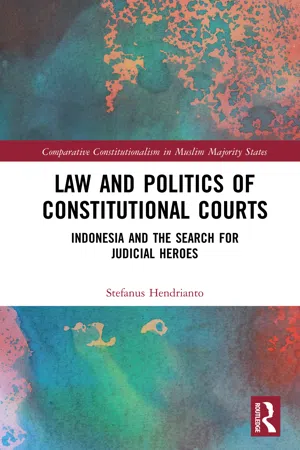
Law and Politics of Constitutional Courts
Indonesia and the Search for Judicial Heroes
- 292 pages
- English
- ePUB (mobile friendly)
- Available on iOS & Android
eBook - ePub
Law and Politics of Constitutional Courts
Indonesia and the Search for Judicial Heroes
Part I
Foundations
Introduction
One of the driving forces behind the resurgence of comparative constitutional law studies of the last two decades is the establishment of constitutional courts as the key feature of constitutional reforms in new democracies.1 Within the growing literature on the court and judicial review, the idea of “judicial heroes” may be something out of the ordinary because it seems overly emotive and not very scholarly. But the heroic persona is nothing new. One of the major functions of judicial review is individual rights’ protection, which requires the role of a judge to defend the individual from the mighty state apparatus.2 The image here is of the judge as a hero who fights for the rights and liberties of the poor and oppressed. Moreover, the legal community has long equated the term “heroic” with the term “activist,” in the sense that heroic judges are those who are willing to use the constitution to strike down acts of parliament.3 Furthermore, the legal community has inducted “activist” judges as “judicial heroes” in the pantheon of heroic courts.4
While currently there are few legal scholars and political scientists attempting to explain judicial empowerment in new democracies from the perspective of judicial heroes, we can find evidence that the role of judicial heroes is part of the larger theme of the study of constitutional courts and judicial review. A lot of scholarly works on the first-generation constitutional courts of new democracies, such as those in South Africa5 and Eastern Europe,6 point out the contribution of judicial heroes in shaping the role of the courts in judicial politics.
The Indonesian Constitutional Court is the world’s 78th Constitutional Court and the first to have been established in the twenty-first century. Within studies of the Indonesian Constitutional Court to date, many scholars have acknowledged the heroic leadership and dedication of the founding chief justice, Jimly Asshiddiqie, in establishing the Court’s institutional legitimacy.7 Nevertheless, since Asshiddiqie’s departure from the Court in 2008, his successors have all either been disgraced or put in prison. Moreover, the second and third-generation Court has become less robust and less innovative than the first. As the Court has undergone this transition from a heroic court to one that is less so, one open question is the impact that individual chief justices can have on the Court’s performance. Thus, it is important to undertake a critical evaluation of the different chief justices, who had different leadership styles, at the Indonesian Constitutional Court from its inception to present day.
I wrote this book in order to illuminate the unique heroism of the first-generation Indonesian Constitutional Court and to critically examine what happened next—after the heroic Chief Justice Asshiddiqie left the scene.8 Studies of the Indonesian Constitutional Court suggest, in my view, an overly simplistic explanation that the first-generation Court was an “activist Court.”9 Moreover, Asshiddiqie’s leadership has received a great deal of criticism from some scholars who believe that Asshiddiqie simply exploited the political space provided by the post-authoritarian moment, and that he forcefully asserted the Court’s role without any compelling legal justification.10 While these scholars might find significance in applying the notion of “judicial activism” to the Indonesian Constitutional Court, the debate over judicial empowerment has moved far beyond the distinction between judicial activism and judicial restraint.11 Furthermore, the label of “activism” does not adequately describe Asshiddiqie’s leadership as he led the Court to issue many decisions that were palatable to the legislature. In many instances, the Court refused to invalidate the statute, but nonetheless issued directives for the government to follow. A scholar described this phenomenon as “hidden activism,”12 in the sense that the Court’s “activism” is somewhat different from the standard model of judicial activism found in a liberal democracy.
Aggressive-bold versus prudential-minimalist heroes
The missing piece of the puzzle regarding Asshiddiqie’s leadership points to a discussion on different varieties of judicial heroism. In my theoretical approach, I rely on the Aristotelean notion of heroism, in which Aristotle discusses heroism in the context of the first two virtues, andreia (courage or manliness) and sophrosune (temperance).13 Here, Aristotle makes a classical comparison between the characters of two Homeric heroes: Achilles of the Iliad and Odysseus of the Odyssey.14 Achilles is the exemplar of andreia and Odysseus is of sophrosune, and Aristotle praises them both because they embody different models of heroic virtue.
The defining characteristic of judicial heroes as vigorous and bold judges is the representation of an Achilles type of judicial hero. But there is an Odysseus type of judicial hero, who does not fit the description of everyday robust and bold judicial heroes. An Odysseus type of judicial hero is the one who knows how to enhance the court’s authority while also fortifying the court against the executive and legislative branches by playing a minimalist role in some policy areas.
Based on Aristotelian heroism, the book offers a theory of Chief Justice Asshiddiqie as a “prudential-minimalist hero”—a judicial hero who relies on practical intelligence and reason to access possible strategies, and whose approach sometimes involves taking seemingly unheroic actions to achieve his ultimate goals. A prudential-minimalist hero must know when to move one step forward with ambitious constitutional interpretation and when to move two steps back by deferring to the political judgments of other branches of government. In other words, a prudential-minimalist type of judicial hero must be equipped with the prudential judgment to recognize when he needs to be cautious in deferring to the government, or when to be bold in breaking new legal ground.
The unique heroism of the first-generation court
The book argues that the founding chief justice of the Indonesian Constitutional Court, Jimly Asshiddiqie, was a prudential-minimalist type of judicial hero. The main feature of Asshiddiqie’s judicial heroism was his reliance on a combination of maximalist and minimalist strategies. Led by Asshiddiqie, the Court struck down many governmental policies, but at the same time the Court sometimes delayed the implementation of its decisions, or it allowed the government to make practical adjustments to its policies.
Under the chairmanship of Jimly Asshiddiqie, the Court employed techniques that I would like to call “quasi-weak-form review.” The concept of weak-form judicial review first emerged in Mark Tushnet’s early articles on an alternative model of judicial review,15 which he refined in his 2008 book Weak Court’s Strong Rights.16 The weak-form judicial review has also come to be known by several other names, such as the “dialogic judicial review model”17 or the “new Commonwealth model.”18 Weak-form judicial review stands for the idea that constitutional limitations can be enforced without designating a final and exclusive role for the judiciary. Under weak-form judicial review, a court’s interpretations merit great respect and have great weight, but its decisions can at times be overridden or rejected by legislatures.
In the Indonesian constitutional system, there is no formal feature that allows political branches to examine any judicial ruling and to override the Court’s decision by ordinary majority vote or otherwise. The Court, therefore, still has the exclusive power of constitutional review. Nevertheless, led by Chief Justice Asshiddiqie, the Court adopted several techniques that can be considered to represent a quasi-weak-form review. First, the Court issued “conditionally constitutional” rulings, in which it allowed the laws in question to remain valid as long as they were applied or implemented in the way the Court interpreted them.19 In some instances, the Court asked the government to interpret the statute in a certain way or prescribed directives to help the government implement the statute. Second, the Court issued weak remedies in different forms, such as “suspended declarations,” which hold the decision of invalidity for a certain period during which the government must adopt a new plan to replace the law; “progressive realizations,” which allow the state to take incremental steps to achieve the full realization of the constitutional rights; and “prospective overrulings,” in which the Court decision would only apply to future cases.
In differ...
Table of contents
- Cover
- Half-Title
- Series
- Title
- Copyright
- Dedication
- Contents
- List of tables
- List of cited cases
- List of abbreviations
- Acknowledgments
- PART I Foundations
- PART II The first-generation court
- PART III The second-generation court
- PART IV Conclusions
- References
- Index
Trusted by 375,005 students
Access to over 1.5 million titles for a fair monthly price.
Study more efficiently using our study tools.
Frequently asked questions
Yes, you can cancel anytime from the Subscription tab in your account settings on the Perlego website. Your subscription will stay active until the end of your current billing period. Learn how to cancel your subscription
No, books cannot be downloaded as external files, such as PDFs, for use outside of Perlego. However, you can download books within the Perlego app for offline reading on mobile or tablet. Learn how to download books offline
Perlego offers two plans: Essential and Complete
- Essential is ideal for learners and professionals who enjoy exploring a wide range of subjects. Access the Essential Library with 800,000+ trusted titles and best-sellers across business, personal growth, and the humanities. Includes unlimited reading time and Standard Read Aloud voice.
- Complete: Perfect for advanced learners and researchers needing full, unrestricted access. Unlock 1.5M+ books across hundreds of subjects, including academic and specialized titles. The Complete Plan also includes advanced features like Premium Read Aloud and Research Assistant.
We are an online textbook subscription service, where you can get access to an entire online library for less than the price of a single book per month. With over 1.5 million books across 990+ topics, we’ve got you covered! Learn about our mission
Look out for the read-aloud symbol on your next book to see if you can listen to it. The read-aloud tool reads text aloud for you, highlighting the text as it is being read. You can pause it, speed it up and slow it down. Learn more about Read Aloud
Yes! You can use the Perlego app on both iOS and Android devices to read anytime, anywhere — even offline. Perfect for commutes or when you’re on the go.
Please note we cannot support devices running on iOS 13 and Android 7 or earlier. Learn more about using the app
Please note we cannot support devices running on iOS 13 and Android 7 or earlier. Learn more about using the app
Yes, you can access Law and Politics of Constitutional Courts by Stefanus Hendrianto in PDF and/or ePUB format, as well as other popular books in Law & Administrative Law. We have over 1.5 million books available in our catalogue for you to explore.