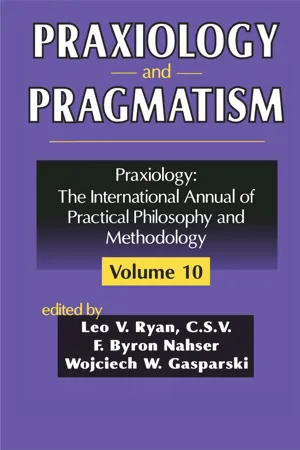
Volume l0 in this distinguished series addresses two distinct but interrelated philosophical movements, which exemplify different approaches to the study of ethics. Praxiology, an unique Central European philosophical movement, embraces the study of purposeful and conscious action and the elements essential to each action, act, and causative act. Pragmatism, an uniquely American philosophical movement, was founded by Charles S. Peirce and William James, and is based on the meaning of conceptions, defined in their practical bearings that guides actions and measures them by practical consequences of belief.
The chapters in this volume are grouped in a section on Praxiology and one on Pragmatism. Each section defines the historical origins of their respective philosophical movements, describes their methodology, and interrelates their impact on "human conduct" and contemporary society. The section on Praxiology presents for the first time in English a seminal study, "The ABC of Practicality," written in l972 by Tadeusz Kotarbinski, the father of modern Polish praxiology. Wojciech W. Gasparski offers an interpretative analysis of Praxiology. Daryl Koehn explores the nature of practical judgment and Timo Airaksinen applies praxiological efficiency in professional ethics.
The section devoted directly to Pragmatism includes scholarly contributions by eight academics on the relevance of pragmatism to management (Juan Fontrodona), business ethics (Sandra Rosenthal), law ( Fred Kellogg), and pragmatic inquiry (F. Byron Nahser). The contribution of Max Scheler to pragmatism (Manfred Frings) and the influence of William James on business ethics(Dennis McCann) are groundbreaking contributions to the study of pragmatism. The volume also includes a teaching model for a classroom application of pragmatism (Jack Ruhe), and concludes with an evaluation of the renaissance of interest in pragmatism in Europe (Jacek Sojka). Leo V. Ryan, C.S.V., professor of management, DePaul University, is past president of the Society for Business Ethics. He is co-editor of Human Action in Business (Vol. 5) and Business Students Focus on Ethics (Vol. 8) of the Praxiology series.
F. Byron Nahser is chairman and CEO, Globe Group, Chicago, the originator of Pathfinder Pragmatic Inquiry Method and author of Learning to Read the Signs: Reclaiming Pragmatism in Business.
Wojciech W. Gasparski is professor of humanities at the Institute of Philosophy and Sociology, the Polish Academy of Sciences, Warsaw, and editor-in-chief of the Praxiological series. He has published numerous volumes and over two hundred articles and conference papers.
- 243 pages
- English
- ePUB (mobile friendly)
- Available on iOS & Android
eBook - ePub
Praxiology and Pragmatism
About this book
Information
PART ONE
Praxiology
The ABC of Practicality1
Tadeusz Kotarbiński
1. The Act and Its Components
1.1. The Essence of Action
This essay describes elements of praxiology, i.e. the science of efficacious action. In order to realise the former in a satisfactory manner, one must, above all, define action itself, i.e. a purposeful and conscious act. Of course, this definition seems to be quite obvious, yet, our actual knowledge of it is usually merely intuitive. When a general description of this concept is needed, or an answer to the question "what particular qualities differentiate all active behaviour from events which are not acts?," the definitions provided do not, in fact, stand the test of criticism. There is often, for example, a common misunderstanding that the intentional agent of an act may only be someone who causes some intentional change in his surroundings. Yet, it is easy to refute such a conjecture simply by giving examples of intentional abstaining or of supervision or providing protection. It is impossible to refuse to acknowledge the fact that an individual has acted, even though after having been asked for information he is unwilling to give it and thus remains silent. And similarly, a baby-sitter is surely also active while in the process of looking after children, ready to chase away any dangerous intruders into their territory. Both of these cases certainly describe individuals who are agents of something, yet, not through having caused any change in their surroundings.
Thus, in order to not merely remain content with an intuitive understanding of the essence of active behaviour, it would be important to find some sort of analytical definition of "agenthood," "agent," "active behaviour," "productive behaviour" and this can be achieved through concrete examples such as a boy shaking pears off a tree. What is contained in this act? A boy has purposely shaken a pear tree, i.e. he has exerted the intentional pressure on the trunk of the tree. Without this, pears would be still hanging on the branches — thus the pressure was indispensable for the fruit to fall down onto the ground. Yet, if there was no ripe fruit hanging on the branches and, moreover, if the shaking was not transferred from the trunk into the twigs, in accordance with the causal principle of the sequence of events, merely shaking the trunk would not have caused the desirable result. In other words, to create the appropriate conditions for a particular pear to fall down, there had to be other circumstances at the moment of shaking the trunk of the tree, apart from the shock, which would create sufficient conditions for the fruit to fall. If this example is not vivid enough to demonstrate the essence of our discussion, another example should aid us in understanding the concept. A person in a lift wishes to reach the fifth floor. In order to do so, he presses a button on the board, which sets the machine in motion, thanks to which he arrives at his destination within a minute. His achievement lies in the fact that he has managed to arrive there at the intended time. And, once again, this is a case of the initial free pressure (of the finger on the button) and the indispensable pressure, because the lift would not begin to move without it. But to make the whole motion possible, the entire lift machinery must be in working order (and not, as is often the case, that, after pressing it, the lift does not move because it has broken down). At the same time, together with the pressure itself, there must occur a series of connected circumstances, and only then, thanks to the causal principle of the sequence of events, the intended result may be reached.
After considering the above examples the following formula may perhaps be clear and simple enough: an individual (I) is the agent of the event (E) at a given moment (tk) if, and only if, an individual (I) in the previous moment (t0) has exerted the free pressure on something - this pressure being an indispensable component to create sufficient conditions for the event (E) to occur because of the causal principle of the sequence of events. The sufficient condition consists exclusively of circumstances occurring simultaneously with the free pressure which has been exerted and includes the pressure itself.
It is quite obvious that in both of the above examples, the agent of the act exerted the pressure on a formed object, the difference being that in order to set the lift in motion it was pressed directly (in any case, the button is a component of the lift), while shaking the pear off, the free pressure was exerted on it indirectly, by pressing something else, namely the trunk of the tree, and that the pressure was somehow transmitted onto the pear.
Thus the question arises whether the proposed definition may also include activities where the act has occurred without causing any change in its surroundings. Where can we find the pressure, for example, in the case of deliberate silence? Yet, the pressure does occur, as anyone who is being questioned well knows, when he purposefully restrains from speaking which entails a particular internal effort. The latter is also a particular kind of the pressure, yet, is not simply mechanical - the pressure on some sort of relationships existing within us. In order to define the above two kinds of the pressure, it seems important to find a common term, i.e. the "free impulse." Thus it seems unquestionable that a babysitter will perform free impulses frequently while caring for her children. From now on, when referring to the general definition of agenthood, the term "pressure" will be replaced by the term "impulse."
One more remark would be important to make regarding the word "moment," which, in itself, sounds rather enigmatic. Does it refer to some dimensionless, unextensible time-point? Quite the contrary! The free impulse is always an event lasting for a particular length of time. The moment of this event is called the interval during which this event takes place together with all of the circumstances occurring within the same interval of time.
1.2. The Elements of Action
Each action, act and causative act (language contains a large range of words defining intentional behaviour) includes certain elements. These are: the agent, the material, the product, the free impulse, surroundings, the effect and the goal. It is important to analyse them. We may emphasis that the "agent" is always someone, an individual who intentionally exerts himself. Though we may often say that "the wind has blown some tiles off the roof," this sort of expression is always substitutive and figurative. No one reasonable (in this day and age) would interpret this expression literally. And now a digression.
Yet, wind or no wind, a mass of moving air has struck a loosely placed roof tile and caused its separation from the roof. The boy who shook off the pears played the same role as this mass of air. And, in general, acts, actions - but only those whose source of the pressure is conscious, and exerted by a given individual, when the pressure takes the form of the free impulse - are specific cases of dynamic processes.
The agent, as such, always wants to achieve something and, therefore, exerts himself to make something take a certain shape. In this case we may say that his goal is to allow it to happen or, in other circumstances, to allow it to remain as it is. This particular thing, which the agent wishes to form in a defined direction, may be called the "material." When the agent, for example, wishes to wash a window, the goal is to make the window free from dirt, while the window itself plays the role of the material. If a doctor wishes to inform his patient what medicine to take, then the goal is to make patient aware of this fact and the patient in this case performs the function of the material.
The material, therefore, is affected and thus becomes the "product." Dough-material turns into a loaf-product. But not only products are created due to action. The very activity of chopping wood causes the original log to become a pair of logs split off from the original log, which differ in their property exactly, because they are a pair of split logs. And it is the same in the case of a loaf of bread where the baked dough differs from the unbaked dough which has been baked. Thus both the log which has become a split piece of wood and the loaf of bread which has become baked dough are not the products of actions, but their effects and, generally speaking, the "effect" of action is that a product composed of particular properties has been made of the material, in short, the effect is the change of the material caused by action (in particular cases, e.g. in cases of caring for or abstaining, that change may be ascertained as being zero).
The unchanging elements of any act include the way in which it is performed, because whatever we do intentionally, it is done in one way or another. For example, in order to shift directly a block we may push it or pull it, or if we wish to press a key we may use any finger in order to do so, etc. And the way of doing something with the intention of multiple usage or simply multiple usage in itself may be called a "method."
Another thing present in any action - which is important for its characterisation - is the fact that we always act in particular surroundings. They are consisted of environment, i.e. the whole of surrounding things, and a situation, i.e. the overall of states of affairs of those things or the way they change while a particular action is being performed - this understood as being the period from the beginning of the free impulse until the end of the change which has been the effect of the action.
It may seem surprising that there has not yet been any mention of the "tool" as being a component of a particular action. This is not due to oversight, but rather the fact that the tool is not an indispensable element of every act. It only becomes important when the agent does not exert the direct pressure on the material.
The above situation is distinguished by the participation of a piece of apparatus in a causative process; "apparatus" being understood as all ancillary objects participating in the action. These may include tools in the strict meaning of the word (because in the broader sense any ancillary object may sometimes be called the tool). What, then, is the tool? It is an object that receives the pressure from the agent and transfers this pressure (or the pressure of other intermediary objects) onto the material, and at the same time this pressure can be increased or decreased, or modified (e.g. the mechanical pressure is sometimes transformed into electric or thermal, etc). A typical example of the tool may be a key to a lock, which transfers the pressure of the hand turning it to the bar that causes it to open. Another example may be a match which, when struck and put to a gas burner, causes it to blaze. A magnifying glass is also a tool. It may be manipulated through subjecting it to the pressure of fingers and setting it against other ancillary objects, in such a way that the rays of the light coming from them strike the eye producing optical data (the receiver is treated in this case as the material). However, defining the tool, as such, needs to be supplemented in some way. After all, an ordinary, stick, picked up by accident in order to scare away a dog is not the tool, nor is a stone which is used to crack a nut. These objects are used as tools, but the tool in itself is an object which has been produced with the sole intention of being used to transfer the pressure. Tools may have a variety of different names, for example, "devices," "gears," "instruments" or "machines" according to their size, complexity or specific use. Sometimes other ancillary objects are also called "devices," which we call "containers." These are objects formed to limit the transferring material or its parts, or other objects, the position of which the acting subjects are concerned with. Thus a container may be a house, a shed, a box, a wastebasket, as well as a train carriage, a road, a pipe, gas piping, etc. Tools, in their strict meaning, and containers are certainly not all the possible types of ancillary objects.
The term "tool" is commonly associated with the term "means" which also has a multitude of meanings - though different, of course. Economic discussions often use the term "material means" when referring to ancillary objects such as buildings, boats, machines, furniture, as opposed to perishable objects e.g. meat or totally fleeting such as running water, lubricants, etc. It may also sometimes be said that, for example, "in a given situation an operation would be the only means of rescuing a patient," where it is evident that "means" does not denote an ancillary object, but a particular act which could be helpful in attaining a certain goal. While not denying this evident discrepancy in the meanings of the word "means" it would be important to be careful and not mix these two distinct forms of its use with each other.
The above presents an image of the structure of a simple act in which there is only one agent and only one free impulse. Such acts give rise to whole, multi-element compound acts, various courses of acts, their accords and sequences. A course of acts is a series of consecutive actions in time. A very simple form of a course of actions is evident, for example, when somebody drives a nail into a wall deeper and deeper performing new action with every hit. Another course of actions is multi subject, when, for example, a team of workers works hard at a conveyor belt, and at the same time each one of them puts their own contribution into the material carried along the conveyor belt. Accords of actions appear, when the entire compound act consists of simultaneous actions, when, for example, one person holds up a container, and another one pours liquid into it. A sequence of actions is a course of accords. Because of the identity or the variety of agents of component actions, and because of the variety of location of the goals of component actions, there exists a great variety of forms of compound action. The entire world of forms of actions, and not only simple, one-impulse actions, will be the subject of research in the present discussion.
2. The Essence of Efficacy
The mam task of praxiology is realising, formulating, justifying and systematising general recommendations and warnings concerning the efficacy of actions, in other words, their practicality. When defining a particular action as being more or less efficacious, or as more or less practical, we evaluate it in some way. But this is a special form of evaluation. It may be called useful or utilitarian evaluation, in opposition to emotional evaluations expressing our emotional relationship to what we are evaluating. Whether or not someone acts honourably or dishonourably, or dances gracefully or clumsily is conditioned by certain emotions which we experience when encountering certain kinds of actions, while we evaluate efficacy, practicality, as if, without emotion, which does not mean that we may not like some kinds of actions which are not efficacious (e.g. negligence). But such emotional accessories do not change the non-emotional character of what, in fact, is important when the subject of reflection is whether a particular method leads to a chosen goal and whether this occurs by the shortest route.
In short, practical evaluation, i.e. efficacious one, comes down to the question of effectiveness and economy of action. What are effective acts? Those which lead to a chosen goal. And they can be performed more or less accordingly with the goal. And when is action economical? Well, there are two different manifestations of this: efficiency and frugality. Peter acted more efficiently than John did, if and only if using the same degree of expenditure of resources, and with their same decrease, he obtained a greater acquisition, a larger number of intended achievements. Peter acted more frugally than John, if and only if having expended fewer resources he obtained the same number of achievements. The one who worked more economically was he, who dealt more thriftily with his own resources, that is, with the things and energies at his disposal. Ideal efficacy will be attained by someone who is energetic enough, and at the same time economical enough, and careful enough about his own resources, therefore, expending them as much as is needed and only as much as is needed to make whatever he has decided. The above pattern will be maintained during further discussions below.
3. The Most General Instructions for Efficacy
3.1. The Preparation
Characteristic examples of instructions for efficacy according to the scope of their range will now be attempted, beginning from the most general ones, i.e. those having value both for simple actions, as well as for compound ones. Undoubtedly, such instructions belong to direc...
Table of contents
- Cover
- Half Title
- Title
- Copyright
- Contents
- Editorial
- Introduction
- PART ONE: Praxiology
- PART TWO: Pragmatism
- Notes about the Authors and Editors
Trusted by 375,005 students
Access to over 1.5 million titles for a fair monthly price.
Study more efficiently using our study tools.
Frequently asked questions
Yes, you can cancel anytime from the Subscription tab in your account settings on the Perlego website. Your subscription will stay active until the end of your current billing period. Learn how to cancel your subscription
No, books cannot be downloaded as external files, such as PDFs, for use outside of Perlego. However, you can download books within the Perlego app for offline reading on mobile or tablet. Learn how to download books offline
Perlego offers two plans: Essential and Complete
- Essential is ideal for learners and professionals who enjoy exploring a wide range of subjects. Access the Essential Library with 800,000+ trusted titles and best-sellers across business, personal growth, and the humanities. Includes unlimited reading time and Standard Read Aloud voice.
- Complete: Perfect for advanced learners and researchers needing full, unrestricted access. Unlock 1.5M+ books across hundreds of subjects, including academic and specialized titles. The Complete Plan also includes advanced features like Premium Read Aloud and Research Assistant.
We are an online textbook subscription service, where you can get access to an entire online library for less than the price of a single book per month. With over 1.5 million books across 990+ topics, we’ve got you covered! Learn about our mission
Look out for the read-aloud symbol on your next book to see if you can listen to it. The read-aloud tool reads text aloud for you, highlighting the text as it is being read. You can pause it, speed it up and slow it down. Learn more about Read Aloud
Yes! You can use the Perlego app on both iOS and Android devices to read anytime, anywhere — even offline. Perfect for commutes or when you’re on the go.
Please note we cannot support devices running on iOS 13 and Android 7 or earlier. Learn more about using the app
Please note we cannot support devices running on iOS 13 and Android 7 or earlier. Learn more about using the app
Yes, you can access Praxiology and Pragmatism by F. Nahser in PDF and/or ePUB format, as well as other popular books in Philosophy & Ethics & Moral Philosophy. We have over 1.5 million books available in our catalogue for you to explore.