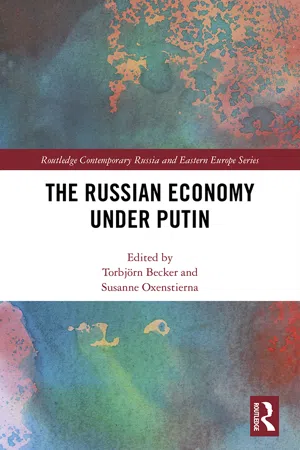
This book presents a comprehensive view of the state of the Russian economy under President Putin. It considers the extent of Russia's integration in the world economy, where Russia's exports of oil and gas are a key factor, discusses Russia's internal challenges, including changing demographics, declining government revenue, the need to counter over-reliance on the oil and gas sector and the consequences of high military spending, and assesses the prospects for economic reform, highlighting especially the power struggles between different vested interests. Overall, the book provides a basis for understanding what has been going on in the Russian economy under President Putin and what the future may look like given the external environment, internal challenges and reform processes.
eBook - ePub
The Russian Economy under Putin
- 242 pages
- English
- ePUB (mobile friendly)
- Available on iOS & Android
eBook - ePub
The Russian Economy under Putin
About this book
Information
1 Introduction
The purpose of this book is to provide readers with a comprehensive view of the state of the Russian economy under President Vladimir Putin. The chapters of the book are organized in three sections: Russia in the world economy; Russia’s internal challenges; and Reforming Russia. This provides a basis for understanding developments in the Russian economy under President Putin and what the future may look like given the external environment, the internal challenges, and the reform processes. In order to address these important issues of the Russian economy under Putin, we have invited an international group of distinguished academics and policy writers who have contributed 11 chapters that each provide an important perspective on the Russian economy.
The present book covers the whole spectrum of economic matters, including Russia’s integration into the global economy, regional economic links, demography and labour market, education, energy, and military economics, as well as the traditional institutional and reform issues that are vital for understanding the political economy of Russia. Several of the chapters highlight the challenges that Vladimir Putin faces in his fourth term in office, but also point to the potential Russia will have if its institutions are reformed. More generally, the book provides a broad analytical basis for the reader to form an independent view on where Russia is coming from and where the country is heading in the next decade.
The volume contributes to the existing literature on the Russian economy by presenting research that reflects the changing preconditions after 2014, when Russia’s aggression against Ukraine started. Previous works on the Russian economy under Putin, such as Åslund (2007), Åslund and Kuchins (2009), and Åslund et al. (2010), cover Putin’s earlier terms in power, which were characterized by a high oil price and quite successful macroeconomic policies combined with weak institutions and a failure to develop democracy. The latter aspects are also the focus of the volume edited by Oxenstierna (2015). The present book emphasizes the conclusions of earlier publications on the economic system’s role in maintaining political power. In addition, it provides in-depth analyses of the consequences for the economy after Western sanctions had been imposed and both the oil price and exchange rate had fallen dramatically. Other topics in the above-mentioned literature, as well as a number of subjects found in several prominent publications, the Oxford Handbook of the Russian Economy (Alexeev and Weber 2013), Routledge’s Handbook of the Economics and Political Economy of Transition (Hare and Turley 2013), and The Russian Economy (Fortescue 2017) – the latter in Routledge’s Critical Concepts in Economics series – have been further researched in this volume; this fully reflects the new Russian reality of increasing authoritarian control of the economy and society as a whole, and the challenges presented by the low oil price and the restrictions on trade and cooperation with the West.
Russia in the world economy
Russia’s economy is an integrated part of the world economy and heavily dependent on developments in other countries, regardless of whether the leaders in Russia or other countries like it or not. The international oil price has long been a key determinant of how the Russian economy develops. This is linked not only to Russia’s substantial exports of oil, but also to the fact that the price of gas and other natural resources that Russia exports tend to move in line with oil prices in the international market. For the duration of Putin’s long period in power, the dependence on international oil prices has meant that more than two-thirds of Russia’s annual growth can be explained by variations in oil prices. Despite many discussions and numerous proposals to diversify the economy, this dependence has not diminished during President Putin’s reign. The development of greater regional cooperation under the rubric of the Eurasian Customs Union is a policy with many goals, including to facilitate diversification, and several projects supported by the Eurasian Development Bank are now under way to promote this.
The oil income has also meant the Russia has been able to import the goods that consumers and companies have desired from abroad, further strengthening the ties between the Russian economy and the world. Companies have also used the international financial market to fund investments in Russia, thus building up substantial external debt in the (semi-)private sector, in contrast to the Russian government, which has little external debt and large foreign reserves. Both the sanctions and counter-sanctions that followed the invasion of Crimea thus had serious consequences for the Russian economy, since they reduced the funding and imports of goods from international markets at a time when oil prices were halved. Russia’s economic problems also spill over in significant ways to its neighbours; for example, the strong economic links between Belarus and Russia have gone from being a long-term blessing for Belarus to creating serious economic problems in recent years. In sum, Russia’s economy under Putin is not an island, but it both depends on and influences its neighbours and the rest of the world in important ways.
While the first part of this book paints this picture in clear colours, the second part moves from the perspective of Russia’s place in the world to a thorough examination of many of its internal challenges, revealing more of the painting’s finer, complex detail.
Russia’s internal challenges
The internal challenges to Russia’s economic development, then, are discussed in the second part of this book. With lower income, the government has to prioritize its spending, which is bound to create a struggle for resources between different ministries that try to cater to their respective constituencies. How spending is prioritized is an important tool in ensuring wide popular support for the president and also particularly important in making certain that the heavy engagements in military activities abroad are successful. Military expenditure is not only a major item in the government’s budget but is also of major interest from an international security point of view. The massive build-up of military capacity that followed the war with Georgia and provided new resources for the invasion of Crimea is affecting both NATO and non-NATO countries close to Russia. However, the Russian military is not isolated from how the economy develops more generally and the trade-offs between different sectors will be of interest not only for the military in Russia but for the world in general. Two important factors that determine the pace of economic development are human capital and the energy sector. This book addresses both how human capital is allocated and how demographics change the overall availability of workers as the economy goes forward. In addition, the energy sector also affects resource allocation across Russia’s regions, which may have an impact on how other sectors that would diversify the economy away from natural resources develop.
Reforming Russia
This book’s final part focuses on the prospect of reforms in Putin’s Russia. The current economic model clearly has limitations in terms of generating sustainable growth, but can or will they be addressed in the near future? The system of corruption, state ownership, and oligarchs may be stable, but can it generate alternative growth models when international oil prices are not fuelling growth? Since Russia is an enormous country in terms of geography, with significant diversity along many other dimensions than the economy, the reform process is not necessarily even across the regions. The power struggle between different interests representing the natural resources sector and sectors that could help diversify the economy also impacts the reform process. The natural resource sector still has significant economic muscle and powerful representatives with close connections to Putin. At the same time, diversification will not happen if policies are geared towards strengthening this sector further. This power struggle has been going on for a long time, but the question is whether the economic problems of recent years have shifted the power away from the natural resource sector. How the reforms are designed and implemented will be crucial for the fate of the Russian economy in the years to come and should be of interest to a wide range of readers.
Organization of the book
Part I Russia and the world economy
In the first part, on Russia in the world economy, Torbjörn Becker provides a bird’s-eye macro perspective on the Russian economy. Chapter 2 makes clear that changes in international oil prices remain a fundamental driver of growth at the macro level and that this has also been a decisive factor for economic development during Putin’s different terms in office. The president’s economic team has developed strategies to deal with the macroeconomic volatility oil dependence implies, to avoid the type of crisis Russia had in 1998. Although the Russian economy has come a long way since then, the country’s status as an economic superpower is only relevant in the CIS region. In the global and BRIC arenas, the Russian economy is still too small to compare itself to the largest economies of the world. However, in the CIS region, the Russian economy directly impacts the economic development of its neighbours through trade and worker remittances. Therefore, the non-fuel-exporting countries in the region are also affected by swings in international oil prices.
Russia’s economic relationship to the rest of the world is not only governed by fluctuations in oil prices but also by the sanctions and counter-sanctions that followed the annexation of Crimea and continued involvement in Eastern Ukraine. In Chapter 3, Evsey Gurvich and Ilya Prilepskiy investigate the impact of financial sanctions on capital flows to Russia. The negative effect on gross capital inflows is significant but declining over time, while the effect on net flows is smaller, due to reduced accumulation of foreign assets. This also impacts real GDP, but this effect is overshadowed by the simultaneous and much larger effect that is due to falling oil prices over the same time period. Although the authorities responded with policies to dampen the immediate effect of sanctions, structural reforms that could generate growth for the medium and longer term are not part of the policy response.
In Chapter 4, Kateryna Bornukova and Igor Livshits provide an in-depth analysis of how Belarus has been affected by Russia’s economic downturn in 2015. The focus is on trade, since a large share of Belarus’ exports go to Russia. The authors find that two-thirds of the 3.9 per cent decline in Belarus can be attributed to its trade with Russia and that the effect is even larger on production of internationally-traded goods. Despite the decline in trade with Russia and major devaluation of the currency, Belarusian exports failed to find new markets. Although the Russian sanctions and counter-sanctions did create opportunities for some Belarusian exports, the overall effect was again negative. These two factors illustrate a business environment in Belarus that is not geared to finding new markets or to exploit opportunities provided by external factors. More generally, the chapter highlights how developments in the Russian economy are important for its neighbours in the CIS region.
Russia’s economic integration with its neighbours is also the topic of Chapter 5, by Yaroslav Lissovolik and Aleksei Kuznetsov, but here the focus is on structural issues and integration as tools to modernize Russia and other countries in the region so as to generate long-term growth. The authors first discuss the economic geography of both Russia and its neighbours and the challenges that this poses, in particular in terms of long distances to ports and expensive transport routes more generally. Further integration of Eurasian countries as well as expansion of the set of free trade agreements with countries in Asia and Europe are strategies for mitigating the problems created by high transport costs. To further enhance productivity and competitiveness, the authors highlight the importance of creating a stable investment environment that attracts long-term investments.
Part II Russia’s internal challenges
The second part of the book on Russia’s internal challenges begins with Susanne Oxenstierna’s chapter on the marked change of direction in Russian defence spending. Russia’s military spending has been characterized by a steep increase since the mid-2000s, followed by the difficult years 2014–2016, when GDP declined and other federal budget items were down-sized, while the defence budget was allowed to climb to 4.4 per cent of GDP. The Russian leadership has for many years given strong priority to defence over other public spending. However, in 2017, a new trend was announced, proclaiming that military spending is to be decreased. Chapter 6 investigates the reasons for the decrease in military spending 2017–2020 and the consequences of lower state defence orders for the defence industry.
The second contribution in this section, by Michael Alexeev, analyses the growth potential of human capital. Chapter 7 begins by stressing the relatively high level of human capital that the Russian economy has, compared to other countries at similar income levels. This provides Russia with an important potential driver of growth, but this potential is not realized because the appropriate market institutions that are needed for this are not present in the country. It is therefore not sufficient to invest in better education in Russia; reform efforts should first be directed towards establishing market institutions, which would then allow Russia to capitalize on already high levels of human capital.
It is not only the quality of workers and the institutions they face that is important for future growth in Russia, but demographic factors more generally are also key. In Chapter 8, Vladimir Gimpelson and Rostislav Kapeliushnikov provide forecasts of the age and education structure in the Russian labour market up to 2030 and explain what this implies for economic growth. In the last 15 years, age and education factor have contributed positively to growth, but looking ahead, the same factors will have little or even a negative effect on growth. Even with appropriate reforms of the pension system and an increase in the employment-to-population ratio, this will not be enough to generate growth. According to the authors, generating growth requires more fundamental institutional reforms, which are both complex and politically difficult to implement.
The final chapter in this section, by Chloé Le Coq, Elena Paltseva, and Natalya Volchkova, investigates how the energy sector affects the manufacturing sector across different Russian regions. In Chapter 7, the authors separate the effects Russia’s resource abundance has, both in terms of a regional Dutch disease effect and a country-wide institutional effect that would also affect economic development. In their analysis, there are no signs that a Dutch disease effect has led to differences in the growth of the manufacturing sector across regions. Therefore, policies aimed at limiting negative effects from the natural resource sector should focus on institutional development at the country level.
Part III Reforming Russia
In the book’s final section, on reforming Russia, three authors provide their perspectives on the prospects of reforms in Russia. Chapter 11 is authored by Sergey Aleksashenko, who focuses on the limitations of the current economic model. He notes that the economy today is balancing on the edge of stagnation and that comprehensive political and institutional reforms are needed to revitalize it. Aleksashenko states that the needed reforms are likely to destabilize the current political system and then asks whether the market-oriented reforms designed by Kudrin could be the needed growth injection, or if stagnation is inevitable.
Anders Åslund then follows with Chapter 11, where he claims that despite its lack of dynamism, the current system is stable and can persist for a long time. A key ingredient for stability is the conservative macroeconomic policy that is implemented and designed to mitigate the effects of volatile oil prices. The fundamental institutional reforms that are needed to generate higher growth are unlikely to be implemented, since the current institutions are focused on political power and control over natural resource rents. In short, according to the author, Russia’s crony capitalism is not designed to generate growth but to maintain political power and distribute wealth ...
Table of contents
- Cover
- Half Title
- Title Page
- Copyright page
- Table of Contents
- List of figures
- List of tables
- Notes on contributors
- Preface
- List of abbreviations and acronyms
- 1 Introduction
- PART I: Russia in the world economy
- PART II: Russia’s internal challenges
- PART III: Reforming Russia
- Index
Trusted by 375,005 students
Access to over 1.5 million titles for a fair monthly price.
Study more efficiently using our study tools.
Frequently asked questions
Yes, you can cancel anytime from the Subscription tab in your account settings on the Perlego website. Your subscription will stay active until the end of your current billing period. Learn how to cancel your subscription
No, books cannot be downloaded as external files, such as PDFs, for use outside of Perlego. However, you can download books within the Perlego app for offline reading on mobile or tablet. Learn how to download books offline
Perlego offers two plans: Essential and Complete
- Essential is ideal for learners and professionals who enjoy exploring a wide range of subjects. Access the Essential Library with 800,000+ trusted titles and best-sellers across business, personal growth, and the humanities. Includes unlimited reading time and Standard Read Aloud voice.
- Complete: Perfect for advanced learners and researchers needing full, unrestricted access. Unlock 1.5M+ books across hundreds of subjects, including academic and specialized titles. The Complete Plan also includes advanced features like Premium Read Aloud and Research Assistant.
We are an online textbook subscription service, where you can get access to an entire online library for less than the price of a single book per month. With over 1.5 million books across 990+ topics, we’ve got you covered! Learn about our mission
Look out for the read-aloud symbol on your next book to see if you can listen to it. The read-aloud tool reads text aloud for you, highlighting the text as it is being read. You can pause it, speed it up and slow it down. Learn more about Read Aloud
Yes! You can use the Perlego app on both iOS and Android devices to read anytime, anywhere — even offline. Perfect for commutes or when you’re on the go.
Please note we cannot support devices running on iOS 13 and Android 7 or earlier. Learn more about using the app
Please note we cannot support devices running on iOS 13 and Android 7 or earlier. Learn more about using the app
Yes, you can access The Russian Economy under Putin by Torbjörn Becker, Susanne Oxenstierna, Torbjörn Becker,Susanne Oxenstierna in PDF and/or ePUB format, as well as other popular books in Social Sciences & Ethnic Studies. We have over 1.5 million books available in our catalogue for you to explore.