- 354 pages
- English
- ePUB (mobile friendly)
- Available on iOS & Android
eBook - ePub
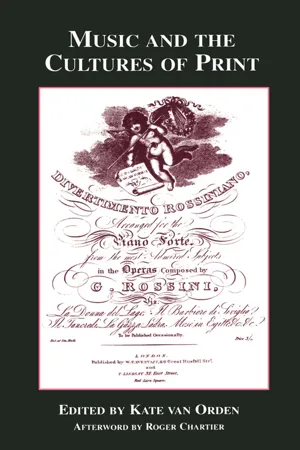
Music and the Cultures of Print
About this book
This collection of essays explores the cultures that coalesced around printed music in previous centuries. It focuses on the unique modes through which print organized the presentation of musical texts, the conception of written compositions, and the ways in which music was disseminated and performed. In highlighting the tensions that exist between musical print and performance this volume raises not only the question of how older scores can be read today, but also how music expressed its meanings to listeners in the past.
Information
Part I
Printing the New Music
Chapter 1
Printing the "New Music"
TIM CARTER
In the present course of our age music is not much in use, not being practiced in Rome by gentlemen; nor is one accustomed to sing with several voices to the book as in years past, even though it provides the greatest possible opportunity to unite and sustain evening parties. Yet music has reached an unusual and almost new perfection, being practiced by a great number of good musicians who ... offer with their artful and sweet song great delight to whomever hears them.1
In his Discorso sopra la musica (c. 1628), the Roman commentator Vincenzo Giustiniani is wistfully ambivalent about developments in music over the previous fifty or so years. He mourns the passing of the convivial round-the-table madrigal singing that, we assume, had played a key part in secular music-making in Renaissance Italy: for him, the complex roles of musical practice in cultural and social discourse had changed significantly. Doers had now become listeners, seduced by the charms and pleasures of the professional virtuosos whose singing lay at the heart of what modern scholars have come to call the "new music." The term derives (by mistranslation) from Giulio Caccini's epochal collection of monodies—madrigals and arias for solo voice and basso continuo—published by the Marescotti press in Florence on 30 June 1602 as Le nuove musiche (approximately, "New Songs").2 This was music to delight the ear and astound the senses; it was also beyond the reach of most amateur performers of the age.
Those amateurs had been kept well supplied by the hundreds of partbooks of madrigals, villanellas, and canzonettas regularly issued and reissued by the music presses of Italy since the advent of single-impression letterpress music printing in the second quarter of the sixteenth century, The great Venetian printing houses of Antonio Gardane and Girolamo Scotto and their successors, emulated by a number of smaller presses in other Italian cities, nurtured a market for their products by the cunning commercial strategies of an emerging music "industry."3 They understood and exploited concepts of advertising, niche marketing, and brand loyalty, controlling supply and manipulating demand while distributing their products across the length and breadth of Italy and beyond. Most bookshops had music on the shelves; most music-lovers bought this music for their libraries or music rooms. And although the tradition of manuscript copying and dissemination by no means died (indeed, it may have been healthier than many have assumed), music became conditioned and controlled by what might conveniently be called a "print culture."
The advertising ploy explicit in Caccini's title is obvious enough. It also reflects a standard deception on the composer's and/or printer's part: as with earlier "new" musics (Adrian Willaert's Musica nova of 1559 is only the most obvious example), these songs were by no means new when they appeared from the press:4 indeed, there is a clear sense that such music was printed only as it ceased to have currency in more immediate performance contexts. Presumably Caccini turned to print specifically in 1601-1602 chiefly because of the claims and counterclaims of precedence in inventing the "new" styles (solo song and recitative) that were then a matter of hot debate in Florence. But whatever his motives, he was one of the first of many monodists to exploit the power of print in order to establish his wares in the musical market-place. Three new publications containing solo songs were issued in 1602 (two were by Domenico Maria Melli), two more in 1606 (by Bartolomeo Barbarino—a reprint of a now lost first edition—and Domenico Brunetti), four in 1607 (Barbarino, Lodovico Bellanda, Severo Bonini, Francesco Lambardi), one in 1608 (Francesco Rasi), five in 1609 (Bonini, Giovanni Ghizzolo, Sigismondo d'India, Melli, Jacopo Peri), and six in 1610 (Barbarino, Bellanda, Ghizzolo, Johann Hieronymus Kapsberger, Enrico Radesca da Foggia, Rasi).5 By the mid-1610s, most composers had jumped on the bandwagon, publishing secular (and, we should not forget, sacred) music in the new styles for voice(s) and instruments:6 some 200 editions of solo songs by over 100 composers appeared in the first third of the seventeenth century.7 Those whom the trend left behind could only mutter darkly about the perils of fashion, the decline of taste, and the loss of respect in the art and craft of musical composition.8
Many editions of solo songs bear all the hallmarks of luxury consumption, being as carefully and elegantly presented as contemporary printing technology would allow. The significant use of upright folio formats may have been dictated by performance needs—with singer and accompanist sharing the score (if indeed they were not one and the same person)—but it also makes these volumes stand apart from the cheaper, more functional quarto or octavo partbooks conventionally adopted for multi-voice (and later, some solo-voice) secular and sacred music in the sixteenth and seventeenth centuries. In terms of paper alone—the major cost of printing in this period—such editions were expensive to produce; they also seem to have sold (in Florence, at least) for two to three times the price of a set of partbooks.9 And consumers got for their money more than just the musical notes. The grand title pages, dedications, prefaces, postfaces, tables of contents, and other paratextual matter found in these editions clearly drew on conventions established in earlier music prints. But they increasingly sought to confer distinction and to offer explanation to "readers" (for the moment, I use the term loosely) needing introduction to new aesthetic and performing worlds.
A great deal more archival work needs to be done before we can answer fundamental questions concerning the production and consumption of these (and for that matter, earlier) music prints. We know too little about the financial arrangements and trading practices that brought these works from the composer's pen to the consumer's bookshelf. At one extreme is the notion of a "vanity press," with composers and/or their patrons (or some other third party) paying the total costs of a small-scale print run produced at no financial risk to the printer and/or publisher. At the other, some printers, in particular Giacomo Vincenti of Venice, appear to have issued solo songs and related repertories on their own initiative, whether as prestigious loss-leaders or for commercial gain. The middle ground was probably occupied by a complex range of temporary or semi-permanent relationships between patrons, composers (and their associates), publishers, and printers, all hoping to attract an audience so as to recoup in whatever way their investment of time, effort, and money.
Certainly there appears to have been a market for this music: Melli's first book of Musiche (Venice: Giacomo Vincenti, 1602) was reissued by Vincenti in 1603 and 1609, and Caccini's Le nuove musiche appeared in Venice in 1607 (printed by Alessandro Raverii), 1608 (the arias only; printed by Giacomo Vincenti) and 1615 (by Vincenti). Even operas such as Jacopo Peri's Euridice (Florence: Giorgio Marescotti, 1600; Venice: Alessandro Raverii, 1607) and Claudio Monteverdi's Orfeo (Venice: Ricciardo Amadino, 1609, 1615)—which would seem to be "vanity" items par excellence—went to a second edition. One is struck by the commerce in music that would seem on the face of it to have little selling power. The striking persistence of the "new music" in print cannot be explained simply by those collections (numerous at least from the 1610s) clearly catering to singers of modest achievement, with simple tunes and pleasant ditties sung to the strummed chords of the Spanish guitar. Rather, much of this repertory made demands that would have taxed severely even the professional virtuosos now entertaining Giustiniani's Roman gentlemen. Yet those concerned with these editions clearly hoped that someone somewhere would procure and somehow use them, for all the difficulties they presented.10 So the question remains, what real benefits were to be gained from printing and publishing this music?
Publish Or Perish?
A portion of the monody repertory—in particular music directly associated with specific singers or their patrons—remained in manuscript.11 But the sheer number of monodists turning to print suggests significant pressure to publish their music from patrons, peers, and even the marketplace. The fixity of print, its ability to standardize a musical text in multiple copies, and the prestige associated with it were alluring indeed. But monodists were typically performer-composers and often approached print with a sense of anxiety that seems more than just conventional, however much false modesty might play a part: witness the care lavished on the design of their collections, on the choice of favorite poetry to set to music, and on the dedications and prefaces expressing concern for the fruits of their labors and giving useful information on how to realize them in performance. In particular, this prefatory material—whether by composers themselves or by friends, associates, or even professional writers and secretaries—offers significant insights into the pleasures and the perils of publishing.12
To take one example from many, in 1626 the Tuscan composer Antonio Brunelli had the Venetian printer Bartolomeo Magni issue his Prima parte delli fioretti spirituali a 1.2.3. quatro & cinque voci per concertare nell'Organo, a set of partbooks of pieces in mixed scorings (1-5 voices and continuo) setting spiritual and devotional texts in Latin, Brunelli had studied in Rome with Giovanni Maria Nanino and then in Florence with Giulio Caccini;13 he pursued a career of moderate distinction in Pisa and Prato, ending up back in Pisa as maestro di cappella of the Knights of St. Stephen. His fifteen opus numbers (six or seven are lost) include sacred music in the concertato style and three books of Arie, scherzi, [or Scherzi, arie,] canzonette e madrigali published in Venice by Giacomo Vincenti (1613, 161414, 161612), containing solo songs, duets, and trios plus instrumental music; he also wrote three student manuals.14 The Prima parte delli fioretti spirituali is dedicated to Maria Magdalena, Archduchess of Florence and one of the three regents ruling Tuscany in the 1620s on behalf of the young Grand Duke Ferdinando II: her fierce religiosity was doubtless enough to persuade Brunelli to produce a volume of this kind in her honor. He also provided it with a revealing preface:
The Author to the courteous Readers15
Publishing new compositions [lit. "Bringing new compositions to light"] is nothing other than opening eyes and minds to search in them with all subtlety every tiniest imperfection. The intelligent and those of goodwill cannot, and know not how to, blame praiseworthy works, but the enthusiasts, and those who presume greatly of themselves, accommodate themselves to them with difficulty; and when they find nothing striking, or to show that they have superiority of intellect, they pronounce this decision:
There are no miracles here: one could do better.
And so, if they take a general view, some of these fine intellects might at first assume that these concertos of mine, becau...
Table of contents
- Cover
- Title
- Copyright
- Contents
- Series Editor's Foreword
- Introduction
- PART I. Printing the New Music
- Part II. Authors and Entrepreneurs
- Part III. Music in the Public Sphere
- Afterword: Music in Print
- Contributors
- Index
Trusted by 375,005 students
Access to over 1.5 million titles for a fair monthly price.
Study more efficiently using our study tools.
Frequently asked questions
Yes, you can cancel anytime from the Subscription tab in your account settings on the Perlego website. Your subscription will stay active until the end of your current billing period. Learn how to cancel your subscription
No, books cannot be downloaded as external files, such as PDFs, for use outside of Perlego. However, you can download books within the Perlego app for offline reading on mobile or tablet. Learn how to download books offline
Perlego offers two plans: Essential and Complete
- Essential is ideal for learners and professionals who enjoy exploring a wide range of subjects. Access the Essential Library with 800,000+ trusted titles and best-sellers across business, personal growth, and the humanities. Includes unlimited reading time and Standard Read Aloud voice.
- Complete: Perfect for advanced learners and researchers needing full, unrestricted access. Unlock 1.5M+ books across hundreds of subjects, including academic and specialized titles. The Complete Plan also includes advanced features like Premium Read Aloud and Research Assistant.
We are an online textbook subscription service, where you can get access to an entire online library for less than the price of a single book per month. With over 1.5 million books across 990+ topics, we’ve got you covered! Learn about our mission
Look out for the read-aloud symbol on your next book to see if you can listen to it. The read-aloud tool reads text aloud for you, highlighting the text as it is being read. You can pause it, speed it up and slow it down. Learn more about Read Aloud
Yes! You can use the Perlego app on both iOS and Android devices to read anytime, anywhere — even offline. Perfect for commutes or when you’re on the go.
Please note we cannot support devices running on iOS 13 and Android 7 or earlier. Learn more about using the app
Please note we cannot support devices running on iOS 13 and Android 7 or earlier. Learn more about using the app
Yes, you can access Music and the Cultures of Print by Kate van Orden in PDF and/or ePUB format, as well as other popular books in Media & Performing Arts & Music. We have over 1.5 million books available in our catalogue for you to explore.