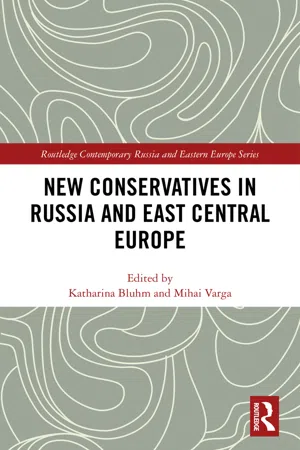
This book explores the emergence, and in Poland, Hungary, and Russia the coming to power, of politicians and political parties rejecting the consensus around market reforms, democratization, and rule of law that has characterized moves toward an "open society" from the 1990s. It discusses how over the last decade these political actors, together with various think tanks, intellectual circles, and religious actors, have increasingly presented themselves as "conservatives," and outlines how these actors are developing a new local brand of conservatism as a full-fledged ideology that counters the perceived liberal overemphasis on individual rights and freedom, and differs from the ideology of the established, present-day conservative parties of Western Europe. Overall, the book argues that the "renaissance of conservatism" in these countries represents variations on a new, illiberal conservatism that aims to re-establish a strong state sovereignty defining and pursuing a national path of development.
- 312 pages
- English
- ePUB (mobile friendly)
- Available on iOS & Android
eBook - ePub
New Conservatives in Russia and East Central Europe
About this book
Information
1Introduction
Toward a new illiberal conservatism in Russia and East Central Europe
Katharina Bluhm and Mihai Varga
The return of conservatism
The western-driven wave of globalization that began with the liberalization of financial markets from the 1970s onward, and strengthened even further with the collapse of the Eastern bloc, has come to an end. It is widely acknowledged that the financial crisis of 2007–09 represents the tipping point, even though it seemed at first that the architecture of the financial markets—with economic liberalism as its ideological frame—had survived largely unquestioned (Crouch 2011). It accelerated the much discussed “crisis of democracy,” becoming manifest in a deteriorating relationship between what were once mass political parties and their supporters. The further rise of China; Russia’s return to the table of global powers; the unsolved crisis of the Eurozone: all indicate the tectonic shifts that are well under way. The struggle over the future of existing institutional arrangements has also become an ideological battlefield, seeing increasingly developed arguments formulated by right-wing or even far-right forces.
This departure from the recent liberal vision of the polity as well as criticism of market economies are often characterized as illiberalism, nationalism, and populism. While these concepts highlight important commonalities, they do not capture the sweeping contestation that liberalism now has to face. A central thesis of this book is that we are witnessing a “renaissance of conservatism,” an attempt to create a new, illiberal, and activating conservatism aiming to change the status quo from within the capitalist order and the traditional cleavage between left and right. This holds especially for East Central Europe (ECE), where communism interrupted the conservative tradition of thought, and where conservatism is being redeployed against communism and liberalism. The literature on Prawo i Sprawiedliwość (“Law and Justice,” PiS) and Fidesz (Fiatal Demokraták Szövetsége, “Alliance of Young Democrats”), the right-wing parties in power in Poland and Hungary, stresses that the agenda of these parties is more systematic and comprehensive than the concept of “populism” would suggest. However, there has been little research done so far to study the genesis of these parties’ agendas and the conservative milieus and intellectual circles that have given the political turn in Poland and Hungary its intellectual foundation and legitimacy.
This is even more the case for Russia, where no populist party conquered power in order to change the track of development. Many scholars have conceptualized Vladimir Putin’s official turn toward conservatism during the period 2011–13 in the context of the mass protests against his third presidency and acts of election fraud as a cynical, eclectic, and populist attempt of an “authoritarian kleptocracy” to stay in power at any cost (Casula 2017; Rodkiewicz and Rogoża 2015; Shekhovtsov 2017). In fact, Russia’s state-owned media and presidential administration play quite skillfully with different narratives and identity concepts such as “one-country-civilization,” “Russian World,” anti-Westernism, nationalism, or traditional (conservative) values. Yet the focus on the official turn to conservatism underestimates the groundwork carried out by conservative milieus and intellectuals, and the discursive power conservative views have developed in Russia.
The declared goal of the conservative intellectual circles in this region is to challenge today’s Western economic and cultural liberalism while at the same time opposing communism. This goes beyond a diffuse “sliding back” toward authoritarian structures and mentalities. More than elsewhere, intellectuals and moral and political activists involved are purposely re-inventing conservatism and trying to determine the political agenda.
With Karl Mannheim (1955 [1936]) and Michael Freeden (2006 [1996]), we argue that the new conservative thought has themes, ideas, and core concepts in common that are related to its communist and post-communist past and reflect severe disappointment with the results of the transition and the manner in which Western integration took place. The references to neo-colonial theories, from which new conservatives in Hungary, Poland, and Russia draw, can only be understood in this context. At the same time their history, different geopolitical positions, and weight have also produced decisive differences. Polish and Hungarian conservatives search for ideational alliances within Central and Western Europe rather than further to the east.
This introduction proceeds as follows. The next subsection reviews major explanations of the rise of illiberalism in the post-communist region and asks why it is that illiberalism, in its conservative expression, emerged in Poland, Hungary, and Russia and not elsewhere. We also clarify our focus on actors, networks, and key concepts of the new conservatism. We then argue why we think that it is conservatism—rather than other conceptual alternatives—that more plausibly captures illiberalism in these three countries and introduce our approach, combining insights from the sociology of knowledge with scholarship on social movements. We then end the chapter by presenting the outline of the book.
Explanations for the rise of illiberalism
The dominance of liberal and neoliberal ideas throughout post-communist Europe was formidable by all accounts: all countries but one (Belarus) sooner or later in their transitional path implemented neoliberal ideas such as “increasing national competiveness” through the pursuit of “fiscal discipline,” an outward economic orientation, and reliance upon markets for the allocation of goods and resources (Ban 2016). Most countries also pursued the liberal political agenda of ensuring free elections, strengthening civil society (initially with external, Western support), building checks and balances around governments, and passing legislation to protect minorities. In the words of one observer: “Liberalism in this part of the world became an obligatory syntax of political thought” (Trencsényi 2014, 136, citing political theorist Aurelian Crăiuțu).
Neoliberalism—understood as an approach to government claiming that “unhindered markets are best able to generate economic growth and social welfare” (Bockman 2013, 14)—boils down to an “identifiable set of economic theories such as monetarism, rational expectations, public choice, and supply-side economics” (Blyth 1999; Ban 2016, 10). It represents more than just a “revived version of classical liberal economics” (Ban 2016, 9), since in contrast to classical laissez-faire liberalism and later libertarianism, it does support the continued existence and relevance of a minimal state that “would protect private property, maintain order, and provide some protection for the poor. In spite of its anti-state rhetoric, neoliberal policies were not meant to eradicate the state, but rather to have forged a new kind of state” (Bockman 2013, 14). Variations existed in the extent to which post-communist countries “embedded” neoliberal policies through welfare spending, with the Baltic and Balkan EU member countries pursuing what was called a “disembedded neoliberalism,” while the Visegrad countries generally followed an approach that combined neoliberalism with—at least until EU accession—relatively generous welfare schemes (Bohle and Greskovits 2012).
Several explanations have been advanced for understanding neoliberalism’s rise to dominance in the region. First, post-communist countries started their transition when neoliberalism was reaching its ascendancy (Appel and Orenstein 2016). Ideas of different inspiration were far less present and absent from the advice extended by international organizations and in particular the Western advisors that did extensive counselling of the post-communist reformers.1 Furthermore, proponents of neoliberalism framed it as a promise not just about economic well-being, but also about democracy and the rule of law (Crawford and Lijphart 1995; Shields 2008), leading to the conceptual “great merging” (Ban 2014) of free market and democracy in the 1990s.2 Following a communist state that had attempted to control all spheres of social activity, mistrust toward the state was widespread and the large-scale retreat of the state a priority for the reformers.
Second, Eyal, Szelényi and Townsley (1998, 73) document how neoliberal reformers strengthened their position and isolated themselves from potential challengers, most importantly by forging an alliance with the new managerial class (in the case of Russia with the young oligarchs) around the “new ideology of managerialism, monetarism,” and also by the means of selective welfare spending in order to contain collective action (Vanhuysse 2006; Greskovits 1998). It has also been noted that neoliberalism bore a certain resemblance to Marxism-Leninism, being a “holistic,” “revolutionary,” and “universalistic” world view claiming to affect all spheres of life, and promising that, if administered in the right dose, it would spur the growth that would trickle down to all (Eyal et al. 1998, 74); it should therefore not come as a surprise that, as Eyal et al. have claimed, there was a certain “overlap in personnel” between the “high priests” of communism and those of post-communism. And precisely this view is shared by new conservatives in the region.
Third, further contributions have emphasized that neoliberalism advanced not so much through sheer coercion, but rather that its success throughout the region was largely due to the existence of transnational academic networks that paved the way for neoliberalism while rejecting other approaches, to “the hybrid and dialogic origins of neoliberalism, rather than the arrogance and might of a Western monologue” (Bockman and Eyal 2002, 336). While this process is referred to as diffusion or translation (Ban 2016), Bockmann and Eyal followed Bruno Latour’s criticism of diffusion and proposed instead the notion of “lengthening networks” as a better metaphor for understanding the advancement of neoliberalism.
How then could alternative ideas—openly challenging neoliberal tenets, and often referred to as the illiberal backlash in post-communist Europe—emerge and, in the case Poland and Hungary, win the support of major political forces? Arguably, this is not just a matter of the extent to which liberalism was embedded (Bohle and Greskovits 2012), as the embedding of liberalism hardly approximates the contours of illiberal conservatism. First, illiberalism is actually quite widespread, irrespective of whether or not the country in question belonged to those countries in which reformers mitigated the impact of neoliberal reforms through welfare spending. Second, even though power holders critical of liberal tenets are present in several post-communist countries (Dawson and Hanley 2016), it is mainly in Poland and Hungary that they invested considerable efforts in developing such criticism into a full-fledged ideological contestation of liberalism (and we would also add Russia to this group). Hence, the strength of conservatism cannot be simply seen in inverse correlation to the amount of liberalism experienced by society. Poland as well as Hungary belonged to the group that actually attempted to “mitigate and embed” reforms (although admittedly not as much as the Czech Republic, as discussed further below). Conservatism, on the other hand, is virtually absent from those countries that did the least embedding of economic liberalism and saw extensive austerity programs following the financial crises, such as Romania (Ban 2016), Bulgaria (Adascalitei 2017) and the Baltic states (Sommers 2014), notwithstanding the signs of illiberalism manifest in the political arenas of these countries (Greskovits 2015).
The weak institutionalization of political systems
Another approach in answering the question about the emergence of illiberalism has been to reconsider the effects of transition and in particular the eastern enlargement of the European Union. Thus illiberalism appears as the result of the lack of institutionalization of established political parties, showing that the parties in power throughout transition failed to ensure the representation of popular interests. This happened because post-communist political party systems have been hardly structured by cleavages and barely enjoy legitimacy, and since political party organizations have tended to be highly unstable (Powell and Tucker 2014). Dissatisfaction with political elites and perceived corruption also tended to be far higher in East Central Europe than in Western Europe (Dahlberg et al. 2013), although the data suggests that if dissatisfaction alone were to explain the rise of illiberal conservatism, it should have emerged in Romania and Bulgaria, not Poland and Hungary.
Furthermore, while the European Union has initially been seen as having made a crucial contribution to the spread of liberal democracy in the post-communist area (Vachudová 2005), more recent contributions have doubted the lasting impact of “Europeanization” (Coman 2014, 920). Rather than “Europeanization,” they document “concentration and abuse of executive power, a systematic political patronage and a plebiscitary interpretation of democracy” (Tomini 2014), although until 2015 liberal democracy was perceived to be far more “resilient” in Poland than in other countries (Tomini 2014; Brusis 2016). Simply put, it was perhaps just a matter of time until the weak institutionalization, deep divisions and volatility of political party landscapes would turn out to be an opportunity for one “political partisan player […] to cement its predominance by degrading democratic competition,” as happened in Hungary from 2010 onwards (Kitschelt 2015; Haughton and Deegan-Krause 2015). This explanation, however, raises the question of what drives that “political partisan player” and why such a player would attempt to do more than simply reverse the liberal transition agenda by attempting to form a new national and international model of political economy. Explanations stressing the weak institutionalization of party systems also fail to address variation across the region: why are conservatives politically successful in Poland and Hungary, pledging to pursue nothing less than a “national-conservative revolution” in those countries while hardly even present in the parliaments of the Czech Republic, Slovakia, Romania or Bulgaria?
The political economy of market reforms and transition
A broad comparative literature on political–economic transition and the different ways in which post-communist countries mastered the economic transition from plan to market suggests that the answer might reside partly in the extent to which post-communist politicians could “embed” the market economy in the wider society, and in which way they managed to integrate their economies.
In the Variety of Capitalism literature (VoC), the Visegrad countries—Czech Republic, Poland, Hungary, and Slovakia—are sometimes called “dependent market economies,” characterized by fast integration into Western and international value chains during the 1990s and an ensuing strong presence of Western capital in key sectors such as manufacturing, banks, or media (Nölke and Vliegenthart 2009; King and Szelényi 2005; Bluhm et al. 2014). Manufacturing investment in the four countries compensated for the deindustrialization that took place in almost all post-communist countries after the breakdown of the Soviet-led international economic system with semi-tech and semi-skilled manufacturing jobs in highly modernized and productive subsidiaries of Western companies. In Poland and Hungary, the strong presence of Western capital sparked calls for something coming close to the re-nationalization of key in...
Table of contents
- Cover
- Half Title
- Series Title
- Title Page
- Copyright
- Contents
- List of illustrations
- Notes on contributors
- Acknowledgments
- 1 Introduction: toward a new illiberal conservatism in Russia and East Central Europe
- PART I: Genealogies
- PART II: Translations
- Index
- Back Cover
Trusted by 375,005 students
Access to over 1.5 million titles for a fair monthly price.
Study more efficiently using our study tools.
Frequently asked questions
Yes, you can cancel anytime from the Subscription tab in your account settings on the Perlego website. Your subscription will stay active until the end of your current billing period. Learn how to cancel your subscription
No, books cannot be downloaded as external files, such as PDFs, for use outside of Perlego. However, you can download books within the Perlego app for offline reading on mobile or tablet. Learn how to download books offline
Perlego offers two plans: Essential and Complete
- Essential is ideal for learners and professionals who enjoy exploring a wide range of subjects. Access the Essential Library with 800,000+ trusted titles and best-sellers across business, personal growth, and the humanities. Includes unlimited reading time and Standard Read Aloud voice.
- Complete: Perfect for advanced learners and researchers needing full, unrestricted access. Unlock 1.5M+ books across hundreds of subjects, including academic and specialized titles. The Complete Plan also includes advanced features like Premium Read Aloud and Research Assistant.
We are an online textbook subscription service, where you can get access to an entire online library for less than the price of a single book per month. With over 1.5 million books across 990+ topics, we’ve got you covered! Learn about our mission
Look out for the read-aloud symbol on your next book to see if you can listen to it. The read-aloud tool reads text aloud for you, highlighting the text as it is being read. You can pause it, speed it up and slow it down. Learn more about Read Aloud
Yes! You can use the Perlego app on both iOS and Android devices to read anytime, anywhere — even offline. Perfect for commutes or when you’re on the go.
Please note we cannot support devices running on iOS 13 and Android 7 or earlier. Learn more about using the app
Please note we cannot support devices running on iOS 13 and Android 7 or earlier. Learn more about using the app
Yes, you can access New Conservatives in Russia and East Central Europe by Katharina Bluhm,Mihai Varga in PDF and/or ePUB format, as well as other popular books in Social Sciences & Ethnic Studies. We have over 1.5 million books available in our catalogue for you to explore.