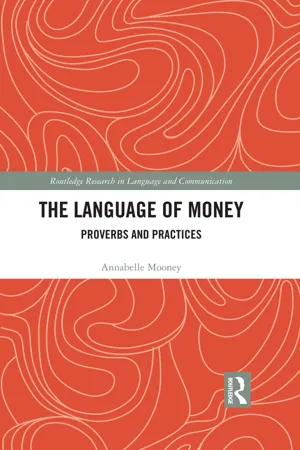
Through a detailed examination of proverbs related to money, this book offers a comprehensive critique of the prevailing everyday ideologies and discourses on money and paves the way toward establishing a new set of proverbs more conducive to financial equality and human well-being. The volume explores a variety of contexts to demonstrate the different aspects of the money system and the linguistic and social structures embedded within them, including pay day loan websites, gambling, get rich self-help books, and new forms of currency. Unpacking this complex relationship between people, money, and language in contemporary society, this book is an ideal resource for students and scholars in language and communication, sociolinguistics, rhetoric, sociology, and media studies.
- 238 pages
- English
- ePUB (mobile friendly)
- Available on iOS & Android
eBook - ePub
About this book
Trusted by 375,005 students
Access to over 1.5 million titles for a fair monthly price.
Study more efficiently using our study tools.
Information
1
Introduction
1.1 At the Beginning
When I was a teenager, I had an interest in money. Cheque books, account ledgers and money itself were all markers for me of an adult life of responsibility. Handling some cash one day, I became acutely aware that it was made of paper. I may have examined it closely. I may have been doing a school project. I don’t remember. But at some point in my adolescent life, it seemed to me that money was simply paper that someone else had promised me was valuable. At a public speaking event, I chose to talk about this. I explained to a room of men that money was just paper. I explained that we all trusted it because we had all been told to. I argued that we could simply make more paper to pay for useful things. Though I didn’t have the vocabulary for it, I suggested that money was a confidence trick that we are all complicit in. The room of men did not like what I had to say. They were puzzled. In explaining why I would not progress to the next round of the competition, they said that they simply did not understand what I was talking about. I asked my mother on the way home: was I not clear? She shook her head and told me they were never going to understand.
I haven’t thought about that talk for a long time. But it seems an appropriate place to begin as it is one of my earliest forays into thinking about money. In the intervening years, I have sometimes wondered what I had wrong. These men were successful and intelligent. There must have been something I was missing. Evidently, trying to argue that money was simply paper with numbers on it was far too naive and uninformed. But despite the various theories of money and economic structure that exist, it turns out my teenage self was not too wide of the mark. Money works because we trust it, it is recognised and accepted by a community of users and it is backed by a particular kind of institutional force.
This is a book about money and language. Using linguistic tools, I examine language that ordinary people engage with and produce around money and financial exchange. And while I cannot do full justice to the extensive work on money from sociology, philosophy and anthropology, I will draw on this research and terminology and its many insights. My goal is not to write or rewrite the history of money or economics.1 My aim is far more modest: to try to uncover some of the prevailing ideas and ideologies we have about money by analysing the language we use to talk about it. As I currently live in the UK, most of my data comes from there. I am well aware that money cultures, practices and languages differ around the world, but I do not deal extensively with such variation in this book. Nevertheless, as money is now a global force and late stage neoliberal capitalism an international practice, much of what is found in the fields of inquiry undertaken here should resonate more widely.
The language data chosen in each chapter have been selected to align with a proverb. As I explain below (see Section 1.3), proverbs are important cultural resources. Among the many spheres of life that proverbs reference, a number of well-known English proverbs either reference money specifically (e.g. ‘money makes the world go round’) or can be applied to financial contexts (e.g. ‘you have to speculate to accumulate’). In considering how to approach the issue of money, it seemed to me that proverbs would provide a number of advantages. First, the proverbs could help to identify appropriate linguistic data with which to work. Second, proverbs themselves carry with them certain presuppositions and entailments which can be assessed in relation to data. Finally, thinking about the validity (if not truth) of the proverbs allows for focussed deliberations. This provides a way of making sense of the data and assessing the proverb itself. Therefore, in each chapter I rewrite the founding proverb in response to what is uncovered in the analysis, providing a pithy distillation of the insights gained.
In this chapter, I first set out my rationale for looking at money, charting some of the steps I followed to arrive at this topic. In this section (Section 1.2), I also briefly outline some of the great variety of work that has been undertaken by linguists in the domain of money and economics. I then outline my reasons for using proverbs (Section 1.3) and document some of the various definitions of proverbs and their persuasive power, rhetorical uses and applications. I also describe the link between proverbs and ideology. This also allows me to gesture towards some of the rich research in the field of paremiology (the study of proverbs).
In Section 1.4 I weave together an outline of the structure of the book with an account of what money is and the key distinctions I rely on throughout the following chapters. I introduce the difference between money objects and money systems and exchange value and use value and explore the connection that money has to both trust and power. In this section I also dispel some of the myths connected to money. Specifically, I draw on work that explains that money did not develop from a barter economy, and I explain that money is mostly created by private banks in the form of debt.
Chapter 2 deals with methodological issues while Chapters 3 to 7 contain the data analysed in relation to one specific proverb. These are briefly set out in Section 1.4. The final chapter brings together insights from the previous five chapters and suggests a different way of thinking about money and our relationship with it. Before this can be done, however, it is necessary to explain why it is worth looking at money at all.
1.2 Why Money?
When I started to think about money and what linguistics might have to say about it, I was initially drawn to financial inequality in a very specific domain: debt. While I knew poverty and inequality existed, I was shocked to learn that doorstep lending2 still took place, and I was extremely alarmed by both the practices and interest rates of payday lenders (see Packman 2014). The effects of these practices are certainly made worse in the UK by a rising cost of living, stagnant wages and reductions in social welfare support. Nevertheless, the poverty being experienced in in the UK was not something I had expected. Being unable to fully participate in society because of a lack of financial means, relying on food banks and being at the mercy of government welfare policy changes all struck me as fundamentally and brutally dehumanising.3 I had briefly been in (modest) debt in my mid-twenties and found the experience extremely difficult. As I am well aware that I belong to a privileged class, I struggled to imagine how anyone could cope with constant, relentless poverty (see Custers 2017).
Initially, I sought to better understand debt advice services and the challenges they face. I was particularly interested in what they would have to say about payday lenders. As far as I was concerned, these were the ‘bad guys’. It was not until I spoke to a debt literacy professional that I changed my mind about what I wanted to work on. She appeared to be unimpressed that I wanted to look at these companies and pointed out that when people need money, they will go to whoever will lend it. It was surely better, she said, that people seek assistance from payday lenders than from loan sharks. She was, of course, correct.
It was around this time that it became clear to me that poverty and debt are not individual problems.4 I had initially thought that with the right knowledge and practices, debt could be avoided. However, I came to see that while financial literacy is certainly valuable, knowing how to budget effectively isn’t much help when you don’t have any money. Payday loan providers, even loan sharks, are not causes but rather symptoms of the poverty and financial insecurity that many in the UK routinely suffer.
Financial inequality is not commonly discussed in the public sphere. The sensation caused by Thomas Piketty’s 2014 book, Capital in the 21st Century, was therefore surprising. Not only has it received the attention of academics and policy makers, but it was also purchased by around 2 million people (Coy 2017). Piketty’s careful historical analysis suggests that inequality is getting worse, driven not so much by income (what people earn) as by wealth (the assets they acquire or inherent). This distinction, and the policies that were suggested in relation to it, were relatively novel in mainstream popular discussion. The idea that accumulated wealth needed to be considered in relation to financial inequality (rather than focussing simply on annual income) was also fundamentally at odds with hegemonic views about the rewards of labour and investment and indeed the sacred cow that is private property. When thinking about these issues, I found I was not immune to the difficulties of thinking about income and wealth differently. One proposal, for example, was to levy a tax on property worth over a specific sum, the so-called ‘mansion tax’.5 While appealing in terms of economic equality, I did find myself asking whether it was ‘fair’ to tax people on the value of their homes. I realised that to some extent I had internalised the idea that assets like houses were deserved on the basis of hard work and savvy financial decision making. I had other justifications in my head. Why punish people, I thought, because of the state of the property market? I certainly thought that the ‘super rich’ should be targeted, but I had trouble drawing a line between the fortuitously asset rich and the stereotypically greedy billionaire.
At the other end of the economic spectrum, proposals have also been made in relation to housing. In 2013 the ‘bedroom tax’ was introduced in the UK. This is a charge levied on social housing tenants deemed to have an ‘extra’ bedroom, one deemed ‘surplus’ to their needs. While the policy was defended on the basis of making good use of existing state housing stock, the ‘unintended’ consequences of the tax meant either uprooting people from their homes and communities or driving them into poverty. Here my confusion took on a different hue. I could not understand why some people found it impossible to see that a house and a home are different things. It seemed pretty obvious that if there is a lack of supply, one should simply build more houses. Nevertheless, I could see the logic of both the argument for the mansion tax and for the bedroom tax. I could see that in terms of allocation of ‘resources’ both the mansion tax and the bedroom tax were, at least in some ways, logical. I knew I was in trouble. Knowing what to think and knowing the right way to think about issues like these is difficult. On the one hand, we are told money is something people earn. On the other hand, I know money is something people need to live and to thrive.
One thing at least is clear. Money is political. Money is also connected to a variety of discourses in a range of fields. It follows that what money means is contested. Indeed, to ask what money means might not even be the right question. But finding the question that I wanted to ask, one that could be explored with linguistic tools, was not straightforward. The central difficulty is exactly that money is polysemous. It refers to money systems, things we use as money as well as the meanings we attach to poverty, wealth and the various objects and practices that index ‘money’.
The development of this project was informed by reading work from linguistics (which I detail in the next subsection), sociology (see Baker and Jimerson 1992; Deflem 2003; Dodd 1994; Ganßmann 1988; Gilbert 2005; Keister 2002; Simmel 2004; Zelizer 1994), psychology (Furnham and Argyle 1998), anthropology (Graeber 2014; Maurer 2006, 2012), literature (Rowlinson 2013) and psychoanalysis (Bennett 2012). Research, in sociology in particular, is increasingly highlighting the social and cultural importance of money, especially the role of money in creating and mediating social relations (see for example, Gilbert 2005; Ingham 1996; Mellor 2010). I also benefited greatly from popular books on the topic of money, economics and consumption (e.g. Chang 2014; Olen 2013; Lanchester 2010, 2014). I return to some of this work in Section 1.4 below and in the chapters that follow.
1.2.1 Language and Money
As one might expect from linguists, who generally investigate how language is actually used by people, work on money tends to focus on particular domains. Here, I want to signal the diversity and richness of work in the field generally as linguistic studies of money, financial behaviour and economics covers a range of areas.
A particularly rich body of work is found in relation to the language of economics and of experts dealing with money (e.g. McCloskey 1998). As both money and economics are abstract, it is unsurprising that analysis in terms of metaphor has been especially productive (Alejo 2010; Ali 2014; Charteris-Black and Ennis 2001; Charteris-Black and Musolff 2003; Henderson 2000; Koller 2005; López Maestre 2000; Oberlechner, Slunecko and Kronberger 2004; Rojo López and Orts Llopis 2010; Pessali 2009; Semino 2002; Skorczynska and Deignan 2006; Smith, G 1995; Tomoni 2012; White 2003). There is also a body of work that examines the historical development of lexical terms for money, focussing largely on the names of coins and paper money (see Addy 1900a, 1900b, Humphries 2004). In terms of slang for money, Coleman’s work (2006), using data from the Historical Thesaurus of English, is extremely comprehensive (see also American Folklore Society 1905; Ardelanu 1860; Lighter 1997; Menmuir 1919; Prenner 1929).
Linguists have also long been engaged with issues directly relevant to money, including class (Block 2013) and neoliberalism (Block, Gray and Holborow 2012; Chun 2016; Holborow 2015). More recent work in linguistics has examined payday loans (Brookes and Harvey 2017a), pawn shops (Brookes and Harvey 2017b), the role the market in constructing both language and society (Kelly-Holmes and Mautner 2010; Mautner 2010), the semiotics of elite lifestyles (Thurlow and Jaworski 2010, 2012), people’s understanding of capitalism (Chun 2017) and the recent financial crisis.6 There has also been work that connects with the particular topics covered in the following chapters. I detail relevant work in those chapters.
The breadth of existing work on money and language across a range of disciplines indicates a few things. First, it demonstrates that money has no single meaning. Second, it shows that money is important to human social activity, far beyond economic exchanges. Third, the spheres in which money is relevant continue to grow. The expansion of uses to which we put money is perhaps best evidenced by the proliferation of financial products available to consumers. While I still struggle to think of mortgages, bank accounts and loans as ‘products’ rather than services, the commodification of debt and credit is a remarkably sophisticated field of human endeavour. Such commodification is not limited to the financial arena. As the work of Mautner (2010) and Kelly-Holmes and Mautner (2010) shows, anything can become a product to be bought and sold, from government services to education, from romantic relationships to religion. Even the individual is now a brand that has to be marketed (Mautner 2010). Money, as a thing and an idea, is somehow connected to all of this.
1.2.2 Ordinary People
It is clear that money can’t be caught, identified, dissected and laid out on a slab to see what it is and how it works. I therefore sought to identify domains containing language either authored by or directed to ordinary people where money is relevant. I use the phrase ‘ordinary people’ not to suggest that people are ignorant or lacking in financial skills. ‘Ordinary people’ in the field of language and money are people who are not directly involved in financial services, economics, economic policy or other related specialist fields. I consider myself an ordinary person.
While we may be ordinary, we are all fluent in the dominant discourses of money. We are all interpellated into a world order where the rich are considered talented and hard-working, the poor lazy and ignorant, where no-one who is willing to work hard will fail to get ahead and where individual choices drive individual success. My suspicion was that if I asked people what money was, I would receive answers that demonstrated the hegemonic nature of these ideologies. And while these may be contested (as Chun’s 2017 book so clearly shows, see Chapter 8), this was not the path I wanted to take. My general hypothesis was that I would learn much more if I came at money from a different angle. My plan, therefore, was to try and sneak up on money. The angle I chose was proverbial.
1.3 Why Proverbs?
As is often the case during a long research project, one is alert to any mention of the topic. As indicated above, conversations with other people informed the direction of my thinking and led ultimately to this book. The conversation with the debt literacy professional recounted above was one of many. Here is another. One evening at a dinner, my student’s partner remarked that he was a Yorkshire man and so necessarily ‘tight fisted’. While I had not considered it before, this drew my attention to the rich vocabulary English has for behaviour with money (see Mooney and Sifaki2017b). In doing this work, I noticed how many English proverbs either directly reference money or are somehow applicable to wealth, povert...
Table of contents
- Cover
- Title
- Copyright
- Dedication
- Contents
- Tables
- Figures
- Images
- Acknowledgements
- Sources
- 1 Introduction
- 2 Approach
- 3 You Have to Speculate to Accumulate
- 4 Money Doesn’t Grow on Trees
- 5 Money Makes the World Go Round
- 6 Money Talks
- 7 It’s Better to Be Born Lucky Than Rich
- 8 New Proverbs, a New Contract
- Appendix 1 Magic Money Tree
- Appendix 2 Emergent Fields Used for Coding Money Lives Data in NVivo
- References
- Index
Frequently asked questions
Yes, you can cancel anytime from the Subscription tab in your account settings on the Perlego website. Your subscription will stay active until the end of your current billing period. Learn how to cancel your subscription
No, books cannot be downloaded as external files, such as PDFs, for use outside of Perlego. However, you can download books within the Perlego app for offline reading on mobile or tablet. Learn how to download books offline
Perlego offers two plans: Essential and Complete
- Essential is ideal for learners and professionals who enjoy exploring a wide range of subjects. Access the Essential Library with 800,000+ trusted titles and best-sellers across business, personal growth, and the humanities. Includes unlimited reading time and Standard Read Aloud voice.
- Complete: Perfect for advanced learners and researchers needing full, unrestricted access. Unlock 1.5M+ books across hundreds of subjects, including academic and specialized titles. The Complete Plan also includes advanced features like Premium Read Aloud and Research Assistant.
We are an online textbook subscription service, where you can get access to an entire online library for less than the price of a single book per month. With over 1.5 million books across 990+ topics, we’ve got you covered! Learn about our mission
Look out for the read-aloud symbol on your next book to see if you can listen to it. The read-aloud tool reads text aloud for you, highlighting the text as it is being read. You can pause it, speed it up and slow it down. Learn more about Read Aloud
Yes! You can use the Perlego app on both iOS and Android devices to read anytime, anywhere — even offline. Perfect for commutes or when you’re on the go.
Please note we cannot support devices running on iOS 13 and Android 7 or earlier. Learn more about using the app
Please note we cannot support devices running on iOS 13 and Android 7 or earlier. Learn more about using the app
Yes, you can access The Language of Money by Annabelle Mooney in PDF and/or ePUB format, as well as other popular books in Languages & Linguistics & Linguistics. We have over 1.5 million books available in our catalogue for you to explore.