Contemporary challenges related to walls, borders and encirclement, such as migration, integration and endemic historical conflicts, can only be understood properly from a long-term perspective. This book seeks to go beyond conventional definitions of the long durée by locating the social practice of walling and encirclement in the broadest context of human history, integrating insights from archaeology and anthropology. Such an approach, far from being simply academic, has crucial contemporary relevance, as its focus on origins helps to locate the essential dynamics of this practice, and provides a rare external position from which to view the phenomenon as a transformative exercise, with the area walled serving as an artificial womb or matrix. The modern world, with its ingrained ideas of borders, nation states and other entities, often makes it is very difficult to gain a critical distance and detachment to see beyond conventional perspectives. The unique approach of this book offers an antidote to this problem. Cases discussed in the book range from Palaeolithic caves, the ancient walls of Göbekli Tepe, Jericho and Babylon, to the foundation of Rome, the Chinese Empire, medieval Europe and the Berlin Wall. The book also looks at contemporary developments such as the Palestinian wall, Eastern and Southern European examples, Trump's proposed Mexican wall, the use of Greece as a bulwark containing migration flows and the transformative experience of voluntary work in a Calcutta hospice. In doing so, the book offers a political anthropology of one of the most fundamental yet perennially problematic human practices: the constructing of walls. As such, it will appeal to scholars of sociology, anthropology and political theory.
eBook - ePub
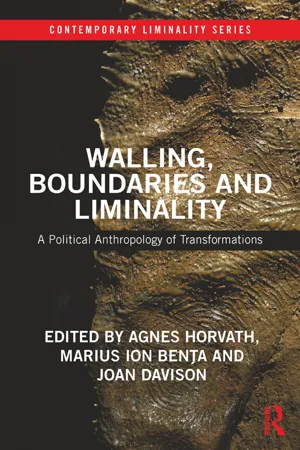
Walling, Boundaries and Liminality
A Political Anthropology of Transformations
- 204 pages
- English
- ePUB (mobile friendly)
- Available on iOS & Android
eBook - ePub
Walling, Boundaries and Liminality
A Political Anthropology of Transformations
About this book
Information
Part I
Theorising walling
Processes of transformation in history
1 Walling Europe
The perverted linear transformation
Linear transformation
Maybe the target nowadays is not to discover what we are, but to refuse what we are. We have to imagine and to build up what could be to get rid of this kind of political ‘double bind,’ which is the simultaneous individualization and totalization of modem power structures. The conclusion would be that the political, ethical, social, philosophical problem of our days, is not to try to liberate the individual from the state, and from the state’s institutions, but to liberate us both from the state and from the type of individualization which is linked to the state. We have to promote new forms of subjectivity through the refusal of this kind of individuality that has been imposed on us for several centuries.
(Foucault, 1982: 216)
Following the spirit, though not necessarily the word, of the Foucault quote above concerning the need to escape modern forms of subjectivation and promote a return to the inner power we all have, the aim of this chapter is to reconsider at its distant historical roots one of the most absurd contemporary political measures, walling. At a fundamental, anthropological level, such constructs are built on the idea of the inferiority of man, considered as harmful to himself and to the property of others, behaving irritably, thus untrustworthy, so walling is needed to force him inside/outside borders. Therefore anartificial apparatus is needed, fairly determined in its container character, a system for controlling the individuals by moulding them into a transformed state, a mass, suitable for governance. In its original form such a binding system of linear transformation, also called matrix (Nering, 1970), is present in nature, is a recipient container in which forms are transformed in their progress towards different appearances – automatically creating wants, sensuals,1 wills or opinions that enable and stimulate entities to move.
The linear transformative system with its logic and function was known at least since Antiquity, though under various different names Hesiod in Works and Days (106) stated that ‘gods and mortal men sprang from one source’, there is only one source for everything, whose quality never departs. For a better understanding we use the modern, Latin name for linear transformation, which is ‘matrix’. Plato in Timaeus (48e) referred to the matrix with the name of the triton genos, or a ‘third kind’, an in-between space, a material substratum of the void, neither being nor non-being, a vessel that is bringing forth forms. This vessel can be best described as an interval between two different appearances of a form, where forms are blending together. It is also present in Aristotle’s discussion of the cube that contains the void – a ‘something’ without own existence – which only has a place: inside the cube, but having no self-existence. Aristotle used the form of a cube as a pure example to explain better the visual form of the matrix: a walled gap, which displaces its own volume in nature, giving way to any yielding medium. It contains the void, not as a self-existing vacancy, but rather, according to Aristotle (Physics, 213b–214a), a volume itself The void as a volume is already there in the cube before the cube was occupied by the ever entering figures of the matrix, who penetrate the cube, and whom the cube should also permeate thoroughly. Most importantly, the matrix has the same volume as the void embodied in it, a volume not separable from the entering figures, however different and so isolated, bordered by the entering characters: ‘it would still embrace an equal measure of vacancy, and would coincide with a portion of “space” and “vacuity” equal to itself’ (Aristotle, Physics, 216a–b).
This is the way the substantial volume of the matrix comprises in equal volume the void, while it is also equal with it in physical properties. Matrix and the void coincide with each other, not exactly in material substratum, but in character. They both form a gap, an interruption, the matrix together with the void: the void is inherent in the essential character of the matrix as they both occupy a place; they are both material substratum. However, the void is inside the matrix; the matrix is walling the void. The matrix is a vibrating place, reciprocating the move of the entering characters from their previous equilibrium into another position of equilibrium, through homology. Their state of equilibrium has been disturbed by the initial stage of the matrix, as if transmitting their vibration. The matrix’s middle stage provides that vibration which caused the oscillation of the different characters, the in-between stage of progressing into another character, the feeling of love towards unification, a solid back and forth movement in a linear way on both sides of the centre of the matrix. Entering in and departing from the matrix is linear, a sequential process, hence transformative.
Hobbes used the matrix, in the sense of a transforming vessel or receptacle, for his idea of commonwealth, while Foucault analysed in detail Bentham’s Panopticon as a refined power-operation-system of disciplinary, moulding technology. Even Leibniz’s insight corresponds to the description of a matrix: ‘Imagine there were a machine which by its structure produced thought, feeling and perception’ (Leibniz, 2014, § 17). Foucault’s (1982) analysis was not simply an exploration of a Benthamite idea, but a major insight about the matrix’s controlling and transforming effects on its subjects, which also makes use of the similarities between the Panopticon, the media and the circus, already present in Plato ’s khóra (in the Timaeus) and diagnosis of theatrocracy (in Laws). It also recalls Gell’s theory about technology and magic, which is founded on the enchantment of technology. Here Gell (1999: 166) interprets the magical effect of technological products on its beholders, explicitly identifying the enchanted magical vessels that have power over us, which is neither different from the walled tower form of Bentham’s Panopticon or Aristotle’s cube and their continuous, disciplinary and anonymous effect, nor the specific mechanism of power used by Hobbes and embodied in the god-man-machine, the Leviathan, or Leibniz’s ‘feeling machine’, cited above.
In reality, the matrix could be everywhere, anytime, as a generalisable model of a functioning moulding process, which is defined as the intersection of dissected characters, each of which is characterised by its own liminal state. However, and this is the main argument of this chapter, in reality there is just one matrix, the matrix of proper quality, with characters, limits and borders, as Plato emphasised it (Plato, Timaeus 50c; see below for further details). Every other alteration is a perversion (the term ‘perversion’ was coined by Scheler (2010) for falsified knowledge). Any departure from the genuine matrix has no validity, like various political and other technologies, walling, disciplining, magic, and any combination of these.
The statement that the authentic matrix is an autonomous, self-sufficient vessel is our focus now, where everything that enters imitates something already existing, while receiving a new appearance. When the character that entered the matrix finally leaves it, it gains a different shape, and this transformation adds a dynamic movement to the otherwise unmoved matrix. Furthermore, alterations can occur, as Plato noticed it, in this moulding down or forming process, still during the stamping and marking period, when perversion could take place, an erratic instance that is not part of the authentic sequence, illustrated by Figure 1.2.
When Aristotle argued that every transformation involves three stages, the stage from which the change proceeds, the stage to which it proceeds and the object which persists through the transformation, he pointed out the necessary involvement of an initiator into the transformation itself – there is no incidental change (Aristotle, Physics, 226a.25). There is always something that initiates the transformation, an interruption, and so the transformation must be distinct, or else no change has occurred. A transformation might shift out of its proper change towards perverted ones, if the original intentions are not valid for the linear process of transformation.
In this chapter I explore a new, dysfunctional mind-set by re-examining those kinds of matrixing political appearances, centrally including walls, which have been imposed on us for several centuries, not without intentions, and not without initiators. This is the way we perceive the contemporary reality of Europe as a walled fortress, where the function and existence of the individuum,2 one’s legitimacy in action and progress in making judgements and taking care has become disfigured. When a whole matrixing technological enterprise has grown over us, then we should invoke the similar mechanical apparatuses of the past that were able to mould feelings, intentions, sensuals and characters into new shapes; apparatuses that moved in response to the intentional impact of enterings. The productions of this machinery are those technological artefacts that are continuously growing, resulting in unbalanced multiplications, building up those monstrous absurdities (coined by Plato for false thinking; see Theaetetus 188c), which can be the outcome of matrix machinations.
Walling
One of this dysfunctional matrixing machinery is walling, which was never more than the exact opposite of the antique homology notion. Homology (a term of Aristotle) is the quality of being in agreement, implying the similarities in thinking shown by every character in life, a mind-set in a measurable likeness between beings. In nature matrix implies homology. The state of being homologous is the fundamental similarity based on common descent from the matrix, by filiation, shown by the word itself: linearity, in linear transformation. This common developmental origin is shown by the similarity of organic compounds (Darwin successfully established a theory on that) of every being in which each character differs from successive compounds by a fixed mind-set in homology or agreement. Homology is a quality, a correspondence able to form a linear transformation in a matrix.
A different message is conveyed through walling, by seemingly promoting security, law and order, while violating understanding and homology. Why build a structure on a deprivation, the break of continuity, if it only promotes a feeling of being weak, a sense of fear and deprivation, and proposes a deficient order distanced from the power of the self? Walling is an extreme and desperate effort at confining and sealing behind a physical separating device, transforming our habitual actions and natural dispositions from self-capability and self-sufficient homology into passive endurance, as it will be shown through some examples from Palaeolithic caves. Why does walling happen? Can it be shown that walling is just one of those fake artificial systems that abuse nature’s moulding down process, interrupting and spying its stamping and marking generations, pervading its binding homology system into a multiplicative absurdity. Is it possible that a falsified transformation is behind our walling destiny, which gives a particular autopoietic dynamics for walling designs. Walling incorporates dissolved, dazzled and upset characters into erratic thinking sets, without offering any way out.
Without doubt the matrix is absorbing the energies of the entering characters, giving it back to the departed ones; it is being moved by the entering figures and maintains in this way the homology. But what happens if homology is disturbed, violated or abused? Can the matrix still keep going on, without being disturbed? Evidently not. The consequence is that not only the homology axiom of the matrix will change, but also the entering characters will lose their original property of being in homology, being equal with themselves, together with the similar loss of the departing ones. The matrix will be deformed into a parasitic machine of absorbing energies, without ever giving them back, swallowing resonation and growing into dangerous absurdities. The appropriate Aristotelian characterisation of the individuum is one that has a solid position, being complete and in comfort with nature, the notion that in nature every individual is in agreement with oneself, nothing is excluded, not even the matrix, will be violated. The matrix will become perverted, passing sickening changes on characters.
It is instructive to note that agreement in the matrix and the property of being equal to oneself are interchangeable, as all those characters who enter into the matrix’s receptacle are blended into another shape without harm or violence. Self-sameness is an absolute principle in nature, but it does not imply being in the same state all the time. There is movement without relinquishing the actual character, without changing its essence (mode of thinking, set of mind) through the matrix itself. If a change of essence could occur, then knowledge itself would cease to exist (see Cratylus 440a). Void is there in the matrix, but not the flux; the matrix is not a ‘leaky pot’ (a term coined by Plato in Cratylus 440d, capturing Heraclitus’ notion of flux), unless its homology is disturbed.
If one’s mode of thinking is not reconciled with these axioms, the matrix process loses its measure and with it the agreement, the harmonious property of the characters of being equal with themselves, the peaceful will to coincide with each other and so the process becomes falsified, the energy absorbing process of the matrix will turn into perversion. Magnitude will take the place of filiation, and instead of homology incommensurability or ‘no common measure’ will overgrow the matrix. Such incommensurable relations are represented by irrational numbers in mathematics (Szabo, 1978), but also easily could be seen in the growth of perverted matrixes, like walling, disciplining and other similar technological arrangements, with their powerful dynamism for occupying forms, places, times. Let’s not be misunderstood: the matrix itself is incommensurable, but as far as it is able to keep the tensionbetween the entering and the departing characters, it is somehow controlled by itself, by homology, which implies a focus on content and the centre, combining genesis and imitation, and not on ‘rigorously defined’ external constraints. But as soon as the whole system becomes violated, the incommensurable too escapes from the general agreement and starts its run into magnitude. Incommensurable magnitude, having no common standard for movement anymore, is the result of growth by division (at the limits, dividing by zero produces infinite growth), the multiplication of departing characters themselves in the perverted moulding process of a forged matrix.
In normality the matrix as linear transformation cannot produce anything else than its nature: linearity, filiation...
Table of contents
- Cover
- Half Title
- Title Page
- Copyright Page
- Dedication
- Table of Contents
- List of figures
- Notes on contributors
- Preface
- Introduction: on the political anthropology of walling
- Part I Theorising walling: processes of transformation in history
- Part II Contemporary examples for transformations through walling
- Conclusion
- Index
Trusted by 375,005 students
Access to over 1.5 million titles for a fair monthly price.
Study more efficiently using our study tools.
Frequently asked questions
Yes, you can cancel anytime from the Subscription tab in your account settings on the Perlego website. Your subscription will stay active until the end of your current billing period. Learn how to cancel your subscription
No, books cannot be downloaded as external files, such as PDFs, for use outside of Perlego. However, you can download books within the Perlego app for offline reading on mobile or tablet. Learn how to download books offline
Perlego offers two plans: Essential and Complete
- Essential is ideal for learners and professionals who enjoy exploring a wide range of subjects. Access the Essential Library with 800,000+ trusted titles and best-sellers across business, personal growth, and the humanities. Includes unlimited reading time and Standard Read Aloud voice.
- Complete: Perfect for advanced learners and researchers needing full, unrestricted access. Unlock 1.5M+ books across hundreds of subjects, including academic and specialized titles. The Complete Plan also includes advanced features like Premium Read Aloud and Research Assistant.
We are an online textbook subscription service, where you can get access to an entire online library for less than the price of a single book per month. With over 1.5 million books across 990+ topics, we’ve got you covered! Learn about our mission
Look out for the read-aloud symbol on your next book to see if you can listen to it. The read-aloud tool reads text aloud for you, highlighting the text as it is being read. You can pause it, speed it up and slow it down. Learn more about Read Aloud
Yes! You can use the Perlego app on both iOS and Android devices to read anytime, anywhere — even offline. Perfect for commutes or when you’re on the go.
Please note we cannot support devices running on iOS 13 and Android 7 or earlier. Learn more about using the app
Please note we cannot support devices running on iOS 13 and Android 7 or earlier. Learn more about using the app
Yes, you can access Walling, Boundaries and Liminality by Agnes Horvath, Marius Ion Benţa, Joan Davison, Agnes Horvath,Joan Davison,Marius Ion Benţa in PDF and/or ePUB format, as well as other popular books in Social Sciences & Sociology. We have over 1.5 million books available in our catalogue for you to explore.