This book provides an interdisciplinary discussion of animals as a source of food within the context of tourism. It focuses on a range of ethical issues associated with the production and consumption of animal foods, highlighting the different ways in which animals are valued and utilised within different cultural and economic contexts. This book brings together food studies of animals with tourism and ethics, forming an important contribution to the wider conversation of human-animal studies.
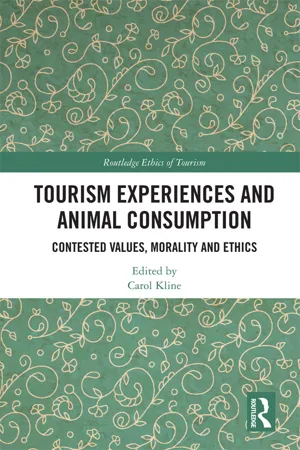
eBook - ePub
Tourism Experiences and Animal Consumption
Contested Values, Morality and Ethics
- 220 pages
- English
- ePUB (mobile friendly)
- Available on iOS & Android
eBook - ePub
1 Introduction
Animal ethics, dietary regimes, and the consumption of animals in tourism
This collection opens new territory in the study of animal ethics in tourism. While food became in recent years a much discussed topic in tourism studies (Cohen & Avieli, 2004; Goolaup, Solér & Nunkoo, 2017; Kim, Eves, & Scarles, 2009; Sims, 2009), and tourism ethics also gained growing attention (Caton, 2012; Fennell, 2006; Lovelock & Lovelock, 2013; Mostafanezhad & Hannam, 2014), the ethics of eating animals is as yet a little explored topic (but see Bramble & Fisher 2016; Chignell, Cuneo, & Halteman, 2015), while the ethics of eating animals in tourism remains practically untouched. The initiative to examine the ethical issues inherent in the eating of animals in a touristic context, in a series of concrete case studies, is thus a welcome initiative. This volume covers a wide range of issues, from the ethics of the direct consumption of animals by tourists in the course of trips or during particular events to the ethics of the farming of domestic animals in factory farms, and even the ethics of the employment of human workers engaged in the killing and slaughtering of domestic animals raised in factory farms, which are eaten by tourists as well as other consumers.
In these introductory remarks, I will first attempt to place these diverse issues into a wider context of fundamental ethical dilemmas raised by the killing and eating of animals, discussed in the contemporary philosophy of ethics. I will then turn to the various dietary regimes which impose ethical restrictions upon the eating of animals in modern societies. Finally, I will sketch out an agenda of ethical issues involved in eating animals in tourism, some of which are discussed in the case studies in this volume.
Ethical dilemmas
The high point of many documentaries on animal life on television is the pursuit, killing, and devouring of prey by predators. This might be distasteful to some viewers, but few would consider the slaughter ‘immoral.’ Neither would depictions of the hunt by ‘primitive’ hunter-gatherers be generally perceived as ethically repugnant, as even some ethicists who tend to disapprove of eating meat concede (Yudina & Fennell, 2013). We tend to dismiss such instances of killing animals for food as ethically irrelevant, since they exemplify a survival ‘need’ of predatory animals or humans imbricated in a natural eco-system. Ethical judgments regarding eating other-than-human animals become relevant only when the killing is not a survival need, but a choice between alternative dietary regimes.
Humans are animals, evolutionarily contiguous with the animal world but separated from it by some distinct ‘human’ traits, such as reflexivity and morality. The equivocality surrounding our consumption of meat is a poignant example of our duality as human animals, suspended between nature and culture. Hence we face a fundamental dilemma: Should we follow our ‘natural’ inclination to eat other-than-human animals, or, as conscious (and conscientious) humans, abstain from it? As omnivorous animals, eating meat comes to us ‘naturally’ and unreflectively; but as reflective humans, we face disturbing ethical questions. However, for most people, eating, and specifically eating meat, is a non-reflective activity, a normal or ‘natural’ routine; hence a conscious effort is needed to become aware of the ethical dilemmas it poses. These dilemmas have been elucidated in a branch of contemporary philosophy known as ‘animal ethics,’ which has flourished in recent decades.
Animal ethics
On the most fundamental level we are faced with two related ethical questions, which are not always clearly distinguished in the literature: the ethics of killing animals for food, and the ethics of eating their meat. The distinction is necessary, since in practice many moderns abstain from killing animals, even as they tend to eat their meat, if the animals were killed by someone else.
The principal Western animal ethics theories in philosophy differ regarding the permissibility of killing animals in general, and specifically of killing animals for food. (For some Asian approaches to these matters, see Kito’s and Brown’s chapters in this volume.) The theories span a wide range of positions, from a total prohibition of killing (and hence eating) animals to total permissibility.
Animal rights theory (Fennell, 2012a) claims that animals have inherent value, i.e. are ends-in-themselves, and opposes all use of animals as instruments or commodities for human ends; consequently, some of its protagonists expressly oppose killing animals for food (p. 161). Utilitarian animal ethics theory (Fennell, 2012b) is also opposed to the killing of animals for food, on the basis of a utility calculus, which takes account not only of human, but also of animal interests. Both theories advocate vegetarianism (Singer, 1980). Animal welfare theory (Fennell, 2013b) is primarily concerned with the quality of life of living animals, particularly those farmed by humans or used by them for work, entertainment, or sport but is not explicitly opposed to killing them for food. Ecofeminism (Yudina & Fennell, 2013), which abstains from general precepts and favors considering ethical issues in context, is not opposed to killing and eating animals in principle, but its ethics of ‘care’ implicitly prefer vegetarianism to the consumption of meat, circumstances permitting. Ecocentrism (Fennell, 2013a) takes a holistic approach, favoring the greater good of biotic communities over individual beings, and is hence prepared to sacrifice individual animal lives for preserving biotic equilibrium, thus accepting ecologically sound hunting, fishing, and trapping of animals (for food) (Cavaliere & Viscidy in this volume). Finally, there is the neo-Kantian position that animals have no moral rights and that it is consequently permissible to kill them (for food) (Baranzke, 2016). While not explicitly invoking Kant, Hsiao (2015) has recently proposed an explicit philosophical defense of eating meat on Kantian lines. Arguing that animals lack moral status, possessed by humans, Hsiao claims that causing pain to animals is not morally bad (p. 279) and that the interests of moral beings (i.e., humans) precede those of non-moral ones (i.e., animals). He hence concludes that moral human welfare interest in eating meat takes precedence over the non-moral welfare interest of animals (p. 280), reflecting a position common in China (Brown in this volume).
A lively controversy between philosophers representing the various approaches to animal ethics is continuing. However, much of it is highly abstract and cerebral. The extent to which these philosophical controversies actually impact upon modern peoples’ eating habits is not known but is probably not very significant, with the exception of Singer’s utilitarian approach, popularized in his Animal Liberation (1973). Notably, the authors of the papers in this volume, devoted to the ethics of eating animals in tourism, rarely refer to these controversies.
Vegetarianism
The most fundamental ethical dilemma in dietary choices is whether to consume other animals or abstain from it: to be meat-eaters or vegetarians. This is the issue with which most of the contemporary animal ethics theories are, at least implicitly, concerned, with the principal ones tending toward vegetarianism; however, these theories differ in the specific reasoning supporting that preference. It might seem that in a book devoted to the eating of animals, a discussion of vegetarianism would be out of place. But it always lurks in the background as the alternative, against which meat-eaters have to defend their dietary choices.
Vegetarianism is a popular movement, supported not only by abstract reasoning but also by ideologies invoking compassion for animals, health benefits, or social and environmental considerations. An important point to note is that an increasingly powerful motive for vegetarianism in contemporary Western societies is the opposition to factory farming, the industrialized production of animals, such as chicken, pigs, and cattle for food, claimed to be causing unacceptable suffering to the mass-produced animals and even to the employees in the meat processing industry (Jenkins this volume). The focus of the discourse on vegetarianism, to no small extent under the influence of Peter Singer’s Animal Liberation (1973), hence moved from the killing of animals to their suffering during their (often short) lifetimes. That issue is also discussed in several chapters in this collection, although only one of the authors (Brown) relates expressly to vegetarianism.
The antagonists and protagonists of meat consumption seek to buttress their respective positions with ideologically tinted versions of human evolution, alleged to prove the naturalness of their respective dietary choices: the vegetarians stick to an early pre-historical period, when our predecessors were still herbivores, their opponents to a later period, starting about 2.5 million years ago, when they began to eat meat; the latter also point out the significant role which meat had played in the evolution of homo sapiens (e.g., Lee & DeVore, 1968; Kaplan, Hill, Lancaster, & Hurtado, 2000). However, from an ethical perspective, the prehistory of the human animal seems to bear no significant weight upon ethical positions regarding the consumption of meat by contemporary humans.
It is important to stress that the historical rise of an ethics of vegetarianism is not bound to a scarcity of animal food resources. People who are forced to subsist merely on vegetables, owing to poverty or harsh environmental conditions, are not ‘vegetarians’; only people who choose voluntarily to abstain from eating meat, even though it is accessible and affordable, can be considered ‘vegetarians.’ Consequently, it appears that vegetarianism was historically, as it is contemporaneously, practiced primarily by the better-off, higher social strata, rather than the lower ones. Perhaps the most salient historical example is Hinduism, in which the religious injunction of ahiṃsā, which prohibits the taking of life, has been followed to varying degrees of strictness in the caste system, with only the highest caste, the Brahmins, practicing strict vegetarianism. In the contemporary West, vegetarianism appears to be spreading particularly among the middle and higher-middle classes, rather than among the lower ones – paradoxically, among the very classes that could most easily afford meat. The practice of vegetarianism can thus be seen as an expression of moral supremacy, an elitist choice of self-denial, endowing the individual with social prestige.
There are several vegetarian regimes in contemporary society, distinguished by the strictness of their respective dietary precepts:
- The so-called veggies, or vegans, abstain not only from eating animal meat, but also from all animal products, such as eggs, milk, or even honey.
- Strict vegetarians abstain from eating animals but consume animal products.
- Semi-vegetarians abstain from eating sentient beings (i.e., animals which feel pain), while eating what they consider non-sentient ones; this often takes the concrete form of abstaining from animal meat (in the narrow sense) while eating fish and seafood, even though it is as yet unclear whether these animals, or even insects (Perdue in this volume), are sentient or not.
- Finally, there is a wide penumbra of partial vegetarians, who prefer a vegetarian diet but sometimes eat meat.
An important emergent dietary regime, related to this issue, is that practiced by so-called locavores, namely people whose diet consists mainly of locally grown or produced food, as one expression of ‘neo-localism’ in advanced industrial societies, exemplified in this volume by Alderman and Caspersen’s chapter on barbecue tourism in the U.S. South. Locavores access local products by ‘alternative food networks’ (Sims, 2009) and abstain from food transported across great distances by major distributors. This is not a vegetarian regime, but a form of protest against the treatment of domestic animals in industrialized, large-scale ‘factory farming’ (whose products are widely distributed), while favoring small-scale, more traditional animal farming methods (whose products are locally distributed).
From an ethical standpoint, vegetarianism can be seen as a personal decision, an act of conscience, not to take part in the killing or exploitation of animals for food, irrespective of whether that decision has any effect on that social practice (though some of its proponents maintain that it might help reduce the number of animals slaughtered for food [e.g., Singer, 1980]). It signalizes a personal refusal to bear co-responsibility for the pain and death of animals owing to the human desire for meat. This raises two questions: (1) to what extent do we bear co-responsibility for the acts of those who are directly involved in the exploitation and slaughter of animals for food? and (2) how consistent is this abstention with the vegetarians’ conduct in other spheres of consumption?
Few ethicists have expressly addressed the first question; Martin (2015) maintains that buyers of meat produced by factory farming are complicit in animal suffering. However, it appears that the longer the chain of intermediary stages in the processing and transformation of an animal’s meat between the slaughter and the final product, the less people feel personally responsible for the killing of the animal (e.g., for the slaughter of a head of cattle in Argentina, which was transported as meat to Europe, made into sausage in a factory, and purchased in a supermarket). Mognard (in this volume) maintains that tourists tend to dissociate between the living animal and the food, thus as foie gras, made of its carcass. This apparent ‘cascading down’ of co-responsibility for the suffering or killing of animals for meat is a significant ethical issue, in need of further examination.
This issue gains further salience when the ethical decisions of vegetarians are examined for consistency of conduct in other spheres of consumption: for example, huge numbers of mice and rats are exterminated in warehouses in countries like Thailand to safeguard stored rice; they are thus killed to preserve rice as food for humans, but it is doubtful whether any vegetarians in the West would abstain from Thai rice for this reason (see also Perdue in this volume). To go even further afield: the building of dams on big rivers like the Mekong for the production of electricity is destructive of riverine life; but no vegetarian probably refuses to use the electricity produced by the dams to prepare his/her meals. It could thus be argued that if we accept that in other spheres our co-responsibility cascades downward from the original killings, then the vegetarian prioritization of the sphere of food to express opposition to the killing of animals is ethically inconsistent. I suggest that it is the repulsion from the concrete act of eating meat, the incorporation of animals into the human body, which makes people prioritize vegetarianism over abstention from other forms of consumption involving animal death, in which there is no corporeal contact between the consumers and the killed animals. Personal responsibility of consumers for the exploitation and killing of animals is a broad issue in the contemporary discussions of animal ethics. It is also an important, though often implicit, issue in the ethics of eating of animals under the specific circumstances of tourism, to which we now turn.
Ethical issues of eating animals in tourism
While the general theories and topics in animal ethics discussed above have a bearing on the ethical issues regarding the eating of animals in tourism, those issues remain on the whole unexplored in the literature. I will therefore attempt below to sketch out an agenda for the study of this topic, by conceptualizing some specific ethical issues regarding the eating of animals against the background of distinctive traits of touristic situations. Since modern tourism is a vast and highly differentiated field, I shall refer here mainly to contemporary Western mass tourists, with a relatively low culture capital, with whom the chapters of this book are also predominantly concerned.
That the eating of animals in tourism remains an unexplored topic might be largely due to the perception of tourism as a zone of permissiveness and indulgence, which should not be judged by the ethical criteria deployed in daily life. Indeed, the issue of ethics in tourism has a paradoxical aspect: the fun and enjoyment, which endows a vacation with its charm, might be antithetical to the moral prescriptions regulating ordinary life. Akrasia, the conscious transgression of ethical precepts (Fennell, 2015), seems to be intrinsic to many modes of touristic enjoyment, and particularly to eating and drinking. Overeating (Ph. Brown, 1996), binge drinking (Tu...
Table of contents
- Cover
- Title
- Copyright
- Contents
- List of figures
- List of tables
- Notes on contributors
- Acknowledgements
- Reviewer acknowledgements
- 1 Introduction: animal ethics, dietary regimes, and the consumption of animals in tourism
- 2 Feasting on friends: whales, puffins, and tourism in Iceland
- 3 Consuming Shangri-la: orientalism, tourism, and eating Tibetan savory pigs
- 4 Who pays for our cheap meat? the impact of modern meat production on slaughterhouse workers: considerations for tourists
- 5 Examining the correlation between tourism and the international trade of peccary: ethical implications
- 6 Eating insects and tourism: ethical challenges in a changing world
- 7 Making a meal of it: a political ecology examination of whale meat and tourism
- 8 Barbecue tourism: the racial politics of belonging within the cult of the pig
- 9 Fat duck as foie gras? Axiological implications of tourist experiences
- 10 The ethical implication of tourism on guinea pig production: the case of Cuenca, Ecuador
- 11 Agritourism providers’ reflections on post-carbon treatment of the wild white-tail deer
- 12 The metaphysical background of animal ethics and tourism in Japan
- 13 Consuming the king of the swamp: materiality and morality in South Louisiana alligator tourism
- 14 Yulin Lychee and Dog Meat Festival: a shift in focus
- 15 Abstracting animals through tourism
- Index
Trusted by 375,005 students
Access to over 1.5 million titles for a fair monthly price.
Study more efficiently using our study tools.
Frequently asked questions
Yes, you can cancel anytime from the Subscription tab in your account settings on the Perlego website. Your subscription will stay active until the end of your current billing period. Learn how to cancel your subscription
No, books cannot be downloaded as external files, such as PDFs, for use outside of Perlego. However, you can download books within the Perlego app for offline reading on mobile or tablet. Learn how to download books offline
Perlego offers two plans: Essential and Complete
- Essential is ideal for learners and professionals who enjoy exploring a wide range of subjects. Access the Essential Library with 800,000+ trusted titles and best-sellers across business, personal growth, and the humanities. Includes unlimited reading time and Standard Read Aloud voice.
- Complete: Perfect for advanced learners and researchers needing full, unrestricted access. Unlock 1.5M+ books across hundreds of subjects, including academic and specialized titles. The Complete Plan also includes advanced features like Premium Read Aloud and Research Assistant.
We are an online textbook subscription service, where you can get access to an entire online library for less than the price of a single book per month. With over 1.5 million books across 990+ topics, we’ve got you covered! Learn about our mission
Look out for the read-aloud symbol on your next book to see if you can listen to it. The read-aloud tool reads text aloud for you, highlighting the text as it is being read. You can pause it, speed it up and slow it down. Learn more about Read Aloud
Yes! You can use the Perlego app on both iOS and Android devices to read anytime, anywhere — even offline. Perfect for commutes or when you’re on the go.
Please note we cannot support devices running on iOS 13 and Android 7 or earlier. Learn more about using the app
Please note we cannot support devices running on iOS 13 and Android 7 or earlier. Learn more about using the app
Yes, you can access Tourism Experiences and Animal Consumption by Carol Kline in PDF and/or ePUB format, as well as other popular books in Business & Hospitality, Travel & Tourism Industry. We have over 1.5 million books available in our catalogue for you to explore.