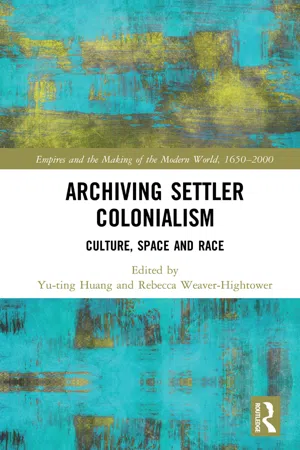
Archiving Settler Colonialism: Culture, Race, and Space brings together 15 essays from across the globe, to capture a moment in settler colonial studies that turns increasingly towards new cultural archives for settler colonial research. Essays on hitherto under-examined materials—including postage stamps, musical scores, urban parks, and psychiatric records—reflect on how cultural texts archive moments of settler self-fashioning. Archiving Settler Colonialism also expands settler colonial studies' reach as an international academic discipline, bringing together scholarly research about the British breakaway settler colonies with underanalyzed non-white, non-Anglophone settler societies. The essays together illustrate settler colonial cultures as—for all their similarities—ultimately divergent constructions, locally situated and produced of specific power relations within the messy operations of imperial domination.
eBook - ePub
Archiving Settler Colonialism
Culture, Space and Race
- 284 pages
- English
- ePUB (mobile friendly)
- Available on iOS & Android
eBook - ePub
Archiving Settler Colonialism
Culture, Space and Race
Part I
Spaces, sites and scales
1More than just symbols
Resurfacing Indigenous place in the Far North of Aotearoa New Zealand
Avril Bell
Over the past thirty to forty years, the settler state in Aotearoa New Zealand, as in the other Anglo settler societies, has developed new policy settings toward Indigenous Māori communities, broadly understood as enacting the ideal of a bicultural society founded on the partnership of Māori (the Indigenous people) and Pākehā (white colonial settlers). In the Aotearoa New Zealand case, the key mechanism of bicultural recognition for Māori has been “Treaty settlements,” which offer some (very limited) compensation for historical injustices, and limited recognition of tribes/iwi as political partners to the state.
There is only one treaty in Aotearoa New Zealand: Te Tiriti o Waitangi/The Treaty of Waitangi, signed in 1840 by representatives of the British Crown and about 540 tribal leaders.1 The Treaty led to the establishment of a colonial government, which within fifty years acquired the vast bulk of the land via a range of means, including wars, confiscations, the imposition of Western property law and subsequent sales. Aotearoa New Zealand was gradually made over as settler-dominated space, with policy toward Māori aimed at their assimilation into settler society. No reserves were set aside that were viable for Māori communities to continue their own way of life. Instead, they were forced into the capitalist wage economy and “civilized” via state education. The settler dream was of “one nation” with Māori gradually being absorbed into the Pākehā population and settler space, their own culture and values relegated to history and the museum, and appropriated in the service of indigenizing the settler nation.
In recent decades, persistent Māori resistance has forced state acknowledgment of the injustices of this history, leading to the establishment of the Waitangi Tribunal as a mechanism for redress. While some tribes never signed Te Tiriti, and many strategically decided that some leaders would sign and others not, all contemporary tribes are able to lodge claims for settlement through the Waitangi Tribunal and/or the Office of Treaty Settlements. In the forty years since its establishment in 1975, the Tribunal released 125 final reports covering 79 percent of the nation’s land area, in addition to “kaupapa reports” on nationwide issues, such as the status of the Māori language and the fisheries settlement that was negotiated at a national level (Waitangi Tribunal 34). The Tribunal’s recommendations are mostly non-binding but provide an important foundation for the negotiation of settlements between tribes and the Crown. At the time of writing, seventy settlements have been agreed with claimant groups, with a number of others still engaged in earlier stages of the process.2 Some tribes have subsequently become major corporate and political actors in their regions.
It is in this context that, in 2011, I embarked on a research project in my hometown, Kaitaia, a small rural community in the Far North of Aotearoa New Zealand, to investigate how non-Indigenous communities were responding to the newly empowered tribes of this era after Treaty settlements. As a Pākehā researcher, I was interested in whether or not the local settler community leaders and organizations were engaging constructively with local tribes seeking political partnerships. When I began this project, Treaty settlements for the five tribes of the area, Te Rarawa, Ngāti Kahu, Ngāi Takoto, Te Aupōuri, and Ngāti Kuri, were still under negotiation.3 However, an opportunity arose for me to explore settler responsiveness to partnership initiatives with these iwi (tribes) through a small case study of the development of a new community complex in Kaitaia.
The building, Te Ahu, was originally planned to house the local museum and archive but ultimately resulted in a complex also including the local library, tourist information center, community hall, theater, local council offices and a suite of meeting rooms. In 2011, I was shown a document, “Te Ahu Discussion Paper on Iwi Engagement” (Piripi), setting out a vision for the development of this complex as a partnership between “the seven people of the north”—the five iwi and the two white settler peoples of the area, Pākehā and Dalmatians. This was an opportunity to explore the issues of settler engagement I had been thinking about—and in my hometown, where I was already known to some of the people involved.
While bicultural rhetoric posits two Treaty partners—Māori and Pākehā—I have already given some sense of the diversity on each side. While Māori share a common language, with dialectical differences, politically and socially the community is organized around diverse tribal, and also urban, groupings. On the settler side, many other communities have arrived to join the still predominantly British-descended population. There are now large Pacific and Asian minority populations, and within the white settler population some distinct ethnic groupings remain prominent in different parts of the country, including Irish, Dutch, Nova Scotia Scots, Norse—and Dalmatians. The Dalmatians are descendants of people from Dalmatia, on the coast of Croatia, who came to Aotearoa New Zealand around the turn of the twentieth century and largely settled in the Auckland and Northland regions.4 The distinctions between these white ethnic groups (as with many identity categories) are rather blurry, and many Dalmatians, Dutch and so on, might also identify and be identified as Pākehā. There has also been a lot of intermarriage between Māori, Dalmatians, and Pākehā, so that many people can identify with more than one of these large groupings. However, in the Far North of Aotearoa New Zealand a distinct Dalmatian culture and identity remains.
This research project was ethnographic in nature, involving attending meetings of the Te Ahu Charitable Trust, the group set up to lead the development, attending events at Te Ahu,5 participating in many conversations with some of the leading players in the development over a succession of visits, and conducting a series of forty-four interviews with some of these key players and a number of members of the wider community. These various forms of data collection took place from 2011 to 2015, with Te Ahu opening in early 2012. The lengthy time scale of this project has allowed me to explore the aims and hopes of the key players, the euphoria at the time the building opened, and some of the disappointments and frustrations throughout the process and since.
The focus of this chapter is on Te Ahu as an example of the remaking of space in a settler society in ways I argue incrementally contribute to decolonization—which here, following Lorenzo Veracini, refers to processes by which settler societies become “reconciled” with Indigenous sovereignty and anteriority (107), rather than Indigenous polities becoming reconciled to their subordination to the settler state, or settler peoples leaving. As the settler-colonial project involves remaking Indigenous space into settler space, so decolonization in this sense involves the resurfacing and “normalizing” of Indigenous space. These kinds of resurfacings are likely to be taking place across the Anglo settler-colonial world, as these societies engage in what is often called a politics of recognition of Indigenous communities living within their borders. While these politics are rightly subject to critique for their myriad limitations, my argument here is that, at least in some instances, something potentially profound—if incremental—is under way. If, as Mark Rifkin has correctly noted, settlement involved quotidian, incremental processes (8–9), or as Nicholas Thomas has argued, settler colonialism was/is an incomplete project (105–107), then we can expect decolonization to be similarly incremental and processual.
My argument at the broadest level then, using Doreen Massey’s theorization of space as multiple to describe Te Ahu as coexistent Indigenous and settler space, is that the settler use of this space must be reconciled with Indigenous prior claim and spatial forms. The work of symbols is also central to my argument as outlined in the following section, which provides a brief overview of Aotearoa New Zealand’s biculturalism and important critiques of it. I then explore two features of the Te Ahu project that I argue are more than purely tokenistic incorporations of Māori cultural symbolism. First, the name of the building “resurfaces” Māori and colonial history, in contrast to previous public buildings on the site. In so doing, it also marks this building and its resources as a Māori place, a place in which the Māori community has a sense of ownership and entitlement, and a place in which history remains lively and active in the present. Second, the carved pou (posts) that circle the building’s central atrium are, for Māori, not merely carvings but the embodiment of living ancestral presences and other entities of the lifeworld that invite greeting and engagement, bringing a Māori ontological style or way of being into this public space. The development of these pou also demanded new forms of engagement between the various peoples of the north and, importantly brought the five iwi back into the heart of the community. In each of these ways, Te Ahu incrementally contributes to recentering Māori in a community in which they have long been pushed to the margins by the myriad processes of colonization (land alienation, economic deprivation, assimilatory policies).
Symbolic and resourced biculturalism
Since the 1980s, the rhetoric of New Zealand nationhood has been of a bicultural nation founded on a partnership between Māori and Pākehā. In addition to the Treaty settlement process, biculturalism has been enacted in various ways that can be broadly categorized as, on the one hand, reforming state institutions to be more responsive to and inclusive of Māori and, on the other, developing Māori-centered and Māori-controlled services and resources. Following the successful claim to the Waitangi Tribunal, the Māori language was made an official language in 1987, and all government bodies and many other private organizations now have Māori as well as English names and incorporate Māori symbolism in their logos. The national anthem is routinely sung first in Māori and then in English,6 and schoolchildren nationwide will learn at least a few basic words and phrases in Māori during their education. The incorporation of various Māori protocols, particularly those of welcome and farewell at the opening and closing of events, has become commonplace in government, in schools, and in other organizations. Educational institutions typically now have marae, a complex of buildings that act as meeting places and sites of collective life in Māori communities, and it is at these marae that ceremonies of welcome are held for important visitors or new intakes of students. In these and other ways, Pākehā-dominated institutions have become somewhat bicultural in their practices.
Some public institutions have gone further, developing parallel governance structures to enact the vision of equal Māori/non-Māori political partnerships. Some examples are the Anglican Church, which has three parallel governing structures—Pākehā, Māori and Pasifika (representing Pacific peoples within Aotearoa New Zealand); the national museum, Te Papa Tongorewa, which has a bicultural, Māori and Pākehā, governing structure; and the National Women’s Refuge, which has equal representation of Māori and non-Māori on their governing body and incorporates separate, Māori-led meetings and refuges within their structure.7
Another strand of biculturalism has seen the development, in various sectors, of Māori-centered organizations with varying degrees of autonomy. Devolutionary, neoliberal governance, which saw public-sector services contracted out to private providers, coincided in Aotearoa New Zealand with the bicultural era, facilitating the development of “by Māori for Māori” providers to contract to provide Māori-centered health and welfare services for Māori communities. In education, for example, a parallel schooling structure has developed, beginning with Te Kōhanga Reo, a preschool education system centering on reviving the language by raising new generations as first-language speakers. Over time Kura Kaupapa schools were opened to take Kōhanga graduates through elementary and secondary schooling, and ultimately three Whare Wānanga have opened to provide tertiary/college level education. Māori broadcasting has also become established in this era, with a network of tribally run Māori radio stations developed from the 1980s and a national Māori television service being set up in 2004.8
These developments have dovetailed with the model of “iwi development” facilitated by Treaty settlements, with at least some Māori social-service providers being tribally based. Treaty settlements largely take the form of the return of some (small) portion of lands lost and an economic settlement as partial compensation for what cannot be returned9—although again this economic recognition is very small. However, these settlements have crucially enabled tribes who have “settled” to develop an economic base.10
Taken together, these policies have led to the growth of a significant Māori middle class and a number of economically powerful Māori corporations, largely tribally based. This tribal basis of Māori development means that iwi are increasingly important economic actors in regional economies. At the same time, however, Aotearoa New Zealand has become a highly unequal society as a result of neoliberal policies. Consequently, many Māori at the lower end of the economic scale have become progressively economically and socially disenfranchised, and subject to predictable he...
Table of contents
- Cover
- Half Title
- Series Information
- Title Page
- Copyright Page
- Contents
- Figures
- List of Contributors
- Acknowledgments
- Introduction: Settler colonialism and its cultural archives—ways of reading
- Part I Spaces, sites and scales
- Part II Subordinate settlers
- Part III Variations in genres
- Part IV Settler psyches
- Part V Settler languages
- Afterword: The global archive of liminal settlement
- Index
Trusted by 375,005 students
Access to over 1.5 million titles for a fair monthly price.
Study more efficiently using our study tools.
Frequently asked questions
Yes, you can cancel anytime from the Subscription tab in your account settings on the Perlego website. Your subscription will stay active until the end of your current billing period. Learn how to cancel your subscription
No, books cannot be downloaded as external files, such as PDFs, for use outside of Perlego. However, you can download books within the Perlego app for offline reading on mobile or tablet. Learn how to download books offline
We are an online textbook subscription service, where you can get access to an entire online library for less than the price of a single book per month. With over 1.5 million books across 990+ topics, we’ve got you covered! Learn about our mission
Look out for the read-aloud symbol on your next book to see if you can listen to it. The read-aloud tool reads text aloud for you, highlighting the text as it is being read. You can pause it, speed it up and slow it down. Learn more about Read Aloud
Yes! You can use the Perlego app on both iOS and Android devices to read anytime, anywhere — even offline. Perfect for commutes or when you’re on the go.
Please note we cannot support devices running on iOS 13 and Android 7 or earlier. Learn more about using the app
Please note we cannot support devices running on iOS 13 and Android 7 or earlier. Learn more about using the app
Yes, you can access Archiving Settler Colonialism by Yu-ting Huang, Rebecca Weaver-Hightower, Yu-ting Huang,Rebecca Weaver-Hightower in PDF and/or ePUB format, as well as other popular books in History & African History. We have over 1.5 million books available in our catalogue for you to explore.