- 204 pages
- English
- ePUB (mobile friendly)
- Available on iOS & Android
eBook - ePub
About this book
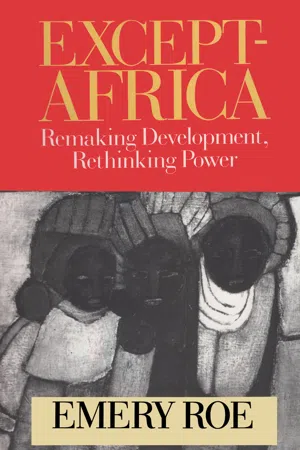
It is a commonplace that the problems of African rural development are becoming increasingly complex--that is, they have grown more numerous, interrelated, and varied. This complexity has generated a multitude of development scenarios. Such scenarios encourage decision making along rigid and narrow patterns that ignore the diversity of local situations and national cultures. Among these is the doomsday scenario, applied to every nation on the continent, best captured in the phrase Everything worksàexcept in Africa. Emery Roe argues that crisis scenarios generated by an expert (usually non-African) elite are self-serving and counterproductive. Despite this, they go largely unchallenged, even when they fail to explain or predict. Except-Africa takes up the challenge of devising development scenarios that do justice to the continent's variegated reality.The book begins by defining what the author means by a development narrative. The subsequent chapters provide alternate scenarios to such dominant models. Chapter 2 sketches four counter-narratives to the tragedy of the common argument, while chapter 3 constructs the most innovative challenge to conventional ways of thinking about Sub-Saharan pastoralism in decades. Chapter 4 develops an alternative scenario of expatriate advising in Africa, while chapter 5 devises a counter-narrative to the all-too-common views about government budgeting in Nigeria, Kenya, and Ghana. Chapter 6 presents a case study and counter-narrative from Zimbabwe of a complex local government reform. The book concludes by moving beyond case material and specific situations to answer the most imperative question in African studies and rural development: What would a politics of complexity look like in Africa if complexity were seriously engaged?Contemporary African studies are dominated by narratives about power. Yet in African rural development, power interests are by no means always clear. Development issues are frequently contingent and provisional. Surviving the tangled fusion of narrative and reality requires a politics of complexity. Except-Africa will be an essential work in meeting that challenge.
1
Development Narratives and Six Ways to Change Them
Introduction
What are development narratives? The short answer is that they are stories (scenarios and arguments) that underwrite and stabilize the assumptions for decision making in situations of high complexity and uncertainty. Each narrative discussed below has a beginning, middle, and end (or premises and conclusions, if cast as an argument) and revolves around a sequence of events or positions in which something is said to happen or from which something is said to follow.1
Rural development is a genuinely complex activity, and one of the principal ways practitioners, bureaucrats, policymakers, and other decision makers (including citizens) articulate and make sense of this uncertainty is to tell scenarios and formulate arguments that simplify or complexify that reality. (We will see why policymakers might want to make their narratives complex.) Indeed, the pressure to generate narratives about development is directly related to the ambiguity decision makers experience over that development. As noted in the introduction, the more uncertain things seem everywhere at the micro-level, the greater the perceived scale of uncertainty at the macro-level and the greater the perceived need for explanatory narratives that can be operationalized into standard approaches with widespread application. Thus, the failure of projects and programs based on development narratives often serves only to reinforce, not lessen, the appeal of some sort of narrative that explains and addresses the persisting, now increasing, uncertainty.
Such considerations raise the question, Can rural development be improved by directly addressing those narratives that underwrite and stabilize that development? The answer is Yes, and to see how this is done, six different options for changing development narratives are discussed, with examples given for each.
But first some explanation about the terminology used in what follows. It is my hope that readers will be uncomfortable with terms such as “defamiliarize,” “denarrativize,” “metanarrativize,” and “counter-narrativize.” I write “hope” because the main aim of Except-Africa is to recast the familiar and taken-for-granted in rural development in a fresh and altogether more useful light. The objective here is, in the words of W.H. Auden, to disenchant and disintoxicate the many development narratives that dominate our understandings of African rural development. Nor do I mean only those odious narratives about “Except-Africa” and its “doomsday scenario” discussed in the introduction. There are those other development narratives taken as given and simply assumed to be the case by development practitioners and scholars alike that must be challenged, e.g., “politics in Africa is about power” or “behind the official rhetoric and policies [read: development narratives] are the power interests that determine them.” Only when we have defamiliarized the familiar will we have a chance to develop new narratives that are more plausible as a platform for positive action in the future.
Briefly put then, one way to change a development narrative is to denarrativize it, an option first mentioned in the introduction. Alternatively, one could create a counternarrative (as in the following trag-edy-of-the-commons example); or use the development initiatives generated by the narrative to alter that narrative (as in the case of land registration); or fill in the “details” of the narrative in order to make it less misleading (as in the systems approach example below). Another option is to identify a more tractable metanarrative that shifts attention away from the development narrative one finds objectionable. There are many instances, however, where little leeway exists to be creative. The best a person can do is to engage another preexisting narrative, which, once engaged, conflicts with the more objectionable one.
The bulk of this book is given to discussing and exemplifying the counternarrative option. For that reason, this chapter devotes considerable attention to the other five options.
Six Options
1. Denarrativize!
You denarrativize a development narrative by insisting that “getting the facts and figures right has to come before knowing what is the real story in question.” Something like this happens, for instance, every time negative academics (Robert Chambers’s term) rely on critique alone: they have simply shown that the official position has little or no empirical merits without, however, providing an effective alternative argument to the one they have so thoroughly discredited. Every reader knows of those wonderful tracts that painstakingly demolish a government or donor orthodoxy but which fall apart the minute they get to the section—if they get there at all—variously called “policy implications.” There, the painstaking gives way to the painfully clear, in that no matter how effective the critique has been as a demolition job, it falls woefully short of developing a more feasible and implementable alternative to that which has been demolished. Still, criticism matters, if only in establishing just how objectionable the development narrative is.
The more general point is that because rural development is truly an uncertain enterprise and has been for a very long time, it is always (always) a fairly easy matter to denarrativize development scenarios simply by pointing out their factual shortcomings. To appreciate just how easy, I have purposively chosen three development narratives that have been considered by and large true within their own contexts.2
Narrative 1: The colonialists deserve little or none of the credit. The British are often said to have invested virtually nothing in the Bechuanaland Protectorate for much of the period prior to Independence in 1966. According to a former permanent secretary of Botswana’s Ministry of Finance and Planning, “it is quite clear that nothing occurred between 1885 and 1955 which contributed significantly to Botswana’s economic and financial development… It was a passive period, devoted to the avoidance of involvement, to the maintenance of a status quo.” This, and like narratives, have had great currency.3
The data do not warrant the conclusion. The period after 1955 was one of substantially greater development financed by Britain, but the pre-1955 period was far from static, at least in that sector—livestock— which proved to be the country’s growth engine for much of its history.
While the numbers are fragmentary, several trends were observed during the “status quo” period prior to the mid-1950s. Between the census period of 1921 and 1956, cattle numbers rose from about half a million to slightly under 1.24 million—an estimated 150 percent increase—compared to a 100 percent increase of the human population during roughly the same time (from some 153,000 to just short of 310,000). In addition, between those years for which we have comparable time series data, 1924 and 1954, cattle exports expanded from around 25,000 head to some 74,600 (an increase of some 200 percent). Income from recorded livestock sales and related products rose by more than a factor of ten between these years from £120,385 to £1,695,000, while the cattle-export price index increased less than 75 percent during the same time (from 69 to 119, with 1910 set to 100). What a status quo!
Narrative 2: Poor, female-headed households are major rural beer brewers and depend on the sale of that beer for much of their income? After Independence, the majority of rural households in Botswana continued to brew traditional beer, and many of these households sold beer at one time or another, though far fewer actually sold on a regular basis. A number of researchers commented on the importance of traditional beer sales to rural poor, female-headed households, and some argued that such households were major producers of that beer (for example, see Dahl, 1978 and Egner and Klausen 1980).
The data available at the time simply did not warrant that conclusion. Most traditional beer appears to have been produced by those who can afford to produce, namely, wealthier rural households. Kjaer-Olsen found that, on the basis of her 1980 survey of thirty-eight cash brewers in three villages, the majority of beer brewers “belonged to the wealthier classes… In our sample, those who brewed for sale came predominately from households that were active in agriculture. 88% of those households that brewed for sale ploughed their own arable lands and of these, two-thirds did so with their own draught power.” In her 1979 survey, Vierich found that, while households holding twenty-two and more cattle accounted for some 29 percent of all households sampled, they accounted for nearly 70 percent of all households selling traditional beer. Similarly another study found that while 34 percent of the sampled households held sixteen or more head of cattle, they accounted for some 44 percent of all traditional beer sellers in that sample. A different study concluded that “only relatively well-off households tend to brew [traditional beer], the capital outlay on equipment and ingredients being so high.” Other studies undertaken at roughly the same time found similar findings.
Narrative 3: Marginal lands are marginal.4 Well after Independence, some dry zones of sub-Saharan countries had faster rates of growth in per capita income, wage employment, and informal sector growth than did some of the agroecologically high potential areas. Although the percentage of the population in wage employment in Kenya’s arid and semiarid lands (ASALs) was less than half that in non-ASAL areas, its annual growth rate was almost 50 percent higher. A similar trend was found in wage earnings per capita in that country. Nor was agriculture left behind in some ASAL areas: seven of the top ten Kenyan districts—in terms of average annual growth rates in total and per capita crop and livestock sales between 1980 and 1985—were classified as “ASAL districts.” Similarly, project implementation rates for ASAL areas in Kenya were frequently no worse than they were for non-ASAL areas for projects like cattle dips and small-scale water supplies, at least in the early 1980s. In short, these ASAL areas were less “low potential” and “marginal lands” than simply “low density” in terms of human population.
Such examples—and their number is legion—underscore the problem with denarrativization: it increases uncertainty by undermining an existing development narrative without at the same time providing an alternative to take its place. In each example, some information has been found to construct a counternarrative—the colonialists did do something, wealthier households did produce traditional beer, marginal lands were not marginal—but we would need much more to fill in the storyline of the counterscenarios than has been provided to this date.
2. Counternarrativize!
Narrative 4: The tragedy of the commons is found through sub-Saharan Africa. The profound limitations of denarrativization in the absence of generating an alternative development narrative to replace the one denarrativized are best shown in the use and abuse of the tragedy-of-the-commons scenario.
The most obvious feature of the tragedy of the commons is its status as narrative. Garrett Hardin goes out of his way to portray it as a story having all the classic properties of a beginning, middle, and end. “The tragedy of the commons develops in this way. Picture a pasture open to all…,” begins Hardin in what must be the most-quoted passage in all of the common property literature. Soon we are in the midst of the story—”the rational herdsman concludes that the only sensible course for him to pursue is to add another animal to his herd. And another … .But this is the conclusion reached by each and every rational herdsman sharing a commons”—and the end comes rapidly and palpably into sight: “Ruin is the destination toward which all men rush, each pursuing his own best interest in a society that believes in the freedom of the commons.”5
The data simply do not warrant this conclusion. When the tragedy-of-the-commons argument is probed empirically—for example, just what evidence is there for desertification caused by overgrazing?—the evidence turns out to be much more ambiguous, or downright contradictory.6 Even where people agree with Hardin that range degradation is taking place and that many commons today are open-access free-for-alls, they often part company over causes. For these critics, long-term climatological changes coupled with expanding and competing land uses have led to degradation more than has the commons. A commons which, the critics hasten to add contra Hardin, was frequently managed in a restricted-access, not open-access, fashion until these outside pressures of climate and competing land uses undermined local management efforts.7
Hardin merits closer reading than some of his critics give him. “It must not be supposed that all commons are bad in all situations,” he tells us; “when there were only a few million people in the world, it was all right to run the hunting grounds as a commons, though even then an area was no doubt often managed as tribal property.”8 Hardin is not saying the commons cannot be managed. Rather, “the commons, if it is justifiable at all, is justifiable only under conditions of low-population density.”9 The crux of his argument is that herders find it to their individual advantage not to cooperate in limiting herd numbers or ensuring range quality even when herders recognize that the overall stocking rate on the commons exceeds its putative carrying capacity and that range deterioration and live-weight loss seem on the rise.10 In such a situation, corrective measures are largely outside the initiative of the individual herder. Either the commons has to be legislated as private property or other coercive devices, such as taxes and user regulations, have to be instituted from the outside.11
If we subscribe to Hardin’s full argument, we should then expect to find at least two states of affairs when a rangeland tragedy of the commons is said to exist. First, even where herders agree that the range is in poor or already heavily-stocked condition, they still act in a noncooperative, competitive fashion. They should evince few, if any, collective practices for managing that commons, which, in turn, encourages its further overutilization. Second, a tragedy of the commons supposes that a privatized rangeland will be better managed (e.g., have a measurably better range condition) than if it were a commons, other factors being equal.
The most thoroughgoing test of Hardin’s full-bodied version of the tragedy of the commons is found in a series of publications based on data collected during the 1979/80 Botswana Water Points Survey.12 These data allow us to address how applicable each element of Hardin’s argument is to rural eastern Botswana, an area of the country that has repeatedly...
Table of contents
- Cover
- Title Page
- Copyright
- Table of Contents
- Preface and Acknowledgments
- Introduction
- 1 Development Narratives and Six Ways to Change Them
- 2 The Tragedy of the Commons
- 3 Old (Risk-Averse) Pastoralism versus New (High Reliability) Pastoralism
- 4 Expatriate Advising
- 5 Boom-and-Bust Budgeting
- 6 Decentralization, Rural Development, and Politics
- Conclusion: The Power Narrative and Its Counternarrative, the Politics of Complexity
- Selected Bibliography
- Index
Trusted by 375,005 students
Access to over 1.5 million titles for a fair monthly price.
Study more efficiently using our study tools.
Frequently asked questions
Yes, you can cancel anytime from the Subscription tab in your account settings on the Perlego website. Your subscription will stay active until the end of your current billing period. Learn how to cancel your subscription
No, books cannot be downloaded as external files, such as PDFs, for use outside of Perlego. However, you can download books within the Perlego app for offline reading on mobile or tablet. Learn how to download books offline
Perlego offers two plans: Essential and Complete
- Essential is ideal for learners and professionals who enjoy exploring a wide range of subjects. Access the Essential Library with 800,000+ trusted titles and best-sellers across business, personal growth, and the humanities. Includes unlimited reading time and Standard Read Aloud voice.
- Complete: Perfect for advanced learners and researchers needing full, unrestricted access. Unlock 1.5M+ books across hundreds of subjects, including academic and specialized titles. The Complete Plan also includes advanced features like Premium Read Aloud and Research Assistant.
We are an online textbook subscription service, where you can get access to an entire online library for less than the price of a single book per month. With over 1.5 million books across 990+ topics, we’ve got you covered! Learn about our mission
Look out for the read-aloud symbol on your next book to see if you can listen to it. The read-aloud tool reads text aloud for you, highlighting the text as it is being read. You can pause it, speed it up and slow it down. Learn more about Read Aloud
Yes! You can use the Perlego app on both iOS and Android devices to read anytime, anywhere — even offline. Perfect for commutes or when you’re on the go.
Please note we cannot support devices running on iOS 13 and Android 7 or earlier. Learn more about using the app
Please note we cannot support devices running on iOS 13 and Android 7 or earlier. Learn more about using the app
Yes, you can access Except-Africa by Emery Roe in PDF and/or ePUB format, as well as other popular books in Economics & Economic Theory. We have over 1.5 million books available in our catalogue for you to explore.