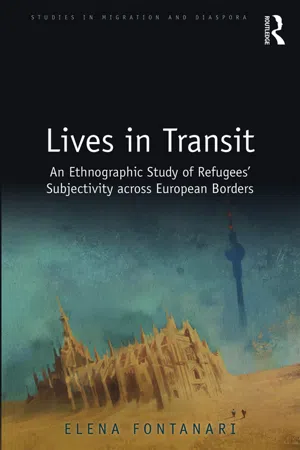
This book explores the border-crossing mobilities of refugees within Europe. Based on ethnographic fieldwork in Germany and Italy, it examines the precarious everyday lives of non-citizens living between and beyond EU internal borders. With attention to the constant re-construction of borders within Europe through negotiation practices, the author shows how the tensions that exist between refugees on the move and the structural constraints that limit their movement produce 'interstices' – small spaces of possibility that open up as a result of refugees' struggling within structural constraints. A comprehensive understanding of the long-term effects of EU borders upon refugees' lives is then afforded through a particular focus on the post-arrival period. Examining the protracted precariousness and multi-directional hyper-mobility in Europe that emerges from the dynamics of the relation between structural mechanisms and the agency of individuals, Lives in Transit reveals how the border regime in Europe impacts mostly upon the temporal rather than the spatial dimensions of refugees' lives, affecting their subjectivities and sense of self. This 'dispossession' of time is advocated as the main problem with the experience of refugees in Europe, causing them to claim a temporal justice, which seeks to gain back control of their own lives and personhood. Calling for migration to be understood as a process of 'becoming subjects', this volume will appeal to scholars of sociology, anthropology, and politics with interests in migration and diaspora studies.
eBook - ePub
Lives in Transit
An Ethnographic Study of Refugees’ Subjectivity across European Borders
- 270 pages
- English
- ePUB (mobile friendly)
- Available on iOS & Android
eBook - ePub
Lives in Transit
An Ethnographic Study of Refugees’ Subjectivity across European Borders
About this book
Information
PART I
The historical context
Asylum in Europe
1Asylum on the move
The humanitarian-security border regime in Europe
The day I got my humanitarian permit in Italia in the Questura [police immigration office] I was very happy and I said ‘now I can go to work to France or Germany’ but the police told me ‘no, this is not for working abroad! This is only for Italia, you can only work here with this document!’ I said, ‘then this is not a document, what is it good for? It is just a piece of paper!’ They broke my heart down that day! I needed something that would make my life better, and they said ‘you can travel around Europe with this document, but not work and settle!’ So I can travel but I cannot work? What do I do with a document that allows me to travel but not to work? What do I travel for, then? And how can I travel if I cannot earn the money to pay the ticket? I was very angry, I was mad, I thought refugees do have right in Europe but at that time, I said nothing and decided to leave Italia anyway.
(Interview with Amal in Berlin, January 2015)
Misunderstanding of the present is the inevitable consequence of ignorance of the past. But a man may wear himself out just as fruitlessly in seeking to understand the past, if he is totally ignorant of the present.
(Marc Bloch, The Historian’s Craft, 1953: 43)
The stories of Amal and the other protagonists are embedded in complex historical processes, which brought them to be treated as ‘refugees’, ‘labour migrants’, and ‘illegal migrants’ alternately. For an understanding of the migration process towards Europe, a historical perspective is crucial. Light needs to be shed on the historical nodes related to the construction of categories such as ‘refugee’, ‘illegal’ or ‘economic’ migrant, ‘asylum-seeker’, etc., highlighting the connected government systems deployed by institutions in order to control and manage them. In this chapter too, I will focus on how these categories have been changed over time according to the different ways in which governments have labelled and managed migration. The purpose here is to underline how the categories are socio-legally produced, and then presented as ontological and moral entities. The knowledge and the discourses produced around these categories create both cultural images and laws, which influence each other and affect the biographies of the migrants (Pinelli 2013a). In reading the historical excursus it is important to keep in mind that these socially constructed categories are the product of a dialectical relationship between national and supranational policies and the subjective drive of migrants that is inherent to any form of human mobility (Karakayali and Rigo 2010). A genealogy (see Foucault 2003 [1975]) of asylum is presented here.
1.1Where does the ‘refugee’ come from?
The ‘refugee’ comes from Europe, being a historical product socially constructed and embedded in Western history. ‘Asylum’ is related to the idea of ‘exile’, which has a powerful symbolic and political value in Western culture.1 The word ‘refugee’ is thought to be of French origin from the late 17th century (réfugié). The Huguenots were persecuted Calvinists who escaped from France to England after the revocation of the Edict of Nantes in 1685 (Kershen 2005). The Huguenots are considered the ‘classic refugee’ (Zolberg et al. 1989); they were forbidden to emigrate and punished if they did, but some of them escaped to England and other Protestant countries such as Prussia, Holland, Denmark, and Switzerland, and even to what is now South Africa (Kershen 2005). However, it is during the 19th century that the ‘refugee’ starts to become a separated social category thanks also to the historic conjunction of large-scale socio-economic changes. The industrialization process, the creation of capitalistic economies, and the building of nation states brought about the, till then, unusual phenomenon of many people moving from the place of their birth, migration from rural locations to towns and cities, and inevitable displacement (Sassen 1996).
Towards the end of the 19th century, the rise of the nation state and its sovereignty principle strengthened the relevance of borders of legal status, entailing the division between those who belonged to the nation, the citizens, and those who didn’t belong, the ‘stranger’. According to Hannah Arendt, ‘the transformation of the state from an instrument of the law into an instrument of the nation’ (1951: 257) has led to the definition of citizens of the state as nationals whether defined racially, ethnically, culturally, or even religiously. The category of ‘refugee’ is hence ontologically interconnected with the existence of the nation state and its principle of birth (citizenship)-nation-territory (Agamben 1995; Malkki 1992). A ‘stateless’ person is one who is outside the space of a state’s jurisdiction, an ‘outlaw’ (Arendt 1951), outside what is considered the norm.
In the first half of the 20th century, Europe was the locus of the First and Second World Wars, which contributed to the redefinition of many nation states’ borders.2 This process produced a high number of ‘displaced persons’ who found themselves without a state and who had to be ‘re-placed’ in the new nation states. At the same time, the still ongoing colonialism and imperialism of Europe in Asia, Africa, and South America contributed to the creation of new borders and related inequalities and discrimination against and forced displacement of various groups of people.
The truth is that I have said something very different: to wit, that the great historical tragedy of Africa has been not so much that it was too late in making contact with the rest of the world, as the manner in which that contact was brought about; that Europe began to ‘propagate’ at a time when it had fallen into the hands of the most unscrupulous financiers and captains of industry; that it was our misfortune to encounter that particular Europe on our path, and that Europe is responsible before the human community for the highest heap of corpses in history.
(Aimé Césaire, Discourse on Colonialism, 2000 [1955]: 7–8)
After the Second World War, the asylum issue underwent a process of internationalization, which had already begun during the 1920s3 but which mostly developed as a reaction to the Holocaust and the large number of displaced persons after 1945. In the 1950s, the issue of refugees became related to the idea of a protection system applied by the international community rather than by single nation states. The Geneva Convention of 1951 set the judicial basis for the international system of asylum we still have now, which was harmonized at the international level by the Protocol Relating to the Status of Refugees agreed upon by the United Nations in 1967. The main change was to link the refugee issue to that of human rights, namely to provide a legal refugee status on the basis of the personal story of each single person rather than on the ethnicity or nationality of the group. Nevertheless, the Geneva Convention being a historical product, its Eurocentric perspective is usually highlighted when difficulties arise in being completely independent from the hegemony of the nation state. Indeed, looking at the definition of ‘refugee’ stated by the Geneva Convention, it is possible to see its ambivalent nature:
[A] person who owing to a well-founded fear of being persecuted for reasons of race, religion, nationality, membership of a particular social group or political opinion, is outside the country of his nationality and is unable or, owing to such fear, is unwilling to avail himself of the protection of that country; or who, not having a nationality and being outside the country of his former habitual residence as a result of such events, is unable or, owing to such fear, is unwilling to return to it.4
On the one hand, the ‘refugee’ is linked with the nation state, since he/she exists as someone who has lost the protection of his/her nation state; on the other hand, while the definition is also linked to the idea of human rights, it shows a universalistic element. This definition sheds light also on the main characteristic defining a ‘refugee’, i.e. persecution. It points also to the fact that this persecution has to be formally recognized as such by the authorities of the receiving country. The latter characteristic is a crucial point, since it points up the role of the political authorities in the definition of the category of ‘refugee’ by arbitrarily recognizing or denying judicial protection.
1.2The ‘refugee’ and the ‘economic migrant’: two global regimes for the government of human mobilities
The global post-war society after 1945 was dominated by the idea of a binary distinction between forced and voluntary migration, characterized respectively by political and economic reasons to move. This separation was strengthened by international authorities, which established a mixed international regime of control and management of human mobilities. The asylum issue was entrusted to a humanitarian international organization, the United Nations High Commissioner for Refugees (UNHCR). At the same time, the issue of economic migration linked to the labour issue was entrusted to a private inter-governmental agency, the International Organization for Migration (IOM). During this period, the USA played a crucial role in orienting such international processes, whose development was embedded in the power axis of the international community at the time. Indeed, the cold-war scenario had shaped the definition of the refugee as an anti-communist white man (Chimini 1998). Therefore, the legal management of migrants who did not fit this definition of refugee was conducted outside the legal framework of asylum. For example, people from the global South fleeing struggles over decolonization and state formation, but also those fleeing non-communist dictatorships in Southern European countries (Castles 2003). Although undocumented, many of them were able to regularize their status as ‘guest workers’ once they had found employment (Scheel and Squire 2014). The latter example shows the strong influence on migration policies of the socially constructed image of the different migrant categories: despite technically qualifying as ‘illegal migrants’, these groups of people were not perceived as a problem, because they could integrate themselves within the matrix of migration policy in the figure of the ‘guest worker’ (Karakayali and Rigo 2010).
The image of the ‘guest worker’ dominated the post-war era in Europe and influenced migration policies, which were based on labour recruitment through bilateral agreements, until the 1970s. The basic idea of this system, implemented particularly by Germany, was the temporary stay of migrants, who had the right of residence only for a limited time related to their role as manpower useful to the Northern European economies. Migrants were treated as ‘guests’, the idea being that they would return ‘home’ when the day arrived that Western European economies had no further need for them. This model of labour recruitment was a way to negotiate the emerging ‘liberal paradox’ (Jurgens 2010): the contrast between those global economic forces that led states to adopt open policies in matters of trade, investment, and migration, and those domestic political forces that entailed them to develop closure policies.
During this period, the refugee was an ancillary figure to that of the ‘guest worker’. It was only after the oil crisis in 1973 that asylum became the central legal channel through which it became possible to regularly reside in Europe. Indeed, in all the main Western European receiving countries restrictive policies were adopted in response to the oil crisis of 1973, leading to the production of the ‘first clusters of irregular migrants’ (Sciortino 2004). ‘Irregular’ migrants could not rely any more on ex-post regularization channels as they could during the guest-worker period. Concomitant with these events, the classic image of the refugee as a white man fighting against communist dictatorship and aspiring to the democratic values of Western democracies (Pupavac 2006) disappeared. The cultural image of refugee shifted from that of the ‘hero’, a single person,5 to that of an anonymous mass of people (Marchetti 2014).
This shift has to be understood in the light of several phenomena within Western countries during the 1970s and 1980s. First, the process of European unification was begun with the building of a ‘common market’ and ‘security space’. Second, the number of people on the move increased considerably between the 1980s and the 1990s,6 accompanied by a geographical shift of the origin countries of those moving, from within Europe to the global South. Further, the asylum system became the remaining legal channel of entry after the virtual abolition of the guest-worker system (Castles 2003; Karakayali 2008). Migrants who might previously have migrated as ‘guest workers’ or ‘Commonwealth migrants’ were better off claiming asylum (Zetter 2007), and they had to invent stories of political persecution (Karakayali and Rigo 2010). The meaningful change concerns the origin of these refugees: they were no longer Europeans, but people from the global South, namely from the so-called ‘Third World’.
The change of migration geographies together with the process of European unification entailed a shift towards the securitization of migration, and a growing emphasis on the figure of the ‘asylum-seeker’ (Zetter 2007; Squire 2009) and the ‘refugee’, which started to be considered as a social problem starting from the 1980s.
1.3The foundations of Schengenland: ‘illegal’ mobility and the process of securitization
Because the story narrated in this book is set in Europe, a focus is necessary here on the historical processes that led to the formation of European asylum and migration policies.7 The European Union was built on the principle of a progressive opening of internal borders for goods, capital, and European citizens. This process was accompanied by the consequent closure of external borders for the non-European citizen.8 It is exactly to this point of building the European Union that the creation of the category of ‘illegal migrant’ as we know it today can be traced. Namely, the ‘illegal migrant’ or ‘outsider’ became defined as a threat to the European social order. One of the pillars on which the European Union project was built was the fight against ‘illegal migration’, which started to be connected with the issues of criminality and terrorism.
In 1985, the responsibility of the Trevi group – established on an inter-governmental agreement – was extended from issues of public order, terrorism, political extremism, and criminality to include the issue of migration (Düvell 2004). Thus, a process of criminalization of migration began, more definitively emerging during the 1990s ...
Table of contents
- Cover
- Half Title
- Series Information
- Title Page
- Copyright Page
- Dedication
- Endorsement
- Contents
- Foreword
- Series editor’s preface
- Acknowledgements
- Glossary
- Preface
- Introduction
- PART I The historical context: Asylum in Europe
- PART II The ethnographic journey: Into the refugeness
- Conclusion: Which Europe, for whom?
- Epilogue
- References
- Index
Trusted by 375,005 students
Access to over 1.5 million titles for a fair monthly price.
Study more efficiently using our study tools.
Frequently asked questions
Yes, you can cancel anytime from the Subscription tab in your account settings on the Perlego website. Your subscription will stay active until the end of your current billing period. Learn how to cancel your subscription
No, books cannot be downloaded as external files, such as PDFs, for use outside of Perlego. However, you can download books within the Perlego app for offline reading on mobile or tablet. Learn how to download books offline
Perlego offers two plans: Essential and Complete
- Essential is ideal for learners and professionals who enjoy exploring a wide range of subjects. Access the Essential Library with 800,000+ trusted titles and best-sellers across business, personal growth, and the humanities. Includes unlimited reading time and Standard Read Aloud voice.
- Complete: Perfect for advanced learners and researchers needing full, unrestricted access. Unlock 1.5M+ books across hundreds of subjects, including academic and specialized titles. The Complete Plan also includes advanced features like Premium Read Aloud and Research Assistant.
We are an online textbook subscription service, where you can get access to an entire online library for less than the price of a single book per month. With over 1.5 million books across 990+ topics, we’ve got you covered! Learn about our mission
Look out for the read-aloud symbol on your next book to see if you can listen to it. The read-aloud tool reads text aloud for you, highlighting the text as it is being read. You can pause it, speed it up and slow it down. Learn more about Read Aloud
Yes! You can use the Perlego app on both iOS and Android devices to read anytime, anywhere — even offline. Perfect for commutes or when you’re on the go.
Please note we cannot support devices running on iOS 13 and Android 7 or earlier. Learn more about using the app
Please note we cannot support devices running on iOS 13 and Android 7 or earlier. Learn more about using the app
Yes, you can access Lives in Transit by Elena Fontanari in PDF and/or ePUB format, as well as other popular books in Social Sciences & Sociology. We have over 1.5 million books available in our catalogue for you to explore.