This collection examines the instrumental role of intersubjectivity in Husserl's philosophy and explores the potential for developing novel ways of addressing and resolving contemporary philosophical issues on that basis. This is the first time Iso Kern offers an extensive overview of this rich field of inquiry for an English-speaking audience. Guided by his overview, the remaining articles present new approaches to a range of topics and problems that go to the heart of its core theme of intersubjectivity and methodology. Specific topics covered include intersubjectivity and empathy, intersubjectivity in meaning and communication, intersubjectivity pertaining to collective forms of intentionality and extended forms of embodiment, intersubjectivity as constitutive of normality, and, finally, the central role of intersubjectivity in the sciences. The authors' perspectives are strongly influenced by Husserl's own methodological concerns and problem awareness and are formed with a view to applicability in current debates – be it within general epistemology, analytic philosophy of language, philosophy of mind, meta-ethics or philosophy of science. With contributions written by leading Husserl scholars from across the Analytic and Continental traditions, Husserl's Phenomenology of Intersubjectivity is a clear and accessible resource for scholars and advanced students interested in Husserl's phenomenology and the relevance of intersubjectivity to philosophy, sociology, and psychology.
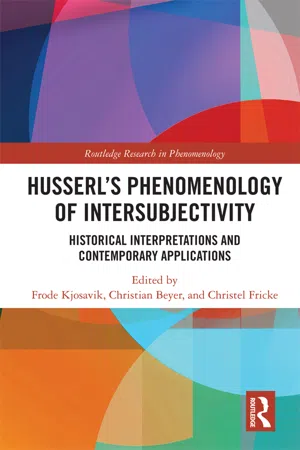
eBook - ePub
Husserl’s Phenomenology of Intersubjectivity
Historical Interpretations and Contemporary Applications
- 380 pages
- English
- ePUB (mobile friendly)
- Available on iOS & Android
eBook - ePub
Husserl’s Phenomenology of Intersubjectivity
Historical Interpretations and Contemporary Applications
About this book
Information
1 Husserl’s Phenomenology of Intersubjectivity
Introduction
As is well known, the only text concerning intersubjectivity that Husserl published during his lifetime was the French translation of his Fifth Cartesian Meditation (Husserl 1931). But in his manuscripts, the intersubjective aspect of virtually every phenomenological problem increasingly drew his attention. Nevertheless, there is no systematic text on intersubjectivity in his numerous manuscripts. Probably in the year 1914, or 1915 at the latest, Husserl wrote a group of 16 texts, together consisting of about 80 pages, which all deal with the problem of empathy with another ego. This collection constitutes the longest cohesive text on intersubjectivity that can be found in Husserl’s manuscripts. Husserl may have been motivated to conduct this research by his work in 1913 on the second section (“The Constitution of Animal Nature”) and the third section (“The Constitution of the World of the Mind”) of his Ideas II,1 and by his revision of the Sixth Logical Investigation during March and April 1914, in which he considers the speech-expression not only from the point of view of the speaker, as he had done in the first edition of this work, but also from the point of view of the addressee whose understanding of this expression is intended by the speaker (Hua XX/II, 33ff.). Husserl probably wrote this group of 16 texts also as a preparation for a contribution to a Festschrift dedicated to the seventieth anniversary of Rudolf Eucken (1846–1926).2 But this Festschrift, intended for publication during the war, never appeared.3 In the following sketches, I make use of several manuscripts from this group.
The first Husserlian manuscripts dealing with empathy (the fundamental notion in Husserl’s phenomenology of intersubjectivity) date from 1905 to 1907 and consist of passages excerpted from Theodor Lipps’s article “Further Thoughts Concerning Empathy” (Lipps 1905). In the years 1903–1904, Husserl was in correspondence with this famous Munich professor, who admired Husserl’s Logical Investigations and initiated the “Munich group of phenomenologists,” together with his pupil Johannes Daubert.
From 1905 onward, Husserl prepared various manuscripts on the problem of empathy. Until 1910, he was mainly concerned with our empathic access to sensations and fields of sensations in a foreign body. Husserl considered the apperception of a foreign body as a sensing body to be the fundamental stratum of empathy. Another source of inspiration for Husserl’s phenomenology of intersubjectivity was his discussions with Wilhelm Dilthey in Berlin in 1905.4 It was Dilthey’s idea of understanding the world of the mind through the concept of motivation instead of the physical concept of causality that led Husserl’s thinking in new directions, opening for him the way to a phenomenology of the comprehension of other minds. Husserl’s thought in this domain can be found in the posthumously published Ideas II (Hua IV).
A major development in Husserl’s phenomenology of intersubjectivity came with the extension of the phenomenological reduction from egological subjectivity to intersubjectivity in the lectures on “Fundamental Problems of Phenomenology” of 1910/11 (discussed in section 1c of the present text). From this time on, empathy and intersubjectivity became central issues in Husserl’s phenomenology, as is evidenced by the group of texts from 1914/15 mentioned above. The result of the increasing importance of intersubjectivity was that, in 1921 and 1922, Husserl conceived a new “great systematic work”5 on his monadological philosophy based on transcendental intersubjectivity (Hua XIV, 1–302), which was supposed to replace his never completed Ideas of 1913. In the following sketches, I shall quote abundantly from the manuscripts written in this context between 1921 and 1922.
What forced Husserl to replace his conception of a phenomenological philosophy in his never finished Ideas with another “great systematic work” were four fundamental and far-reaching insights that occurred in the development of his transcendental phenomenological philosophy: first, the insight that the formulation of the transcendental reduction in Ideas I was misleading (see below, section 1b); second, the extension of the transcendental reduction to intersubjectivity (see below, section 1c), an insight achieved already in the year 1910/11 but not taken into account in the conception of Ideas, which Husserl started to write only one year later, in 1912; third, the conception of a genetic phenomenology (phenomenology of genetic constitution), achieved between the years 1918 and 1921, which follows the phenomenology of static constitution; and fourth, the insight achieved during the same years (1918–1921), that, in phenomenological philosophy, reality—or existence—has priority over possibility (see below, section 28).
In his lectures “Introduction to Phenomenology” of 1926/27, Husserl takes a fundamental step that allows for the solution to the phenomenological problem of the resemblance between the appearance of my own living body and that of a foreign body. This step is decisive for the “association” of the perception of a foreign body with my own body and for transferring the sense of a living body to the foreign body. I refer to this text below in section 4 of this study. With this step, I dare say, Husserl’s phenomenology of intersubjectivity was established.
The following presentation provides only sketches of Husserl’s phenomenology of intersubjectivity, arranged in a manner as systematic as possible. A detailed study of Husserl’s thoughts on intersubjectivity would fill a whole great book.
I. Methodological and Other Preliminary Questions
Husserl calls his various phenomenological reductions “doors that open onto a certain field of phenomenological research.” Among these, the most important are the following four phenomenological reductions, all of them playing a role in Husserl’s phenomenology of intersubjectivity.
1. Four Kinds of Phenomenological Reduction
(a) The Eidetic Reduction to Essences, or to the (conditions of the) Possibility of Transcendental Subjectivity
For a long time, Husserl divided his phenomenological philosophy into a “first philosophy,” the eidetic science of essences or of the (conditions of the) possibility of transcendental subjectivity, and a “second philosophy,” a scientific metaphysics of realities (existences) through a phenomenological interpretation of the empirical sciences of facts.6 But by the year 1921 at the latest, Husserl realized that this division could not be maintained (cf. below, section 28). Nonetheless, phenomenology as an eidetic science of essences (eide in some Platonic sense) remained fundamental for him. The first section of Ideas I is entitled “Essence and Knowledge of Essence.”
In this work, Husserl writes that “[…] pure or transcendental phenomenology is to be established, not as a science of facts but as a science of essences (as ‘eidetic’ science). […] The corresponding reduction […] is the eidetic reduction” (Hua III/1, 6). The eidetic reduction is a reduction to essences. Knowledge of essences (a priori knowledge in Kantian terms) begins with individual, imagined examples. For example, beginning with an intentional act of perception, or, in geometry, with a geometrical (not real, never exact) triangle, the phenomenologist then imaginatively changes (varies) it and grasps intuitively its conditions of possibility. The conditions of the possibility of the act of perception are thereby grasped, while this individual example must remain what it is. These conditions of possibility constitute the essence of this individual—it’s “what it is.” The eidetic insight into these conditions is at the same time an intuitive insight into the impossibility of the opposite, an intuitive insight that it could not be otherwise. The eidetic insight is therefore an insight into a necessity. Husserl often uses the example of geometrical knowledge for eidetic or a priori knowledge, but he also stresses the differences between geometry and phenomenology. Husserl writes in Ideas I that, as in geometry, so too in eidetic phenomenology, to achieve the clarification we seek,
[w]e must exercise richly our phantasy in the free reshaping of what is given in phantasy. […] Thus, one can really say, if one likes paradoxical discourse and if one understands its ambiguous meaning, that “fiction” is the vital element of phenomenology, as it is of all eidetic sciences, and that fiction is the source from which the knowledge of “eternal truths” draws its nourishment.
(Hua III/1, 148)
In a footnote, Husserl adds that “[…]this sentence, taken as an [isolated] quotation, is especially suitable for ridiculing, from a naturalistic point of view, the eidetic mode of cognition” (Hua III/1, 148).
(b) The Transcendental Reduction to Egological Subjectivity and its Misleading Formulation in Ideas I
In a text probably written during the years 1921–1922,7 alluding to the second section of his Ideas I, “The Fundamental Consideration of Phenomenology,” Husserl writes:
The talk of “residuum [Residuum]” and of “exclusion [Ausschaltung] of the world” must be avoided.8 It easily misleads one to the opinion that the world falls out of the subject matter of phenomenology and that, instead of it, only the “subjective” acts, modes of appearances referring to the world, belong to its subject matter. In a certain, understandable manner, this is true. Yet, if universal, transcendental subjectivity is posited in legitimate validity, then within it lies, on the side of the correlate, the world itself as legitimately existing in accordance with all that it truly is. Thus, universal-transcendental research also contains within its subject matter the world itself in accordance with all its true being, consequently also all the sciences of the world, namely, as eidetic transcendental sciences, all a priori ontologies of the world, and, as “empirical” transcendental sciences, all empirical sciences of the factual world.
(Hua VIII, 432)
It is not only the expressions “residuum” and “exclusion” that may be misleading in Ideas I, but also what Husserl writes in §89 of this work. He says there that the real tree as a thing in nature is not the same thing as the tree as a noema, that is, the tree in the how (mode) of its givenness to me or to us. The tree in nature “may burn, may dissolve into its chemical elements. But the sense [Sinn, i.e., a part of the noema] of the tree cannot burn: it has no chemical elements, no forces, no real properties” (Hua III/1, 205). This formulation may lead to the false opinion that, according to Husserl, the noema is something like a mental image of a tree, a mental image which “cannot burn, has no chemical elements, no forces, no real properties.” However, in §43 of his Ideas I, Husserl says implicitly that the tree there in nature, given to us in perception, may burn, has chemical elements, etc.
(c) The Transcendental Reduction to Intersubjectivity
In the same text, written probably in the years 1921/22 and quoted above, Husserl writes:
Originally, I placed too much emphasis in this reduction [to pure consciousness] on the stream of consciousness, as if the reduction were a reduction to it. In any case, this was my first conception of the introduction of the phenomenological reduction in the year 1907 [in the “Five Lectures” (Hua II)]. There is a fundamental error in this conception, but one that is not easily rendered transparent. This error is abolished with the “extension” of the phenomenological reduction to monadic intersubjectivity in the lectures of autumn 1910/11.9 Already at that time, I pointed out that it could seem that the reduction to the “stream of consciousness” results in a new solipsism. However, the difficulty is solved if we make it clear that the reduction leads not only to the actual stream of consciousness […]. The further elucidation rests upon the demonstration of the double reduction, to which all representifications [Vergegenwärtigungen]10 can be submitted, i.e., the reduction of the representifications as present [gegenwärtig] experiences, and the reduction “in” the representifications.
(Hua VIII, 433f.)
Instead of speaking of a “double reduction,” it seems to me better to say that in those lectures Husserl transformed the quasi-solipsistic phenomenological reduction by expanding it to the transcendental intersubjective field. This expansion is a reflexive explication of the representifying acts of empathy of the phenomenologizing ego. In fact, “double reduction” cannot mean two reductions, it means two steps in one transcendental reduction. In 1921, when Husserl began to prepare his never written “great systematic work,” he reread and annotated the text of these lectures from 1910/11. This shows that, at that time, he planned to base this philosophy not only on a transcendental ego or a singular consciousness but on transcendental intersubjectivity (cf. Hua XIV, 3n1): By my representifying act of remembering, my own past stream of consciousness is included in the transcendental field. Similarly, by my representifying act of empathy, intentional acts of other consciousnesses with their objective intentional correlates are included in this field. The transcendental sphere is no longer an “immanent” sphere in the sense of being the sphere of all that appears to me,11 since other egos in their spheres have “things” existing through appearances for them.
Whereas Kant’s “transzendentales Ich” does not allow for a plurality of Is, Husserl’s transcendental or absolute subjectivity is, like Leibniz’ universe of monads, an intentionally unified plurality with God, the “monad of monads” (the unity of unities), as its highest principle. The other ordinary egos are intentionally included in the transcendental field as “transcendences” by my acts of empathy and by my social acts. God is included in this transcendental field on two grounds: first, as a condition of the possibility of the subjective constitution of the cosmic order of a world out of the factual and for us “accidental” hyletic data (Husserl speaks of God as a postulate of reason);12 and second, as the telos of the transcendental-genetic development of human rationality and love.
Husserl’s “double reduction” consists, first, in the transcendental reduction to an abstract, solipsistic, Cartesian ego and then, as a second step, in extending the transcendental field by including other subjects in it. These other subjects are the intentional correlates of the empathic and social acts of my own concrete ego. As these other subjects are representified in my concrete subjectivity as my co-subjects (or co-constituting subjects), they are representified as constituting together with me our common intersubjective world...
Table of contents
- Cover
- Half Title
- Series
- Title
- Copyright
- Contents
- Preface
- Introduction
- 1 Husserl’s Phenomenology of Intersubjectivity
- Part I Intersubjectivity—Meaning and Methodology
- 2 Husserl on (Intersubjective) Constitution
- 3 Intersubjectivity: In Virtue of Noema, Horizon, and Life-World
- 4 On Husserl’s Genetic Method of Constitutive Deconstruction and Its Application in Acts of Modified Empathy into Children’s Minds
- Part II Particular Others and Open Intersubjectivity
- 5 On Knowing the Other’s Emotions
- 6 What Is Empathy?
- 7 Anonymity of the ‘Anyone.’ The Associative Depths of Open Intersubjectivity
- Part III Communication and Community
- 8 Intersubjectivity, Phenomenology, and Quine’s Philosophy of Language
- 9 From Empathy to Sympathy. On the Importance of Love in the Experience of the Other
- 10 Intersubjectivity and Embodiment
- 11 Husserl on the Common Mind
- Part IV Normality and Objectivity—The Life-World, the Sciences, and Beyond
- 12 Constructivism in Epistemology—On the Constitution of Standards of Normality
- 13 On the Origins of Scientific Objectivity
- 14 Husserl on Intersubjectivity and the Status of Scientific Objectivity
- 15 Models, Science, and Intersubjectivity
- Contributors
- Index
Trusted by 375,005 students
Access to over 1.5 million titles for a fair monthly price.
Study more efficiently using our study tools.
Frequently asked questions
Yes, you can cancel anytime from the Subscription tab in your account settings on the Perlego website. Your subscription will stay active until the end of your current billing period. Learn how to cancel your subscription
No, books cannot be downloaded as external files, such as PDFs, for use outside of Perlego. However, you can download books within the Perlego app for offline reading on mobile or tablet. Learn how to download books offline
Perlego offers two plans: Essential and Complete
- Essential is ideal for learners and professionals who enjoy exploring a wide range of subjects. Access the Essential Library with 800,000+ trusted titles and best-sellers across business, personal growth, and the humanities. Includes unlimited reading time and Standard Read Aloud voice.
- Complete: Perfect for advanced learners and researchers needing full, unrestricted access. Unlock 1.5M+ books across hundreds of subjects, including academic and specialized titles. The Complete Plan also includes advanced features like Premium Read Aloud and Research Assistant.
We are an online textbook subscription service, where you can get access to an entire online library for less than the price of a single book per month. With over 1.5 million books across 990+ topics, we’ve got you covered! Learn about our mission
Look out for the read-aloud symbol on your next book to see if you can listen to it. The read-aloud tool reads text aloud for you, highlighting the text as it is being read. You can pause it, speed it up and slow it down. Learn more about Read Aloud
Yes! You can use the Perlego app on both iOS and Android devices to read anytime, anywhere — even offline. Perfect for commutes or when you’re on the go.
Please note we cannot support devices running on iOS 13 and Android 7 or earlier. Learn more about using the app
Please note we cannot support devices running on iOS 13 and Android 7 or earlier. Learn more about using the app
Yes, you can access Husserl’s Phenomenology of Intersubjectivity by Frode Kjosavik, Christian Beyer, Christel Fricke, Frode Kjosavik,Christian Beyer,Christel Fricke in PDF and/or ePUB format, as well as other popular books in Philosophy & Phenomenology in Philosophy. We have over 1.5 million books available in our catalogue for you to explore.