eBook - ePub
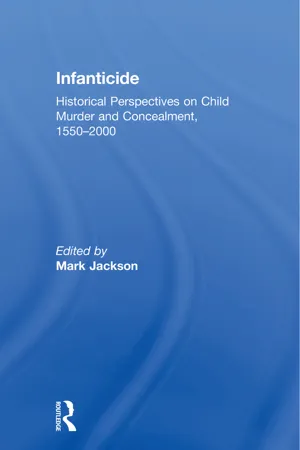
Infanticide
Historical Perspectives on Child Murder and Concealment, 1550–2000
- 308 pages
- English
- ePUB (mobile friendly)
- Available on iOS & Android
eBook - ePub
About this book
The history of infanticide from the 16th through to the late 20th century is the subject of this volume. Collectively, the contributions explore how the concealment of pregnancy, birth and death, particularly by unmarried women, became a central preoccupation of witnesses, doctors, courts and legislatures concerned with suspicious infant deaths. While the emphasis is upon Britain, original and stimulating accounts of infanticide accusations and trials in France, Germany, and South Africa provide compelling comparative analyses. Presenting a series of case studies, successive chapters expose striking continuities, across both time and space, in the social history of infanticide. Clearly written, focusing on a range of original cases and documents, and addressing critical historiographical questions, Infanticide will be invaluable to historians and students researching the social history of medicine, law, crime, and gender. In addition, it will appeal to lawyers, doctors, and others interested in understanding the historical roots of modern debates about infanticide.
CHAPTER ONE
The trial of Harriet Vooght: continuity and change in the history of infanticide
Mark Jackson
At the Devon Lent assize session held at Exeter castle in March 1865, a twenty-one-year-old unmarried domestic servant, Harriet Vooght, was charged with the murder of her new-born child. The judge, in his charge to the grand jury, accepted that 'there were several circumstances tending to show that the death of the child had not been attended with any violence on the part of the mother' but, pointing to medical evidence that 'a piece of tape had been tied around the neck of the child', he directed the jury to 'find a bill for wilful murder and thus place her on her trial for the capital offence'.1 At the trial, it appeared that on Monday 9 January, Harriet, who had been a nurse in the service of Mr Martin Strickland at Starcross near Exeter, had become ill and retired to bed early. Although her condition seemed to improve, on the Wednesday a surgeon had been called to the house to examine her. Suspicious that she had either given birth to a child or had a miscarriage, he searched the room and found a dead female child in a box. On examining the child's body, the surgeon concluded that death had been caused by strangulation but was not prepared to confirm that the child had 'ever had a separate existence from the mother'. In her defence, it was established that Harriet 'had always borne a kind and humane character' and that she had 'made clothes for the child', thereby dispelling prosecution claims that she had harboured any intent to kill it. On the balance of the evidence, the trial jury acquitted her of murder but found her guilty of concealment of birth. Harriet was sentenced to fifteen months' imprisonment with hard labour.2
Harriet Vooght was not the only woman to be accused of concealing or murdering her new-born child in Devon that year. At the same assize session, Margaret Enwright was also accused of murder when, after persistently deflecting the suspicions of her fellow servants and her mistress that she had recently given birth, a new-born child was found alive in a locked bag in her room. The child died a short time later and, in the light of medical evidence suggesting that the child's death might have been caused by an act of violence, Margaret was committed to gaol on 1 March 1865 to await trial for murder. At the assizes, however, the indictment was rejected by the grand jury and Margaret was released.3 In a similar vein, Emilie Raw, a twenty-five-year-old servant from Tormoham, was committed to gaol on 1 December 1864, charged with 'endeavouring to conceal the birth of her child'. She pleaded guilty and was sentenced to three weeks' imprisonment with hard labour.4
Significantly, this batch of mid-Victorian trials for concealment and child murder bears striking parallels to other English cases both from the early modern period and from the twentieth century. Throughout the seventeenth and eighteenth centuries, for example, unmarried women (often domestic servants) who concealed their pregnancies and gave birth to illegitimate children alone were often suspected of murder if the children were subsequently found dead. As in the cases of Harriet Vooght, Margaret Enwright, Emilie Raw, and many other women accused of concealment and murder in England during the nineteenth century,5 early modern trials routinely focused on the marital status of the defendant, on the evidential weight of concealment, on the preparation of child clothes as a defence against a murder charge, on the testimony of doctors as to the viability of the child and the mental and physical state of the mother, and on the character and disposition of the accused woman.6
As many recent cases in England and North America have shown, the main evidential issues considered at the trial of Harriet Vooght have also been reproduced in cases of suspected infanticide in the late twentieth and early twenty-first centuries. The most striking modern case, and certainly the case that captured the greatest public and media attention on both sides of the Atlantic, was perhaps that of Caroline Beale, a young unmarried Englishwoman who was discovered in September 1994 leaving America with the body of a dead child hidden under her coat. As the investigation into, and the furore over, the death of Caroline's child (and into the recent deaths of other new-born children) demonstrate, modern judges and juries remain preoccupied with the marital status of the mother, with concealment of pregnancy and birth, with the mother's moral character, and with medical and psychological attempts to reveal her physical and mental state during pregnancy and at the moment of birth.7
Strikingly, apparent historical continuities in cases of suspected child murder across many centuries have not been confined to events in the courtroom. In a wider context, many of the social, legal, political and cultural concerns related to the supposed murder of new-born children also demonstrate remarkable historical constancy. For example, just as William Hunter in the late eighteenth century denounced the fathers of supposedly murdered illegitimate children as the real culprits in these cases for having seduced and deceived credulous young women,8 so too mid-nineteenth-century commentators regarded women accused of concealing and murdering their new-born children as the victims of men who had seduced and ultimately betrayed them. Such attitudes to the criminal responsibility of men and to the vulnerability of women, which found expression in much contemporary literature, were partly responsible for the persistently high acquittal rates for infanticide throughout the eighteenth and nineteenth centuries.9
At another level, eighteenth-century anxieties about the increasing leniency of juries and about the extent to which the law was no longer acting as a deterrent in these cases were reproduced in the mid-nineteenth century. Thus, legal debates at the time of the Royal Commission on Capital Punishment in the 1860s about the need to revise the laws relating to infanticide clearly echoed many of the arguments about repealing the law nearly one hundred years earlier in the 1770s, when proponents of reform had not only contended that the heavy burden of guilt in the case of unmarried women accused of murder was out of line with public sympathy for such women but also warned that a number of legal loopholes were being exploited by the defence in order to encourage juries to acquit. In both periods, the overwhelming fear expressed by the judiciary, and ultimately by the legislature, was that the sovereignty of the law was being undermined.10
Within a purely English context, the nature of the evidence considered in court, attitudes to women accused of concealing and murdering their children, and concerns about the authority of the law show remarkable parallels or continuities from the early modern period through to the late twentieth century. However, within the history of infanticide more generally, there are equally conspicuous parallels across space. As a number of detailed historical studies have shown, the central features of English trials for infanticide have been mirrored in cases from many other geographical settings. Thus, the prosecutions of women for killing their new-born children in France, Germany, North America, Ireland and Poland have shared significant features with cases from England throughout the early modern and modern periods. Whenever and wherever suspicious child deaths have been investigated and evidence assessed, the narratives of birth and death devised by suspects, communities, courts and legislatures have almost uniformly given privileged treatment to the marital status and sexual behaviour of the mother, while giving particular weight to evidence of concealment of the gestation, birth and death of the child.11 Indeed, persistent and widespread preoccupations with the evidential weight of concealment by unmarried mothers, and with the social and legal implications of secrecy, constitute one of the most remarkable features of the history of infanticide.
There are a number of ways in which such evident historical and geographical continuities can be explained. At one level, parallels between early modern cases and cases from the nineteenth century, such as that of Harriet Vooght, can be traced to continuities in the legal framework within which women were prosecuted. Throughout the seventeenth and eighteenth centuries, single women were tried under the terms of a statute of 1624 in which concealment of death was taken as evidence of murder.12 The construction of this statute, enacted during a period of strident concerns about the rising level of illegitimacy and its impact on the poor rates, was firmly shaped by beliefs that single women (rather than married women) were concealing their pregnancies and murdering their children in order to evade the shame and punishment associated with mothering an illegitimate child. For much of the seventeenth century, effective implementation of the 1624 statute resulted in the conviction and hanging of many unmarried mothers.13
By the middle decades of the eighteenth century, shifting attitudes to the certainty of the medical evidence, reappraisals of the character of accused women and the emergence of new rules of evidence combined to undermine support for the 1624 statute. In the absence of an alternative verdict, the majority of single women were acquitted of murder. As a result, during the latter half of the eighteenth century, growing concern at the manner in which the terms of the statute were being ignored by juries led several commentators and members of parliament to push for reform. In particular proponents of reform argued that the more certain application of a suitable (that is, lesser) punishment would more effectively discourage women from concealing and murdering their illegitimate children.14
Efforts to repeal the 1624 statute in the 1770s ultimately floundered, largely as the result of persistent judicial opposition to reforming the criminal law. However, in 1803 the statute was repealed as part of sweeping conservative reforms introduced by Lord Ellenborough. The 1803 statute returned the trials of unmarried women to common-law rules of evidence, in which the prosecution once again had to establish that a dead child had been born alive rather than being able to rely merely on evidence of concealment to prove murder. However, in cases where the murder of an illegitimate child was not proven, the statute gave juries the option of returning an alternative verdict of 'concealment of birth', for which an unmarried woman could be sentenced to a maximum of two years in prison.15
Significantly, while the 1803 statute can be construed as a moment of change when early modern preoccupations with concealment as evidence of murder were clearly weakened, Lord Ellenborough's Act nevertheless embodied many earlier presumptions about single women, illegitimacy and concealment. These fixations - with concealment in particular - persisted in subsequent amendments to the law. In the 1828 Offences against the Person Act, disposing of the body of a dead child in order to conceal its birth, even if the child was still-born, became a separate offence for which both unmarried and married women could be imprisoned for two years, with or without hard labour.16 In 1861, in a clause that remains in force at the time of writing, the offence of concealment was extended further to include men as well as women.17 Although these amendments to the law can be seen as indicative of substantial shifts in attitudes towards the responsibility of men and women in these cases and towards the legitimacy of censuring the behaviour of married as well as unmarried mothers, they also mark striking continuities in legal presumptions about women who kept their pregnancies secret and concealed the births and deaths of their children.
Within the present context, it is important to recognize that the legal framework within which Harriet Vooght and many other women were tried in the nineteenth century was in many ways a powerful legacy of the 1624 statute, in which early modern anxieties about the sexual behaviour of single women, illegitimacy and concealment had been crystallized in legislation. While the impact of enduring legal formulations of new-born child murder partly explains evident similarities between early modern and modern trials for infanticide, it may also help to explain geographical parallels. Early modern and modern English legislators were acutely aware of legislation being framed elsewhere in Europe and supposedly borrowed from other jurisdictions.18 In addition, settlers in America in the seventeenth century clearly carried with them both general Puritan concerns about sexual behaviour, illegitimacy and the morality of concealment, as well as a mo...
Table of contents
- Cover
- Half Title
- Title
- Copyright
- Contents
- List of figures and tables
- Acknowledgements
- Notes on the contributors
- Abbreviations
- 1 The trial of Harriet Vooght: continuity and change in the history of infanticide
- 2 Accusations of infanticide on the eve of the French Wars of Religion
- 3 Infanticide in early modern England: the Court of Great Sessions at Chester, 1650-1800
- 4 'The unfortunate maid exemplified': Elizabeth Canning and representations of infanticide in eighteenth-century England
- 5 Bodies of evidence, states of mind: infanticide, emotion and sensibility in eighteenth-century England
- 6 Infanticide and the erotic plot: a feminist reading of eighteenth-century crime
- 7 Infanticide, slavery and the politics of reproduction at Cape Colony, South Africa, in the 1820s
- 8 The murder of Thomas Sandles: meanings of a mid-nineteenth-century infanticide
- 9 Getting away with murder? Puerperal insanity, infanticide and the defence plea
- 10 Images and impulses: representations of puerperal insanity and infanticide in late Victorian England
- 11 The boundaries of Her Majesty's Pleasure: discharging child-murderers from Broadmoor and Perth Criminal Lunatic Department, c.1860-1920
- 12 Legislating for human nature: legal responses to infanticide, 1860-1938
- 13 'Nothing in between': modern cases of infanticide
- Index
Trusted by 375,005 students
Access to over 1.5 million titles for a fair monthly price.
Study more efficiently using our study tools.
Frequently asked questions
Yes, you can cancel anytime from the Subscription tab in your account settings on the Perlego website. Your subscription will stay active until the end of your current billing period. Learn how to cancel your subscription
No, books cannot be downloaded as external files, such as PDFs, for use outside of Perlego. However, you can download books within the Perlego app for offline reading on mobile or tablet. Learn how to download books offline
Perlego offers two plans: Essential and Complete
- Essential is ideal for learners and professionals who enjoy exploring a wide range of subjects. Access the Essential Library with 800,000+ trusted titles and best-sellers across business, personal growth, and the humanities. Includes unlimited reading time and Standard Read Aloud voice.
- Complete: Perfect for advanced learners and researchers needing full, unrestricted access. Unlock 1.5M+ books across hundreds of subjects, including academic and specialized titles. The Complete Plan also includes advanced features like Premium Read Aloud and Research Assistant.
We are an online textbook subscription service, where you can get access to an entire online library for less than the price of a single book per month. With over 1.5 million books across 990+ topics, we’ve got you covered! Learn about our mission
Look out for the read-aloud symbol on your next book to see if you can listen to it. The read-aloud tool reads text aloud for you, highlighting the text as it is being read. You can pause it, speed it up and slow it down. Learn more about Read Aloud
Yes! You can use the Perlego app on both iOS and Android devices to read anytime, anywhere — even offline. Perfect for commutes or when you’re on the go.
Please note we cannot support devices running on iOS 13 and Android 7 or earlier. Learn more about using the app
Please note we cannot support devices running on iOS 13 and Android 7 or earlier. Learn more about using the app
Yes, you can access Infanticide by Mark Jackson in PDF and/or ePUB format, as well as other popular books in History & World History. We have over 1.5 million books available in our catalogue for you to explore.