This book advocates for a new analytical framework that extends our understanding of multimodal meaning-making in the novel. Integrating theoretical traditions from stylistics and the influential social semiotic approach to multimodal communication developed by Kress and van Leeuwen, Nørgaard applies this method of analysis in order to build on existing stylistic practices that look at linguistic features in the novel to encompass other semiotic resources found in the form, such as typography, layout, images, paper and book-cover design. The volume grounds the discussion with supporting examples from novels that feature experimentation with multiple semiotic resources as well as more traditional novels, furthering the argument that all novels are inherently multimodal. Offering new insights and tools for unpacking multimodal meaning-making in this critical literary genre, this volume is an indispensable resource for graduate students and researchers in multimodality, stylistics and literary studies.
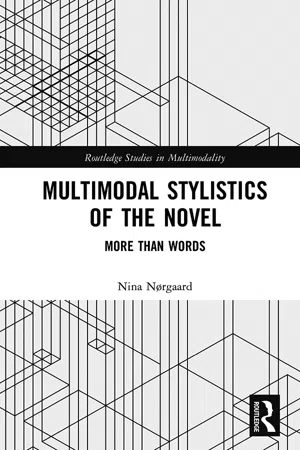
- 340 pages
- English
- ePUB (mobile friendly)
- Available on iOS & Android
eBook - ePub
About this book
Information
1 Introduction
1.1 Aims and Motivations
For many years, stylistics has been a well-established field of research for scholars and students interested in the ways in which meaning is created through language in literature and other types of text. Drawing on linguists’ insights on language and communication as well as employing their concepts and methodologies for analysis and interpretation, stylisticians explore what is communicated linguistically by a given text, and, even more importantly, how it is communicated. Accordingly, stylistics is characterised by the rigour and precision which are distinctive of linguistics and which ensure that stylistic analysis is anchored solidly and systematically in the actual wording of the text.
A metaphor that is often used by stylisticians about their academic field is that of the stylistics toolkit, or toolbox, which consists of linguistic terms, concepts and methodologies ready to be employed for stylistic analysis. Over the years, developments in modern linguistics have inspired and informed a number of specialised sub-branches in stylistics such as formalist stylistics, functionalist stylistics, pragmatic stylistics, historical stylistics and corpus stylistics. Other branches such as feminist stylistics and critical stylistics devote their attention more to contextual matters such as the linguistic manifestation of gender relations, power structures and ideology in text, while others again (i.e. cognitive stylistics/cognitive poetics) focus on the cognitive processing of the text by the reader (cf. Nørgaard, Busse & Montoro 2010: 1–49). Along with the development of new linguistic paradigms and the subsequent growth of new branches in stylistics, new descriptive and analytical tools have been added to the stylistics toolkit.
Since the different branches primarily find their methodology in linguistics, a common denominator for most stylistics output so far has naturally been a tendency to focus monomodally on the wording1 of the data put up for analysis. However, recent years have seen a growing interest amongst stylisticians in analysing distinctively multimodal texts such as film, television programmes, drama performance, advertising and music (cf. e.g. McIntyre 2008; Bednarek 2011; Morini 2013). Furthermore, and of central importance to the present study, changing technologies in text processing, printing and publishing have led to an increased output of literature – and novels in particular – which in addition to wording makes use of modes such as (special) typography, layout, colour, images and other graphic elements for its meaning-making. If stylisticians wish to include in their analysis the meanings that are created by all these semiotic modes and their interaction, and to be as systematic and consistent in handling these modes as they are in their analysis of wording, they need to expand their toolkit with appropriate tools for the task.
It is the aim of the present study to develop and explore a framework for stylistic analysis of the novel that incorporates multimodal semiosis. To this end, new tools and methodologies are adopted from social semiotic multimodal theory as introduced in Multimodal Discourse (Kress & van Leeuwen 2001) and Introducing Social Semiotics (van Leeuwen 2005a), and as treated in depth – mode by mode – in e.g. Reading Images (Kress & van Leeuwen 1996), “Colour as a semiotic mode” (Kress & van Leeuwen 2002) and “Towards a semiotics of typography” (van Leeuwen 2006). It is common to these and to other key works in the field such as O’Toole’s The Language of Displayed Art (1994), O’Halloran’s Mathematical Discourse (2005) and Baldry and Thibault’s Multimodal Transcription and Text Analysis (2006) that they all aim to develop a consistent systematic framework for analysing multimodal texts which is (ideally) as “grammatical” in outlook as are linguistic approaches to language. This is reflected in the subtitle of Kress and van Leeuwen’s pioneering book, Reading Images: The Grammar of Visual Design (1996), just as the title of van Leeuwen’s more recent book, The Language of Colour (2011), points to affiliations with the study of language. Because of its grammatical orientation, the social semiotic approach to multimodality would seem particularly appealing to stylisticians who wish to be as rigorous and systematic in their analysis of modes other than wording as they are in their treatment of wording. Furthermore, the social semiotic approach to multimodality is inspired by and builds on a specific branch of linguistics, Halliday’s Systemic Functional Linguistics (cf. e.g. Halliday 1994), which has had a substantial impact on much work in stylistics. As will be argued in the present book, this in effect means that the combination of functionalist (Hallidayan) stylistics with the social semiotic approach to multimodality will result in a stylistics sub-branch, a (social semiotic) multimodal stylistics, which can handle the meaning-making of wording, typography, colour, layout, etc. – and their multimodal interaction – by means of a relatively consistent terminology and methodology. The affinity between Halliday’s theory of language and the social semiotic approach to multimodality will be treated in more detail in Chapter 2.
The object of my analysis is the novel. Previous work in multimodal stylistics (cf. e.g. Gibbons 2012; Luke 2013) has tended to centre on explicitly multimodal novels – especially those in which the use of different modes is envisioned as an integrated part of the literary narrative which would be changed considerably, and in some cases simply would not work, if the images, colour, special typography, layout, etc. were removed (cf. definitions and discussions of “multimodal novels” in Chapter 2). In addition to such novels, I am equally interested in the multimodal semiosis involved in more traditional “illustrated” novels, exemplified by the special illustrated edition of Dan Brown’s The Da Vinci Code (2004), as well as in novels that many readers would probably tend not to think of as multimodal at all – i.e. visually conventional novels which consist of a verbal narrative set in “standard” typography, colour and layout, and which make no use of images and other graphic elements for their meaning-making. According to Kress and van Leeuwen (2001), all types of communication are multimodal since they invariably involve more than one semiotic mode. This includes printed verbal text, which always depends on the modes of wording, typography, layout and colour for its realisation and should ideally be analysed accordingly. In the present study, I will pursue this line of thought by exploring the applicability of a multimodal stylistics framework to the analysis not merely of explicitly multimodal novels but also of (visually) more conventional novels, which less obviously invite such an approach. My categorisation of novels will be explained and discussed in Section 2.5.1.
One of the effects of adding multimodal tools to the stylistics toolkit is the fact that it enables (and invites) stylisticians to extend their object of analysis and hence the concept of “the text” to comprise not only the different modes that are involved in the literary narrative from the first word to the final full stop, but also elements such as the book cover, the paper, the quality of the printing and other aspects of the materiality of the novel. An extension like this is, of course, not without challenges, and will be discussed in Chapter 2.
It should be mentioned that the different aspects of the novel I am interested in here are also explored by various scholars in e.g. literary studies and book history. A few well-known examples are McGann’s The Textual Condition (1991), Greetham’s Textual Scholarship (1992), Genettes’s Paratexts (1997 [1987]), Bray, Handley and Henry’s Ma(r)king the Text (2000) and Tanselle’s Bibliographical Analysis (2009), whose value I fully acknowledge and respect. However, because of the stylistics auspices of the present study and my wish to explore the possibility of extending the practice in stylistics of anchoring analysis solidly in the lexis and grammar of the text to other semiotic modes and their interaction – and to do so with a systematic and (relatively) consistent methodology – such work will only play a minor role here.
The research presented in this book first and foremost endeavours to examine and explain multimodal meaning-making in the novel and to extend the traditional field of stylistics to include meanings beyond those realised by the mode of wording. At the same time, however, and in line with other work in stylistics (cf. Wales 1989: 438; Jeffries & McIntyre 2010: 2), the specific object of analysis conversely reflects light on the theory and methodology employed. Examples of this are, for instance, seen in Chapters 4 and 8 on typography and the materiality of the novel. Chapter 4 thus discusses van Leeuwen’s distinctive features (2006) and semiotic principles (2005b) for the description and analysis of typography and suggests adjustments in the light of the literary data analysed, while Chapter 8 on the materiality of the novel presents data that have not yet been examined from a (social semiotic) multimodal perspective and consequently necessitate methodological development.
The book has been some years in the making. It consequently builds on, combines and further develops ideas presented in earlier articles and book chapters (e.g. Nørgaard 2009 on typography; 2010a on modality; 2014 on multimodal stylistics; 2015 on paper) as well as material and ideas that have not been published before. Whenever I rely closely on wording and ideas presented in my previous work, it will be indicated in the text or by a note.
1.2 Structure of the Book
The book is structured in nine chapters. Following the brief setting of the scene of the present introductory chapter, Chapter 2 provides a more substantial – yet still general – presentation of the theory and methodology that inform the book, a review of work that has already been done in the field, a delimitation of the text types put up for analysis and motivations for the methodological choices on which the book is based. Chapters 3 to 6 respectively centre on a different semiotic mode: wording, typography, layout, images and other graphic elements. In each of these chapters, the relevant terms, concepts and methodology that were introduced in Chapter 2 are presented and discussed in greater detail and are subsequently applied to the analysis of different literary examples. With its focus on wording, what is presented in Chapter 3 is relatively conventional in a stylistics context. The aim of the chapter is to present a traditional functionalist stylistic analysis of wording in a novel, since social semiotic multimodal stylistics springs from and builds on this particular branch of stylistics. Chapters 4 to 6, in contrast, deal with modes that are new in stylistics. Consequently, these chapters are more exploratory than Chapter 3. The analytical focus of Chapter 7 is the book cover. This aspect of the novel is usually neglected in stylistics as well as in more traditional literary criticism, yet is clearly also meaning-making when readers pick up the novel and start reading it. Chapter 8 explores the semiotics of the physical form and the materiality of the novel. This is by far the most exploratory chapter of the study since as yet only few tools applying to this aspect of the novel have been developed in multimodal semiotics. The chapter points to aspects of the novel’s materiality and physical form that are clearly meaning-making in their own right as well as in multimodal interaction with the rest of the novel – aspects which may well be included in the stylistic analysis of the novel if analysts want it to be truly multimodal. The concluding chapter sums up the findings of the study, reviews its main theoretical and methodological contributions to the fields of stylistics and social semiotic multimodal theory and considers possible directions for further research in the field. Chapter 9 is followed by two appendices. Appendix A presents colour versions of selected images put up for analysis and displayed in black-and-white in Chapters 4–8. Appendix B provides an overview of the multimodal stylistics toolkit that is proposed in the book.
Note
1 As explained more extensively in Chapter 3, I define the mode of “wording” as the lexis and grammar, or “lexico-grammar”, of the text (cf. Halliday 1994: xiv). “Language”, in contrast, is used as a more general term, referring to written and/or spoken language, thus covering the modes of wording, typography, sound, etc. Since the term “language” is used extensively in linguistics, stylistics and other contexts, I shall primarily use the term “wording” when there is a need to distinguish wording from e.g. typography and layout.
2 Multimodal Stylistics
What, Why and How?
2.1 Preliminaries
This chapter establishes the general theoretical and methodological framework for the rest of the book. It first surveys the field of stylistics as it has developed into different branches over time, including prominent scholars and work in the field as well as core concepts and ideas. This is followed by a presentation of social semiotic multimodal theory, focusing on work by its main proponents, core concepts and ideas as well as certain points of criticism of the field as it stands. In this section, the concepts of mode and multimodality will be defined and discussed. Having thus introduced the two most central disciplines involved in the study, the chapter moves on to synthesising the two into what is the main contribution of this book, i.e. the development of a framework for a social semiotic multimodal stylistics. This section presents motivations for developing this new branch of stylistics, challenges and criticism of the field, and a survey of the work that has been done in multimodal stylistics so far and of work that belongs to different theoretical paradigms yet shares its object of analysis (i.e. multimodal aspects of the novel) with the present study. The last section presents further methodological considerations, including the categorisation of novels in terms of their multimodality, reflections about the extended notion of the “text” that is entailed by the study, the selection of analytical material and issues pertaining to the question of how to present the multimodal material under scrutiny.
2.2 Stylistics
The work presented in this study is first and foremost conceived of as a contribution to stylistics. In the following, I shall therefore provide the necessary contextualisation for the development of a new branch within this field of research. To this end, I will give an overview of relevant sub-branches in stylistics and their respective foci as well as of the foundational ideas of stylistics more generally. Doing so allows me to position my own work in terms of the concerns I share with other stylisticians and identify the ways in which I offer something different. I shall focus on the branches that are most pertinent to the development of a multimodal stylistics. For a more comprehensive overview of and introduction to a wider range of sub-branches in stylistics, see Nørgaard, Busse and Montoro (2010: 1–49).
2.2.1 Formalist Stylistics
The interest in style, inherited by all branches of modern stylistics, arguably dates back to the concern with style in oral performance that is characteristic of work following the tradition of Aristotle’s Rhetoric. Another, more pivotal source of inspiration is the work done on literary style by proponents of Russian Formalism from the 1910s to the 1930s, which was taken up in the 1960s and early 1970s by stylisticians in the West, especially in Britain and the US. As a reaction against what they saw as the vagueness of contemporary literary criticism, Russian and later also Czech formalists such as Roman Jakobson, Viktor Shklovsky and Jan Mukařovský wanted to make the study of literature more “scientific” and objective by focusing on the observable linguist...
Table of contents
- Cover
- Half Title
- Title Page
- Copyright Page
- Dedication
- Permissions
- Preface
- Table of Contents
- 1. Introduction
- 2. Multimodal Stylistics What, Why and How?
- 3. Wording
- 4. Typography
- 5. Layout
- 6. Photographs, Drawings and Other Graphic Elements
- 7. Book-Cover Design
- 8. The Materiality and Physical Form of the Novel
- 9. Conclusion
- Appendix A Colour Images
- Appendix B The Multimodal Stylistics Toolkit
- References
- Index
Trusted by 375,005 students
Access to over 1.5 million titles for a fair monthly price.
Study more efficiently using our study tools.
Frequently asked questions
Yes, you can cancel anytime from the Subscription tab in your account settings on the Perlego website. Your subscription will stay active until the end of your current billing period. Learn how to cancel your subscription
No, books cannot be downloaded as external files, such as PDFs, for use outside of Perlego. However, you can download books within the Perlego app for offline reading on mobile or tablet. Learn how to download books offline
Perlego offers two plans: Essential and Complete
- Essential is ideal for learners and professionals who enjoy exploring a wide range of subjects. Access the Essential Library with 800,000+ trusted titles and best-sellers across business, personal growth, and the humanities. Includes unlimited reading time and Standard Read Aloud voice.
- Complete: Perfect for advanced learners and researchers needing full, unrestricted access. Unlock 1.5M+ books across hundreds of subjects, including academic and specialized titles. The Complete Plan also includes advanced features like Premium Read Aloud and Research Assistant.
We are an online textbook subscription service, where you can get access to an entire online library for less than the price of a single book per month. With over 1.5 million books across 990+ topics, we’ve got you covered! Learn about our mission
Look out for the read-aloud symbol on your next book to see if you can listen to it. The read-aloud tool reads text aloud for you, highlighting the text as it is being read. You can pause it, speed it up and slow it down. Learn more about Read Aloud
Yes! You can use the Perlego app on both iOS and Android devices to read anytime, anywhere — even offline. Perfect for commutes or when you’re on the go.
Please note we cannot support devices running on iOS 13 and Android 7 or earlier. Learn more about using the app
Please note we cannot support devices running on iOS 13 and Android 7 or earlier. Learn more about using the app
Yes, you can access Multimodal Stylistics of the Novel by Nina Nørgaard in PDF and/or ePUB format, as well as other popular books in Languages & Linguistics & Linguistics. We have over 1.5 million books available in our catalogue for you to explore.