- 240 pages
- English
- ePUB (mobile friendly)
- Available on iOS & Android
eBook - ePub
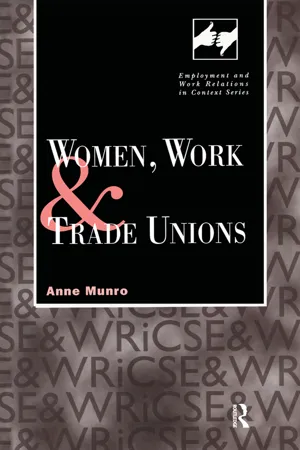
Women, Work and Trade Unions
About this book
This study focuses on working-class women, catering and cleaning workers, and the way their interests were presented in trade unions. It argues that there is an institutional bias within trade unions which precludes the full representation of women's interests. Based on empirical research into two trade unions in the National Health Service, the book stresses the importance of how women's work is structured, in order to investigate the role of trade unions in challenging or reproducing inequalities.
Part One
The Context
1 Women in Trade Unions
In this chapter, the literature which directly addresses the issues of women's roles in trade unions is reviewed. Much of the literature from the early 1980s provides valuable insights into aspects of this area, although it tends to lack a clear theoretical framework. The desire to conclude optimistically about the future of trade unions leads many writers to ignore the evidence of their own research (Aldred 1981, Beale 1982). Recently a number of writers have engaged in a more thorough analysis (Rees 1990 and 1992, Cunnison and Stageman 1993, Briskin and McDermott 1993, Lawrence 1994, Colgan and Ledwith 1996, Bradley 1999).
For the purpose of analysis it is necessary to distinguish between the reasons why people do or do not join trade unions, and secondly why they are either active or inactive within the union. The first set of issues will be addressed in terms of organization and recruitment, while the second set of issues will be addressed in terms of participation and representation. These headings will form the basis for the structure of this chapter. While it is the latter area which will be particularly developed, a review of the whole field provides the context for the material.
Organization and Recruitment
The main growth of union membership during the 1970s was among women workers and the decline in union membership during the 1980s and 1990s has been least rapid among women workers (Labour Research 1996b). However, there are still proportionally fewer women in trade unions than men. This has raised the question of whether women are more difficult to organize into unions, and if so why? In an attempt to respond to this question, the discussion is divided into issues of organization and issues of recruitment. Organization refers to the process by which workers develop a collective and specifically trade union response to improving working conditions. It focuses on workers themselves and their position within the labour market. In contrast, recruitment focuses attention on the actions of trade unions, not on the actions of workers. Under recruitment, the focus is on the role of trade unions in actively enrolling women members.
Organization
There are four main arguments developed in the literature on organization, linked to workplace, skill levels, part-time working and job attachment. Each of these arguments will be assessed in turn.
Firstly, it has been argued that women tend to work in small scattered workplaces, where it is generally more difficult to organize (Aldred 1981, Ellis 1981, Beale 1982). Many women are employed in small firms, in isolated groups, in the informal economy and in home-working. Because of the nature of women's jobs, many women are employed in small work groups even where the employing organization is large, for example as office cleaners or canteen staff in a large factory. In small work groups, daily and close contact with the employer or management may make worker organization uncomfortable and difficult. This discomfort may be experienced as disloyalty where control is both patriarchal and paternalistic. Communication with wider union structures can be difficult. Employers frequently adopt policies of favouritism or higher wages as a reward for passivity, which lead to distrust and jealousy between workers. They may bar workers who attempt any sort of organization (Hoel 1982, Beale 1982).
The evidence from the literature appears to support the argument that women tend to work in those areas of employment where organization is more difficult. However, despite these problems, there is also evidence, both historical and contemporary, which suggests that organization is possible where the trade unions are prepared to invest the necessary time and energy. Drake (1984) describes the organization of domestic servants in the 19th century, while there have been some more recent successes with home-workers (Wrench and Virdee 1996).
Secondly, Ellis and Aldred argue that organization has always been greater among skilled workers who have greater bargaining power, whereas women are concentrated in unskilled and low-grade work (Ellis 1981, Aldred 1981). This viewpoint is problematic. Trade unions have their roots in craft organizations, and have always been strongest where workers have vital positions within the economy. However, the concept of 'skill' cannot be understood without reference to social definitions in the context of a sexually segregated labour market. Are men better organized because they are more skilled, or are they defined as more skilled because they are better organized? Does women's work involve less objective skill content, or is women's work defined as unskilled because women are less well organized? Despite the potential problems with this argument, the relationship between skill and organization is an important one which is addressed during the discussion of this research.
Thirdly, Beale and Aldred argue that it is more difficult to organize part-time workers, and that 40 per cent of women work part-time (Aldred 1981, Beale 1982). Part-time workers have fewer legal protections than full-time workers, which may make organization more risky for part-timers. Where they work on twilight shifts, communication with other workers or the union may be difficult. While this does point to added difficulties to organization, part-time working alone is not necessarily a good indicator of the level of union organization. Where a firm or organization is unionized, part-time workers are just as likely as full-time workers to be union members, as is the case in the public sector. This suggests that part-time working in itself does not prevent union membership; in fact union density has been more stable among part-time workers during the 1990s (Labour Research 1996b).
Fourthly, Ellis (1981) argues that job attachment is likely to coincide with involvement in unions. She suggests that job attachment is a reflection of continuity of work, job control and commitment to the job for its intrinsic satisfaction. She further argues that women tend to be in those jobs without control, low-grade work, unskilled work and individual repetition (boring) work. This argument is based on a male definition of job attachment, for example, with attachment being linked to length of service, and with satisfaction being linked to skill level. However job attachment is defined, it is difficult to substantiate a relationship between it and trade union involvement. Research such as Coyle's work on unemployment (1984), has found that women workers frequently do feel a high level of job attachment. Many women work in the service sector where workers have a strong sense of the intrinsic value of their jobs, which may promote job attachment. Indeed in this research among hospital cleaners, a group with little control, and defined as unskilled, there was considerable commitment to the job, to the health service and to the patients.
Lawrence (1994) cautions against using a different explanatory framework to account for women's involvement in trade unions compared to men. The increases and decreases in union density for both men and women may be better understood with reference to factors outlined by Bain and Price – industrial structure and potential membership, employer and government policies towards trade unions and so on (Bain and Price 1983). However, there is some indication that because of the vulnerability of women workers in certain sectors of the labour market, organization may require greater time, effort, and support from trade unions. This leads on to the second aspect of this section, considering the role unions have played in recruiting women members.
Recruitment
Historically, some unions have actually barred women from membership and many have only reluctantly admitted women members (Lewenhak 1977, Boston 1980, Drake 1984). Although actual bars to membership no longer exist, until recently comparatively little effort has been devoted to the recruitment of women. The increase of women union members has been most marked in the public sector, where less effort was required from unions themselves. In the public sector groups of women workers tend to be larger and less isolated than many in the private sector, especially in service industries, and management in the 1970s acquiesced with union growth. The comparative failure to recruit more women in the private sector may be linked to the problems discussed earlier, of small isolated work groups. Recruitment in small workplaces may not be regarded as 'cost-effective'; or recruitment among groups such as home-workers might actually cause a clash of interests between new and existing members (Munro 1982).
Beale (1982) argues that the recession in the early 1980s, with its resulting loss of members, forced the unions to recruit women. There is indeed evidence that the union membership crisis is causing the union movement to consider ways of recruiting more women members (Cunnison and Stageman 1993). Unions such as the TGWU have run specific campaigns to recruit women members. In 1996 the TUC launched the New Unionism project, which aims to focus resources on recruitment, particularly trying to appeal to women and young workers (IRS Employment Trends 1997). Training for lay officers and full-time officials is central to this development, with an objective of enabling them to 'take ownership of regenerating the union in the workplace' (IRS Employment Trends 1997:7). Underlying such attention to women's membership of unions, however, there seems to be an assumption that increased union density among women workers will automatically improve the representation of their interests. Evidence from the historical literature, and from the more recent experience of unions with a majority of women members, suggests that this assumption should not be made.
Participation and Representation
The concepts of participation and representation are sometimes conflated, but need to be analytically separated, reflecting the distinction between participative democracy and representative democracy. This is particularly important because of the explanatory framework attached to each. The literature which can be linked to participation primarily focuses attention on the actions of women members themselves. In contrast, that which can be linked to representation looks at the actions of trade unions – the extent to which women's interests appear in the bargaining agenda (although this area has received less attention in much of the literature). This difference of focus is obviously of great importance in terms of prescriptions for future policy.
The concept of participation is problematic in terms of how it is identified, how the significance of different forms of participation is compared, and how it is quantified. Most studies assess participation in terms of the formal structures of unions, post-holding and attendance at meetings being two of the key indicators used. There is, however, a need for a wider notion of participation which takes account of activities outside of formal structures. In a number of texts 'representation' is used to denote the proportion of women holding posts within unions. In this analysis, however, representation is used to signify take-up and presentation of interests, while post-holding is considered as an aspect of participation.
Women’s participation in trade unions
There are two main bodies of literature which are relevant to this discussion. There is the literature that comes from the general area of the sociology of work, and which focuses on women's employment and in particular on notions of women's 'work-consciousness'. There is another body of literature that is less theoretically based, which will be called the 'practical' literature, and which comes from some of the texts already mentioned and from the considerable literature emerging from trade unions themselves.
A number of valuable workplace studies attempt to link empirical research to broader theoretical issues in the context of women's work (Pollert 1981, Cavendish 1982, Wajcman 1983). The issue of work-consciousness is posed in the light of the potential for women to act to change their disadvantaged position in employment – do women have an awareness of the unequal social relations of production and do they seek collective responses to challenging them? However, the concept of consciousness and how it relates in complex and contradictory ways to work and the family are problematic. Does women's role in the home result in a different form of consciousness in the workplace? Beechey raises a number of other questions which are not adequately addressed in the literature.
What do we mean by the term 'consciousness'? Is there such a thing as women's consciousness? Is women's consciousness essentially the same as men's or different from it? If women's consciousness is different from men's, how can we account for the differences? How can we develop a framework for analysing consciousness which is appropriate to women? (Beechey 1983: 39)
The particular danger in this literature, as Beechey points out, is that of assuming an 'ideal type' of feminist consciousness. This may result in the pathologizing of women who do not achieve this 'ideal' consciousness. This becomes particularly problematic when we consider participation in trade unions. The concept of work-consciousness seems frequently to assume a notion of 'union-consciousness', that is, an awareness that the route to changing and improving present work situations lies in active involvement in trade unions. Thus, if women are not active in their trade union, they must lack the 'proper' work-consciousness. However, as the studies referred to above show, male trade union officers and activists frequently act in ways which make active involvement very difficult for women. Therefore, it seems impossible to consider work-consciousness or union-consciousness without looking at the constraints placed on women's involvement and activity, and die possible limitations on improving their position in work.
As Lawrence points out (1994), activism within trade unions has always been a minority activity among both men and women. She argues that reasons for participation should be studied as well as barriers to participation. While this is an important point, it is necessary to look specifically at the problems women face in the light of the widespread acceptance of 'the passive woman worker' thesis:
It is one of those taken-for-granted assumptions that women, and particularly women workers, are generally more placid, stable, fundamentally exploitable than men. (Purcell 1984: 54)
Purcell critically considers the arguments in this debate and attempts to reappraise the relationship between the concepts of militancy and militant trade unionism. She concludes that variables related to work and market position are far better indicators of militancy than gender, although this has to be understood in the context of a sexually segregated labour market:
From a consideration of the industries and unions, it seems to me that situational variables can be used to give plausible explanations of both women's militancy and women's acquiescence in industrial relations, which rely very little on sex or even gender per se. (Purcell 1984: 67)
The 'passive woman worker' thesis has been further applied to black women, in particular women of Asian origin. When discussing older Indian women, Westwood (1984: 77) says that there 'was nothing in their experience or the ideology of their community which lent support to trade unionism'. While this observation may be accurate in the context of this case study, Parmar (1982) criticizes any assumed link between passivity among Asian women and their cultural background. She discusses strategies of resistance outside of 'traditional trade union activities', and argues for an acceptance of the relevance of other forms of organizing. Thus there is a need to be sensitive to alternative forms of activity and organization in which women may be involved.
The literature divides into two contradictory lines of argument, the one claiming a distinct women's work-consciousness and the other claiming that differences between men and women result from differences in their situations, not from their sex. Although this research does not focus primarily on issues of work-consciousness, any arguments that suggest that women's union-consciousness is in any way 'lacking' or 'undeveloped' is rejected, and it is argued that the assumed link between work-consciousness and union-consciousness is problematic. Attempts to identify a specific women's work-consciousness obscure more than they reveal. In the light of these points this research is particularly concerned with understanding the constraints and limitations on women's activities within unions which relate to trade unions themselves and the nature of work organization.
Barriers to participation
There are obviously many factors which will affect women's ability to participate in trade unions. These many factors are presented in what has been termed the 'practical literature'. To clarify a little what these factors are, Stageman's categories of obstacles of a practical nature, of an institutional nature and of male dominance can be used as a starting point (Stageman 1980a).
Obstacles of a practical nature
Most commentators point to the problem of union meeting times and places not suiting women members, especially part-time workers (Stagemen 1980a and 1980b, Ellis 1981, Beale 1982, Coote and Campbell 1982). They suggest that women have particular difficulty attending meetings outside of work time, because of their domestic responsibilities. Also, it is contended that the venues of meetings, particularly those in the evening, are inappropriate for some women, for example rooms in public houses. Another frequent argument is that women, especially if they have children, lack time and energy to become involved with their unions. They are also deterred by the prospect of union responsibilities on top of domestic responsibilities (Aldred 1981, Beale 1982, Coote and Campbell 1982). Beale suggests that taking time off for union business during work hours may be more difficult for women, for example for part-time workers or workers on piece rates for whom it may mean...
Table of contents
- Cover
- Title
- Copyright
- Contents
- Acknowledgements
- List of Tables
- List of Abbreviations
- Dedication
- Introduction
- Part I: The Context
- Part II: Women's Ancillary Work
- Part III: Ancillary Workers' Trade Unions
- Bibliography
- Index
Trusted by 375,005 students
Access to over 1.5 million titles for a fair monthly price.
Study more efficiently using our study tools.
Frequently asked questions
Yes, you can cancel anytime from the Subscription tab in your account settings on the Perlego website. Your subscription will stay active until the end of your current billing period. Learn how to cancel your subscription
No, books cannot be downloaded as external files, such as PDFs, for use outside of Perlego. However, you can download books within the Perlego app for offline reading on mobile or tablet. Learn how to download books offline
Perlego offers two plans: Essential and Complete
- Essential is ideal for learners and professionals who enjoy exploring a wide range of subjects. Access the Essential Library with 800,000+ trusted titles and best-sellers across business, personal growth, and the humanities. Includes unlimited reading time and Standard Read Aloud voice.
- Complete: Perfect for advanced learners and researchers needing full, unrestricted access. Unlock 1.5M+ books across hundreds of subjects, including academic and specialized titles. The Complete Plan also includes advanced features like Premium Read Aloud and Research Assistant.
We are an online textbook subscription service, where you can get access to an entire online library for less than the price of a single book per month. With over 1.5 million books across 990+ topics, we’ve got you covered! Learn about our mission
Look out for the read-aloud symbol on your next book to see if you can listen to it. The read-aloud tool reads text aloud for you, highlighting the text as it is being read. You can pause it, speed it up and slow it down. Learn more about Read Aloud
Yes! You can use the Perlego app on both iOS and Android devices to read anytime, anywhere — even offline. Perfect for commutes or when you’re on the go.
Please note we cannot support devices running on iOS 13 and Android 7 or earlier. Learn more about using the app
Please note we cannot support devices running on iOS 13 and Android 7 or earlier. Learn more about using the app
Yes, you can access Women, Work and Trade Unions by Anne Munro in PDF and/or ePUB format, as well as other popular books in Business & Business General. We have over 1.5 million books available in our catalogue for you to explore.