Closet Drama: History, Theory, Form introduces the emerging field of Closet Drama Studies by featuring twelve original essays from distinguished scholars who offer fresh and illuminating perspectives on closet drama as a genre. Examining an unusual mix of historical narratives, performances, and texts from the Renaissance to the present, this collection unleashes a provocative array of theoretical concerns about the phenomenon of the closet play—a dramatic text written for reading rather than acting.
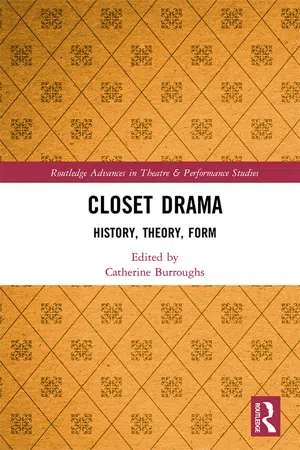
- 278 pages
- English
- ePUB (mobile friendly)
- Available on iOS & Android
eBook - ePub
About this book
Information
Part I
Closet drama and stagings of history
1 Introduction
“Closet Drama Studies”
Catherine Burroughs
But there is a vast difference betwixt a publick entertainment on the Theatre, and a private reading in the Closet: In the first we are confin’d to time, and though we talk not by the hour-glass, yet the Watch often drawn out of the pocket, warms the Actors, that the Audience is weary; in the last, every Reader is judge of his own convenience; he can take up the book, and lay it down at his pleasure; and find out those beauties of propriety, in thought and writing, which escap’d him in the tumult and hurry of representing.
From John Dryden’s “Preface” to his Don Sebastian, King of Portugal, a tragedy, acted at the Theatre Royal, 1690; cited in Jonas Barish, “Notes” 1
Closet Drama, definition of: a play that is not intended to be performed onstage, but read by a solitary reader, or, sometimes, out loud in a small group. A related form is the closet screenplay, developed during the twentieth century. The dichotomy between private “closet” drama (designed for reading) and public “stage” drama (designed for performance in a commercial setting) dates from the late eighteenth century.
https://en.wikipedia.org/wiki/Closet_drama
As the first book to discuss in detail the history, theory, and form of the closet play—a dramatic text never intended to be acted or a play impeded from stage performance by circumstances—this volume inaugurates a new field, Closet Drama Studies. Featuring twelve original chapters and an Appendix by distinguished scholars that historicize and theorize about the closet play as a genre, this book offers new ways of deploying closet drama as a critical lens for (re)visiting a wide range of texts and historical narratives. In describing the precise nature of the closet drama form, it is important to re-visit what earlier theorists have written and to raise, in our own era, the following kinds of questions: how does focusing on the closet play as an historical phenomenon with established formal features encourage different ways of reading plays and of interrogating the concept of “performance” itself? What does the closet play—or variations of the form—enable? How do histories of theatre and drama change when we consider this rich tradition?
More specifically, what does the word “play” mean to writers, or, as playwright Suzan-Lori Parks has written in her short, witty essay, “theatre”: “Jesus. Right from the jump ask yourself. ‘Why does this thing I’m writing have to be a play?’ The words ‘why,’ ‘have’ and ‘play are key. If you don’t have an answer then get out of town” (“Elements of Style” 7). Because this volume challenges assumptions made about not only dramaturgy but also storytelling, Parks is relevant as she addresses the concept of form in the same essay: “Form should not be looked at askance and held suspect—form is not something that ‘gets in the way of story’ but is an integral part of the story … I don’t explode the form because I find traditional plays ‘boring’—I don’t really. It’s just that those structures never could accommodate the figures which take up residence inside me” (7–8).
Of special interest to this volume are the ways in which critics have used the following terms: “academic theatre”; “dialogues”; “lyrical or poetical dramas”; “choric poems”; “dramatic poems”; “dramatic monologues”; “monodrama”; “marginalia”; “private theatricals”; “staged readings”; “reader’s theatre”; “radio plays”; “playscripts” in television and film; “hip-hoperas”; “school plays”; “children’s drama”—and even the concepts of “rehearsals” and “rehearsal space.”
This collection looks at these categories in order to shed new light on the exciting ways that playwrights and writers of closet drama “explode” and/or exploit the closet play for new modes of dramatizing their own voices. Carefully building on the critical texts that have highlighted antitheatricality in the Renaissance, Romantic, Victorian, Modernist, and Post-Modernist periods, the book is divided into four sections that address its central concerns: “Closet Drama and Stagings of History”; “Gender, Sexual Politics, and the Closet”; “Closet Drama and Genre”; and “Future Directions for Closet Drama Studies.”
Additionally, this book seeks to honor Jonas A. Barish’s achievement as the founder of Closet Drama Studies, for, at the time of his death in 1998, he was planning to write what would have been the definitive book on the closet play. As Andrea Stevens wrote in a review of The Antitheatrical Prejudice (1981), this is “the sort of book almost no scholar today would attempt to write—not least because the norms of academic publishing have shifted so significantly over the past thirty-odd years” (www.thehareonline.com/printpdf/book-reviews/antitheatrical-prejudice).
In The Antitheatrical Prejudice, Barish traces with impeccable scholarship the history of a tradition that regarded the stage, plays, and actors as enemies of moral rectitude. Churches and related institutions have always been skeptical about anything connected to theatre—assuming that audiences are susceptible to its “embodied” dreaming. The Church of England, Protestant and Puritan offshoots, and European Catholics drew a direct line between acting on the stage (as an “evil” impersonation of what God had created) and the “performative” behavior they believed playgoing inculcated in their congregations. William Prynne’s Histrio-mastix (1633), which weighs in at more than a thousand pages (the main title is forty-three lines!), demonstrates the ideology of the Puritans’ antitheatrical zeal against Renaissance plays and its transvestite theatre, as they targeted ceremonies and rituals of even the Christmas season, such as mummering (or “jennying” or “jannying,” the act of visiting friends’ houses), masking, dancing, and other celebrations that derived from the saturnalias and bacchanals of Rome. In the eighteenth century, Thorel de Campigneulles stated that “if a play is bad reading, it is worse than seeing it, for one has time to meditate, and each person really dramatizes it for himself” (Barras 246–47; 250 cited in Barish, “Notes”). And, in his pamphlet, “A Short View of the Immorality and Profaness of the Stage” (1698), Jeremy Collier fulminated about the lasciviousness and impiousness of the characters in Restoration comedies, which, after 1662, introduced women to the stage. 2
Barish uses the phrase “antitheatrical prejudice” to describe this persistent phenomenon of opposing theatre from Plato to the 1980s. His scholarly achievement recalls M.H. Abrams’s The Mirror and the Lamp (1953), still considered one of the most stunning works of literary criticism in the twentieth century. In this critical study, Abrams introduced us to the ways that Romantic writers shifted from the idea of “the mirror”—a way to describe the attitudes of eighteenth-century poets as they crafted works primarily based on imitation—to the metaphor of “the lamp,” an image for poets’ illumination of the external world, what Abrams labeled “the Greater Romantic Lyric.”
Although Barish did not live long enough to write his book, his research would have established a new standard for those working in the fascinating and complex field of the closet play. This is why it is all the more fortunate that he left behind six boxes of typed and hand-written notes, currently in my possession and the subject of the Appendix at the end of this volume.
As I have elsewhere written, the “traditional closet drama resembles a play script—composed of dialogue, monologues, soliloquies, asides, and stage directions—but it is dominated by a ‘literary,’ ‘poetic,’ and/or ‘choric’ element conducive to the act of contemplation and intellectual study” (“Women and Closet Drama”). Such variations of the form emphasize the performance of rhetorical over bodily moves to the point where “speech-making is the central action; monologues and soliloquies proliferate, and, when dialogue appears, it often resembles stichomythia–swift, one-line exchanges as in a ping-pong match.” Moreover,
Interiority is privileged. Rarely does a closet play contain scenes among more than three characters, since [its] focus is often an argument or a debate, the action being the working out of a physical problem or the advocacy of a moral position and, even in the internal debate, the dialogic nature of such an exchange is predominately monologic. [Further], the intellectual appeal and the “austerity” that Barish identifies in the form (simple plots, for instance, characters that speak at length) result in the dramaturgy’s comfort with, indeed a relishing of “sententiae”—that is, prescriptions for social behaviour that moralize and/or advocate. These didactic moments function like the choral passages in Greek drama—when the action is summarized, reflected upon, and offered as a “product” for intellectual and spiritual consumption—and which also lend themselves to memorization and quotation. In short, the intentional closet play is primarily a tool for learning, rehearsing, reflection, and re-reading.(“Women and Closet Drama”)
Inspired by Jonas Barish’s work, I have been able to extend my formulation to underscore closet drama’s distinctive rhetorical character:
These didactic moments—when the action is summarized, reflected upon, and offered as a “product” for intellectual and moral development—reveal one of the more fascinating aspects of the genre, [which is] … that the reader is in a solitary setting such as her library, study, or “closet”—historically, in the case of women, a site of privacy—and the plays are crafted to encourage a “poring over” of the text in ways obviously impossible in a live theatrical performance.(“Women and Closet Drama”)
In addition, the closet play has often been used as a tool for educating students—especially young women—in the classroom, in religious training, in elocution, voice, and public speech. Frequently, closet dramatists have published their plays before they have been acted, in order to gain the attention of theatre managers and directors, or they have published them without much hope of a stage performance, a situation that I have labeled with the terms “rejected theatre,” “disappointed authorship,” and “intentional closet play,” 3 drawing on phrases used by eighteenth-century dramatists themselves. The intentional closet drama has ambitions to be “a tool for learning, rehearsing, reflection, and re-reading. It posits a reader who … has time enough … to study both the closet play’s content and form” (“Persistence” 219).
And yet, considering the difficulties in pinning down a definition of closet drama based on its formal features—do we proceed backwards from a dramatist’s statement of intent or do we infer intent from the formal appearance of a text on the page—it might be more accurate in the present age to recognize that the phrase expresses an author’s and/or reader’s desire both to privilege “voice” over “body” and to experiment with new ways of wedding them together in actual theatre spaces. In fact, dramas such as Percy Shelley’s The Cenci (1819) and Oscar Wilde’s Salome (1893), both of which were initially unstaged because of censorship, might also be labeled what Martin Puchner calls “de facto closet dramas” (“Closet” 271), plays that stayed in the closet because of differing historical circumstances.
An edited volume about early modern “academic drama,” published in 2008 by Jonathan Walker and Paul D. Streufert, stresses the fact that “academic plays seek to articulate humanistic ideals within the unpredictable circumstances of concrete social relations, which students can inhabit and observe through the simulacrum of dramatic performance” (2). That is, they encourage “young scholars” to seek “rich instructional opportunities through the dramatic mode—for invention, the imitation of classic exemplars; for rhetoric, the disputatio of the dramatic agon; for oratory … the practical delivery of well-formed speeches” (2). Indeed, the preservation of approximately seventy-one extant and original university plays in Greek, Latin, and English “literally represent narratives of early modern learning” (6). 4
This educational and pedagogical aspect of closet drama is related to the vogue for “Reader’s Theater,” a postwar American movement in which actors (amateur and professional) read plays aloud in front of audiences, without the need for blocking or memorizing lines. Today reader’s theatre is touted as an educational technique for enhancing the public speaking skills of high school and college students, and its British origins came from the practice of amateurs and actors reading segments from plays in intimate settings, such as the salon, drawing room, or family library—or in spaces designed for public performance. These practices are also related to “staged readings,” which, in recent years, have successfully showcased a number of plays previously labeled as closet dramas, or which have been previously unacted.
Throughout history, writers have talked about their work in ways that connect closet drama with reader’s theatre and privately staged plays. Here, for example, is early-Restoration writer Margaret Cavendish in one of the epistles she attached to her Playes, published in 1662:
I must trouble my Noble Readers to write of one thing more, which is concerning the Reading of Playes … for they must not read a Scene as they read a Chapter; for Scenes must be read as if they were spoke or Acted … whereas in Reading only the voice is imployed; but when a Play is well and skillfully read, the very sound of the Voice that enters through the Ears, doth present the Actions to the Eyes of the Fancy as lively as if it were really Acted.(262–63)
With her turbans and feathered hats, Cavendish was a woman willing to put herself out as a kind of budding actress and a writer who created dramas with proto-feminist, utopian themes, such as in The Convent of Pleasure (1668), which Shannon Nicole Strawhun writes led to the development of a style that “had at the time helped to fuel more and more interest in women’s drama” (http://blogs.shu.edu/ecww/project/shannon-nicole-strawhun/).
An anonymous writer in Barish’s notes remarks: “Nay, Reading it self gives us a kind of Theatrical Representation of the whole subject we read.”
The Reader can no sooner enter into a great or passionate story, but he builds a Stage in his Fancy; he follows, in his Eye of Imagination, both: the Hero to the Field, and the Lover to the Bour, the Grott, or the Closet; and has not only the aforesaid personal Ideas, but also all the whole Scene of Action painted in his Fancy. And a too dangerous Impression (if such can be received from either of them) may as easily be taken from a favorite character upon the Stage, as the Play-house one.(Anon, 2nd Defence of Dramatic Poetry cited in Barish, “Notes”)
This idea of “the sound” of a written text’s “voice,” which discussions of closet drama encourage us to consider, points to the fact that, as recently as 2010, one of Broadway’s more successful plays, Gatz—a reading of F. Scott Fitzgerald’s novel, The Great Gatsby (1925)—was dramatized in its entirety. The New York Times drama critic, Ben Brantley, announced in his rave review: “the most compelling love affair” of the theatre season is “between a man and a book.” Gatz confronts the seemingly “elusive” task of staging the “chemistry that takes place between a reader and a gorgeous set of sentences that demand you follow them wherever they choose to go.” This eight-hour drama—“unlike anything you’ve ...
Table of contents
- Cover
- Half Title
- Title Page
- Copyright Page
- Dedication
- Table of Contents
- Contributors
- PART I: Closet drama and stagings of history
- PART II: Gender, sexual politics, and the closet
- PART III: Closet drama and genre
- PART IV: Future directions for Closet Drama Studies
- Works cited
- Index
Trusted by 375,005 students
Access to over 1.5 million titles for a fair monthly price.
Study more efficiently using our study tools.
Frequently asked questions
Yes, you can cancel anytime from the Subscription tab in your account settings on the Perlego website. Your subscription will stay active until the end of your current billing period. Learn how to cancel your subscription
No, books cannot be downloaded as external files, such as PDFs, for use outside of Perlego. However, you can download books within the Perlego app for offline reading on mobile or tablet. Learn how to download books offline
Perlego offers two plans: Essential and Complete
- Essential is ideal for learners and professionals who enjoy exploring a wide range of subjects. Access the Essential Library with 800,000+ trusted titles and best-sellers across business, personal growth, and the humanities. Includes unlimited reading time and Standard Read Aloud voice.
- Complete: Perfect for advanced learners and researchers needing full, unrestricted access. Unlock 1.5M+ books across hundreds of subjects, including academic and specialized titles. The Complete Plan also includes advanced features like Premium Read Aloud and Research Assistant.
We are an online textbook subscription service, where you can get access to an entire online library for less than the price of a single book per month. With over 1.5 million books across 990+ topics, we’ve got you covered! Learn about our mission
Look out for the read-aloud symbol on your next book to see if you can listen to it. The read-aloud tool reads text aloud for you, highlighting the text as it is being read. You can pause it, speed it up and slow it down. Learn more about Read Aloud
Yes! You can use the Perlego app on both iOS and Android devices to read anytime, anywhere — even offline. Perfect for commutes or when you’re on the go.
Please note we cannot support devices running on iOS 13 and Android 7 or earlier. Learn more about using the app
Please note we cannot support devices running on iOS 13 and Android 7 or earlier. Learn more about using the app
Yes, you can access Closet Drama by Catherine Burroughs in PDF and/or ePUB format, as well as other popular books in Letteratura & Teatro britannico. We have over 1.5 million books available in our catalogue for you to explore.