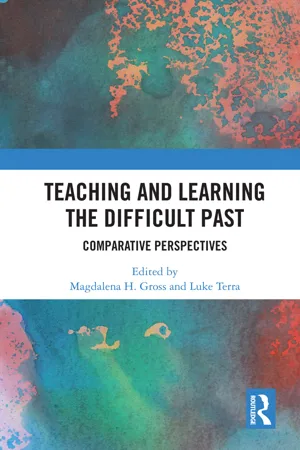
Building upon the theoretical foundations for the teaching and learning of difficult histories in social studies classrooms, this edited collection offers diverse perspectives on school practices, curriculum development, and experiences of teaching about traumatic events. Considering the relationship between memory, history, and education, this volume advances the discussion of classroom-based practices for teaching and learning difficult histories and investigates the role that history education plays in creating and sustaining national and collective identities.
eBook - ePub
Teaching and Learning the Difficult Past
Comparative Perspectives
- 304 pages
- English
- ePUB (mobile friendly)
- Available on iOS & Android
eBook - ePub
Teaching and Learning the Difficult Past
Comparative Perspectives
About this book
Information
Part I
Theorizing the Teaching and Learning of Difficult Histories
1 Teaching Difficult Histories
The Need for a Dynamic Research Tradition
Researchers have produced a great deal of significant and insightful research on teaching difficult histories in recent decades, but in order for the field to have an impact on practice, a more dynamic tradition is needed, one that moves beyond analyzing factors that inhibit controversy and suggests ways of overcoming those constraints. Such research would focus less on static portrayals of avoidance and resistance and more on understanding circumstances in which curricular, pedagogical, and cognitive changes can take place. In an applied field such as education, the goal of research must be to improve practice. This means asking questions about how change takes place, using research methods that elucidate change, and employing theoretical frameworks that explain change. Change (in curriculum, pedagogy, or cognition) may be less common than stasis, but studying change best enables us not only to contribute to academic knowledge but also to improve education.
Teaching Difficult Histories: The State of the Field
Although it is impossible in a brief chapter to do justice to the broad array of scholarship on teaching difficult histories, three areas stand out as having received systematic attention. The first involves research on textbooks and curriculum. Scholars have examined, for example, how textbooks deal with topics that may reflect negatively on a nation’s past (e.g., Crawford, 2006; von Borries, 2003), involve continuing international disagreements (e.g., Chung, 2011; Kim, 1997), or are connected to other issues that remain divisive in a given setting (e.g., Oteiza, 2003; Podeh, 2000). In the United States, this has included research illustrating the absence of topics and perspectives that might undermine a progressive and consensual narrative of the national past (e.g., Loewen, 1995), as well as more specific studies of how curricula, texts, and other educational materials omit, marginalize, or dehumanize specific groups such as Blacks (Brown & Brown, 2010; King & Womac, 2014), Latina/os (Noboa, 2006), Asians and Asian Americans (An, 2016; Hartlep & Scott, 2016), LGBTQ persons (Thornton, 2003), Native Americans (Shear, Knowles, Soden, & Castro, 2015), and women (Schmidt, 2010). Other studies from around the world have detailed the political debates that swirl around curriculum revisions that include attention to controversial topics in national history (e.g., Clark, 2009; Fogo, 2015; Sneider, 2011; Taylor, 2012).
A second area of investigation has focused on teachers’ approaches to controversial issues. A relatively large body of literature focuses on teaching controversial topics (reviewed in Ho, McAvoy, Hess, & Gibbs, 2017), but much of this work deals with government or civics courses rather than history (although factors influencing teachers’ practices are likely similar). The majority of this research has examined how and why teachers avoid controversy and has pointed to pressures of standardized testing, fear of parental or community opposition, lack of administrative support, anxiety about students’ emotional responses, and lack of commitment to engaging in societal critique or addressing the interpretive nature of history. (For examples from history, see James, 2008; Kello, 2016; Levstik, 2000; Kitson, 2007; Kitson & McCully, 2005; Magendzo & Toledo, 2009; McCombe, 2006; Romanowski, 1996; Zembylas & Kambani, 2012.)
The final area investigates students’ thinking. This work has focused on how students understand potentially controversial historical topics, particularly those that have relevance for contemporary identities, such as issues that touch on nationality, race, ethnicity, religion, or political community. Some studies have examined how students’ backgrounds and societal contexts lead them to interpret curriculum content in particular ways (e.g., Barton & McCully, 2012; Levy, 2014; Schweber & Irwin, 2003; Spector, 2007; Wills, 2001; Woodson, 2015, 2017), while others have focused on how students in a given setting, but from varied backgrounds, interpret history differently than each other. This latter category includes studies from the United States (Epstein, 2009; Howard, 2004), Canada (Peck, 2010), Northern Ireland (Barton, 2005), Israel (Goldberg, Porat, & Schwarz, 2006; Kolikant & Pollack, 2009; Pollack & Kolikant, 2012), England (Andrews, McGlynn, & Mycock, 2009; Grever, Haydn, & Ribbens, 2008), and other countries. This work has established that students’ societal identifications play a crucial role in how they make sense of the past, and that this is particularly so for topics that are related to ongoing controversy.
Each of these bodies of work has contributed to our understanding of the teaching and learning of difficult histories. Taken together, they provide a solid basis for claims that, thirty years ago, might have been little more than logical assumptions grounded in personal experience but lacking in systematic empirical support. And each of these traditions has the potential to generate further, productive research. Scholars will continue to examine the ideas of students, practices of teachers, and content of curricula—in different settings, among distinct populations, and for previously unexplored topics. Such studies will yield new insights that help us better understand both specific educational contexts and broader issues involved in history teaching. Yet, in themselves, studies like these are not adequate to fully inform practice, for they are concerned primarily with static portrayals of existing settings rather than efforts to bring about deeper and more reflective understandings of the past.
Research Questions: Focusing on the Process of Change
A dynamic research tradition would investigate concrete efforts to change how history is taught and learned. We already know a great deal about students’ thinking, teachers’ practices, and the content of curriculum, but what happens when practical interventions are instituted to change these? What does the process of innovation look like, and what are its outcomes—both intended and unintended? What facilitates the process of change, and what obstructs it? Although there are a few studies in these areas already—along with a great deal of anecdotal knowledge—there is not yet a systematic and cumulative knowledge base for change.
Studies of Teachers Who Confront the Difficult Past
One such body of research would investigate teachers who do address the difficult past. Although we may be frustrated by how many teachers avoid such topics, there are nonetheless those who are willing to confront difficult histories. If we had a better understanding of what motivates teachers to take on this task, then we might be better able to encourage others to do so, through pre-service teacher education or in professional development programs. As Gross (2013) notes, “Understanding the process by which teachers choose to teach difficult silenced histories is essential … because it is on teachers that we rely to impart information about the difficult past” (p. 104). In the United States, for example, Salinas and Castro (2010) studied Latina/o pre-service teachers whose personal experiences with discrimination and economic injustice influenced their attempts to disrupt the official curriculum. Similarly, King and Brown (2014) profiled teachers who were passionate about expanding students’ understanding of history in ways that would include the Black experience through counter-hegemonic content, links to students’ own backgrounds, and global/diasporic elements of Black history. And in Poland, Gross (2013) found that teachers’ motivations to address traumatic and hidden wartime histories were deeply personal, closely tied to a sense of self, and derived from what they considered their personal, professional, and moral obligations.
If it were possible to convince more teachers to tackle difficult histories, then we would need further evidence of what happens when they do so. Do they try to develop support for their efforts from administrators, colleagues, parents, or community members, and if so, what are the results of those efforts? How do they go about developing resources for instruction, or using those that are already available? What do they do pedagogically, particularly when students either resist engaging with controversial topics or oversimplify the issues? We will need answers to these questions in order to support teachers who hope to expand their practice. Although each teacher’s circumstances will be different and will require innovation, we cannot expect them to succeed if they are not given the tools they need. We need to help them learn from the wisdom of practice of other teachers who already have begun the journey.
Finding participants for such studies may be easier than it seems if we make use of existing professional networks. In a country as large as the United States, and with so decentralized an educational system, there are a great many teachers who are committed to teaching controversial history, and there are networks of resources devoted to such efforts (e.g., the Zinn Education Project, https://zinnedproject.org). In Europe, organizations such as the European Association of History Teachers (http://euroclio.eu) and the Association for Historical Dialogue and Research (www.ahdr.info/home.php) have long been involved in developing resources and providing professional development aimed at transforming history teaching, particularly in areas of inter-ethnic or inter-religious conflict. Researchers would benefit from seeking out participants in such projects in the quest to better understand the practical realities of teaching controversial history.
Studies of Curriculum Construction Around Difficult Histories
In centralized education systems, official curricula and approved textbooks have perhaps the greatest influence on what happens in classrooms. Although sometimes ministries of education or other educational authorities may simply be charged with carrying out political directives, other times they are dedicated to designing curricula that are in line with contemporary theory and research, and this may include controversial topics. Evidence of how professionals in these settings go about the process would be helpful to others who are undertaking such changes. This might involve investigating how curriculum developers tie together broad purposes, syllabi, specific objectives, instructional materials, and professional development, as well as how they develop support for their efforts both among superiors and in schools. Such studies would shed light on what is often regarded as the “black box” of curriculum development. Studies that look only at curricular products require speculation on the forces that influenced them, but insider knowledge of the process of construction could produce insights into how curriculum change comes about.
Such research is rare, in part because analyzing curriculum construction requires evidence of processes that usually are not open to outsiders. Weldon (2009), however, was able to draw on her experience as a curriculum officer in South Africa (along with other sources of evidence) to analyze how controversial topics were included, albeit sometimes in a muted way, in post-apartheid history curricula. Her research points to the influence of specific and concrete political pressures, ministerial personalities, regional resources and capacities, and relations between provincial and national governmental authorities. By contrast, Misco’s (2007) study of Holocaust curriculum development in Latvia focused on a group of curriculum writers whose work was sanctioned by the government but lay outside ministerial structures. He found that the deliberative model used in the project led writers to a deeper and more nuanced understanding of their purposes, and that this enabled them to construct a curriculum that moved beyond the superficial and non-offensive content that had previously characterized teaching about the Holocaust in Latvia. Symcox’s (2002) study of “national” history standards in the United States, meanwhile, provides insight into how professional historians and historical organizations (independent of any governmental authority) reached consensus over the structure and content of standards that often touched on topics considered controversial in the U.S. context.
Each of these studies was conducted by individuals who had been directly involved in the process of curriculum development. For those without such access, however, an important avenue of research would involve the impact of curricula. How do teachers respond to new curriculum or textbooks? How do they interpret mandates for addressing difficult history, and how do they implement these in practice? To what extent do their practices reflect, or perhaps deflect, purposes that guide the inclusion of difficult history in the curriculum? And how does professional development influence the process of change? Most of these questions can be investigated without access to closed-door meetings; evidence can be drawn from interviews with teachers, observations of classrooms, and attendance at professional development or “rollout” meetings. Information gleaned from these sources would not only provide an academic understanding of the consonance or slippage between official and enacted curricula, but also would inform efforts by other authorities to address difficult historical issues. Currently, however, the number of examples is limited by the rarity of official curricula that tackle such topics; thus, two of the few studies in this area are those in South Africa (Weldon, 2009) and Latvia (Misco, 2010).
Studies of Students’ Developing Understanding of the Difficult Past
Particularly important is research on how students’ ideas change as the result of engaging with difficult history. That, after all, is the purpose of education: to bring about changes in students’ thinking. We hope that after studying difficult historical topics, students will become more thoughtful and reflective, more willing to base their ideas on evidence, better able to consider the perspectives of people in the past, and better informed about how the past has influenced contemporary society. Although we have evidence from some settings about how students respond to difficult topics—particularly how they resist such information or assimilate it to prior understandings—most studies have yielded static portrayals of thinking that need to be supplemented by dynamic investigations of thinking over an extended period. Those would involve comparisons of students’ ideas not only before and after units of study, but also at multiple points along the way. Such studies would lead to information on the specific texts, instructional strategies, explanations, or discussions that motivate students to expand their ideas. To say that students resist or assimilate new ideas is too blunt a conclusion; we need to know which specific experiences create opportunities for change, however incremental those may be.
In contexts in which students study controversial topics over multiple years, cross-sectional studies may provide some evidence of how ideas change. In Northern Ireland, for example, students study history during each of the first three years of secondary school, and this involves looking at many of the most contentious aspects of the region’s past, with an emphasis on multiple perspectives and the use of historical evidence. (Notably, however, instruction is sometimes so balanced, and contemporary issues are so neglected, that these controversial topics may come across as bland; Kitson, 2007.) Barton and McCully (2005, 2010, 2012) examined how students’ ideas differed after studying history for one, two, and three years. They found that although students reported developing a strong attachment to understanding multiple perspectives, many of them nonetheless developed increasingly partisan viewpoints, as they drew from the balanced curriculum in a way that supported their own comm...
Table of contents
- Cover
- Half Title
- Title
- Copyright
- Contents
- List of Contributors
- A Foreword on Inheritance: Difficult History in Difficult Times
- Introduction: What Makes Difficult History Difficult?
- Part I Theorizing the Teaching and Learning of Difficult Histories
- Part II Teaching Difficult History
- Part III Learning Difficult Histories
- Index
Trusted by 375,005 students
Access to over 1.5 million titles for a fair monthly price.
Study more efficiently using our study tools.
Frequently asked questions
Yes, you can cancel anytime from the Subscription tab in your account settings on the Perlego website. Your subscription will stay active until the end of your current billing period. Learn how to cancel your subscription
No, books cannot be downloaded as external files, such as PDFs, for use outside of Perlego. However, you can download books within the Perlego app for offline reading on mobile or tablet. Learn how to download books offline
Perlego offers two plans: Essential and Complete
- Essential is ideal for learners and professionals who enjoy exploring a wide range of subjects. Access the Essential Library with 800,000+ trusted titles and best-sellers across business, personal growth, and the humanities. Includes unlimited reading time and Standard Read Aloud voice.
- Complete: Perfect for advanced learners and researchers needing full, unrestricted access. Unlock 1.5M+ books across hundreds of subjects, including academic and specialized titles. The Complete Plan also includes advanced features like Premium Read Aloud and Research Assistant.
We are an online textbook subscription service, where you can get access to an entire online library for less than the price of a single book per month. With over 1.5 million books across 990+ topics, we’ve got you covered! Learn about our mission
Look out for the read-aloud symbol on your next book to see if you can listen to it. The read-aloud tool reads text aloud for you, highlighting the text as it is being read. You can pause it, speed it up and slow it down. Learn more about Read Aloud
Yes! You can use the Perlego app on both iOS and Android devices to read anytime, anywhere — even offline. Perfect for commutes or when you’re on the go.
Please note we cannot support devices running on iOS 13 and Android 7 or earlier. Learn more about using the app
Please note we cannot support devices running on iOS 13 and Android 7 or earlier. Learn more about using the app
Yes, you can access Teaching and Learning the Difficult Past by Magdalena H. Gross, Luke Terra, Magdalena H. Gross,Luke Terra in PDF and/or ePUB format, as well as other popular books in Didattica & Didattica comparata. We have over 1.5 million books available in our catalogue for you to explore.