![]()
1 Trends towards feudal capitalism
Introduction
The most important invention of the first industrial revolution was the steam engine. The second industrial revolution spawned the combustion engine, and the third industrial revolution the computer. The fourth industrial revolution will see the rise of robots. These robots will be integrated into all types of products, both known and unknown (Valnazarova & Ydesen, 2016).
The fourth industrial revolution is being driven forward by robotization and globalization (Schwab, 2016). Robots with artificial intelligence are of a qualitatively different order than the wave of automated machines we saw in the third industrial revolution (Brynjolfsson & Saunders, 2013). These robots can be programmed to sense their surroundings, understand what is happening, adapt their behaviour in accordance with this understanding and learn from their actions, without any need for reprogramming (Brynjolfsson & McAfee, 2011; 2014).
Obviously, we do not know how the fourth industrial revolution will progress, but we can apply historical insight and innovation theory, as well as our understanding of economics, in order to predict some likely developments.
The fourth industrial revolution is developing globally, with no geographical centre (Dickinson, 2016). It is also taking place at enormous speed. The spread of computers from the 1950s onwards was limited by many factors, including the world situation, East–West tensions and the absence of a well-developed internet (Rogers, 1962). No such limiting factors apply to the spread of robot technology. This spread is exponential, is taking place worldwide and is systemically connected (Reinert & Rogoff, 2009).
The fourth industrial revolution can be summed up in six concepts. We have described three of them above: the rate of spread, which is driven by cascading innovations; the global area of impact, which is driven by globalization; the systemic links, which are driven by robotization and informatization. The three other concepts are linked to the three concepts listed above. These concepts are threshold value, feedback and time-lag. Threshold value is relevant because some sectors will join the fourth industrial revolution only once a certain threshold value has been exceeded, not unlike the situation where a dam bursts once a specific threshold is exceeded. Feedback may be understood as meaning that some people understand what is about to happen before others. The former group react and adapt to the new development before others do so. Accordingly, the former group gain an advantage over the others, who will come on board later. Time-lag means that the more one is part of the fourth industrial revolution, the less of a time-lag one will be willing to accept. For example, this time-lag may be the time that elapses between sending a message and receiving a response. One of the consequences of this is that a relatively long time-lag will function psychologically as information stress.
These six concepts – rate of spread, global impact area, systemic links, threshold value, feedback and time-lag – function both as descriptions of what is happening in the fourth industrial revolution, and are also used here as explanations of the consequences of the fourth industrial revolution.
The knowledge society is mushrooming out of the global economy, and artificial intelligence and robotization are the key drivers (Frankish, 2014). This development will shape the workplaces of the future, which will be completely different from the workplaces created by the industrial revolution (Barrat, 2015). Industry created the industrial worker. The knowledge society will create a new type of “industrial worker”, the knowledge worker (Case, 2016). The knowledge worker is not a homogeneous category, but consists of different types of worker, distinguished by level of competence, type of function performed and manner of thinking (Brynjolfsson & McAfee, 2014).
The five elements that emerge here – the knowledge society; globalization; robotization; the future workplace; and the knowledge worker – are all based on a revolutionary innovation that will change the basic assumptions underlying all social systems (Brynjolfsson & McAfee, 2011). Innovation is the overarching driver of the new knowledge society that we are seeing foreshadowed today, according to Brynjolfsson and Saunders (2013).
This chapter explores the following research problem: What constitutes the fourth industrial revolution?
The questions that we investigate in order to answer this research problem are the following:
• How does the knowledge society constitute an aspect of the fourth industrial revolution?
• How does globalization constitute an aspect of the fourth industrial revolution?
• How does robotization constitute an aspect of the fourth industrial revolution?
• How does the workplace of the future constitute an aspect of the fourth industrial revolution?
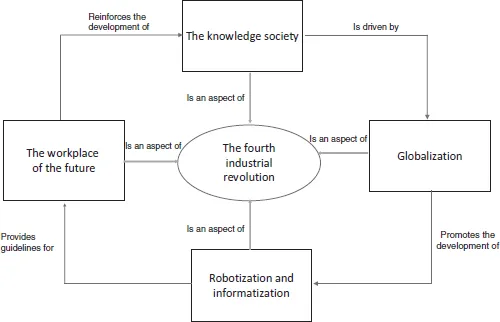
This introduction is visualized in Figure 1.1, which also shows how we have structured this chapter.
Figure 1.1 The fourth industrial revolution
Analysis and discussion
In the following, the four elements in Figure 1.1 will be analysed and discussed.
The knowledge society
Several simultaneous trends characterize developments towards the knowledge society. Innovation is without doubt one such tendency that will increase (Gans, 2016). However, it is debated whether the market alone will manage to accommodate the major challenges we face (Ford, 2016: 283). These challenges include migration from areas of famine, drought, poverty and an unworthy life, and people fleeing war, crises and conflicts (Johnson, 2014). Another challenge also related to migration is the growing climate crisis (Smil, 2012). A third challenge is the rising unemployment among people who lack the necessary education and expertise demanded of the fourth industrial revolution (Ford, 2016). A fourth challenge is the issue of economic disparity, the ever-widening gap between rich and poor, both globally and nationally, as well as in urban areas (Piketty, 2016).
Economic, psychological and social security will come under strong pressure (Bauman, 2013; Sennett, 1999, 2003, 2013). The use of terms such as “the working poor” (Shipler, 2005) and “the precariat” (Standing, 2014b; Savage, 2015) signal clear indications of this trend. The middle class, the backbone of capitalism in the 20th century, will be marginalized and decimated with the emergence of the fourth industrial revolution in the 21st century (Wacquant, 2007, 2009a, 2009b; Savage, 2015; Standing, 2014b). Even those with a long university education will experience job insecurity – many will have educated themselves into unemployment (Gupta et al., 2016; Coates, 2016).
A “perfect” social storm occurs when inequality grows at a catastrophic rate, unemployment increases, job security is threatened for a growing number and robotization takes over even the most underpaid jobs in, for instance, the service industries (Ford, 2016; Wacquant, 2009b).
Paradoxically, productivity increases for those who have jobs, due to the new robotic technology, and those working in high-tech manufacturing will enjoy higher wages. However, the conflict between those with well-paying jobs in high-productivity occupations, and those with poorly paid jobs and the unemployed, will increase sharply (Savage, 2015; Standing, 2014b). In addition, social tensions will increase due to a gradual disconnection between productivity and pay (Pilger, 2016). Thus, although productivity and profits increase, wages relatively decrease (Piketty, 2014; Ford, 2016). If this gradual disconnection is correct, then the social contract will slowly come under stress and be weakened (Goodman, 2015). The disconnection between productivity and wages will have many social, economic and political consequences. Inequalities will grow and expectations of a better future for people and their children will lessen. Despair and desperation will grow side by side with apathy (Savage, 2015; Standing, 2014b; McGill, 2016). Thus, the ingredients for a perfect social storm will be brought forward by cascades of innovations that will most likely lead to economic and social crises (Johannessen, 2016). It seems reasonable to assume that it will only take a little spark for the social storm to develop into a social revolution (Petras et al., 2013).
The underlying main driver behind this development is information and communication technology (ICT). Moore’s Law states that every 18 to 24 months, computer power is doubled (Thackray, 2015). From 1950 up until today, this development has affected people’s lives, organizations’ development, nations’ wealth creation and the dynamics of globalization (Webster, 2004). All levels of society have been affected by these developments. The rapidity of the pace of change even affects us right down to the level of our thoughts – what we think and believe about our own and our children’s future (Pilger, 2016; Savage, 2015). One example of these developments is the recent explosive growth in electric cars, which in the not too distant future could be the only vehicles permitted in traffic; a little further into the future, these electric cars may be self-driven. Thus, such a minor aspect of current technological development may result in our cities being less polluted. Consequently, people may move back to the inner cities, resulting in new re-structuring and re-organization of urban areas; this could even result in the rich living in the city centres while the poor move into the countryside (Wacquant, 2007).
Technological developments will very likely lead to new educational offerings, new jobs requiring different skills, and new functions in institutions and organizations (Pilger, 2016).
Then comes the paradox. Those with relatively long university educations will also find that their jobs are taken over by robots. This could prove to be those who thought they were very secure in their jobs, such as lawyers, doctors, radiologists, journalists, teachers, financial clerks, etc. Any jobs that involve instrumental, linear, repetitive processes that can be predicted by some logical algorithm will eventually be threatened by the “super-intelligent” robot (Pilger, 2016; Savage, 2015; Ford, 2016). The reason for this threat is that the classic relationship between productivity, wages and consumption will collapse (Ford, 2016: xvii). The explanation is that the increased productivity to a lesser extent will go to salaries, but find its way to profits (Piketty, 2014). What we will see is that although productivity increases, salaries will not increase at the same rate (Sprague, 2015).
Globalization
Among the factors that drove forward globalization were China’s new economic orientation towards the West around 1988 and the fall of the USSR (1991) that followed that of the Berlin Wall in 1989. This led to more than 1.5 billion people being incorporated in the capitalist economy (Stigliz, 2003, 2007; Swider, 2015; Dickinson, 2016). Another essential prerequisite for globalization was the new ICT and Internet that functioned as an integrative mechanism (Brynjolfsson & Saunders, 2013).
There are two main aspects of globalization. The first is that more and more people are drawn into wealth creation, education and out of extreme poverty (Smil, 2012; Valnazarova & Ydesen, 2016). The second is that some areas are depleted, and poverty becomes entrenched (Rodrik, 2011; Standing, 2014b; Rojecki, 2016). Mason (2015: ix–xxi) describes this development by referring to the country Moldova in Eastern Europe which has remained an economic backwater despite globalization.
One of the results of globalization is obvious – the competition economy as we know it from economics textbooks no longer exists (Roat, 2016). In the present day, it is the major international funds and large international corporations that largely control developments (Charnock & Starosta, 2016; Petras & Veltmeyr, 2001). Figuratively, these operate as feudal vassals setting limits for competition and wage conditions; this new brand of capitalism in the fourth industrial revolution is often referred to as “feudal capitalism”. These three factors, financial capital, neo-liberalism and feudal capitalism, are radically transforming the international working class (Rojecki, 2016; Charnock & Starosta, 2016). People are seeking better lives for themselves and their families where there are jobs, and where wages are relatively higher (Olds, 2004; Petras et al., 2013). This is resulting in large-scale global migration (Dickinson, 2016), such as from Africa to Europe, but also migration within regional and national areas, such as f...